October 2020 Training Challenge: Assess Your Home Alone Activities Efficacy


Part of me can’t believe it’s already October and part of me reminds the first part that this has been the longest year ever. Regardless, it’s time for our October training challenge!

List enrichment strategies you employ while you’re gone and objectively go through the list to determine if those strategies are effective. 

Not only is this training challenge dedicated to the “Independence” chapter of our book, it’s also a great exercise in taking a descriptive vs. prescriptive approach to your enrichment plan. (Note: we decided what the training challenges were going to be well before Covid hit. While you may not be gone at work all day at the moment, this exercise still applies for shorter outings!)


Descriptive vs. Prescriptive

For those of you who’ve heard us speak this year, you’ve heard us talk about taking a descriptive approach to your enrichment plan.

Descriptive: “I see a change in my animal’s behavior because of the activities we’ve done or provided.”

Prescriptive: “I provided an activity for my pet therefore he’s enriched.”

With the descriptive approach, we observe behavior to determine if the activity was effective instead of assuming that it was. Did it actually meet the animal’s needs as we intended? If it did, great! We can keep doing it. If it didn’t, well, then it’s back to the drawing board. Emily wrote a great blog post about this here. It’s not enough for us to just assume that our pet’s needs are being met while we’re gone, we need to actually observe that that’s true. 


How can I tell if those activities are effective?

There are a few ways we can tell if these activities are effective:

  • They’re being used. If you leave a stuffed Kong for your pet and it’s untouched when you return, that’s not an effective strategy. 
  • Watch your pet on video. Want to know if the window film you put up for your pet’s reactivity is actually decreasing reactivity throughout the day? It’s time to break out a recording option and see what your pet is up to during the day. 
    • Recording options can be high-tech, like Furbo and Nest (these are affiliate links), or low-tech, like Skyping or Zooming yourself or setting up a laptop to record shorter absences.
  • Observe your pet’s behavior when you come home. Providing activities while you’re gone can be the determining factor between having an adolescent dog who’s bouncing off the walls when you come home vs. one who’s excited but not uncontrollable. 


Now what?

  • Make a list of the enrichment activities you utilize while your pet is home alone. 
  • Make a list of desirable and undesirable behaviors that you’re hoping these enrichment activities address.
  • Observe your pet’s behavior. Are those activities effective in increasing desirable behaviors and decreasing undesirable behaviors?
  • Adjust your enrichment plan accordingly. 
  • Share your findings with us on social media! @petharmonytraining on Facebook and Instagram


Happy training!

Allie

PSA: Don’t Lure Uncomfortable Pets Closer to People


Today’s post is really more of a PSA:


Don’t lure uncomfortable pets closer to people. 


We get a lot of requests from people who are struggling with their pets showing aggressive behaviors towards new people, kids, other pets, or sometimes themselves if it’s a new adoption. And while I love when people take the initiative to start getting their pets comfortable with scary things by using food, we have to be really careful about how we do it. 


The danger of using food incorrectly

A phrase that I wish I heard a lot less than I unfortunately do, is, “I don’t get it. He is clearly uncomfortable but approaches people.” While there are a lot of reasons why that behavior can crop up, one of them is that we can teach our pets to approach people they’re not comfortable with by luring them closer with food. 

For example, let’s say a creepy van pulls up to the sidewalk as I’m walking and offers me $1000. The driver’s arm is outstretched with a stack of cash. Let’s be real; I’ll probably approach the van and try to take the $1000. That’s a super valuable amount to me and worth the risk. However, I’m definitely not comfortable. If the driver makes a sudden movement I will absolutely go into fight or flight mode. If I safely get the $1000 and nothing bad happens, I’ll be more likely to approach other strange vans handing out free cash. But, again, that doesn’t mean I feel safe doing so. 

Now, let’s replace the creepy van with a person your pet is uncomfortable with and the $1000 stack of bills with a super delicious treat. It’s the same scenario. Your pet may approach the person and take the treat from their hand, but probably doesn’t feel comfortable doing so.They may stretch their neck as far as it’ll reach to grab the treat. They may flinch or startle (or worse) if the person makes the slightest move. It’s absolutely possible to teach an animal (or me, apparently) to put themselves in an uncomfortable position for a high-value reward. And, by doing so, we can teach animals to approach people who they’re not comfortable with, which I often see leading to bites. 


Decreasing distance is a side effect. Comfort is the goal

When I’m working with a new client and their pet is exhibiting stranger danger or leash reactivity, I often have to remind them that distance– getting closer to the person or other animal– should be a side effect but not a goal. As illustrated above, it’s very possible to teach an individual to move closer, but without comfort, we’ve forfeited safety and can be inadvertently teaching a dangerous behavior. Distance in and of itself should not be the goal. It should not be the sole factor by which we measure success.

Comfort, which can be observed in the animal’s body language, should be our goal. When an animal is more comfortable, they’ll typically, naturally move closer to the person. The getting closer part isn’t something we really need to teach. Decreasing distance between the pet and the new person is a side effect of them feeling comfortable, not the other way around. 


What to do instead

I’m going to be intentionally vague here because realistically if your pet is exhibiting aggressive behaviors you should seek professional help. Safety is serious. We can (and usually should!) use food to build a desirable association with the new person, but start by using food at a distance. This can take several forms and, preferably, we should be setting up the environment to keep the pet from feeling like they have to exhibit the aggressive behaviors. Again, a professional behavior consultant can help you with all of the nuances of that. 


Now what?

  • If you’re currently using food to lure your pet closer to individuals they’re afraid of, discontinue doing so. 
  • Pair scary things with treats from a distance with the help of a professional behavior consultant. We offer remote sessions locally to internationally; email us at info@petharmonytraining.com to schedule your first session.
  • Need help now? Check out our “Setting Yourself Up for Success: Behavior Modification Basics” course to get immediate help. 


Happy training!

Allie

How to Work with Multiple Pets at a Time


Last week we discussed the pros and cons of working with pets individually vs. with multiple at the same time. Check it out here if you haven’t yet read that post. Now that you’ve considered if you should be working with an individual pet vs. your whole crew, let’s get into the details of how to make that possible. 


Working individually

I observe body language for a living: canine, feline, and human. Often when I make the recommendation to someone to work with one of their pets individually, I’m met with a look of apprehension. Sometimes that apprehension stems from time or worrying about not being fair to another animal, but sometimes it’s because they’ve tried it before and it didn’t work well for them. In those cases, the client usually describes to me that their other pet– the one left alone– spent the entire time barking or scratching at the door. I can understand the apprehension of trying it again if that was the case before!

When this happens and it’s not a matter of separation, isolation, and/or confinement anxiety, then I recommend to my client to give the other pet something really awesome to work on while they’re alone: stuffed Kong, bully stick, food puzzle, etc. If that doesn’t work, we can work on building duration with the other pet in the separated room. If it is a matter of separation, isolation, or confinement anxiety we can work through a behavior modification plan to address those more serious behaviors. 


Working with multiple pets simultaneously

There are a number of ways to be successful at this task and each situation may look a little different depending on the specific needs of the animals and what you’re working on. Here are some tips for working with multiple pets at the same time (but know that there are other options out there than just these!):


Many hands make light work

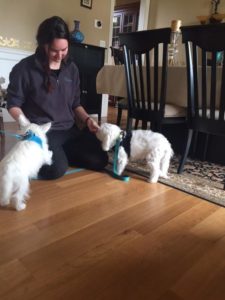
So often I hear that people are worried about two animals trying to take the same treat at the same time and a fight ensuing. In that case, if your pets don’t yet have a great “wait” behavior, treat each simultaneously from two hands like in the picture below. 


You can also get additional help from others. Have 4 animals? Get 4 hands into the training mix. This can help with letting you focus on your particular task, too, if you’re working on growing your animal training skills. Many hands really do make light work in this case.


Baby gates can help improve safety

As I mentioned in the post about how Covid-19 is impacting behavior (read it here), I have a lot of clients at the moment currently working on dog-dog interactions within the house. I’ve seen a significant uptick in dogs having trouble living with one another and I know some of my colleagues have mentioned seeing the same trend. In those cases, we will eventually need to work with the dogs in relatively the same space. We’ll also need to make sure we do so carefully and safely. 

We can absolutely have both dogs on leash (and for those of you working on dog/cat relationships, we often get the cat comfortable wearing a harness and leash, too!) with two handlers. That said, it becomes trickier when we need to rely on multiple people’s schedules to work on the pets’ relationship. This is where baby gates can be incorporated. 

Set up a baby gate so that you can work with one pet on one side and one on the other. This usually brings some peace of mind to the humans as well which can make the session more fun for everyone. If having pets on just one side of the baby gate is still too close for them, then you can set up two gates with however much “dead space” you need in between, kind of like an airlock:


Stationing

The last technique we’ll talk about here is stationing: teaching a pet to go to a particular place and hang out there. Sometimes trainers will refer to this as place work, mat work, or something similar. With stationing you can have one animal on a mat or bed out of the way while working with another, then switch them. This is a more advanced approach in that you need to be able to focus on the animal in front of you but also keep whoever is stationing in mind and reinforcing each appropriately. I tend to give a treat to the stationing animal whenever I treat the one I’m currently focusing on.

This is a regular technique used in zoos where it’s more challenging to separate animals for training. Regardless of your feelings about zoos, many do a wonderful job of training their animals– usually to safely participate in husbandry and medical procedures– and can be a good place for inspiration of what’s possible with training. 

Check out this video showing crocodiles training and stationing from the Wildlife Conservation Society and Bronx Zoo:


It’s often easier to teach animals to station separately before bringing them together. A professional trainer can help you with this process; it will need to be well-proofed, especially if you have trouble keeping a high rate of reinforcement (aka how frequently you treat).


Now what?

  • Try your hand at training multiple animals at once. Choose one of the above options to start with.
  • Practice whichever option you choose before bringing your pets into the mix. Practice doling out treats single-handedly. Teach stationing separately. Practice splitting your attention between observing multiple individuals at a time. Whatever you choose, it will be easier for you and less frustrating for your pets to practice without them first.
  • Start short and sweet. Work with your pets just a minute or two at a time. Assess how it went and how it can be improved on then try again for another minute or two. 
  • Consult with your professional trainer or behavior consultant– especially if there are safety concerns between the pets. A professional can help you fine tune your skills, your pets’ skills, and help you keep everyone safe during the training process. Email us at info@petharmonytraining.com to be paired with a consultant and set up your first session. 


Happy training!

Allie


Pros of Working with Pets Individually vs. Multiple at a Time


We’ve been asking y’all what you want us to talk about and a topic that keeps coming up is training in mult-pet households. It just so happens that I had planned a short series of posts for this month talking about training in multi-pet households so the timing is serendipitous! This first post is going to go into the pros of working with one animal at a time vs. multiple animals at once. The cons for each are essentially the pros of the other so I didn’t feel the need to go in-depth on those. Next week we’ll get into how to work with multiple animals at a time.


Pros of training individually 

For those of you who have multi-pet households and have used professional training services, you’ve probably heard at some point to separate your pets and train them individually. Here are some of the reasons why a professional trainer or consultant will recommend this:

  • It’s easier for your pet to focus
  • It’s easier for you to focus and be more effective
  • Eliminates competition between pets if there’s concern for guarding

Let’s explore the pros of working with one pet individually in more depth:


It’s easier for your pet to focus

Distractions come in many forms, and one of them can be in the form of other individuals. If you’ve ever been reprimanded as a kid for talking with your friend during class, you know that’s true. One way of decreasing distractions is by working one on one with an animal. This can especially help if you’re teaching something brand new or something more challenging!


It’s easier for you to focus and be more effective

Unless you’re training with a multitude of different animals every week, chances are that training is still a skill that you’re actively developing. That means it will require you to focus more on the task at hand and will be more challenging to split that focus between multiple animals. Here’s an example of what I mean by having your focus be split being more challenging:

You’re driving down a route that you’ve driven many times before. You know exactly where you’re going so you have the music cranked and you’re singing along to a song you know well. You’re able to do both of those things because both activities are well-versed and fairly habitual. 

Now let’s say you’re driving to a place you’ve never been before. Your GPS says that you’re getting close. You turn the music down so you can find the place better. Finding this new place requires more of your focus and attention so you prioritize it by taking away the distraction of the music.


It’s absolutely possible to train multiple animals at once. The question is, though, are you currently proficient enough at training to do so? Can you observe and make quick decisions on multiple animals behaving in different ways at the same time? Can you continue to keep a high rate of reinforcement with multiple animals so nobody gets frustrated working in this environment? 


Eliminates competition between pets if there’s concern for guarding

While there are many other benefits to working with your pet solo, the last one we’ll talk about here is resource guarding. Training activities can have a lot of resources associated with them: treats, toys, your attention. If we’re not careful about how we’re going about the training, it’s possible for pets to guard those resources and end up in a fight. Training pets individually is a good way to mitigate this issue or potential issue. 


Pros of training multiple animals at a time

Although pet parents likely hear that they should work with their pets 1 on 1 more often, there are also pros to training multiple animals at a time:

  • Saves time
  • Provides distraction more similar to real life for a multi-pet household
  • May be necessary for certain goals

Saves time

This is one of the main reasons I hear pet parents asking about training their pets together. If we have multiple pets and a busy schedule, it makes a lot of sense to work with everyone all at once. I also find many people tell me that they feel bad for sequestering one of their pets to another area while they’re working with another individually. Sometimes it’s less to do with time and more about the guilt we place upon ourselves.


Provides distraction more similar to real life for a multi-pet household

Wait… didn’t I just say that limiting distractions can be a “pro” of training individually? Yep! Distractions can be either desired or undesired depending on where your pet is in their training! If your pet is on the “proofing” stage of learning then it might be beneficial to have another pet around providing distractions. Learn more about the stages of learning here.

If you have a multi-pet household and want to be able to use a certain cue with a certain pet in day-to-day life, you’ll likely need to proof that cue with the other pets around. This is especially true if you’re working with pets who feed off the others’ behaviors.


May be necessary for certain goals

If you have, say, a dog who is getting into fights with the other dog living in your house, eventually we’ll need to work with both individuals simultaneously depending on what the goal is. This goes back to working in more real-life situations. 

We’ll get into different options for how to work with multiple animals at the same time next week. 


Now What?

  • Identify a behavior that you’d like to teach your pet. 
  • Looking at the pros of working with your pet individually or with multiple pets at once, where do you think you and this particular pet need to start? If you’re teaching a brand new behavior to your pet, it’s usually recommended to teach individually first. 
  • Start training!
  • Stay tuned next week for tips on how to work with multiple animals at a time. 


Happy training!

Allie

7 Tips for Introducing a New Dog or Cat to Your Resident Pets

As I’m writing this, we’re smack dab in the middle of our free “Dog-to-Dog Aggression & Prey Drive Workshop” this week and both Emily and I are having a blast getting to know our workshop attendees! As I was thinking about the workshop and our upcoming course on the same topic, I realized that one of the topics we don’t get into as much is how to set up introducing a new dog or cat into your household so you can mitigate some of those future issues. A blog post seemed like the perfect way to supplement the workshop! So without further ado, let’s get into 7 tips for introducing a new pet into your household. 

1. Learn each species’ body language first.

For those of you who’ve followed our blog for a while, you probably knew that this tip was going to be in here! I truly believe that one of the most important, most influential things we can do as pet parents is to learn our pets’ body language. Yes, there are signals that are intuitive and there are some people who have a natural inclination towards understanding body language without learning it. However, there are body language signals that aren’t intuitive: lip licks, stress yawns, tap outs, cat tail wagging is usually angry, and so on. 

Everyone needs to study animal body language to understand the nuances and it’s our responsibility as pet parents to know what our pets are saying. There are a lot of great resources available online (and some not so great ones) to help learn each species’ body language. Check out this blog post for more information on dog and cat body language and resources. 

2. Go slow. Even slower. 

I know it’s tempting to try immediately integrating your new household member in with the rest of your pets. We want to start this new chapter in our lives as soon as possible! Sometimes doing that turns out fine. But there are many times where it does not and people need to bring in a behavior professional after fights have already happened and there’s been damage to the relationship– which makes it harder to work on. Resist the temptation; do slow introductions. Whatever time frame popped into your head– go slower. 

When I’m working with clients who are integrating new pets into the household I tell them that  my time frame is at least 2 weeks for day-to-day cohabitation with supervision; longer if any pet has a history of having trouble making new friends. There have been cases where it’s taken months but everyone was happy, healthy, and safe throughout the entire process. This is absolutely a situation where slow and steady wins the race.

3. Don’t provide opportunities for conflict. 

Reading it that way, many people would say, “Sure! Makes sense! Moving on.” But what if I said that trying to feed your new pets together can count as a common opportunity for conflict? Giving them chewies together? Playing fetch together? Being in a tight space together? 

For some pets these scenarios may not be sources of conflict; but you don’t know if that’s true or not for your new pet. And, you don’t know if that’s true or not for your pet and this particular individual at this particular point in their relationship. For example, I’ll share my credit card with my husband, but not a stranger. Nor would I have shared my credit card with my husband when I first met him. There would’ve been conflict if he’d tried to take it from me when we first met. Relationships change and evolve over time.

Let’s work on their relationship together before adding resources– and opportunities for conflict– into the mix. (Side note: I always recommend feeding pets separately even after the initial introduction period. It’s such an easy management tool and I have so many people tell me that their pets got into a fight over the food bowl that the risk just doesn’t seem worth it to me. Unfortunately, I feel like I see few people agree with that sentiment until it happens to their own pets.)

4. Provide plenty of exit strategies (especially for cats!).

There’s a fine balance between keeping your pets near you so you can supervise them and keeping them so confined that they can’t leave the situation if they want to. For introducing new dogs to one another, this can look like having them interact in a larger space (but not so large that you can’t get to them if needed) and routinely monitoring interactions and separating when needed (see the next tip for more information on that.) For dogs and cats, cat trees are my go-to for providing exit strategies. 

5. Provide plenty of break time and be an advocate for your pet.

Have you ever had a roommate who just won’t leave you alone? How did you feel in those interactions? Did you eventually snap at them? The same thing happens with our pets, too.

We need to provide adequate break time and time apart for our pets. This can especially be true for the resident pet and older pets. They didn’t necessarily consent to having a new roommate and it’s unrealistic to expect them to hang out with their new roommate 24/7 without conflict. 

Break time should also be based on their body language and behavior. This particular point reminds me of a client I had last year. They brought a new, younger female dog home and the male resident dog was periodically growling at her and eventually lunging and biting. When they brought me in they asked about changing the resident dog’s aggressive behavior. As I asked them more questions, it became clear that the resident dog was asking the new dog to give him space and that she wasn’t respecting his request and eventually that led into the fights. I told them to be his advocate; she was the one pestering him until he snapped. As we worked through their behavior modification plan and reintegrating them, they realized that that was true– she was annoying him. When they saw that happening they’d call her over and give her something else to do. Fights didn’t happen anymore after that! 

6. Don’t let them “just work it out”.

This is another fine balance item. There’s a fine line between micromanaging appropriate interactions and stepping in and appropriately managing and modifying behavior. This is one of the reasons why it’s vital to know and understand your pets’ body language before you’re in a situation. You need to first know what appropriate interactions and inappropriate interactions really look like! There are plenty of instances where I’ve seen people try to discourage appropriate interactions and other instances where people needed to step in a lot sooner to keep everyone happy and healthy. (Another side note- there are very polite ways to step in without correcting, physically grabbing, etc.)

7. Seek professional help- especially for animals who’ve had trouble making new friends in the past.

When in doubt, seek professional help. A professional can help you with all of the above and help create a viable, sustainable behavior modification plan for your household. It’s what we’re here for!

Now what?

  • It’s never too late to learn about body language and appropriate vs. inappropriate interactions. Our Setting Yourself Up For Success: Behavior Modification Basics course is chock full of body language information for dogs!
  • Do you have a relatively new pet in your house and you think their relationship with the resident pets could be better? You can always go backwards, increasing management through separation, and start back at square 1 with the above tips.
  • Do you have pets in your household that aren’t getting along well or are sometimes getting into fights? Our Dog-to-Dog Aggression & Prey Drive course is for you! This course starts on Wednesday 9/2/20 and client spots are going fast. Check out more course info here

Happy training!

Allie

Leash Reactivity Practice… in a Parking Lot?

Leash reactivity (I.E. barking, lunging, growling on leash when seeing another person, dog, car, etc.) is one of the maladaptive behaviors that I help clients with the most. It’s a pervasive issue in our country. When I’m in the beginning stages of working with a client and their leash reactive dog, I often hear myself saying, “the exercises that we’ll do are fairly simple; it’s the implementation that’s difficult.” And, because of that, I almost never have them start out by using those exercises on a walk. Here’s why.

You have to crawl before you can walk.

Have you ever had that dream where you show up for a test but you’ve never attended the class? How did you feel in that dream? Scared? Frustrated? Destined to fail?

Teaching your dog a new behavior modification exercise on a walk is like having them take a test when they’ve never attended the class. We’re expecting them to not only use a brand new skill, but learn a brand new skill, in an incredibly difficult environment when they may or may not be ready and capable of learning. Doing this often leads to frustration on both the human and the canine ends. There are, of course, exceptions to the rule but by and large it’s not as effective or efficient to start out training in this difficult scenario. Slow and steady wins the race.

Your dog isn’t the only learner.

 As I tell many of my clients, “If you already knew this you wouldn’t need me.” We often add this pressure onto ourselves that we need to know everything and be instantly good at something. We don’t give ourselves the same grace during our learning process that we would to a child. That pressure can lead us to throw ourselves into situations that we’re not ready for. 

I usually find that it takes longer for the human to learn how to do the behavior modification techniques than it does the dog. Though, to be fair, the human usually has more to remember, implement, and sometimes unlearn than the dog does! Plus, ask any teacher: you need to know way more about a subject when you teach it vs. when you’re using it. And if you’re training your dog then you are teaching. 

For this reason, I like to move at the pace of whoever is at the earliest step in that particular learning process– regardless of species. For example, I will sometimes do consultations for new adopters who’ve adopted a dog that I or a team I know has worked with in a shelter. I know the dog has been taught a particular exercise and now it’s a matter of teaching their new family how to do it too. We’ll need to work at the human’s pace, as they’re at an earlier step in that particular process than the dog is. 

Conversely, take someone who has worked with a leash reactive dog before. They’re adept at doing the exercises from working with a previous dog and just need help transferring those skills to a new one. In this case we’ll need to work at the dog’s pace. 

Most frequently, however, I have cases where both the human and the dog are new to leash reactivity exercises. We’ll need to play these by ear and examine skill levels at each step to ensure that all parties are ready to move onto the next task. Each individual moves at their own pace, and that is perfectly okay. 

Real-life situations have a lot more variables

Even when both dog and handler have a solid foundation built of their leash reactivity exercises in easier, low-stakes situations, taking those skills straight to a neighborhood walk can still be challenging. There are a lot of variables on a walk and you’re likely to encounter extra-challenging situations, like people popping up from behind corners or exiting their houses, multiple triggers coming from different directions at the same time, barking dogs in yards (especially if they’re on an electric fence and you don’t know if they’re going to stop or go through it), general trigger stacking throughout the experience, and more. It’s much easier to continue working on those skills and exercises in increasingly difficult situations and work your way up to implementing those skills on a walk instead of jumping straight to a neighborhood walk. 

Your neighborhood wasn’t designed for leash reactive dogs.

Neighborhood planners don’t keep leash reactive dogs in mind in their design plans and it shows! I always tell clients that distance is their best friend when working with a leash reactive dog; if their dog starts reacting then move away from the trigger until they stop. I frequently hear some protest to that statement in the beginning, along the lines of, “I can be 4 houses down and he’s still barking!” Both statements are true. There’s a distance that exists where your dog will not be reactive towards a trigger and it’s farther than 4 houses away. Your neighborhood planner wasn’t thinking about leash reactivity. 

I find that in many cases we can’t start off immediately working in the neighborhood partially because we can’t get the proper distance. Across the street or 4 houses down doesn’t cut it. That’s where parking lots can come in. Specifically, I like using those giant strip mall parking lots that big name pet stores often have (at least in my area!) Park and work in the very back of the lot and you’ll get the distance you need, a more steady stream of triggers to practice with, and fewer surprises as usually people will park near the store and go only from their car into the store and back. (Note: large parks can also get you the distance you need but because people walk more sporadically and erratically in parks I still prefer parking lots.)

What if I have to walk my dog?

Up until this point, I’ve made a big and sometimes untrue assumption: you don’t need to walk your dog. There are many cases I see where this assumption is true. The family has a fenced-in yard that the dog will potty in and we can replace walks with other mental and physical activity while we’re working on the reactivity. In the suburbs that is often the case. However, there are absolutely situations where the family does not have a fenced-in yard that the dog will potty in or doesn’t have a yard at all and an indoor potty space isn’t a viable option. These are more challenging because we can’t avoid walks but we’re also not ready to practice on walks. In these cases we’ll heavily increase the management on walks to avoid triggers as much as possible until we’re ready for this scenario. 

Now what?

  • Are you someone who’s struggling with working on your dog’s leash reactivity while on a neighborhood walk? Take a few steps back (figuratively) and find an easier scenario to practice in. Your behavior consultant can help you with this!
  • Not sure how to work on leash reactivity? Join us for our FREE Roadmap for Behavior Solutions Workshop next week (8/16/21-8/20/21) to take the first step towards your behavior modification journey. Sign up here: https://petharmonytraining.com/roadmap-workshop/

Happy training!

Allie

August 2020 Training Challenge: Work on a Relaxation Protocol or Mat Work

This month’s training challenge is dedicated to the “Calming Enrichment” chapter of our book Canine Enrichment for the Real World and is one of my favorite exercises for clients:

Work on a relaxation protocol or mat work

This exercise is something that most pets can benefit from. I incorporate it into flight training, building a sense of security, teaching pets to be calm, and teaching them to hang out in a particular location. Almost all of my clients working through anxiety and aggression behavior modification plans get this exercise!

Oso demonstrating mat work on a pillow case.

Different options:

There are several different types of relaxation protocols and ways to do mat work. Even though some of the protocols don’t require performing them on a mat (or bed, blanket, towel, etc.), I still like to include one. Options include:

  • Dr. Karen Overall’s Relaxation Protocol
    • This is my favorite for so many reasons: the frequency of treating is higher than most people do on their own which lends itself to it working faster and more consistently & it tells you exactly what to do so there’s less room for error as long as you’re following the instructions. 
    • Emily has further developed this protocol and put a special agency twist on it which we’re finding makes it even more effective! She’ll be teaching a course on Pet Harmony’s version of this protocol for the International Association of Animal Behavior Consultants. Stay tuned for more info on that upcoming course.
  • Suzanne Clothier’s Really Real Relaxation Protocol (this link contains the first half of this protocol; the full protocol is available for sale here.)
    • I like this one for pets and people who need less rigidity than Dr. Overall’s RP and who also have some training prowess under their belt. It can sometimes be too loosey goosey for someone newer to training. 
  • Mat work
    • Similar to the Really Real Relaxation Protocol, but I would say even more loosely structured when it comes to relaxation as our goal. Some people start with this to teach their pet to go to a mat and then switch to one of the above protocols. 

There are other options out there but these three are my go-to exercises. No matter which option you choose, start working on this in just one location before taking it on the road. 

Now what?

  • Choose an exercise that you’d like to work on. 
  • Choose a mat, bed, blanket, towel, rug, or whatever works for you and your pet! We want to pair this mat with relaxation. I like bath mats quite a bit; the rubber backing helps it to not slide when you’re practicing. 
  • Start practicing! Remember that the goal is relaxation– not stay. I advise against using a “stay” cue and having that be the primary criterion. It’s okay if they’re not perfect at this yet! 
  • Send us your pics and videos of your pet working on the August training challenge! Email us at info@petharmonytraining.com or connect with us on Facebook or Instagram @petharmonytraining.

Happy training!

Allie

Shifting the Focus

“It’s not all about you.” How many times have you heard this statement? We could all probably be rich if we had a dollar every time we heard that phrase (okay, maybe not rich but could at least buy a new food puzzle for our pets). Well, I’m here to give you one more dollar; this time, in relation to our pets’ behavior. 

Others’ behavior often feels very much about us. It can feel like a slight, like retaliation or revenge, or purposefully trying to get our goat. But – here’s your dollar – your pets’ behavior isn’t about you. It’s about them. This isn’t to say that we don’t cause or influence certain behaviors to happen. It’s not to say that your relationship with your pet isn’t a factor in their behavior. It means that they’re behaving this way to meet their own needs first and foremost. 

Let’s narrow our focus a bit to look at the situations where I find myself having this conversation with clients. Common statements that start this discussion include:

He gets mad at me when I leave and pees out of spite. 

She’s protecting me whenever someone comes to the house. 

He won’t listen to me when he’s reactive; he’s stubborn.

Why is he doing this to me?

In each of these statements, the focus is on the human. What if we assumed it had nothing to do with the human? What if we put the focus on the animal? In that case, those statements could become:

This cat is anxious when left alone, and elimination can often happen due to fear or stress. 

This dog is afraid of strangers, and is protecting herself from a perceived threat.

This dog currently has “mountain lion brain” and can’t respond to you because the fear center of his brain has taken over everything else.

Your pet isn’t giving you a hard time, they’re having a hard time. 

Okay, that last one I stole from a social media meme that was going around a while ago. If anyone knows who the original source is please let me know so I can give them credit! 

When we change the stories we tell ourselves about why our pets do what they do, it can be not only eye-opening, but also relieving. I wrote about that in this blog post last year. 

Behavior serves the individual who’s doing the behavior and all behavior serves a function (except arguably for stereotypic behavior, which is beyond the scope of this post). Behavior serves to meet needs, from physical to mental to behavioral needs. Reactivity and aggression serve to tell a threat to go away. A recently declawed cat eliminating outside of the box serves to relieve the pain litter often causes on sore paws. Not coming when called from the yard serves to prolong the fun they’re having. It’s about them, not about you.

Now what?

  • The next time you catch yourself thinking about your pet’s behavior with yourself as the focus, try reframing it and put your pet as the focus instead. What need could they be trying to meet?
  • Not sure what’s included in your pet’s needs? We go in-depth into those categories in our book Canine Enrichment for the Real World. Join us in our Enrichment for the Real World Community group on Facebook for more free info, too!
  • Speak with a consultant if you need extra help shifting the focus of your pet’s behavior.

Happy training!

Allie

Two small dogs resting on blankets on a couch.

What Should I do if my Pet Growls When I Try to Move Him?

Does your dog growl when you try to physically move him, especially off the couch? You’re not alone, and it’s more common than you’d think. This post explains why that growl usually isn’t about dominance or defiance, and walks through practical, hands-off alternatives — like luring, cues, and gates — that let you both get what you want without the conflict. You’ll also learn why trying to ‘fix’ the growl itself can backfire, and what a real long-term solution looks like.

When Positive Reinforcement Isn’t

If you’ve been following us, even for just a short period of time, you’ve probably already heard us say, “Only the learner decides what’s reinforcing.” I talked a bit about this in a blog post last month in regards to high-value foods, but I wanted to expand on it and share one of the reasons we say it so frequently from a different angle. And, to do that, we need to rope in a common phrase heard in the dog training world: positive reinforcement. 

Now, because this blog is meant for pet parents, I try not to use too much terminology. But because I hear many pet parents use the term positive reinforcement themselves, I think it’s safe to talk a bit about it here. I’ll try to break it down as much as possible while still being accurate (because inaccuracies from watering down science can get us into trouble!) The simplest definition of positive reinforcement is: 

A consequence [to a behavior] that is added to the environment and maintains or increases that behavior in the future.

Positive = added (think math, not morals). Reinforcement = any consequence that makes the behavior more likely to occur in a similar context in the future

I get it; this can be a really confusing topic. That can be especially true because the way in which this phrase is used in reference to dog training or animal behavior has been pretty bastardized as it’s made its way into mainstream vernacular. The diluted definition that I most frequently see is something along the lines of, “I’m giving him treats that he likes so he does the behavior more in the future.”

But… Allie… isn’t that the exact same thing? Nope. There are two big differences between the real definition and the diluted one:

  1. Positive means added– period, end of story. It does not mean that we’re adding something that’s necessarily desirable, or that the animal likes (even though in most cases it is!). There are times where adding something undesirable increases behavior. (I know; it’s weird and gets confusing when we throw things like high-value vs. low-value treats into the mix. For now, just trust me.)
  2. The real definition relies on observation to determine whether the consequence was, indeed, reinforcing. We can only say that a consequence was reinforcing when the past consequence strengthened future behavior. The diluted definition makes an assumption that it will be reinforcing, but doesn’t follow through with the critical component of making sure that the assumption is true. 

Let’s break that down further with a few examples:

Example 1: Positive means added, whether it’s desirable or undesirable.

A dog is barking at a stranger. The dog has a history of fearful body language around strangers, and this is no exception. The stranger yells at the dog to stop barking (adding: yelling). The dog cowers further and starts barking louder. The next time the dog encounters a stranger, he barks loudly at them. (People frequently call this punishment, but it’s actually reinforcement: the behavior was strengthened in future scenarios & the barking increased in volume). 

Example 2a: The only way to determine if a consequence was reinforcing is to observe the behavior in similar context(s) after the consequence was presented.

A cat head butts you for attention. You pick him up, believing that you’re reinforcing the behavior (adding: physical contact). The cat does not head butt you in the future. (This tells us it wasn’t reinforcement, but punishment: the behavior decreased or stopped). 

Example 2b: The only way to determine if a consequence was reinforcing is to observe the behavior in similar context(s) after the consequence was presented

Millie is fearful of people reaching toward her, as evidenced by her body language. To help her feel more comfortable with hands in general, we start working on a “hand targeting” exercise (touch your nose to the hand). I lay my hand flat on the floor, when she investigates I mark with a “yes”, then place a treat a few inches in front of her (added: treat). Millie investigates my hand 3-4 times, then stops investigating. (Punishment: the behavior decreased or stopped). 

Example of hand targeting
Picture by Nick Djalila on Unsplash

Why is this distinction between definitions important?

As much as I try to avoid terminology in this blog, I see enough well-meaning people talking about “positive reinforcement” incorrectly that I decided that we needed to hash this out. When we think we’re doing a technique correctly, but in fact aren’t, then we think that that methodology doesn’t work. We get the mindset that “using positive reinforcement” doesn’t work in some scenarios or with some animals or even at all. When, in reality, we can’t actually “use” positive reinforcement. We can deliver a consequence and see if it actually fits the positive reinforcement criteria by observing future behavior. 

We need a descriptive observation, not a prescriptive assumption. This is why your consultant will ask you what you’ve tried to do in the past to modify a behavior and compare that to what’s happening now. They’re figuring out if that approach actually works in the way that they or you assumed it would. In the Millie example, I assumed that she would continue investigating my hand because I gave her a treat for doing so. But Millie’s behavior said that my assumption was wrong. She stopped investigating my hand. (For those curious, we tweaked how we were delivering the food so instead of placing the treat in front of her we tossed the treat behind her and that fixed it. It was then truly positive reinforcement [added: treat; reinforcement: she more frequently investigated the hand when it was presented to her].)

This is what we mean by “only the learner decides what’s reinforcing.” We need to observe their behavior, determine whether the behavior is being strengthened, and only then can we decide if the exercise we’re doing is reinforcing. We don’t get to make an assumption. We don’t get to decide that it’s going to be. Only the learner can tell us that it is or isn’t through their future behavior. 

Now what?

  • Think about a behavior that you’ve been working on for a while where there hasn’t been much long-term progress (even baby steps of progress). Is your assumption matching your observation? 
  • If you’ve been working on something for a while without any progress, it’s time to tweak! Your trainer or consultant can help you figure out what component is not working as assumed and how to troubleshoot. 
  • Need professional help with troubleshooting? That’s literally our job. Email us at info@petharmonytraining.com

Happy training!

Allie

P.S. Since we’re talking about consequences, I feel obligated to put in this post that a consequence needs to happen within 3 seconds of a behavior to be associated with it (technically up to 5, but it’s much less effective after 3) and the consequence is the first thing that happens after a behavior. This is why scolding a dog who potties in the house while you’re gone isn’t effective. Way too much time has elapsed and a lot of other things have happened in between. We’ll delve more into this in a future post.