
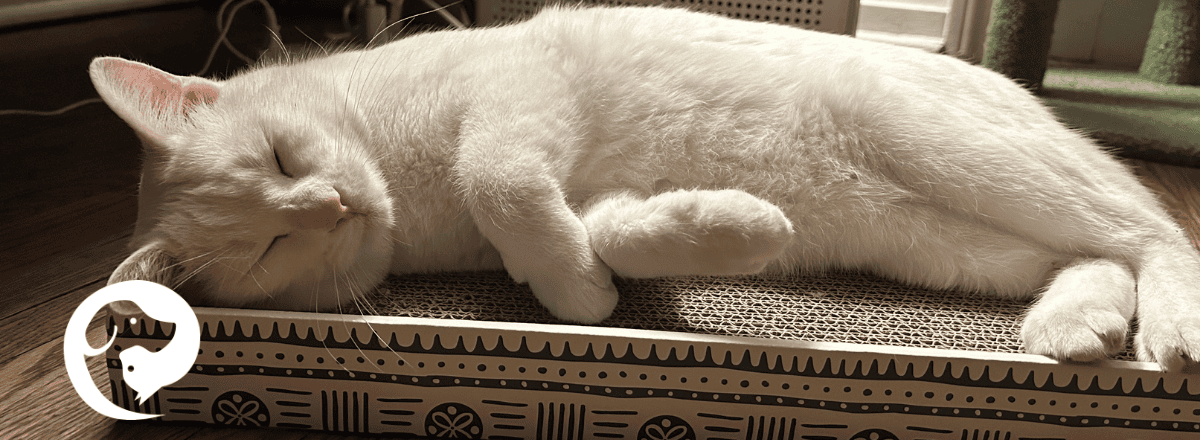
Why "Just Get a Scratching Post" Never Works
Estimated reading time: 7 mins
Photo of Elmer the cat courtesy of Sanketh Menon
You Googled it. Of course you did. “How to stop cat from scratching furniture” pulled up fifty listicles that all said the same three things: buy a scratching post, spray Feliway, trim their nails. So you did all three. And your cat is still shredding the corner of your couch.
Allow me to assuage your concerns about your implementation: it’s not that you did it wrong. It’s that the advice itself was built to fail you.
The Internet's Favorite Trick: Tell You What to Do, Not What to Look For
Almost every piece of cat-scratching advice online follows the same pattern. It hands you a solution first (a specific product, a specific spray, a specific post…) and assumes that if you apply it, the problem will resolve. Buy the post, place the post, problem solved.
That’s called a prescriptive approach, and it’s the reason so much internet advice for pets falls apart the moment it meets a real animal. A prescriptive approach decides ahead of time that a particular thing will work, hands it to your cat, and calls it done, but fails to consider whether it actually worked for your cat. It treats “scratching post” as a one-size-fits-all panacea in the same way “food puzzle” gets treated as automatic enrichment or “positive reinforcement” gets treated as a guarantee that your cat enjoyed the treat you gave them. The category gets mistaken for the outcome.
Your cat didn’t read the listicle (probably, anyway, we don’t know your cat). They don’t know they’re supposed to like sisal rope, or that the post is supposed to go by the window. They’re going to do what they’re going to do, and if the internet’s formula doesn’t happen to match what your specific cat needs, you’re left standing in front of an untouched scratching post wondering what’s wrong with you. Or worse, what’s wrong with your cat.
Nothing is wrong with either of you. The formula wasn’t built for the animal in front of you.
What a Descriptive Approach Looks Like Instead
At Pet Harmony, we borrow a concept from linguistics that we come back to again and again: prescriptive versus descriptive. A prescriptive rule tells you what should happen. A descriptive approach tells you what’s actually happening — and builds from there.
Applied to scratching, a descriptive approach means we don’t start with a product. We start with three questions:
- What need, or needs, might this behavior meet?
- What are we actually trying to accomplish?
- How will we know if what we tried is working?
Scratching is a species-typical behavior. It conditions your cat’s claws, stretches muscles across their paws, legs, and back, strengthens their core, and deposits scent that marks territory. Your cat isn’t destroying your furniture out of spite or boredom, they’re meeting multiple biological needs with one activity. The goal was never “own a scratching post.” The goal is “give this cat a way to meet their needs without ruining your furniture, your budget, and your peace of mind.” Those are two very different starting points, and only one of them holds up once you’re standing in your living room with an actual cat who has actual opinions.
Your Cat Has Preferences, and a Formula Can't Know Them in Advance
This is where the descriptive approach and the prescriptive approach really part ways. A one-size-fits-all post assumes every cat wants the same material, the same shape, in the same spot, at the same angle. Real cats don’t work that way. There are three things your cat likely has strong, individual opinions about:
Material
Some cats love sisal rope. Others want carpet, cardboard, wood, or bare drywall. Others loooooove them some fabric. Whatever they’re already choosing to scratch on your furniture is a clue — it’s data your cat is already handing you, if you’re paying attention to it instead of the listicle. If your cat keeps shredding your brocade sofa, they’re telling you that brocade is their texture of choice. So finding or making a brocade scratching post for them is going to be much more likely to attract them.
Orientation
Some cats are vertical scratchers who want to reach up and stretch tall. Others are horizontal scratchers who prefer to dig into something flat on the floor. Still others want something between those two extremes: a gentle incline that lets them do the digging motion while also getting that nice “heart opening” stretch. A tall post for a horizontal scratcher is a prescriptive solution being applied to a descriptive problem. It is never going to fit if your cat prefers horizontal or gently sloping surfaces.
Location
Cats scratch near where they sleep, near entry and exit points, and in high-traffic areas where life actually happens. That scent marking element of scratching is really important for a cat’s sense of security. For kitties, home is where their smells are. So a post tucked in a back bedroom might seem more aesthetically pleasing to us humans, but it’s entirely missing the point from the cat’s perspective. One of the most common reasons cats scratch your sofa and chairs is because those pieces of furniture tend to be in locations where your cat wants to spend a lot of time–precisely because that’s where you spend lots of time.
None of this can be answered by a formula. It can only be answered by watching your cat.
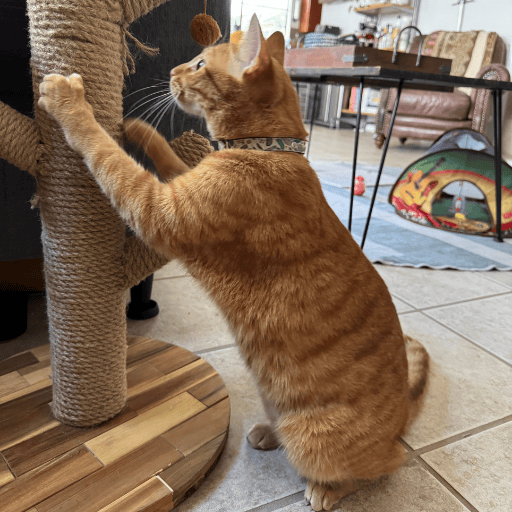
Pedro Pickle Pascal, aka Pickle, having a scratch on his sisal scratching post. Photos courtesy of Erin Beverly, Heckin’ Good Dog Training, Austin.

Frank the cat has many scratching surfaces in his house, but is modeling in front of his favorite scratching post. Photo courtesy of Karla Alexander.
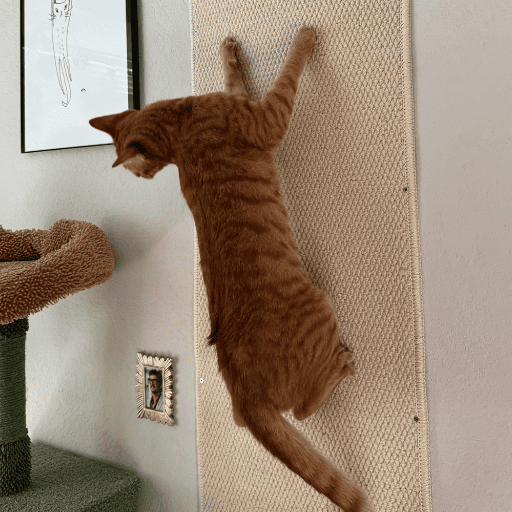
Pickle enjoys many scratching AND climbing surfaces. Here his humans have mounted a strip of carpet on the wall for him (along with his personal portrait of Pedro Pascal).
How to Actually Figure Out What Your Cat Needs
This is the part the internet skips, because it’s slower and less satisfying than “buy this.” But it’s the part that actually works.
Preference Testing
Instead of guessing, give your cat two or three options at once: different materials, different orientations, placed in different spots. Watch which one they actually choose. You’re not deciding for them what enrichment looks like, you’re letting them show you!
Trial and Eval
Once you’ve placed a new option, give it real time. Cats can take days or even weeks to start using something new, especially if their existing habit (your couch) is still just as available. Swapping something out after two days and declaring it a failure is still a prescriptive mindset wearing a descriptive costume — you have to actually let the trial run.
Observing Outcomes
This is the step most owners skip, and it’s the one that tells you whether anything you’re doing is working. Is your cat using the new surface at all, even occasionally? Is scratching on the furniture decreasing, even if it hasn’t stopped completely? Progress in behavior work is rarely all-or-nothing. It shows up in trends over days and weeks, not in one dramatic before-and-after moment. If you’re only checking in once and calling it a failure, that’s not an outcome. You’re just repeating the same prescriptive mistake with extra steps.
What to Do Right Now, While You're Figuring This Out
Descriptive work takes a little time, and that’s okay. But you don’t have to just watch your couch get shredded in the meantime! Here’s what to do instead:
- Temporarily cover the targeted surface. Double-sided tape, furniture covers, or foil on the specific spot can interrupt the habit while you test alternatives. This isn’t mean to be a solution, it’s just a management strategy to buy you time for your trial.
- Place a new scratching surface close to the damaged area. It feels counterintuitive, but location matters enormously to a cat. The closer the alternative is to the original target, the more likely it is to actually get used.
- Mark the moment they use it. A clicker or a verbal “yes” immediately followed by a treat tells your cat they made a good choice. This is where the next piece comes in.
Your Cat Can Be Trained
The internet just told you the wrong way to do it.
Somewhere along the way, “cats aren’t dogs” turned into “cats can’t be trained,” and that’s simply not true. Like all sentient beings, cats are capable of learning from their environment and, just like all sentient beings, positive reinforcement increases their behavior. These learning principles evolved long before cats did; it’s how even the earliest organisms evolved to survive around 3.5 billion years ago. If prokaryotes swimming around in the primordial ooze were capable of learning, our cats certainly are, too. They learn new behaviors and unlearn old ones, just like every other living being. What they need isn’t a different way to learn, they just need an approach that actually accounts for who they are instead of who a listicle assumed they’d be.
You can’t punish a cat out of scratching any more than you could punish a bird out of flying. But you can teach them where to scratch by making the right choice easy and building it around what they actually prefer — not around what worked for someone else’s cat on the internet.
Here’s to harmony,
Emily
Now What?
Your cat isn’t a problem to be fixed with the right purchase. They’re an individual animal with real preferences and real needs, and those needs don’t disappear just because a five-minute listicle didn’t account for them.
The internet gave you a formula. Your cat needed a process. When you stop asking “what am I supposed to buy” and start asking “what is my cat actually telling me,” you stop fighting an endless cycle of returns and untouched cat trees — and you start making progress that sticks.
If you’ve tried the formula and you’re still standing in front of a shredded couch, that’s not a you problem. That’s a sign you need a descriptive approach, not another prescriptive one. We’d love to help you build it.
PS: Capitalism
Want to support our free, public content? Check out our Amazon shop. It’s full of enrichment and pet care items (that we really, actually use). Our team spends a significant amount of time working on content every week. We love it! But we’re also out here trying to pay our bills.
* Pet Harmony, LLC is a participant in the Amazon Services LLC Associates Program, an affiliate advertising program designed to provide a means for sites to earn advertising fees by advertising and linking to Amazon.com.

EMIly strong
Emily Strong has been in the animal welfare industry since 1990 and has been a behavior consultant since 2008. She is the co-owner of Pet Harmony, co-author of Canine Enrichment for the Real World, and a national speaker.
Emily started working with animals at a young age and struggled with the notion that you have to hurt, scare, or intimidate animals to help them. Emily loves helping current and prospective behavior professionals and working with pet parents through our in-depth services. She enjoys working with all species.
Copyright 2025 Pet Harmony, LLC. All Rights Reserved.
Terms & Conditions, Privacy Policy
Results are not guaranteed because behavior, human, canine, or otherwise, are not guaranteeable.