

The internet’s cat-scratching advice (buy a post, spray Feliway, trim nails) fails because it’s prescriptive: it hands you a fixed solution without asking what your specific cat needs. This post walks through a descriptive approach instead, using material, orientation, and location preferences to figure out what actually works. It also covers how to manage the damage while you test options, and why cats absolutely can be trained to scratch appropriately once the approach fits the individual animal instead of a generic formula. The goal isn’t a specific product — it’s a process for reading what your cat is already telling you.
Tag: cat training
Set it and Forget it: Enrichment Strategies for Busy Times
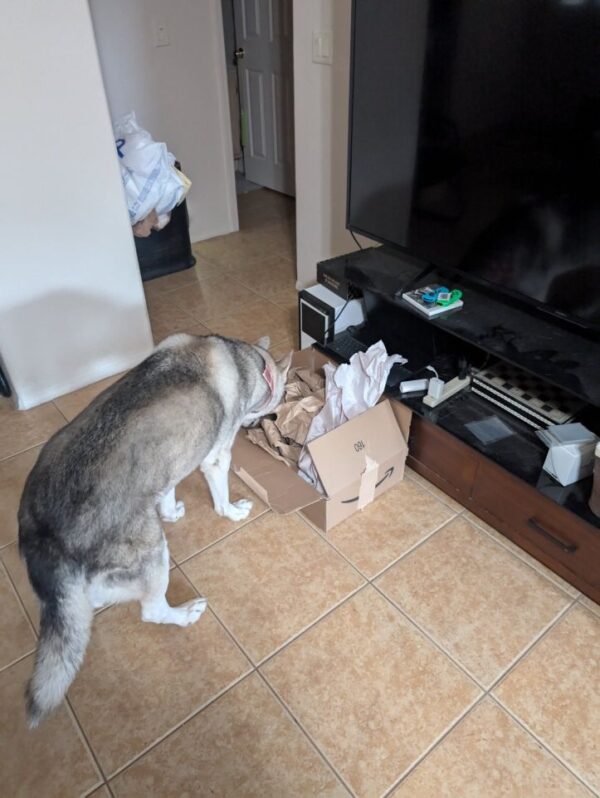
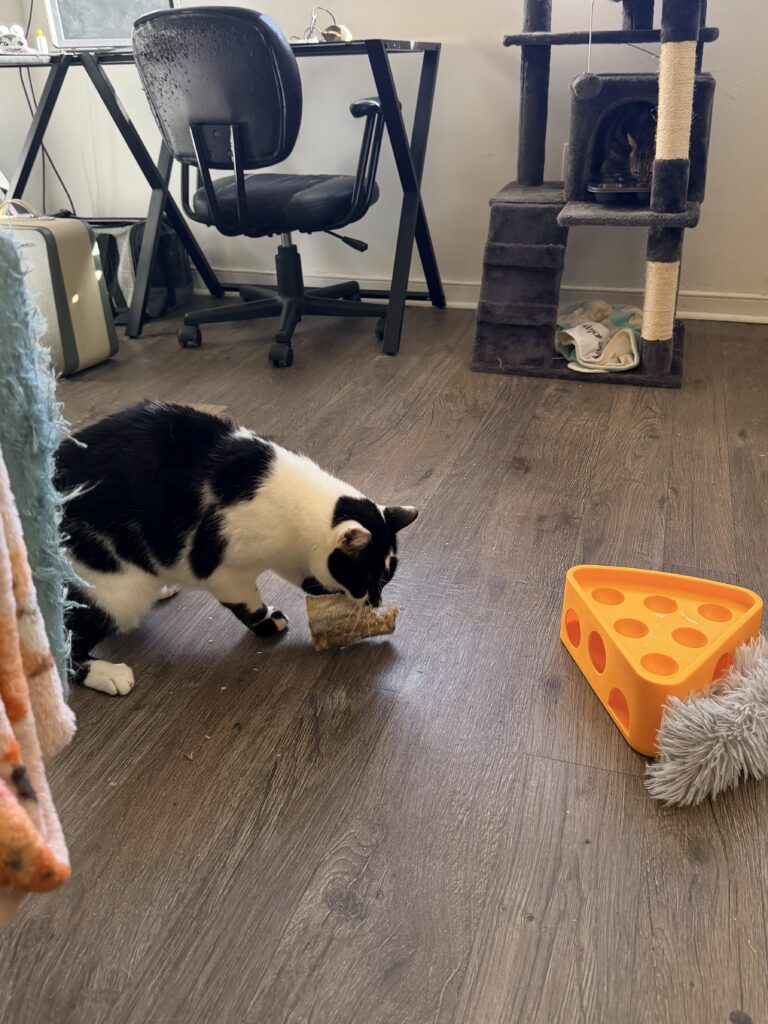


What Owning a Cat Teaches You About Agency
Why Cats?
I love cats. Cats are regal, majestic creatures. They defy the laws of science by filling any container they curl up into. They purr, and rub on you, and curl up on your lap to snuggle. I have had cats from the time I was small. I cannot remember meeting a cat I didn’t like, though I’m sure I have.
I once saw a meme that made me laugh out loud. It said:
“What if the Internet is filled with cats because dog people go outside?”
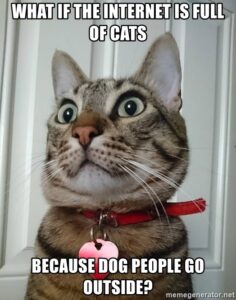
So, if you’re here on our website, then you are obviously a cat person.
While that may not be true, it is true that if you follow Pet Harmony, you probably care a lot about your pet. You might have a pet whose behavior puzzles you. You may feel frustrated by the behaviors your animal is displaying. I promise to relate my experience with cats to dogs- and to other species, as well.
Cats get a bad reputation. I have heard many people describe cats as jerks. They’re not loyal like dogs. They make their own decisions. They never consider what you need. They’re independent, and they don’t really need us. Cats are lazy and prefer humans to dote on them like the feline gods they are!
After getting my first two dogs, and becoming a dog trainer, I’ve met many people and dogs. Often, people are happy with their dogs, only wanting to prevent future problems with a new dog. Just as often, however, I’ve run into people who are frustrated with their dog’s behaviors. Since I have been a dog trainer for quite a few years now, I’ve noticed a trend among people unhappy with their dogs. They tell me:
“He never listens to me.”
“She only minds when she wants to.”
“He won’t stop getting on the counter!”
“She nips at me when I try to make her do things.”
I understand those feelings. I know it is frustrating to think you got a man’s best friend, just to find they won’t listen to you, destroy your house, steal your food, or even hurt you. Those feelings are totally and completely valid. When I hear these things, what I understand from it is basically this:
Their dog is acting like a cat. Well, a stereotypical one, anyhow.
Cats Are a Lesson in Consent. (And Agency)
What I mean when I say that their dog is acting like a cat is really that their dog has opinions. Their dog has things they like and things they dislike. Their dog likes some things better than listening, especially if they don’t understand why they should listen. Dogs are very social creatures. They descend from creatures that worked together to bring down large prey. Wild felines, however, are usually pretty solitary. What that means is though both wild canids and wild felines are individuals with wants and needs, our concept of “dog-ness” includes a certain level of “clinginess” and working for its “master” (which is a strange use of words we can get into another time). We expect dogs to appease us. However, our society’s concept of “cat-ness” is usually aloof and independent.
What a cat really needs, as well as any pet, is agency and consent. Agency is the ability to have control over certain outcomes in your life. This can usually come in the form of choices given to an individual. Consent is the ability to assent to or approve of something, especially something that is happening to oneself. Each of these creates a sense of freedom in the animal. Trapped animals lash out, bite, and scratch. An animal that is given agency will feel more secure, and less likely to lash out.
Why Agency? Check out Allie’s excellent post about it, here, or read about it in Emily and Allie’s book, Canine Enrichment for the Real World.
How do I give my pet a sense of Agency?
Give them choices. That doesn’t mean that you open every door and window and take out any safety measure for your pet. It means you offer them choices that don’t endanger your pet or anyone in your home. If your cat (or dog) doesn’t like to be out when new people are over, make them a safe place to hide away from people until they leave. They may surprise you and come to observe the new person. Don’t pick them up and force them to interact. This is removing their ability to control the situation and thus limiting their choices. If you let them choose when, how, and if they want to interact, don’t be surprised if you find they are more willing to come out in the future. Conversely, if you force them to interact with someone, they may become more reclusive in the future.
When we brought home my cat, Sylphrena, she was 6 months old. My husband and daughter had limited experiences with cats, and were upset that she didn’t want to be held by them, but would (often) allow me to hold her. At first, I wasn’t sure why. After watching the way they held her, I realized why. My daughter and husband would often hold her tighter if she struggled to get away. This would result in a teenage kitty tantrum: scratches, bites, and occasionally growling. Obviously, she didn’t like it, but they couldn’t understand why she would let me hold her.
When an animal allows me to pick them up, I give them the choice to leave, by pulling my hands away, while still on level with the animal. If the animal runs away, so be it. Should they choose to stay, I try petting them and see if they settle down to snuggle. Then I can put my arms back around them. If they start to struggle again, I let them go. In this circumstance, I am both giving my pet choices, and allowing them to consent to being held (or not).
Allowing Sylphrena to feel safe by giving her the choice to leave really built her relationship with me. She knew I would let her go if she wanted, and knew she had agency if I tried to hold her. She wasn’t trapped.
I taught my family how to help her feel secure and safe by allowing her to make the choice whether she wanted to stay (or not), and over time she has become more trusting of my husband and daughter.

There are little things you can do every day to give your pet agency and let them consent:
- Petting consent tests (for any species)
- Making different textures and types of chews and toys available (for many animals)
- Sensory areas with pet-safe plants and textures your pet loves. (I will likely be making another blog specifically about this after I make one for my pets!)
- Allowing your pet the choice to move away from other people or animals (do not force them to say hello!)
- Making different textures available to scratch on for kitties
- Having multiple litter boxes available in different areas for your cat (you can even provide different litter options to see what they prefer)
Many times, if we just look at what our pet is telling us with their body language, we can see what they really need or want– and if we can safely provide them with the agency to do that thing, we can improve their quality of life– and, in most cases, our own as well. Because a content and healthy creature doesn’t feel the need to lash out.
Now What?
- Learn more about your pet’s species-specific body language, so you can tell if they like something or not.
- Find one way to allow your pet more agency in their life
- Research and prepare your home with appropriate furniture or enclosure requirements unique to your pet
- If you’re not sure where to start, try our free Facebook group, Enrichment for Pet Behavior Issues Community.
- If you now want to own a kitty, or are just looking for another, check out this article on how to prepare your home for a new kitty!
Here’s an excerpt:
Bringing home a cat is an exciting time for the family. They provide laughter, companionship, and can even teach little ones about responsibility. However, preparing your home for a kitty can bring about some uncertainties and renovations to ensure your cat is well taken care of and comfortable in your home.
To help you get started, Redfin reached out to 14 cat experts, from Seattle, WA to Ottawa, ON, including us. Here is our best advice on how to prepare your home for a kitty. Check out How to Prepare Your Home for a Kitty: 14 Tips from the Pros.
You Have to Practice Before the Test
When I’m giving a client a new activity, I always tell them to practice first in scenarios where they’ll be more successful. For example, practicing loose leash walking or the flight cue inside. Or Look at That or a greeting strangers protocol with faux triggers or people they know. Every now and then, someone will come back to me with:
I tried what you said to do and it didn’t work.
After some sleuthing, we sometimes find that the problem is that they tried to use it in a more difficult situation before they or their pet were ready. That happens to all of us (myself included!) at some point! But, if we go straight to testing without practicing, we usually fail the test.
Practice makes perfect
This cliche applies to behavior modification: practice makes perfect. Well, as close to perfect as we can expect from a living, breathing individual with free will. The situations in which we want to use our pet’s skills are usually higher stress situations, either due to excitement or distress. I liken this to a “test”, where you’re expected to perform skills you’ve been learning in a higher stress situation. But the only way to do well in that type of situation is to practice a lot in easier scenarios that gradually build in difficulty.
Imagine we plucked someone off the street, told them the basics of brain surgery, and then asked them to perform brain surgery on someone. Show of hands of who’d like that person to operate on them? That’s a hell no from me! I want someone who’s gone through school, practiced on cadavers, and has operated on a bunch of people before me. I want someone who’s practiced.
Teaching our pets something once or twice and then asking them to perform it in a high-stress situation is like asking someone we’ve plucked off the street to perform brain surgery. It’s just not going to go well. And, if through luck it does, it’s not going to be predictably replicable. We need to practice in easier situations that gradually build in difficulty in order for them to succeed.
What do easier situations look like?
This will be different depending on the skill or maladaptive behavior we’re talking about and where the pet is in their learning journey. In general, easier situations can look like something as simple as you and your pet training in your living room without anyone else around or it can look like a watered-down version of the situation you’re working up to. You have a lot of options when it comes to an easier situation. In general, choose a scenario where you’re pretty sure your pet will be successful.
Keep in mind that “easier” is subjective, and is based on current skills. Calculus is easy for someone with a Ph.D. in math but it’s hard for a 3rd grader. Staying still is hard for a puppy but is easy for a service dog. The goal is to practice in situations that gradually increase in difficulty but for each step to still be easy for your pet’s current skill level.
Now what?
- Determine what an easier situation looks like for a skill you’re trying to teach.
- Start practicing! If your pet is doing well, keep practicing. If they’re not doing well in that situation, that means it’s currently too difficult for them. Go back to the drawing board to figure out what would be easier for them and try again.
Happy training!
Allie
May 2021 Training Challenge: Overt vs. Covert behavior
Happy spring! I have no idea how we’re already in May, but here we are. And with the new month comes a new training challenge. Here’s the challenge for May:
Describe 1 construct or label using overt behavior
Okay. What the heck did I just say? This training challenge requires a bit of a vocabulary lesson. Now, y’all know I try to not be super vocab-heavy or technical in these blog posts, but this is one where the technical terms end up being the easiest way to communicate this concept. I promise to make it as painless as possible! Let’s dive in.
Overt vs. Covert Behavior
Overt behavior refers to observable, measurable behavior. Examples of this include:
- The person took three steps to the right
- The hawk is flying at 20 mph
- The dog’s ears turned back and are sitting low against the skull
- The cat jumped onto the counter
There’s no arguing whether these behaviors are or are not true because we can see them and measure them.
Covert behavior refers to internal thoughts, feelings, motivations, and intentions. And a construct is our interpretation of those covert behaviors. If you want to think of covert behavior and constructs as the same thing for now, go for it. The technical differences between those two aren’t as relevant for our level of discussion. Examples of this include:
- The dog is mad that I left him alone and that’s why he pees when I’m gone
- The dog is anxious when I leave him alone and that’s why he pees when I’m gone
- The dog doesn’t know to not potty inside and that’s why he pees when I’m gone
- The dog is trying to claim his territory when other dogs pass by the house and that’s why he pees when I’m gone
As you can see, there’s a whole lot of debate as to whether these behaviors are or are not true. Here we have the exact same overt behavior- urinating when left home alone- but I’ve heard all of the above as constructs people have created to explain that particular behavior.
Here’s the thing with covert behavior and constructs: we’ll never know if they’re accurate. Heck, we’re even terrible at guessing the covert behavior of our fellow humans, with whom we speak the same language! How can we assume that we’re better at guessing the covert behavior of another species that doesn’t speak the same language?
One more vocab word to throw into this mix: labels. A label is something we use to describe someone. For example, we could say a pet is:
- Stubborn
- Fearful
- Aggressive
- Anxious
- Sweet
All of those are labels.
Why does all of this matter?
All of this matters for a few different reasons:
The words we use shape our judgment, and ultimately can shape how we feel about our pets
Let’s say we have a dog who sometimes lies down in the middle of a walk and cannot be coaxed to get up for several minutes at a time.
Overt behavior: lies down while on a walk for several minutes
Constructs and labels I’ve heard people use to describe this behavior:
- Stubborn
- Too hot to walk
- Scared
- Watching everything; attentive or focused on their surroundings
- Getting old and joints might hurt
Now, how do you think the person who thinks their dog is stubborn feels about them vs. the person who thinks their dog is getting old with ouchy joints feels about them? My guess is those two people have a pretty different relationship with their pets and feel very differently about this particular behavior.
Our judgment shapes our decisions, for better or worse
Let’s continue with the previous example. Each of those people would likely choose a different path to change that behavior. This might look like:
- Stubborn: force them to walk
- Too hot to walk: manage by walking in the morning when it’s cool
- Scared: seek help from a behavior professional
- Watching everything; attentive or focused: train a watch me or attention cue
- Getting old and joints might hurt: speak with their vet about pain management options
One behavior, 5 different options for treatment based on our assumptions about what’s happening. But, and I can’t stress this enough:
We don’t know if our assumptions about covert behavior are accurate.
That means that we can’t make training decisions based on covert behavior, constructs, or labels. While we might be right in our assumptions, we can end up doing more harm than good if we’re wrong. For example, if the person thinks their dog is stubborn but actually they’re too hot to walk or in pain, forcing them to walk could end up seriously injuring them. Assumptions do not make for effective decisions; observing overt behavior makes for effective decisions.
Our assumptions cloud our observations
I see people on a daily basis who are struggling to reconcile seemingly incompatible thoughts, theories, assumptions, etc. that they have about their pets. The most common I hear is reconciling the “sweet” label with a dog who is biting people. This usually comes in the form of the following statement:
They’re so sweet 95% of the time but it’s just that 5% we’re worried about
It’s hard for us to wrap our heads around how a pet who is sweet can also bite someone; sweet individuals don’t hurt others. When I see this happen we usually have a discussion that we’re the ones setting up that false dichotomy; their pet can still be very sweet with them but also fearful and biting other people. They’re not mutually exclusive behaviors.
Sometimes, though, I see people struggling with that more than others. In those situations, I often see where folks will hold fast to a label or construct that they have about their pet and it makes it so they cannot see overt behavior that contradicts that label.
For example, I’ve worked with a few clients who had leash reactive dogs and would even bite other dogs in some situations. The dog was showing clear signs of stress around members of their own species and even though we went through all the typical spiels about anxiety-related behaviors, they still believed that their dog truly enjoyed other dogs because they had a dog friend as a puppy. They couldn’t see the stress signals I was pointing out to them because that contradicted who they thought their dog was. Needless to say, those folks made much slower progress than their counterparts until we reached the point where they were able to see with their eyes, not their ideas.
Hold up. Don’t you use labels and constructs all the time?
Yep! I do. Even though we shouldn’t make training decisions based on constructs or labels, they’re really helpful for communicating as long as all involved parties are defining those words the same way. For example, if I had to describe leash reactivity as barking, lunging, growling, and air snapping at the end of a leash when a dog is near another dog every time I talked to a client, we’d never get anything done. Instead, I tell my client, “this behavior that you’re describing I’m going to call leash reactivity.” That way we can communicate more efficiently and be on the same page as to what we’re defining as leash reactivity.
But, what about the anxiety label you use? Isn’t that an assumption?
Right again! Those of you who have done an initial consultation with me might remember that when I describe your pet’s behavior as an anxiety-based behavior, I’ll actually say it’s a behavior based in anxiety, stress, fear, however it helps you to think of it. The next sentence is usually something along the lines of, “Those are all technically different, but for our purposes, I’ll use those phrases interchangeably because we can treat them all the same way and that’s really what I’m more interested in.”
Those are, however, all still labels or constructs. The reason I feel comfortable using those to make behavior decisions is because of body language. There has been enough study on body language, and studies are still coming out, that we can make an accurate enough guess as to broad strokes of covert behavior– like excitement and fear. So really those behavior decisions are happening based on body language and other behavior observations (overt behavior), and we attribute those body language signals to different constructs or labels.
Back to the training challenge
Alright, I think we’ve detoured from this month’s training challenge enough for it to now make sense.
Your task for this month is to take 1 construct or label that you have for your pet and describe it using only overt behaviors. Here’s an example:
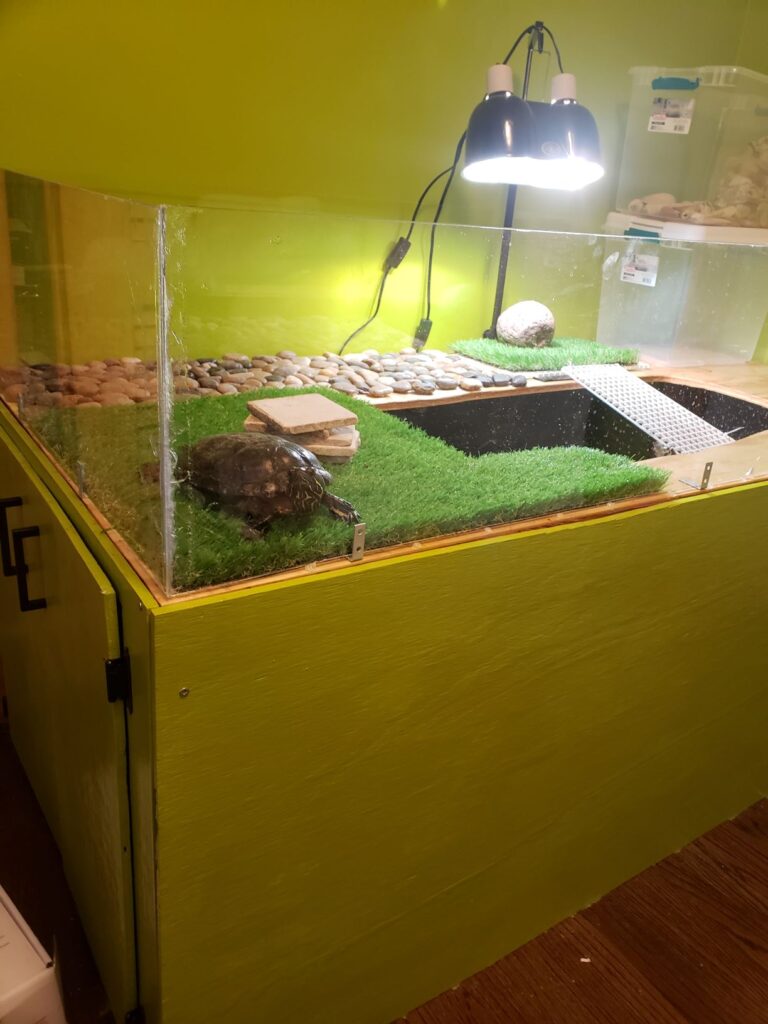
Construct: Zorro likes his new tank setup
Overt behavior: Zorro is spending more time basking, less time trying to escape, and less time performing repetitive swimming behaviors in his new tank setup than his old one.
If you’re feeling extra ambitious for this challenge, you can then turn that overt behavior into a different construct or label so you can see how easy it is for folks to create different explanations for the same behavior, like this:
New construct: Zorro has realized that I have finally outsmarted him when it comes to him escaping and he’s given up. I’m finally smarter than my turtle.
Now what?
- Choose a construct or label.
- Think about what your pet is actually doing when you use that construct or label. What do you see with your eyes?
- Share your results with us on Facebook or Instagram @petharmonytraining
- If you’re interested in learning more about this topic, we have a video training on overt vs. covert behavior in our Beginning Behavior Modification course.
Happy training!
Allie
P.S. We have something BIG in the works to help even more pets and their people. Stay tuned for an announcement later this month!
April Training Challenge: Drop It
Happy kind of spring! We have another fun training challenge this month:
Teach a “drop it” cue during play
Playtime can very often double as training time. The two do not have to be mutually exclusive!
Before we get into some examples of how to do this, let’s have a brief chat about what I mean by “drop it”.
“Drop It”: The Behavior
When I say “drop it”, I mean the specific behavior of removing an item from your mouth. I like to have specific cues that mean specific behaviors to limit confusion with a pet as much as possible.
If you are using “leave it” for both behaviors of not putting something in your mouth and removing something from your mouth and it’s working, keep doing it. I’m not here to fix things that aren’t broken. However, if your pet is struggling to learn that the same thing means two different behaviors, then I suggest having one cue for each. Remember: just because we understand the concept of synonyms does not mean our pets do.
Another reminder: our pets don’t speak human language. You need to teach your pet what the “drop it” cue means before it’s going to reliably work. Fairly often someone will tell me that their pet does not drop something when asked to. And, almost just as often, I’m met with blank looks when I ask them how they taught that behavior. Stubborn quite often means they were never taught how to do it in the first place.
And, one last note: this behavior needs to be reinforced just like all others if you’d like to see it continue. If the only time you’re using “drop it” is to ask your pet to give up something amazing for nothing in return or only at the end of a play session, they’re going to discontinue following that cue pretty quickly. Like all behaviors, it needs to be worth it to the individual performing it.
“Drop It” with Fetch
There are a few variations that usually work for teaching this cue while playing fetch.
Option 1: 2-Toy Fetch
- Grab two identical (if possible) toys that your pet likes playing fetch with.
- Throw one toy.
- When your pet brings Toy 1 back, make a big fuss over Toy 2. Make it seem like the most fun toy that’s ever existed.
- When your pet drops Toy 1, immediately throw Toy 2. The hope is that throwing Toy 2 (continuing the game) reinforces the drop it, not any other behavior– like sit. We’ll only know if this is effective for this pet if they continue dropping the toy moving forward.
- Pick up Toy 1 while they’re chasing after Toy 2.
- When your pet brings Toy 2 back, make a big fuss over Toy 1.
- When your pet drops Toy 2, immediately throw Toy 1.
- Repeat until your pet reliably drops the toy. Pay attention to the cues that they are going to drop the toy. Some will chew it a few times then drop, others it’s based on proximity to you, others it could be a change in head position.
- Add in your “drop it” verbal cue right before they drop it. If you’ve successfully completed Step 8 you should be able to tell when they’re going to drop it and say your cue before the behavior happens. Reinforce by tossing the other toy, like before. Repeat until, in this context, your pet reliably drops the toy on cue.
- If you want to add some other behavior between the drop it and toss, now’s the time.
Option 2: Using Treats
- Grab a toy or two that your pet likes playing fetch with
- Throw the toy
- When your pet brings the toy back, show them a treat (luring) and say “drop it”.
- When your pet drops the toy, give them the treat, then pick up the toy. If you’re having trouble with your pet grabbing the toy again when you’re reaching for it then toss the treat instead of handing it to them so they’re busy while you’re picking it up.
- Because you’ve already rewarded the “drop it” behavior, you can ask for a sit or anything else you’d like before throwing the toy again.
- Repeat the above steps 5 times.
- The next time your pet brings the toy back, say “drop it” without showing them the treat. If they do, awesome! Hand or toss them the treat. If they don’t, repeat the above steps.
- You can either slowly phase out the treat and just have the continuation of the game be the reinforcement (if it is, actually and indeed, reinforcing enough) or you can keep the treat in the game long-term. There’s no harm in that.
“Drop It” With Tug
Let’s get one question that I hear frequently out of the way: does tug cause aggression? The short answer is no. The slightly longer answer is that there have been one or two studies looking at tug and aggression and they did not show that there was a significant correlation between the two. Now, two studies are not a lot and there could absolutely be more research done on this and that’s something we should keep in mind. Anecdotally, I frequently play tug with dogs who are considered “aggressive” and still have all my limbs (even the resource guarders!)
The way to teach “drop it” with tug is exactly how you would do it with fetch, just with tugging instead of throwing. I recommend playing for just a few seconds at a time (10-15 seconds). This can often make it easier for them to drop it because they’re not fully in the throes of tugging.
Now What?
- Choose your game and toys.
- Get to playin’! If you’re using treats, you may need to experiment with the type of treat to get the perfect value of “worth dropping the toy for” vs. “not too exciting that play stops”.
- Share your progress with us @petharmonytraining on Facebook and Instagram.
Happy training!
Allie

Agency: What It Is & Why Your Pet Needs It
A few weeks ago there was a discussion in our Enrichment for Pet Behavior Issues Community Facebook group where I realized that I’ve never actually written a post about agency itself. Sure, I’ve included this topic in other posts but I’ve never devoted an entire post to this topic alone. It’s about time that changed! So this week is solely devoted to a topic that I don’t think gets near enough attention in the pet community: agency.
What is agency?
Agency is the ability to have some level of control in our environment and be able to make choices that will result in a desirable outcome. One of the important factors here is that agency requires at least two desirable choices. A “cake or death” decision a la Eddie Izzard doesn’t fly.

A pet example of a choice that fits the criteria would be the choice to sleep on comfy bed A or on comfy bed B. An example of a choice that doesn’t fit the criteria would be come when I call or get shocked. Make no mistake, though, it’s entirely possible to use food coercively as well. Such as, you can have delicious treats but only if you approach a person you find scary. Those examples don’t have at least two great choices to choose from.
Why agency is important
There are so many reasons why agency is important that it would take me an entire book chapter to explain them all 😉 The short answer is it’s helpful in:
- Combating learned helplessness
- Creating resilience
- Improving behavioral health
- Improving quality of life (I don’t have research to back this bullet point up since “quality of life” is pretty subjective, but I think it’s safe to say that this is likely true from an anecdotal capacity and if we look at all the other things agency does for an individual.)
On a more practical note, having agency can be huge when it comes to how an individual reacts in certain situations. Here’s the example I use with my clients to illustrate this point:
Say that you’re at an educational wildlife event. The presenter is holding a snake. You hang out at the back of the room, fearful to move closer. The presenter continues talking about the snake they’re holding and offers for anyone to touch the snake who would like to do so. By the end of the presentation you’ve made your way to the front of the room and touch the snake. This was not a scary experience because you had full control over whether or not you put your hand on the snake.
Now, let’s say you’re having a picnic. You’re sitting and chatting with your friends when you put your hand down– right on top of a snake. Chances are you’re not okay with this scenario, even though it’s the exact same behavior– hand on snake– as above. You may scream, run away, or perform some other fight or flight behavior. The difference between these scenarios is that you didn’t have the choice to touch the snake in the picnic but did in the presentation.
We seem to see this with our pets, too. I often see reactive dogs who are far less reactive when they’re able to move away from the scary thing than when they’re made to sit there and watch it. Or dogs with separation anxiety who display fewer stress-related behaviors or less intense stress-related behaviors when they’re given more space to move about in the house (though, confinement anxiety is also a thing). While we can’t necessarily ask our pets in these situations if it’s agency that’s truly causing the change in behavior, we see it consistently enough that it’s a valid hypothesis.
How can I provide more choices in my pet’s life?
There are so many ways to do this and we have a lot of examples in our book, Canine Enrichment for the Real World. Here are some easy options:
- Multiple sleeping areas to choose from
- Being able to choose where they go and what they sniff on a walk
- Food preference tests
- Toy preference tests
Here are couple that are more involved but also allow for even more agency in situations where it really counts:
- Cooperative care & start button behaviors for medical and grooming procedures
- Being able to choose whether or not they move closer to a stressor– without luring with food
But… what if they make poor choices?
Agency doesn’t mean that your pet has full authority to do whatever they want. If you have a pet who bites people coming into the house they still need to be managed to ensure they don’t bite people coming into the house. We should not diminish safety to increase choice.
Agency means providing choices that don’t compromise safety, physical health, mental or behavioral health, or enable them to practice unwanted behaviors. That sometimes means that our pets may not have multiple choices in a situation. When that happens we can acknowledge that and work on training a skill that allows our pet to have choices in future similar situations. For example, a dog who doesn’t have a rock solid recall (come when called) shouldn’t be off-leash even though being off-leash allows for more agency. Instead of resigning to that, we can work on training a rock solid recall for future use.
Now what?
- Assess the choices your pet currently has. Don’t be critical or hard on yourself; we’re simply assessing to see where we have room for improvement.
- In those areas where you find your pet doesn’t have agency, ask yourself why that is. Is it to mitigate safety concerns? Is it to mitigate unwanted behaviors? Or, are there situations where you’re not quite sure or because it’s what someone once recommended or you think it’s what you should be doing? Keep probing until you find those answers.
- If you’re newer to agency and thinking about your pet’s choices, choose one of those easier situations to increase your pet’s desirable choices.
- If this is something that you’ve been working on or thinking about for a while, you may want to consider one of the more involved options. Cooperative care is a great place to start for almost everyone.
- If you’re interested in learning more about agency and how to incorporate it into your pet’s life, check out our book Canine Enrichment for the Real World and be sure to join us in our Facebook group.
Happy training!
Allie
Behavior Modification vs. Weight Loss: a False Dichotomy
I’ve mentioned before that issues seem to come in waves. In the spring we usually get a lot of new leash reactivity clients. With the pandemic we got a huge wave of intrahousehold aggression cases. This winter, though, it seems to be pets who need behavior modification who are also on a weight loss plan.
Whenever I find that I’m having the same conversation multiple times per week, I add it onto the blog list. So this week is all about how to use food in training while sticking with your pet’s weight management strategy. Let’s dive in!
Why we use food in training
I’ve talked in a previous blog post about why we use food in training so frequently. Check it out here for a more in-depth explanation. The short answer is that it’s easier to dispense than other options and usually more effective than other options. Our pets need food to survive which means that it’s valuable; if it’s not valuable (even in a specific moment) it means that there’s something else going on that we need to troubleshoot. Again, there’s a much more in-depth exploration of this topic here.
There are plenty of times where the behavior needs and the physical needs of an animal seem to be at odds with each other. A pet going through a behavior modification plan and a weight loss plan at the same time is one of those scenarios. The good news is that we don’t necessarily have to choose between the two!
Cutting calories
There are a few different ways to cut calories for pets who need to lose some weight while continuing to use food in training:
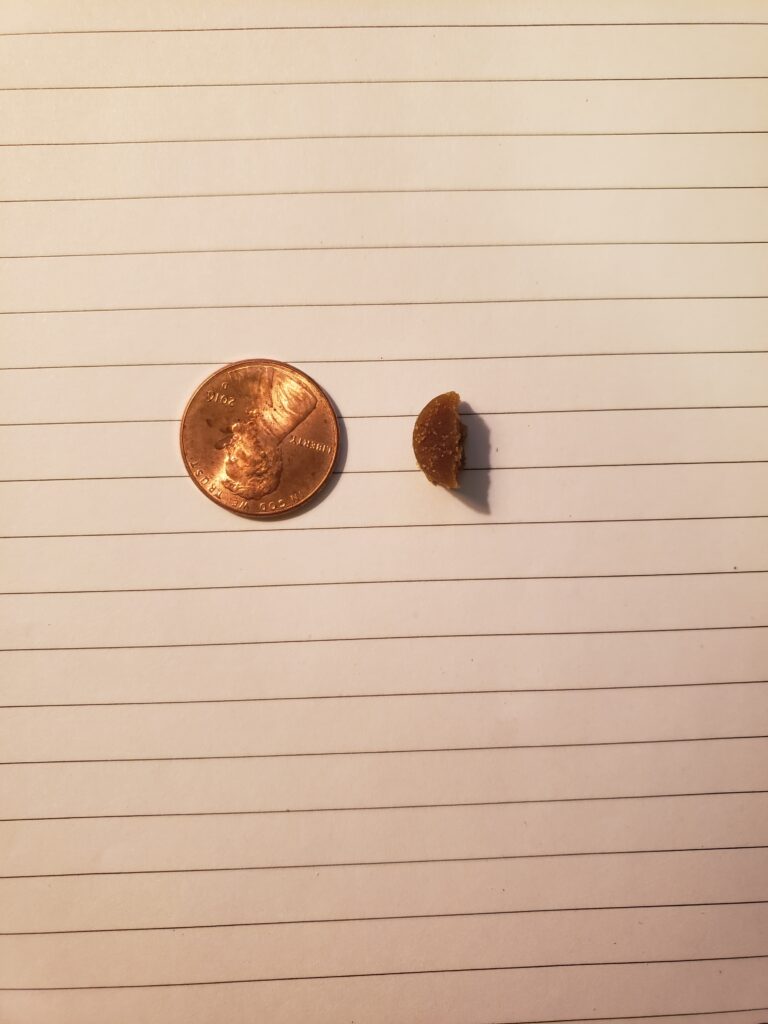
- Use smaller treats. Below is an example of how small of a treat I use for 83-lb Oso. He works better for larger treats, but these suffice for things he knows how to do really well and for playing “find it”.
- Experiment with fruits and veggies. If your pet loves low-calorie foods, use them! I trained Oso’s “out” behavior (hanging out outside of the kitchen) exclusively with veggie scraps. Check out the blog about that here.
- Lickety Stiks (below) or broth cubes. Great taste and fewer calories with these flavored liquid options! (Also, shout-out to Duncan’s parents for calling the Lickety Stik “bacon goo” in a recent session. I’m totally stealing the phrase and still giggling about it.)
- Use their meals for training. Set aside some of their breakfast to use for training throughout the day.
- Feed less at mealtime if it’s a treat-heavy day. If you know you’ve dispensed a lot of treat calories one day, take out the equivalent from that evening’s meal. Talk with your vet before resorting to this a lot to make sure your pet is getting the nutrients they need.
One thing to keep in mind is that treat value matters (more info here). It’s not necessarily as easy as switching out treats or using kibble in training. There are times where you will need to use the higher-value– and usually higher-calorie– treats to get effective results with your training. Talk with your behavior consultant about where you can cut calories and where it’s imperative to use the better stuff.
Using other reinforcers
Although using food in training is effective and often easier, it’s not the only thing that works. You can absolutely experiment with using other things that your pet enjoys: toys, play time, petting, praise. And don’t forget those “real-life reinforcers”: going through the door, putting the leash on, coming up on the couch. Here’s a post I recently wrote about teaching Oso to stay out of our basement without using any food.
Now, if you’ve been with us for a little while you probably know what I’m going to say next. Remember: only the learner decides what’s reinforcing. If you decide to switch from giving treats for a sit to only petting them on the head and they stop sitting, then petting on the head isn’t actually reinforcing that behavior.
To label something as reinforcing we need to observe how behavior changes over the course of our training. If the behavior continues happening or happens more, then what we’re doing is reinforcing. If the behavior happens less frequently or stops happening all together, then it’s not reinforcing.
Long story short: we should only use something other than food if it’s actually effective.
Phasing out food
I often hear the term, “phasing out food” when poking around the dog training internet (and used to say it myself!) What this should mean (not what it always means when used, though) is that we switch from using food to using some other type of reinforcer for a specific behavior. It doesn’t mean we stop using food altogether or that we stop providing any type of reward for performing a behavior. Really this is another way of saying “using other reinforcers” like the above category.
One way to combat weight gain while on a behavior modification program is to phase out food for behaviors that your pet knows how to do really well in the situations in which they know how to perform them. Oso is great at sitting in the house. Every now and then he gets a treat for sitting, but more often than not he doesn’t. We’ve phased out food for that behavior in that context. Now, he doesn’t have as strong of a reinforcement history for sitting at the vet clinic. That’s harder for him to do and so he still gets treats each time he sits in that context.
So if we’re concerned about weight gain while working through a behavior modification program, we can phase out food for some behaviors while using treats for others.
Increasing exercise in other ways
One of the challenges for especially dogs going through a weight loss program and a behavior modification program at the same time is that often many of the typical exercise activities are out. Leash reactive dogs often need to limit walks in order to limit triggers. Doggy daycare is out for pups displaying dog-dog aggression. Finding a dog walker is challenging for those stranger danger kiddos.
That doesn’t mean we can’t exercise our pets in other ways, though. We just need to get a little creative with it. Last year’s February training challenge went through several different ways to provide more physical exercise inside the house for dogs cooped up in the winter. Check it out here.
Oso gets most of his physical exercise inside the house in the winter (and we certainly don’t have a big house!) It’s very possible to keep up with the physical exercise part of your pet’s weight loss program while following management strategies for their behavior modification program. Make sure to speak with your vet about incorporating different exercises into your pet’s routine to ensure that it’s safe to do so with them.
Shelving parts of a behavior modification program while working on a weight loss program
There are several stages to a behavior modification program. The first stages are much more about human learning and behavior than it is about training your pet. That means that the first stages don’t necessarily require a lot of extra, high-value treats! If your pet is at a seriously unhealthy weight, let’s work on managing their behavior issues (the first stages) instead of modifying their behavior so we can progress quicker through a weight loss program. As long as we’re managing the behavior so that it’s not getting worse over time we can safely come back to it later.
Now what?
- If you know your pet needs to lose some weight, your vet should be the first person you talk to. They can help you put together a plan to help your pet safely lose weight.
- Do a food preference test to determine what your pet’s favorite foods are and also what lower-calorie foods we can use in training.
- If there are behaviors that your pet knows how to do really well, start phasing out treats by decreasing how frequently you treat and increasing other types of reinforcers. Remember: if the behavior starts deteriorating you’re not actually reinforcing.
- Explore different types of exercise. Again, talk to your vet first to make sure the exercise is appropriate for your pet. But after that, have at it!
- Speak with your behavior consultant about how to mitigate calorie intake while working through your pet’s behavior modification plan. We’re here to think outside the box for you!
Happy training!
Allie