A white cat snoozing on his cardboard scratcher.

Why “Just Get a Scratching Post” Never Works

The internet’s cat-scratching advice (buy a post, spray Feliway, trim nails) fails because it’s prescriptive: it hands you a fixed solution without asking what your specific cat needs. This post walks through a descriptive approach instead, using material, orientation, and location preferences to figure out what actually works. It also covers how to manage the damage while you test options, and why cats absolutely can be trained to scratch appropriately once the approach fits the individual animal instead of a generic formula. The goal isn’t a specific product — it’s a process for reading what your cat is already telling you.

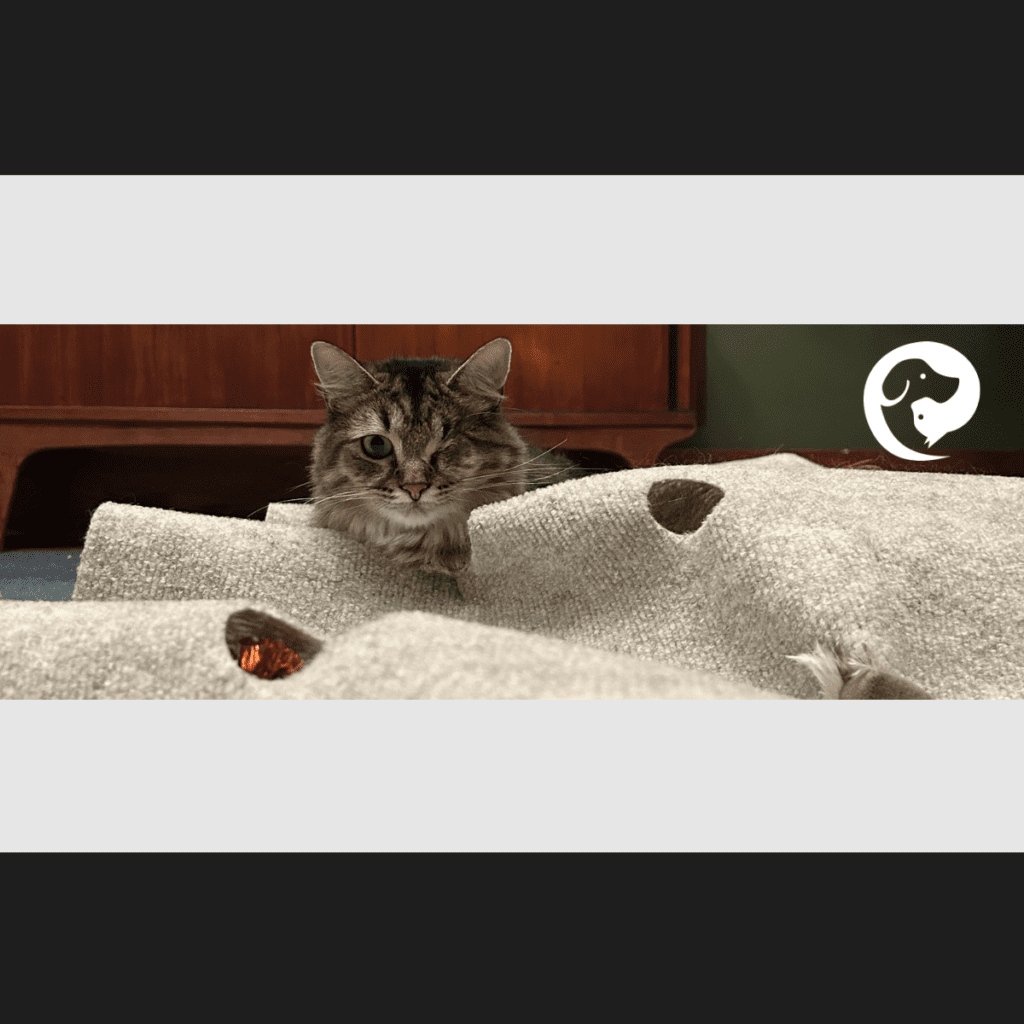
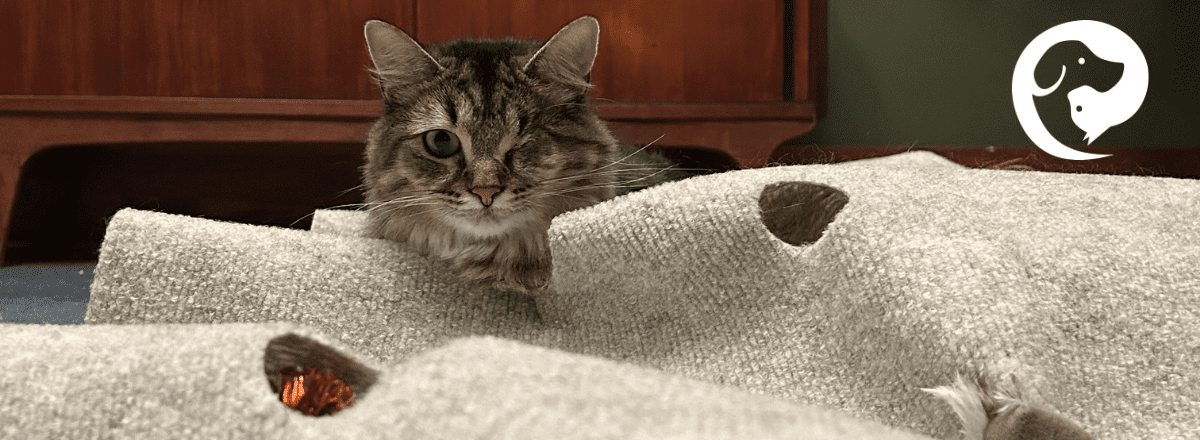
A long haired tabby cat with one eye looking over a rug that has toys hidden under it.

3 Purrfect Ways to Stimulate Your Cat’s Brain
3 Purrfect Ways to Stimulate Your Cat's Brain

A long haired tabby cat with one eye looking over a rug that has toys hidden under it.

Estimated reading time: 8 minutes

Enrichment is kind of a buzzword nowadays. If you have been the proud guardian of a dog, I would be pretty shocked if you hadn’t at least come across the concept of enrichment and why it matters. 

And if you have spent any amount of time around the Pet Harmony team and our social media accounts, you will also know that we are not only passionate about enrichment but also super serious about its use. In fact there are dozens of Pet Harmony blogs like this one about meeting your dog’s needs via intentional use of enrichment. 

Why brain games matter for cats

It occurred to us however that there is another domesticated species out there who is as abundant in pet homes as dogs and they deserve some enrichment love too. With that, I present to you 3 ways in which you can stimulate your cat’s brain in order to meet their needs and improve welfare and well-being. 

Bored, understimulated cats can wreak havoc on your home just as much as bored and understimulated dogs can. Yet, we seldom stop to consider just how important it is to provide our cats with species appropriate opportunities to play and use their brains. 

I hope this blog will provide you with the knowledge you need to get started on keeping your cat’s brain engaged and behaviorally healthy. 

But first…cats!

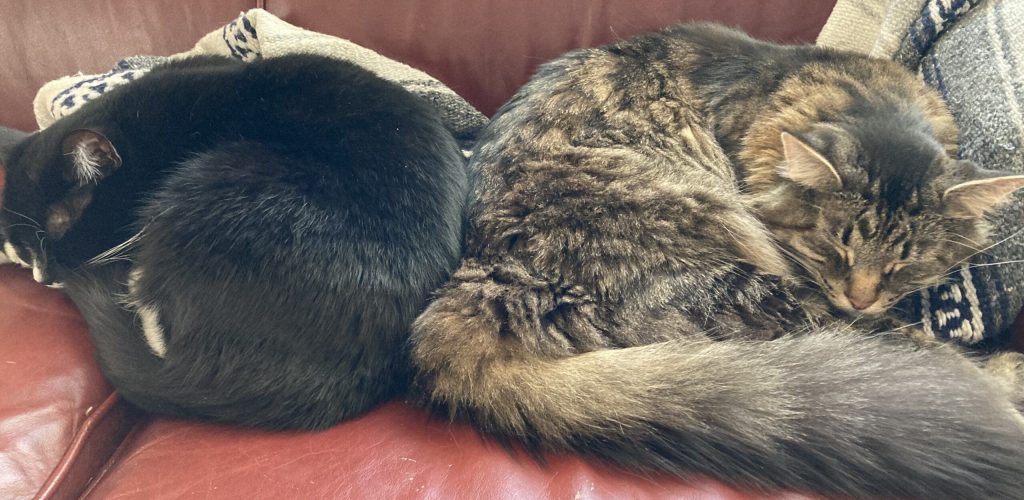
A (mostly black) tuxedo cat curled up next to a large, long haired tabby
Sushi (left) and Charm (right) enjoying a species-typical activity: snoozing. Photo courtesy of Sami Griffin, Wise Whiskers Training.

In order to know how to appropriately provide our felines with games that will help them thrive, we should know a bit about who they are as a species, yes? There are literally books, journals, articles and research studies all dedicated to the species felis catus. For the sake of time, we will just focus on some of the behaviors that the vast majority of healthy felines engage in regularly. This will help us narrow down our focus on the kinds of brain games that will get that purr motor running. 

In no particular order, here is a partial list of the behaviors you may have noticed your domesticated cat engaging in: 

  • Most active at dawn and dusk (crepuscular) 

  • Grooming of self and conspecifics (fellow cats)

  • Scent marking 

  • Higher altitude perching 

  • Scratching

  • Kneading

  • Sniffing 

  • Resting/sleeping 

  • Hiding out in hidey spots 

  • Foraging for all the snackies 

  • Batting or pushing items around by using their paws 

  • Chasing and catching moving objects or “hunting”

This is by no means an exhaustive list and may in fact be just the tip of the iceberg. But there are plenty of behaviors in the above list that can help us develop a plan around meeting the needs of our cats by tapping into their behavioral diversity. 

What exactly are “brain games” for cats anyway?

Now that we have a good idea of what behaviors we are going to tap into, we can focus on defining what we mean by brain games. Brain games are just a simpler way of saying activities that encourage thinking, problem solving, choice, control and independence. In other words, using the brain in a way that not only replicates species typical behaviors but also makes the brain work to achieve a desired outcome. 

That might sound hard to implement but I promise that it isn’t. Brain games do not need to be overly complicated or cost a lot of money. In fact, you can probably find items already in your home that can get you started. This blog post aims to make it as simple as possible so that you don’t have to spend hours of time or buckets of money on helping your cat live their best life.

Benefits of brain games and mental enrichment

The benefits of enrichment and brain games have been well established by now both in research and in the vast amounts of anecdotal evidence Pet Harmony’s behavior consulting team has collected over the many years we have been in operation. 

Here is list of why we highly encourage the folks we work with to incorporate mental stimulation into their cat’s daily repertoire: 

  • Reduction of boredom and stress
  • Supports confidence and emotional well-being
  • Helps prevent behavior concerns (destructive scratching, undesired vocalization, inappropriate elimination, nighttime zoomies)
  • Improves quality of life for indoor cats
  • Strengthens the human–cat bond

All wins for you and your cat! 

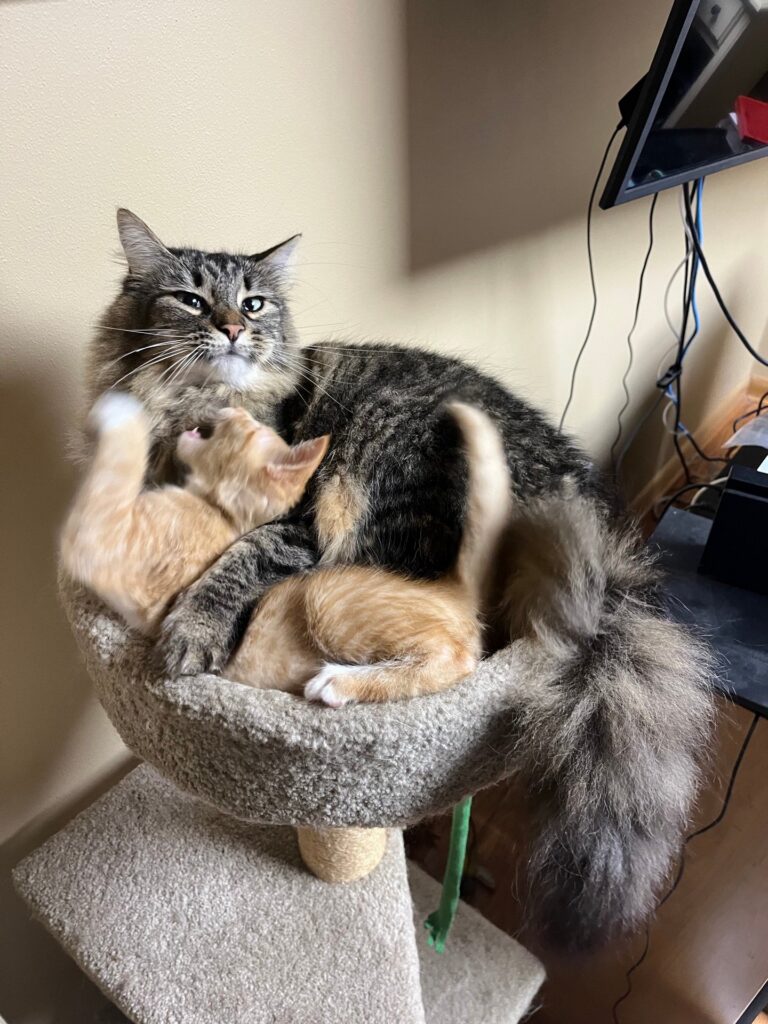
A long haired grey tabby being playfully whacked by an orange kitten.
Thorin enjoying (?) a foster kitten. Photo courtesy of Jenna Swiertz Doubek, Silver Linings Companion Animal Services.
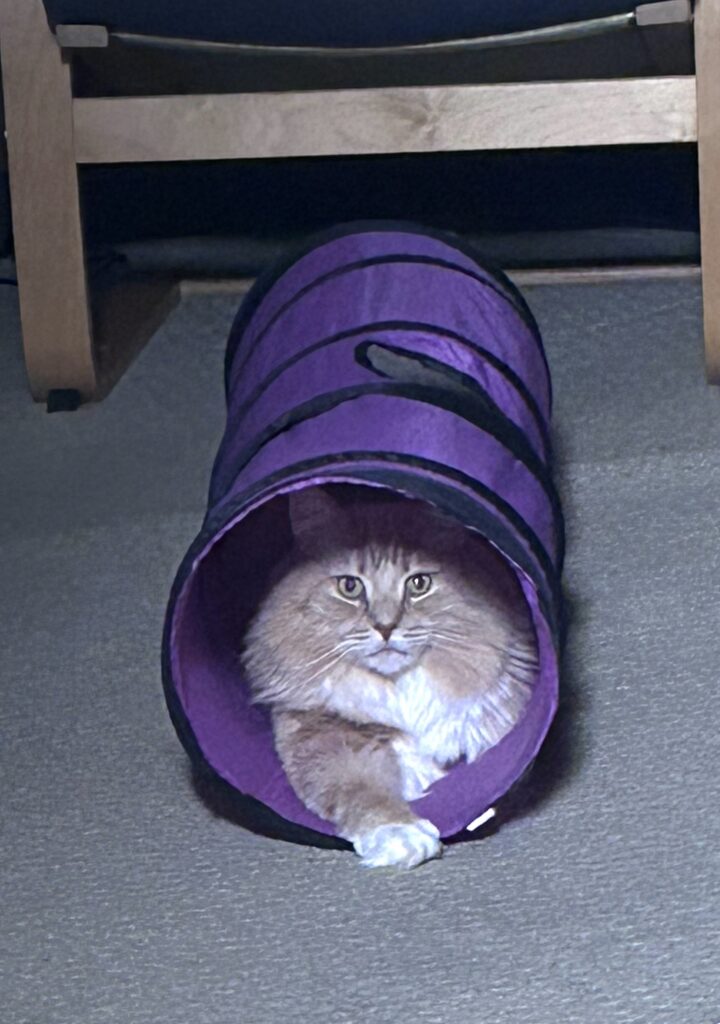
A fawn and white long haired cat inside of a purple fabric tube.
Barnie presiding over his tunnel. Photo courtesy of Cat Chambers, Whole Hearted Dog Training.
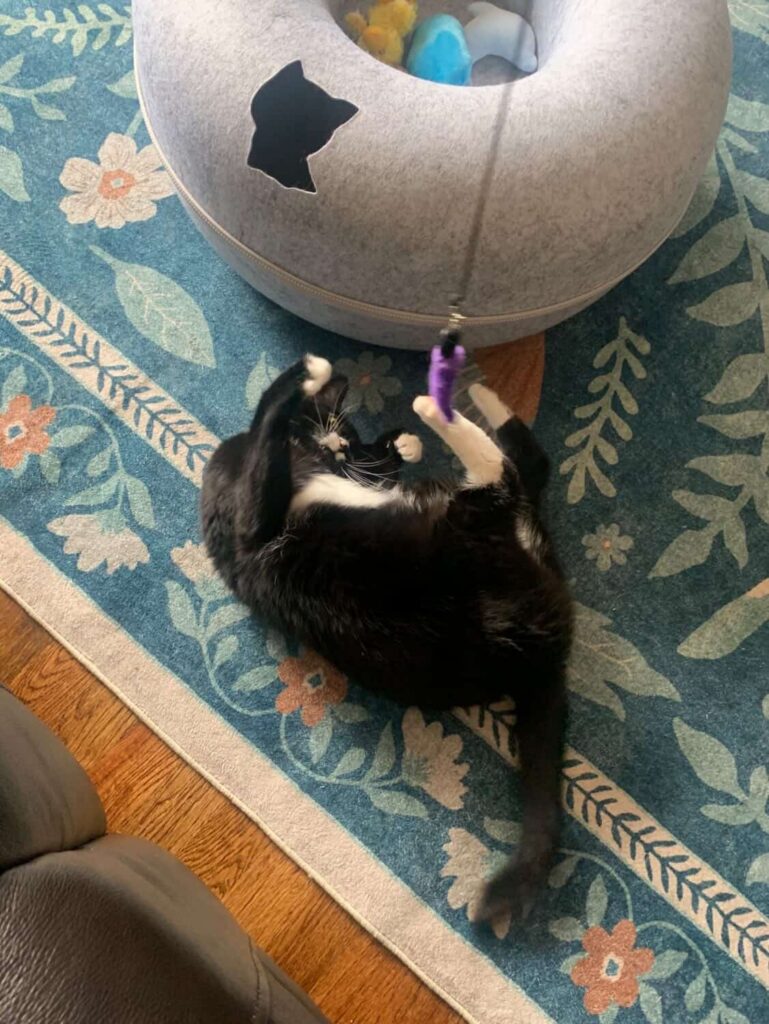
A (mostly black) tuxedo cat on her back, playing with a lure toy.
Sushi getting some playtime in with a lure toy. Photo courtesy of Sami Griffin, Wise Whiskers Training

This is your cat’s brain on the hunting sequence

I think the most bang for your buck brain game you can play with your cat would replicate something called the Hunt>Catch>Kill>Feast>Groom>Sleep cycle. This is what is called a modal action pattern (MAP). In order for a behavior or series of behaviors to be considered a MAP, they should meet the following criteria: 

  • They should be innate, meaning they do not need to be taught 
  • They are shared by most members of that species 
  • They are often triggered by a specific environmental cue (i.e., another animal running away)
  • Once they are triggered, they typically are expressed in an ordered sequence of actions 

If we look at our cat MAP above, the ordered sequence of events is broken down into the following specific behaviors: 1. Hunt 2. Catch 3. Kill 4. Feast 5. Groom and 6. Sleep. 

Lots of cat guardians know about the “hunt” portion of this sequence. And do a decent job of replicating it in play which is probably why the cat wand toy and laser pointer business is booming. I want to challenge all of you feline loving individuals out there to expand on the hunt portion of the sequence and to start to include the rest of the behaviors in the sequence. Here is how you can do that: 

  1. Play with your cat with their favorite wand toy. How you play matters though. The way you move the toy should mimic the way a real bird or rodent would move. Jerky, erratic movements that are moving away from your cat are more likely to kick that modal action sequence into gear than if you fly the wand directly into your cat’s face. Afterall, how many mice do you know that would walk directly into a cat’s face? Unless their name is Ratatouille, I’m guessing none. 
  2. Make sure you are moving the toy that is at the current skill level that your cat has. Too hard, they may give up. Too easy, they may get bored. 
  3. Let your cat catch and “kill” the toy by kicking, scratching at or biting it. As soon as they complete the “kill” action, place a large, high protein, cat appropriate snack right near the “prey” they just caught and “killed.” 
  4. Allow them to eat the snack for as long as it takes them. 
  5. You can repeat this sequence for a few more cycles and then pause and observe your cat after they eat the snack. 
  6. If they start grooming themselves, then you can continue to observe what happens next. Are they indicating they might like to take a nap or are they indicating they might like to hunt some more?

The reason I (and so many other cat behavior professionals) like replicating this sequence is because while humans did domestic cats as a species, cats still truly carry the vestiges of their feline ancestors deep in their DNA. If we can provide them with species-typical activities (things that are normal for domesticated cats to do), it really is one of the best ways to keep their brains busy but also to meet their needs. 

2 more ways to keep your cat’s brain in tip top shape

There are other simple ways to encourage your cat to engage in instinctual behaviors that are components of the predatory sequence.

“Hunting” for snacks

The second way that I love to replicate the MAP we discussed above is so easy, I am almost embarrassed to share it. I said almost, so here it is: 

  1. Get about 5-10 of your cats favorite, small crunchy treats 
  2. Pick a room of your house that has either tile or hardwood on the floor 
  3. Show a treat to your cat. 
  4. Place it under your hand and then “flick” it across the floor so that it easily slides across the floor and your cat can track it, chase it, catch it, bite it and consume it. 
  5. Rinse, repeat until the treats are gone or your cat starts grooming and indicates they are done.

Pro tip: If your cat has a hard time tracking the moving treat, make it easier in the beginning 

I have played this game with more cats than I can count and have maybe met 2 or 3 who are not that into it. The rest? They love it! 

Cat whack-a-mole

My last game involves a common cat behavior that cracks me up every time I see it. You know how I can easily lose an hour of my life? Google cats knocking things off of shelves and there is your answer. I say this as someone who does not currently share my life with a cat so I get some of you might not be as amused as I am. 

In order for our paw-dextrous cats to have fun that doesn’t include breaking every glass in your house, let’s provide them with another, more human accepted outlet. Food puzzles like this one allow your cat to be as “pawsy” as they like without you having to take multiple trips to Crate and Barrel to replace your drinkware. 

If you are into DIYing things you can easily replicate the above puzzle by repurposing an old cardboard box. Save your toilet paper tubes, cut them to the length that will work for your cat  and secure them to the bottom of the box. Add treats and viola! Easy peasy, kitty squeezy. 

Tricked ya! A bonus section for folks who can’t use food

For the cats out there who have restricted diets,  there are plenty of other ways to provide your cat with brain satisfying activities including the following: 

  • Window watching stations
  • Scent enrichment (new smells, herbs, safe plants)
  • Environmental changes (new perches, rearranged furniture)
  • Training simple cues (targeting, sit, stationing). If you haven’t target trained your cat, you really are missing out on some fun.
  • “Catifying” your space to include tunnels, bridges, hiding spots or even an outdoor “catio” can all be incredibly enriching for your cat and allows your cat the agency to explore their environment in new and safe ways.
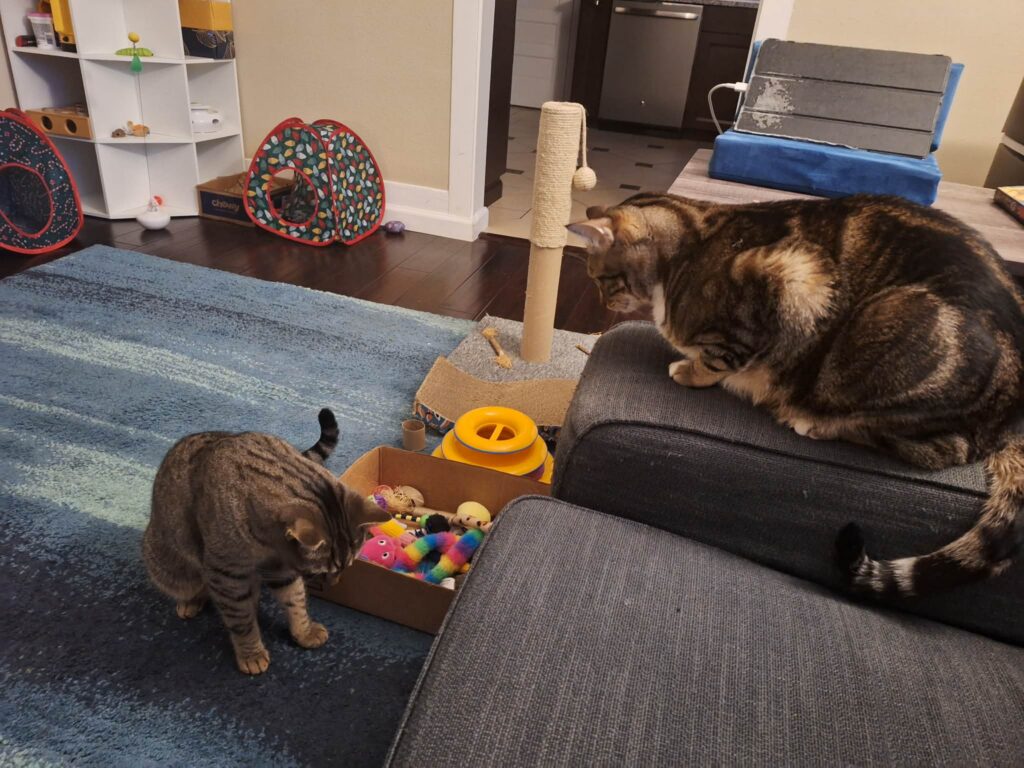
Two tabby cats next to a box full of small stuffed toys.
Flash and Cayde waiting for snacks to fall into their foraging box full of stuffed toys. Photo courtesy of Michelle Thomas, Ready, Pup, Go.
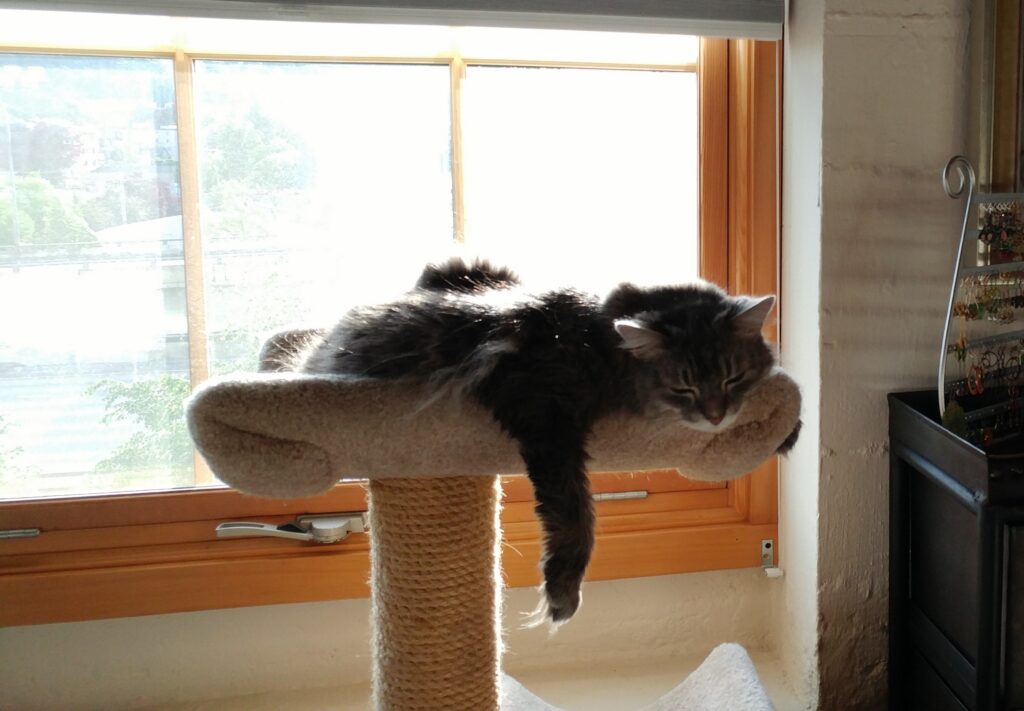
A grey long haired tabby cat lounging on top of ac at tree next to a sunny window.
Photo of comfy Jesse courtesy of Shivani Seastone, Paw Potential Training & Behavior
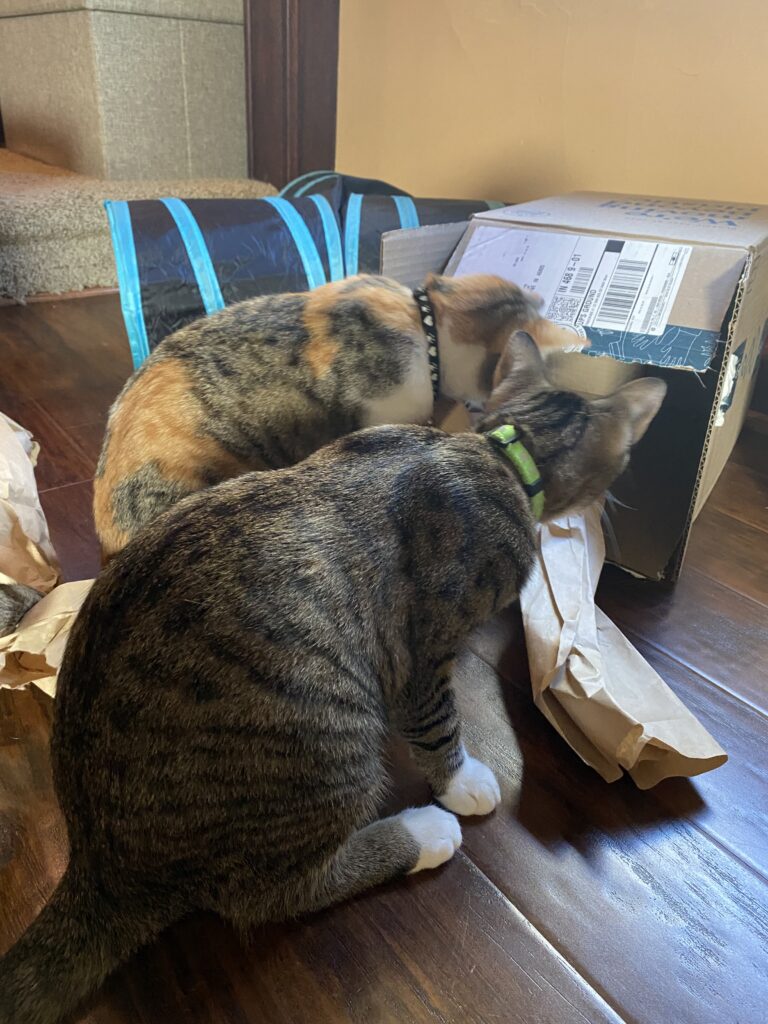
A calico tabby and tabby cat pulling paper out of a box.
Organa (calico) and Ripley pulling paper (and treats!) out of a box.

Here’s to harmony,

MaryKaye

Now What?

Cats like to have fun too! Small measures can have big impacts so have fun exploring options with them as your guide. Here are some tips to get you started

  • Match difficulty to your cat’s experience
  • Respect individual preferences (food-motivated vs. play-motivated)
  • Watch body language for frustration vs. engagement
  • Keep sessions short and positive
  • Watch for results of the brain games you provided. Enrichment is as much about the outcome as it is the engagement of the activity. 
  • Be curious, creative and have fun! And let us know how it goes! 

Looking for more cat related content? This post rounds up other Pet Harmony blogs and podcast episodes that are feline focused.

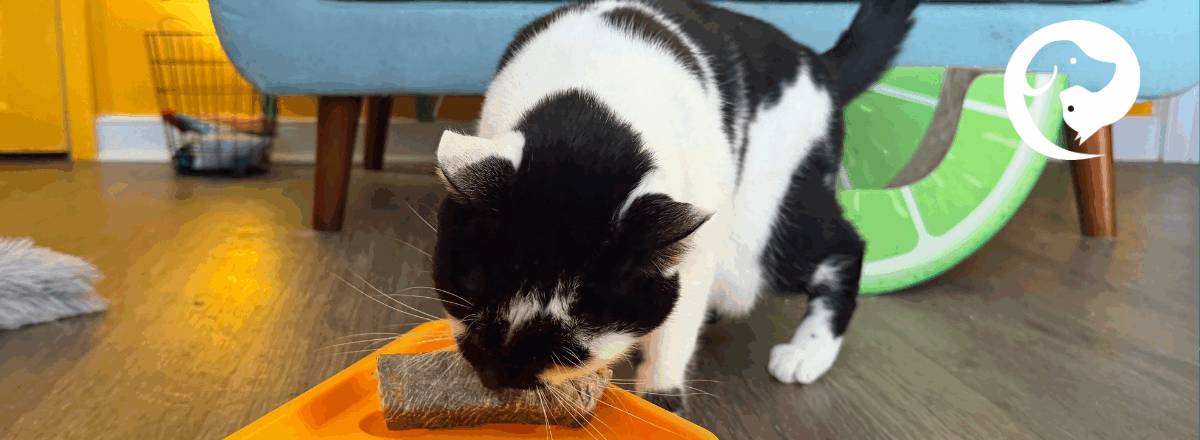
A white and black cat pulling a fish skin out of a toy.

Set it and Forget it: Enrichment Strategies for Busy Times
Set it and Forget it: Enrichment Strategies for Busy Times
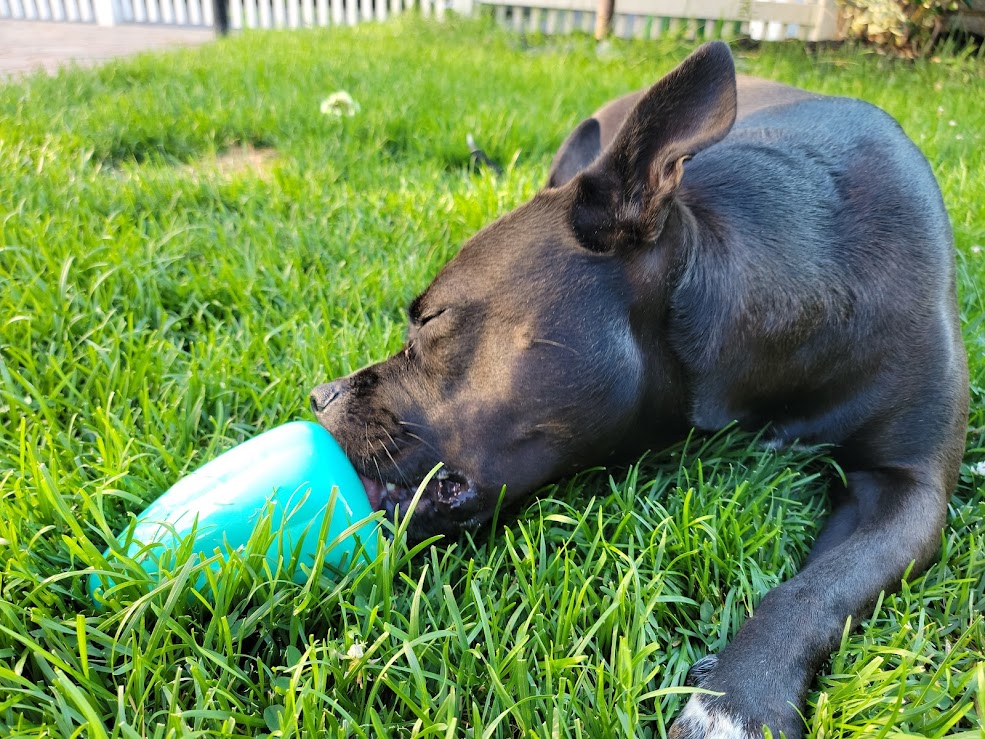
A white and black cat pulling a fish skin out of a toy.

Cover image courtesy of Sam Pierce (Dognitive Behavior and Training)


Life sure is funny. It seems like just yesterday that I was talking to you about preparing the household for the transition of returning to school and here we are again, preparing for yet another transition.

Holiday season, winter doldrums, arctic freeze, anyway you slice it, things are in the process of changing…again. And if you have been following us for any length of time, you will already know that we are particularly passionate about three things around these parts: welfare and wellbeing, meeting an animals’ needs and responding proactively to the changes that living life on the daily brings. 

We humans are really good at putting pressure on ourselves and especially around holiday time it can feel like things need to be “just so” in order to be good. I am here to both challenge the notion that things have to be perfect to be good and that it is ok to take some shortcuts every now and then especially if they help us ease into a new transition. 

Now I want you to imagine your best cheesy salesperson voice and let me introduce you to the concept of Set it and forget it Enrichment Strategies: the One and Only True Way to Survive the Holiday Season! New and improved and guaranteed to make your lives easier! 

Ok, all joking and hyperbole aside, I am going to present to you some ideas to help you make meeting your dog’s needs just a little bit easier during the upcoming busy season. I promise that it will be manageable and take just a wee bit of effort on your part but you will get paid exponentially in doggy kisses, kitty purrs, a more satisfied pet and hopefully a little more wiggle room in your already busy schedule. How’s that for a sales pitch? Are you ready to read on? 

What Does “Set It and Forget It” Enrichment Mean?

The whole idea of “set it and forget it” essentially means that once you arrange something, it will then work automatically and thus requires little to no further attention. When it comes to enrichment our goal for “set it and forget it”  includes the following concepts: 

  • Enrichment doesn’t have to mean daily crafts or complicated activities.
  • Enrichment systems can keep working even when you’re busy.
  • The enrichment strategies should build consistency, predictability, and calm for both pets and people.

The goal is to have our strategy be low-effort for you, foster independence in your pet and be sustainable in the long term. A quick overview of some examples might include: 

  • Rotating enrichment stations
  • Safe spaces that stay stocked
  • Long-lasting chews or puzzle feeders that don’t require supervision

Build Your Enrichment Menu

Ask any chef and they will tell you one of the most important parts of cooking is not the finished plate but rather two important aspects that come before the cooking. Chefs spend time creating a menu in its entirety and then prep by creating something called the mise en place. Which is just the fancy French way of saying everything in its place. Meaning that before a chef cooks the meal, they first must decide what it is they will be cooking and then prepare and organize all the tools and ingredients they will need to cook it. Veggies must be chopped, herbs and spices measured, workstation cleaned, equipment readily accessible and knives at the ready. Only then does the true artistry of cooking commence. 

Part of “setting it and forgetting it” is to create your menu first and your mise en place second. Just like a chef, creating an enrichment menu for your pet will help lessen your labor in the long run. You can read more about this here: Create Your Pet’s Enrichment Menu but here are some easy steps to create a menu:
Identify your pet’s favorite enrichment types (eating, chewing, foraging, destructables, exploring, playing, etc)

  1. Identify your pet’s favorite enrichment types (eating, chewing, foraging, destructables, exploring, playing, etc).
  2. Gather a few go-to items for each category.
  3. Keep materials organized and easy to access in a location where you can gather everything you need. This might be a shelf in the pantry, a corner of the freezer, a section of a closet or even a storage bin.

Creating an inventory of what material you will need for your mise en place may feel like a bit of labor now, but once it is done, will save time in the long run. Creating a visual menu or checklist or spreadsheet now will help for those times when we need to make quick decisions, especially when time or energy is low. 

A black dog lying in the grass licking food out of a toy.
Minnie relaxing in the grass with a toy stuffed with frozen food. Photo courtesy of Katie Nahabedian (Pride and Joy Dog Training)
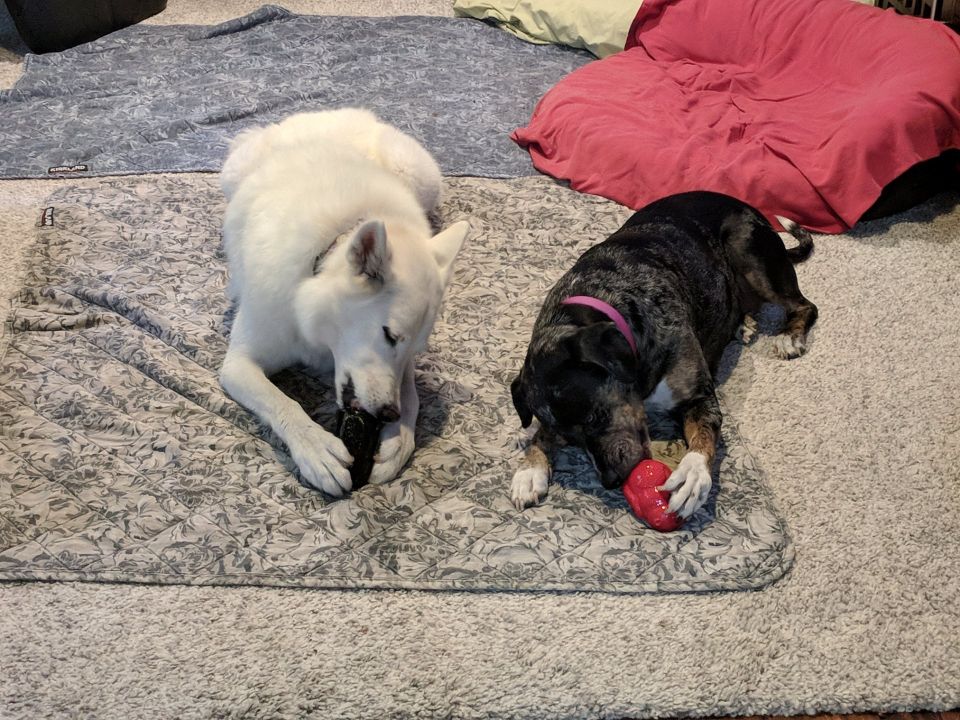
Some besties prefer to work on projects together, like Kara (left) and Georgia (right). Photo courtesy of Susan Cripps (A Dog's Tail)

Long-Term Calming Projects

One of my personal favorites for “set it and forget it” enrichment is a category that Pet Harmony refers to as long term calming projects

Long term calming projects are enrichment activities whose goal is to help your pet better self-regulate, gain independence, de-escalate, and ease into rest and or relaxation. Resting, self regulation, independence and learning how to de-escalate are skills that can be taught, practiced, and learned, and long term calming  projects are a big component of that process for our consulting team. 

Here are some examples of long term calming projects for dogs: 

  • Snuffle mats 
  • Licki mats
  • Stuffed Kongs or Toppls 
  • Chewing preferred items

And for cats and other obligate carnivores (such as ferrets): 

  • Small stuffed Kongs 
  • Licki mats
  • Snuffle mats  

Safe Spaces That Work on Autopilot

The holiday season can be stressful for everyone including our pets. Schedules are upended, visitors are more frequent and predictability and routine are tossed by the wayside. Creating a safe space that your pet can retreat to when things feel overwhelming for them is a crucial part of a set it and forget it strategy. 

We want our pets to know that they have a space that is always available to them if they need time away from the hustle and bustle. This can be a crate, a room or a section of the home where they will feel secure, they can rest, and where they will not be disturbed.

If your pet doesn’t have a defined safe space yet, watch where they currently rest and see if that will function as one. Remember though, if your pet’s preferred resting location is the family room couch and that is where a lot of activity will be happening in the next several weeks, you may want to help them learn that another location is quieter, calmer, and more relaxing. 

Providing a long term calming project in the new location, and pairing it with sound masking to cut down on ambient noise and your pet’s favorite blanket or bed can help boost the overall performance of the safe space.

When it comes to safe spaces it is incredibly important to understand that the safe space is not just about a location. It is mostly about the feeling of security it brings to your pet when the guests are gathered around the turkey and the egg nog is freely flowing. A safe space’s goal should not necessarily be about isolation but rather about the comfort that it provides for pets who may be overstimulated by changes in their routine. If you would like more tips on how to help your pets survive the holiday season read here and here

A grey and white dog snuffling treats out of a cardboard box with crumpled paper inside.
Turk snuffling out some snacks from a box full of shreddable materials. Photo courtesy of Rebecca Najarian (Dogs Plus Love).
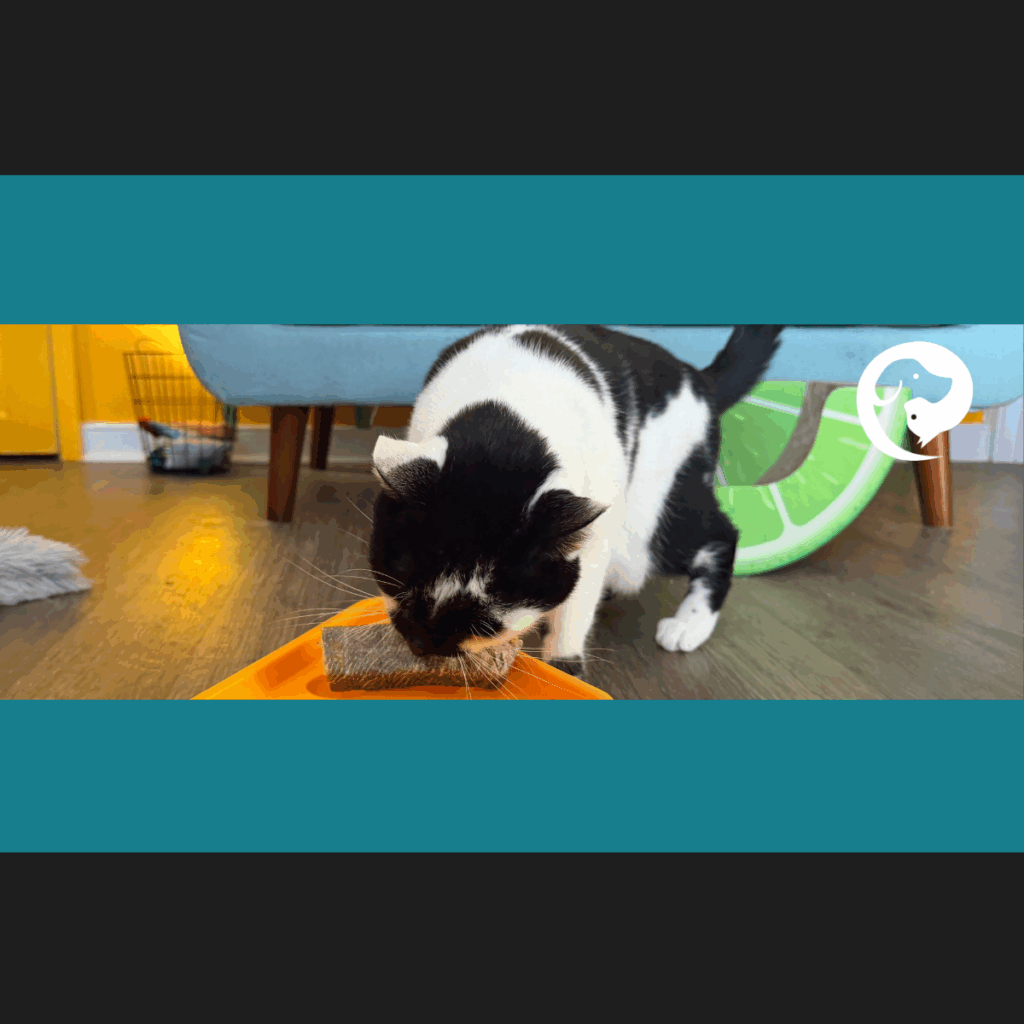
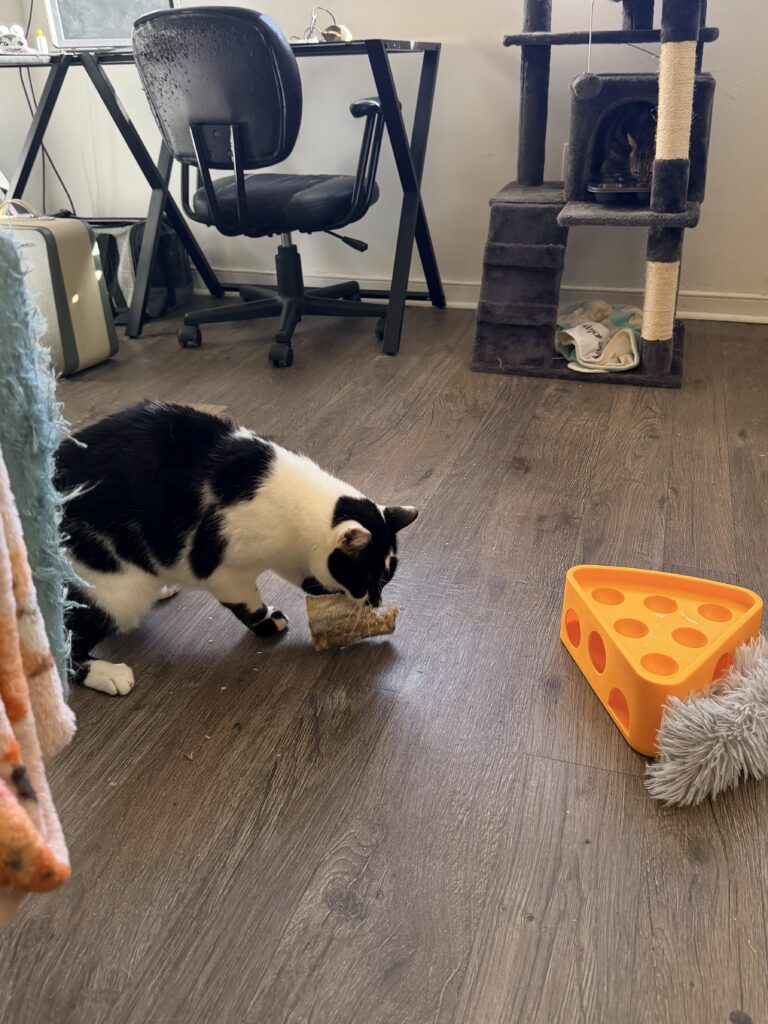
A white and black cat chewing on a fish skin. In the background, a tabby cat in a cat tree is eating treats out of a muffin tin.
Cowboy (foreground) chews on a fish skin while Joylyne (in her safe space--the cat tree) eats treats out of a muffin tin. Photo courtesy of Sam Pierce (Dognitive Behavior and Training).

Results May Vary–Observe and Adjust

Good enrichment strategies of any kind should be guided by results, not by expectations. You might expect that once your pet engages with a preloaded snuffle mat they will then settle in for a long winter’s naps. However, what works for one individual may not work for another and it is important to adjust not only our expectations but also our plans if needed. Here are some tips to help with that: 

  • Observe outcomes so you can see what truly meets your pet’s needs.
  • Watch body language and look for signs that the enrichment is working, ie-relaxed body language, longer rest periods, lower intensity of undesired behaviors and faster recovery time are just some of the signs that tell us our strategies are going well.

Even though we are talking about set it and forget it, it is important to note that changes occur and we should expect to pivot when necessary. Developmental stages, health status, and physicality all will vary throughout a pet’s life and we should be prepared for adjustments in our plans as needed.

Here’s to harmony,

MaryKaye

Now What?

Preparedness makes for smoother transitions and preparing for the busy weeks ahead should include your pets so that you don’t have to panic at the last minute when Fluffy decides they can’t tolerate Uncle Bub half way through the holiday feast. 

To recap, ways that you can proactively prepare for the weeks ahead include the following:

  • Decide on a location for where you can store prepared enrichment items for your pet
  • Decide on a location that will function as your pet’s safe space 
  • Create your enrichment menu 
  • Gather the supplies and ingredients you will need to create your enrichment items 
  • Have young kids in the family? See if you can get their help with creating the enrichment activities. There are some great pet safe recipes online that can be used for licki mats, Kongs or Toppls 
  • Organize by day so that you can easily rotate items 
  • Pull out when you need them 

Copyright 2025 Pet Harmony, LLC. All Rights Reserved.

Terms & ConditionsPrivacy Policy

Results are not guaranteed because behavior, human, canine, or otherwise, are not guaranteeable.

A fluffy cat resting inside of a cardboard box.

Why Your Cat Needs a Safe Space (and How to Build One That Works)
Why Your Cat Needs a Safe Space (and How to Build One That Works)
A fluffy cat resting inside of a cardboard box.

Cats, like other sentient beings, can get anxious and/or overwhelmed by their environment and the other beings in it from time to time. And like other sentient beings, if they don’t have a way to escape that chronic stress, it can impact both their physical health and their behavioral health. When I worked with clients I used to tell them that the sustained pressure of living with chronic stress will eventually come out somehow: through explosion, implosion, sublimation, or learned helplessness. 

  • Explosion looks like conflict-seeking behaviors–like cats fighting each other.
  • Implosion looks like self-harming behaviors–in cats, that often looks like overgrooming to the point of damaging their coat and sometimes even their skin.
  • Sublimation looks like acting out in seemingly unrelated ways–like peeing in your boots.
  • Learned helplessness in cats often looks like a loss of personality and behavioral diversity, just doing the bare minimum to take care of themselves and stay alive.

One of the most impactful things we can do to alleviate that chronic stress and prevent any of those kinds of harm from happening to our kitties is create a dedicated safe space just for them. Whether you’re bringing home a new cat, managing a multi-pet household, or simply supporting a shy or anxious kitty, a well thought out safe space can be the difference between a stressed out cat and one who feels confident enough to explore the world around them and genuinely enjoy their life.

At Pet Harmony, we believe in setting up environments that support the behaviors we want to see. So let’s talk about what a feline safe space looks like, why it’s so powerful, and how you can create one that meets your cat’s unique needs.

What Is a Safe Space for a Cat?

A safe space is a quiet, cozy, and low-traffic area where your cat can retreat, decompress, and feel in control of their surroundings. Think of it as your cat’s personal sanctuary—free from stressors, full of comfort, and of course full of opportunities for cats to meet their own needs.

A safe space can be a whole room – like a guest bedroom – or a designated nook—like a cozy corner with a tall cat tree and a hiding spot. The key is that your cat feels safe there, and that security often comes from choice, control, and predictability.

Why Your Cat Needs a Safe Space

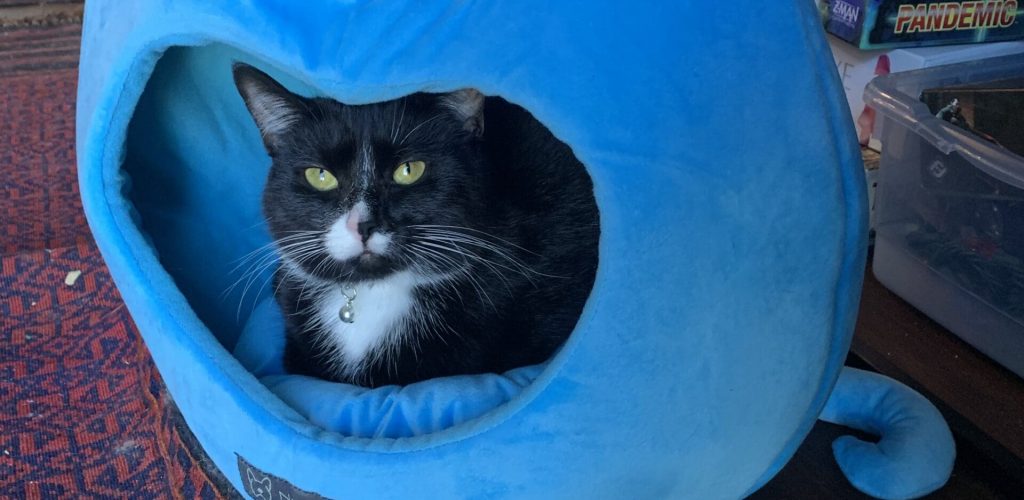
A black and white cat peers out from inside a plush blue fabric hut that is shaped like a creature. It has eyes and the cat enters through the open mouth.
Sushi resting inside her cozy creature. Photos of Sushi and Charm (on the blog title image) courtesy of Sam Griffin (Wise Whiskers Training).

Cats as a species are both predators and prey, which means they can have a tendency to be hyper-aware of their surroundings and therefore can be really sensitive to everything that’s happening around them. Changes in routine, unfamiliar guests, renovations, or even a new smell can be enough of a stressor to set them off kilter.  

On top of that, interpersonal dynamics among cats or between cats and other species can be pretty subtle and hard for us to notice, but can function as significant chronic stressors for them. I had a client where the only sign of conflict between two cats was that one would give the other a hard stare when she tried to approach the litter box, water bowl, or food bowl that the first cat was guarding. That look was enough to cause major distress in the second cat that resulted in a urinary tract infection and persistent inappropriate elimination, even after the infection was resolved. I’ve also worked with multiple clients where the source of the cat’s chronic stress was a mystery until we discovered that a stray cat was marking their territory in their yard.

The take-home point is that the source of a cat’s stress isn’t always immediately obvious to us, and they will do better if they have the ability to move away from their stressors on their own. A safe space gives them the choice to step away and complete their stress response cycle.

How to Set Up a Cat-Friendly Safe Space

Let’s break this down into manageable steps so you can set your cat up for success.

1. Choose the Right Location

Pick a quiet area away from high foot traffic, loud appliances, or busy windows. If you live in a bustling household, a guest room or home office with a door that can close is ideal. If space is limited, try using a tall piece of furniture, curtain dividers, or even a modified closet. If the other pets in your home are contributing to the cat’s stress, make sure their respective safe spaces are separated from each other.

2. Add the Essentials

Here’s your feline-friendly checklist:

  • Hiding spot: A box, covered bed, or carrier are usually good options to trial and eval.
  • Vertical space: A cat tree, shelf, or wall-mounted perch are good, but ideally your cat’s perch will be the highest thing in the room–otherwise, you may find that your cat is just using the vertical space you gave them to access a space that you maybe didn’t want them to access.
  • Litter box: In a discreet but accessible spot. Preferably with a ramp or low point of entry so they don’t have to climb a high barrier to get in and out of it.
  • Food and water: Placed at a distance from the litter box.
  • Toys and enrichment: Interactive toys, puzzle feeders, or a wand toy can all be good options, but if your cat doesn’t currently play with toys you may want to do a play preference test to find out what your cat enjoys. Give them things that they can use to entertain themselves without needing your involvement.
  • Comfortable bedding: Something warm and soft that smells like them.

Pro tip: Let your cat choose where they feel safest within that space—observe and support their choices.

3. Make it Smell Familiar

Scent is a huge part of how cats experience security. Place a used t-shirt, blanket, or towel with your scent in the area. If you’re welcoming a new cat, you can try using synthetic feline pheromones like Feliway to help ease the transition, but if you have something of theirs from their previous home that smells like them, that would be ideal.

4. Limit Unwanted Access

Let your cat know this space is theirs. Keep dogs, kids, or other cats out, especially if your feline is stressed or new to the home. Respect their boundaries—this isn’t the place for unsolicited cuddles or surprise visits.

An orange and white and a calico cat perched on different spots on a cat tree, resting comfortably.
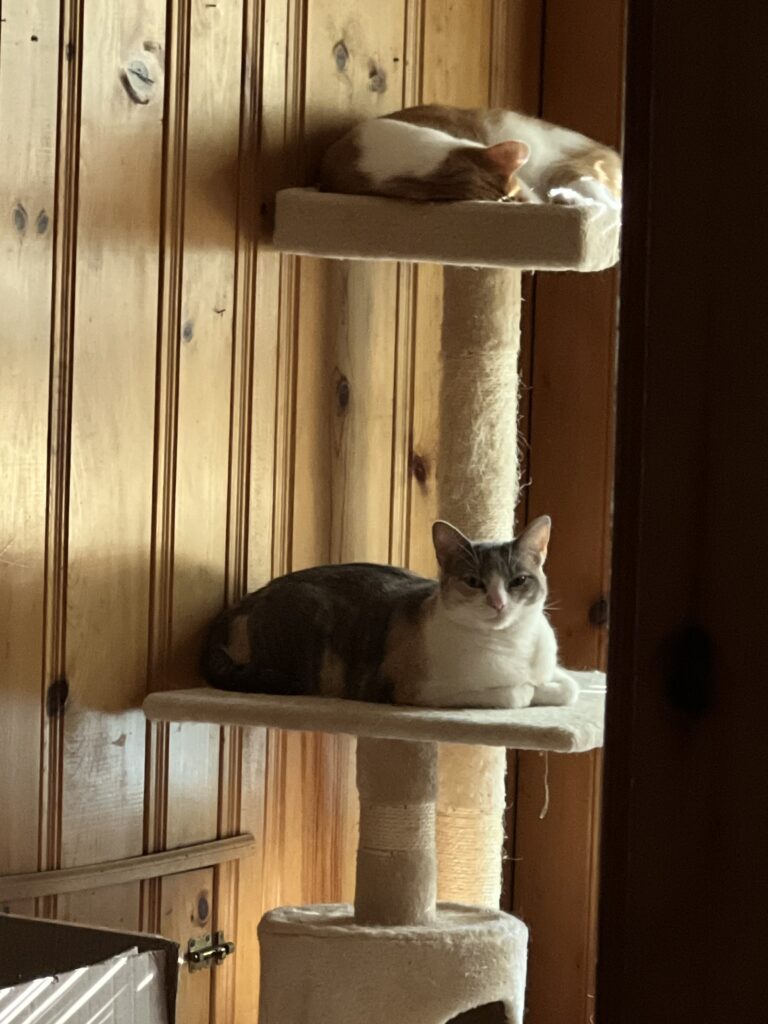
Kronk (upper level) and his sister Yzma (lower level) resting on the cat tree in their private area, away from the main part of the house. Photo courtesy of Eric Graf.
A handsome fluffy cat resting on top of a folded comforter on a high shelf inside a closet.
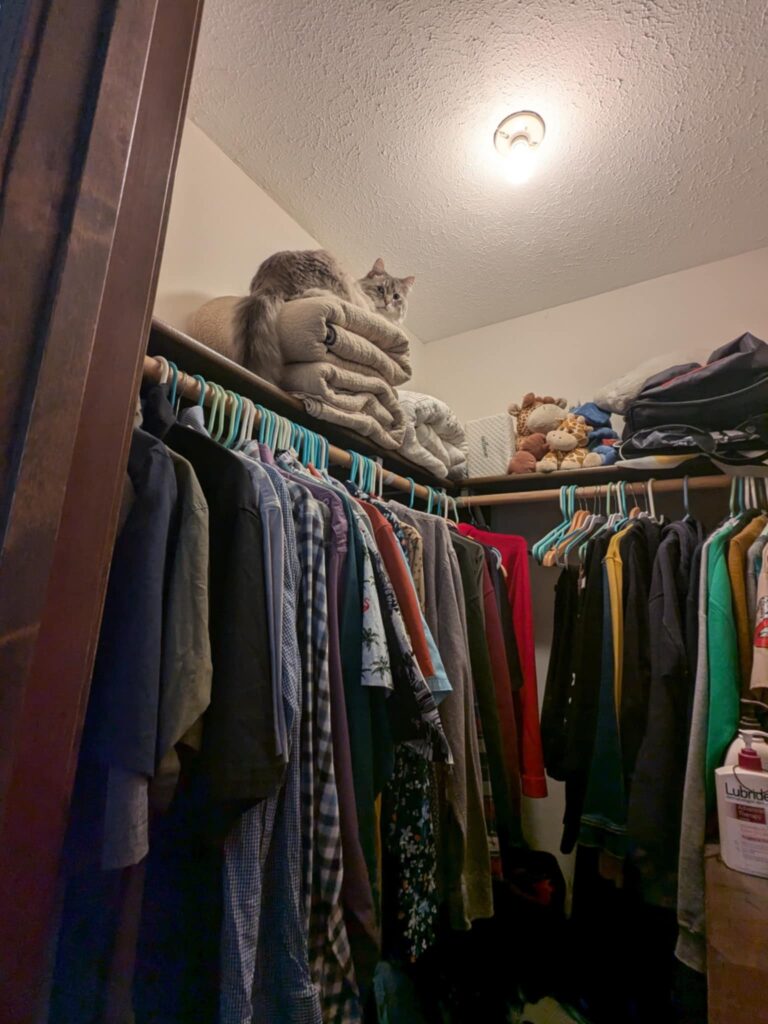
Finn The Cat (his given full name) has chosen a high shelf inside a closet to be away from his dog brothers and sister. He asks his person to help him onto his cozy perch. Photo courtesy of Jordan Bradley (Click to Communicate).

What a Safe Space is Not

Creating a safe space doesn’t mean isolating your cat or punishing them by locking them away. The goal is to offer choice and control, not confinement. Think of it as empowering your cat to engage with the world at their own pace. times that may mean giving them the ability to come and go from their safe space as they please. When that isn’t an option, the next best thing is to figure out your cat’s cues for requesting to go in and out of their space and facilitating their requests. If even that isn’t an option – because we’ve all got lives and we can’t be watching our pets 24/7 – keep an ear out for when your cat is asking to leave their safe space, so they never feel trapped there.

Safe Spaces and Behavior Goals

If you’re working with a behavior professional to address your cat’s distress – like reducing fear, reactivity, or inappropriate elimination – a safe space is often the foundation of your plan. Why? Because learning only happens when an animal feels safe. And just like us, cats can’t thrive if they’re constantly on edge.

If you’ve been following us for any amount of time you have almost certainly heard us say this: Behavior is communication. If your cat is hiding, hissing, or avoiding someone in your household, they may be telling you they don’t feel safe. Meeting that need is the first step toward changing their behavior and improving their physical, behavioral, and emotional health.

Final Thoughts

Whether you’re welcoming a kitten or supporting a senior cat through a big life change, creating a safe space is a gift of agency and care. It tells your cat, “You’re safe here. You’re in control. You get to choose.”

And from that foundation, trust grows. Confidence builds. And your relationship with them blossoms.

Here’s to harmony,

Emily

Now What?

Need help setting up the perfect safe space for your cat—or navigating behavior challenges? Our team at Pet Harmony offers personalized, evidence-based support to help your pet thrive. Let’s make life easier for you and your feline friend.

Copyright 2025 Pet Harmony, LLC. All Rights Reserved.

Terms & ConditionsPrivacy Policy

Results are not guaranteed because behavior, human, canine, or otherwise, are not guaranteeable.

Image with a cat sleeping in a cardboard box. Text reads: Trash to Treasure: How We Use Recycled Enrichment to Support Natural Pet Behaviors
Trash to Treasure: How We Use Recycled Enrichment to Support Natural Pet Behaviors
It’s a beautiful spring day and I’m sitting at the Firefly Coffee House finishing my house-made bagel with peach spice cream cheese schmear (yes, it was good). As I finish scraping the cream cheese out of the small plastic container, I think to myself “I wish Petey was here…” You see, one of my dog’s most important roles in our home is cleaning out items bound for the recycling bin. My next thought was…how unhinged of me would it be to put this in my car so I can take it home to Peter? 

In this week’s episode of Enrichment for the Real World, Emily (who would undoubtedly encourage my cream cheese trash caching impulse) discusses exactly how to introduce your pets to the world of DIY pet enrichment. If you’ve never given your pet this type of activity, I suggest you give it a listen! 

We’ve covered this topic on the blog in different ways over the years, so if you are unsure why we are all handing our trash over to our pets, here are some great places to start:

As discussed in most of these blogs as well as on the podcast, any time you provide your pet a new activity, watch them. See how they work on the item. If they ingest non-food items, your trash enrichment opportunities will look different, or they may not be an option for your pet. 

Related: If you provide your pet with an item that previously contained food, make sure you read the ingredients so you know it is safe for them. Here is a reference with common ingredients and household items that can be dangerous: Potentially Dangerous Items for Your Pet – US Food & Drug Administration

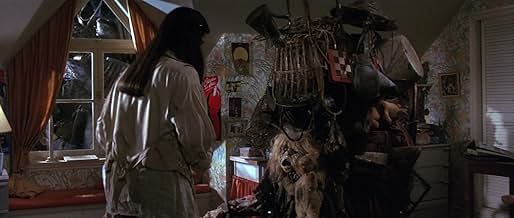
The Junk Lady: What's the matter, my dear, don't you like your toys?

Sarah: It's all junk!
Junk Lady from the movie Labyrinth found on IMDB https://www.imdb.com/title/tt0091369/characters/nm0117350/
The Junk Lady: What's the matter, my dear, don't you like your toys? Sarah: It's all junk! Junk Lady from the movie Labyrinth found on IMDB https://www.imdb.com/title/tt0091369/characters/nm0117350/

Creative Ways to Use Recycled Materials for Enrichment

In a Pet Harmony first (probably?), the whole team is here to share the actual ways we utilize materials that are on their way to the recycling (or trash) bin to encourage species-typical behaviors with the pets in our homes. 

If the number of blogs we have (and that list up there isn’t even all of them) that discuss using trash for enrichment doesn’t tell you how common and important these practices are in our households, seeing the overlap in the way we are all using these items might. Here are some of the most common materials and activities I saw in submissions from the team: 

  • Toilet paper / paper towel tubes: Tuck the ends in on a tube and suddenly it’s a tiny paper pocket. Chuck some treats in there and you can:
    • Just hand it over and watch your pet pull the tube apart to get to their snack.
    • Hide them around – now you have an activity that encompasses scentwork, foraging, and dissecting (tearing apart).
    • Put them inside other items, much like the next point…
  • Box in a box in a box / nesting doll boxes: That’s it. Just stuffing food/treats inside of boxes and then putting boxes inside of other boxes. 
  • Takeout containers: These items come with bonus flavors / scents since they just had food in them!
  • Plastic food containers: Ditto on these. Yogurt, cottage cheese, cream cheese, peanut butter…anything your dog can have that comes in a container also comes with a potential activity. Toss them the container and let them clean it out before you chuck it in the recycling/trash bin.

Ellen’s blogs on Budget Friendly Enrichment Options and Explore Variety Through a Cardboard Box describe these activities in more detail. 

Why Recycled Enrichment Supports Natural Pet Behaviors

Species-typical behaviors are at the core of enrichment. Ensuring that ANY species living in captivity have outlets for behaviors that are normal and innate is a basic component of welfare. Learning your pet’s species-typical behaviors allows you to find creative but budget-friendly ways to meet their needs. In the sections that follow, you will see how our team uses items described in the previous section (and more!) to allow the species they live with to engage in behaviors that meet their individual needs. Spoilers: it’s not just foraging!

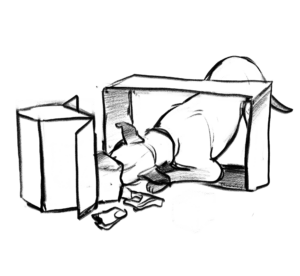
Sketch of a dog climbing through an open box and putting their head into another
A sketch of ghost the dog maneuvering through some box obstacles. Drawn by the talented Taylor Duffy.

Here are a few examples of species-typical behaviors that we are supporting with, well, junk: 

  • Emily’s eclectus parrot, Cah’ya, gets curled up plastic straws as a stand-in for another bird to preen 
  • Taylor’s dogs get to move, stretch, and balance with box obstacle courses
  • Bundini the bunny gets to dig and burrow even though he lives indoors at Emily’s house thanks to large cardboard boxes
  • MaryKaye’s 17 year old senior citizen (dogizen?), Fonzy, can still shred and dissect like a young pup thanks to toilet paper tubes 
  • Ellen re-stuffs toys with old scraps of fabric so Griffey and Laika never run out items to dissect

We Love Trash

The time has come! Let’s dig into the trash stash and see what the team gets up to at home. I suggest you put on this inspiring song by Oscar the Grouch while you read. 

Emily, Copper, and Miley (plus Bundini the rabbit and Cah’ya the eclectus parrot)

The dogs have their own recycle bin where we put any cardboard or plastic trash that is safe for them to destroy and they get to choose what they want to pull out.

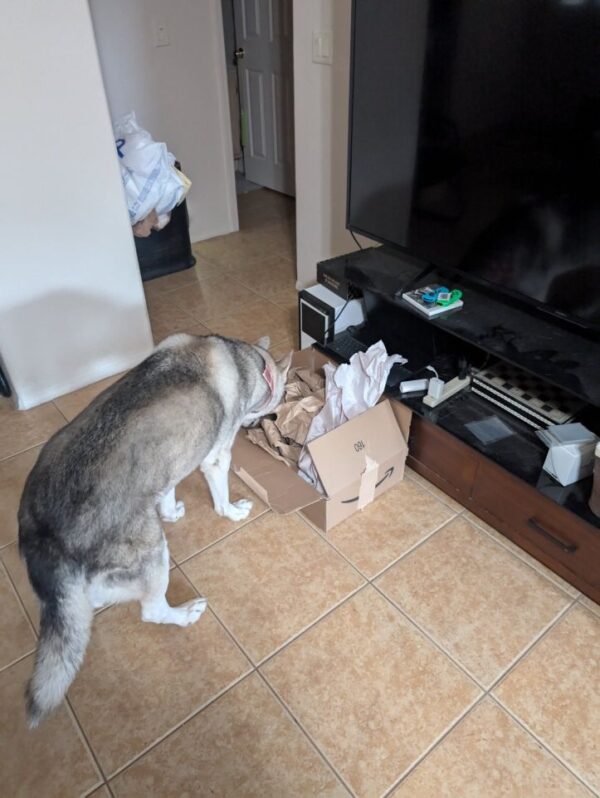
Medium and small cardboard boxes get turned into “russian nesting dolls,” by which I mean I put packing paper and dog treats into the largest box, put the next largest box inside it, then put packing paper and dog treats into that box, put the next largest box inside it, and so on.

Paper towel rolls and toilet paper rolls get stuffed with balled up pieces of packing paper and dog treats for the dogs, packing paper and cage mix for Cah’ya, and hay and alfalfa pellets for Bundini. 

Large cardboard boxes get set aside for Cah’ya so she can turn them into her “nest”. She regularly destroys her nests, which allows me to replace them with the next box.

I have a wacky whirly tool for the times when I end up with a plastic straw. I try to avoid straws whenever possible, but when they happen I can use the wacky whirly tool to turn the straw into a springy coil. When I’ve collected enough of them, I tie them all together and hang them in the bird room for Cah’ya to allopreen and/or shred them. The added benefit is that when she’s done with them and they eventually have to be thrown away, they no longer pose a risk to wildlife in their springy-coil state!

Scraps of fabric from any fabric project I’ve got going on end up as bird toys – again for allopreening or shredding – or as knotted tug toys for Miley, my puppy.

Everyone once in a while we get a really gigantic cardboard box – usually when we buy a new piece of furniture or other household item – and I’ll use it to make Bundini’s “burrow.” Since he lives in our house he can’t physically burrow underground, so I cut rabbit-sized holes on either side of the gigantic box, stuff the box full of hay, and let Bundini burrow in the hay in the box. Like Cah’ya, he eventually destroys his burrow boxes, which allows me to replace it with the next gigantic box.


Claire and Olivia

Any possible boxes that are received are always a go to. I also use paper towel/toilet paper rolls, packing paper, and paper bags – especially from takeout! Since she’s on the smaller side, if we get a large box, I will fill it with treats and paper, and encourage her to get inside of it and rummage which she loves.

I like to also use toys Olivia hasn’t paid attention to in a while and stuff all the trash into those. 

I’m a big fan of letting Olivia sniff “safe trash” outside because she loves to sniff and check it out for a while. I think it also builds her confidence.

We also were gifted a nice comforter in a plastic carrying bag and it ripped on the side, so she would crawl into it and roll around which I found hilarious. I left it there forever to entertain her.


Tiffany Chen and Sihtric

I like to collect recyclables like cardboard boxes, paper towel tubes, paper bags, and the packing paper from Chewy boxes. I stash them in a big bag in the kitchen. On days when it’s too hot or windy here in Las Vegas to take Sihtric for a walk, I go straight to that stash. I’ll stuff the boxes and tubes with treats, then pile everything into a big box for him to dig through. If I’m feeling a little extra, I’ll toss in a chew and a Toppl filled with canned food.

Shredding and sniffing are his favorite things, so he really takes his time with it. I love this setup because it’s super low effort on my end, and while he’s busy with his box, I get to do my own thing. Afterward, he’s usually passed out, which tells me his needs are met!


MaryKaye and Fonzy

Senior dogs love to get down and dirty in the trash too! While my 17 year old pooch may not have the teeth and jaw strength for super thick cardboard boxes anymore, he can still shred a toilet paper roll or paper towel tube with the best of them!

I am a little more discerning about the materials I give to him so that I can help him be successful and not get overly frustrated. The things that have proven to be most successful for him include cracker boxes, brown paper delivery envelopes and the aforementioned paper toilet and paper towel tubes. He also loves treats wrapped up in “gently used” wrapping paper so we have a saved pile of used wrapping paper at the ready when he is looking for something fun to do. While senior dogs’ physical abilities may change over time, you can still meet their needs by finding the right kind of trashy treasures! 

Ellen, Griffey, and Laika

I’m constantly looking for ways to use what I already have to make homemade pet toys from recyclables. It is one of the ways that I can practice some creativity and stretch my brain while taking care of my dogs. But, to be honest, when it comes to day-to-day life with my dogs, I keep it pretty simple. I stick with a couple tried-and-true options:

  1. I use a small, dog-accessible bin next to my desk specifically for my scrap paper. Sometimes my dogs get fed up with me doing the human work thing, and their default is to go over, pull out some paper, and give it a good ol’ shred. I always make sure there is something in there for them!
  2. I use scraps of old rags, shirts, socks, old stuffed toy carcasses… You know the kind, to create foraging boxes. It’s cheaper than buying all new stuffed toys, it keeps the mess better contained, and it lets my pups use their nose, rip and shred, and eat all at once.
  3. The good ol’ treat wrapped in paper, wrapped in a box, wrapped in paper, wrapped in a box, in a box, in a box, in a bag, stacking doll of destruction. This one is the most time and effort for me both in building and clean up, but I love watching my dogs use their muscles to get through all the layers.


Corinne and Opie

I love Opie more than anything in the whole wide world, but if I have to hear him scream at me with boredom after the kids have gone to bed I’m gonna lose my ever-loving mind. The solution for us (which also completely eradicated him chewing on our baseboards and gives us something to occupy him during kids’ bedtime) is to split his meals into shreddables (literally any thickness, he’s so talented!) and hide them around the house. We usually do 5-6, but I’m not afraid to divide it into 8-9 if I see the glimmer in his eye. Coffee cups, takeout bags, newspapers, ads, return envelopes, toilet paper tubes, paper towel tubes, children’s artwork (*gasp* I ask first…usually), anything!


Allie and Oso

There are a few ways that I incorporate recyclables into Oso’s enrichment plan. I use them to create his DIY destructible toys which primarily serve two functions:

  1. Fun and boredom relief
  2. Stress-relief (from good stress or bad stress- he chooses to shred regardless of what the big feeling is)

We also have a little bucket next to our garbage can for Oso-safe recyclables that he can pull out when he wants. It’s so cute to watch him grab one and trot away as if he found a treasure. 


Taylor, Ghost, and Eden (plus Took and Lilith the cats!)

Some of our favorite trash items are Aldi boxes and paper bags, fiber egg cartons, paper towel rolls and toilet paper rolls, craft paper, extra napkins, and sometimes things like tires, unoccupied lime scooters, bricks, extra wood, etc. 

For the cats, Took and Lilith love all the paper and boxes that come with grocery shopping. We change the landscape of the kitchen and office from time to time a little by experimenting with different boxes. Some they gravitate to and others get quickly moved along to the recycling. 

We are building skills for our younger cat Lilith to learn to explore a little for her food, so small cardboard pieces help make up pseudo-slow feeders. 

For the dogs we go a little sillier with our trash! We love cardboard and egg cartons for the fun find it games, and food puzzles too. But sometimes the “trash” gets a second life in confidence building games. Here are some examples: 

  • Foot targets out of wood and grip tape for our fitness practice
  • Old tires or different surfaces (pre checked for any scary things) for investigating and standing on
  • Crumpled up napkins for added difficulty in their “shreddables” 
  • Old towels for rolled up treats puzzles and find it games 
  • Obstacle courses made of different materials and surfaces to play with getting on and over (sometimes they even move!?) 
  • Surface library (different textures, angles, heights) from leftover tiles pieces, yoga mats, blankets, plastic, etc.
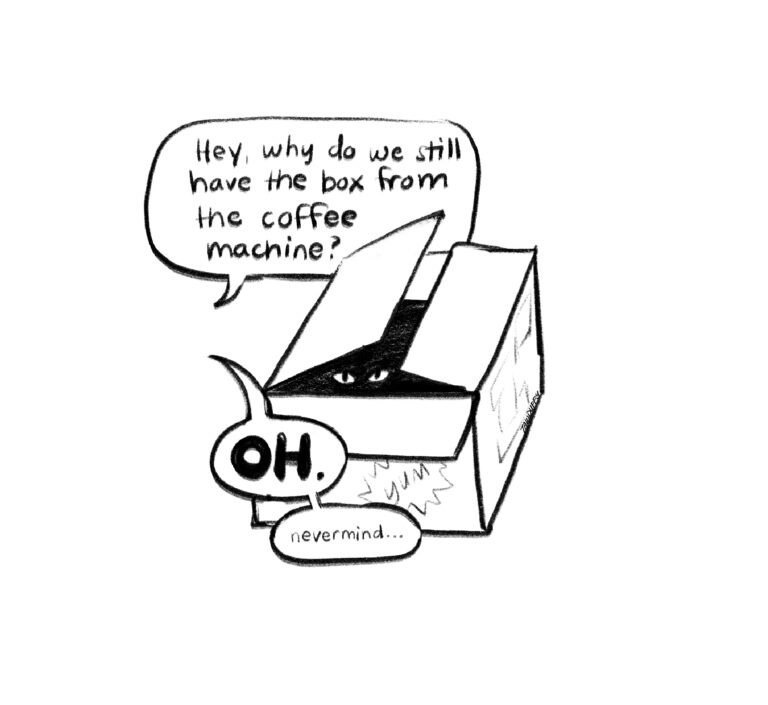
Sketch of a box with the lid slightly ajar. The inside is dark with two eyes peering out. Quote bubbles float above and below the box that say: "Hey, why do we sill have the box from the coffee machine?" "OH, nevermind..."
A cat doing top-secret cat activities inside of a box. Drawn by the talented Taylor Duffy.

Tiffany Holmes and Petey

One of Petey’s favorite snacktivities (that’s an activity that includes a snack, obviously) is searching for hidden destructibles. I discuss this in detail in Indoor Adventure Time, but we also play this outside in our small back yard as well. The rules are simple: I put some food in some sort of containers that he can pull apart and destroy, I hide them, and he sniffs around to find and dissect them so he can get to his snacks.

His other favorite is having his dinner (which is kibble) out of a takeout container that has remnants of the takeout inside. Pizza boxes and the small white paper containers with flaps at the top that tuck in to close (as in Chinese takeout boxes with no metal handle) are top tier.

Trash is an important part of one of Petey’s safe spaces as well! When my mom gifted us toilet paper and paper towels from Costco, Petey benefitted not only from the cardboard tubes, but the giant boxes as well. When he needs to move away from hollering out the window, I’ll cue him to his room, chuck a handful of treats into his giant snuffle box full of packing paper, and he dives right in.


And Now for the Dramatic Conclusion

If you ever cut out and/or decorated windows and doors in a giant cardboard box and turned it into a playhouse as a kid, you’ve felt the joy of homo sapiens’ species-typical behaviors in the form of play!  

So the next time you find yourself looking at a package or box and thinking “this is a good one for enrichment, I better save it,” we say: you’re welcome. 

And for anyone who read this far: I DID bring home that little plastic cup with leftover peach spice schmear and give it to Petey, and he loved it.


Now What?

Did our dedication to trash spark any ideas for you? If you’re ready to begin setting up your own trashrichment, but aren’t sure how to keep all of this extra junk around, here are a couple of ideas from the team:

  • Keep the biggest, nicest, thickest boxes and use them for storage
  • Have an open bin with safe items for your pets to access like Emily and Ellen
  • Save the big boxes for big snuffles–throw in packing paper or other paper items and throw in some treats

If the creativity is flowing and you want to learn more, sign up for our weekly newsletter for more tips, info, and events!

Here’s to harmony (and trash) !

Tiffany (Holmes) & the Pet Harmony Team

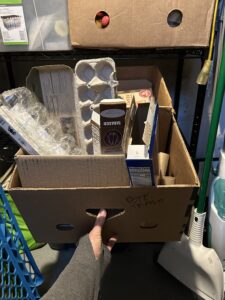
A hand pulling a large cardboard box off a shelf to see inside. It is full of other cardboard and plastic materials. There is writing on the box that says "Pete Trash."
Petey's trash treasures are stored in a big cardboard banana box on a rack in the basement.
A cat peeks out between books in a bookshelf. Feline enrichment!

Feline Enrichment for the Real World

A cat peeks out between books in a bookshelf. Feline enrichment!

Feline Enrichment for the Real World

Estimated reading time: 6 mins

What is enrichment?

At Pet Harmony, we talk about enrichment all the time, but if you’re new to living with cats, or just recently joining us, we need to define enrichment. It’s more than just Kongs and toys. Enrichment, as described in episode 1  is “meeting all of an animal’s needs in order for them to be physically, behaviorally, and emotionally healthy enough to perform species-typical behaviors in safe, healthy, and appropriate ways.” 

So, like canine enrichment, feline (cat) enrichment needs to be specific to them. Just because something works for a dog, doesn’t mean it will work for a cat — and just because a certain activity helps one cat, doesn’t mean it will work for another. We need to provide cat-specific enrichment to have a healthy cat. When our cat is healthy, our relationship with them is so much better.

Typical feline behavior (species-typical behavior)

Anytime I am trying to figure out what species-typical behaviors are, it is important to research the species. When we know what an animal usually does, we can give them ways to meet those needs that don’t compromise their physical, emotional, and behavioral health — or our own. 

Here are some behaviors cats typically perform:

  • Dig around in loose substrate in order to urinate and defecate. 
  • Bury or hide their urine and feces in said substrate
  • Groom or “bathe” themselves
  • Scratch on things
  • Jump and climb
  • Hang out in elevated spaces
  • Hideout in small spaces 
  • Eat multiple small meals in a day
  • Follow a hunting cycle of stalk, pounce, eat, groom, sleep
  • Bat small objects with their paws, sometimes causing them to fall

Notice that I said these are some things cats typically do. Not all cats do all these things, and I also didn’t list all the things cats do. These are just some very interesting areas that can become problematic for your home if your cat doesn’t have an outlet.

How do I provide enrichment for a cat, and why does it help?

If your cat is performing a species-typical behavior in a way we don’t like, we can offer activities we do like. Even if they seem unrelated, they may still reduce stress as well as behaviors we don’t like. 

Here are four easy enrichment ideas to try with your cat.

Provide multiple, desirable elevated spaces for your cats

And train them to use them.

Buy or make a tall cat tree, or install cat-friendly shelves. If they weren’t in your house, elevated spaces available to them outside are: the tops of cars, roofs of houses, fence lines, trees, and rocks. Small, three-foot-tall scratching posts with beds attached do not make good elevated spaces for cats.

Why? Access to high spaces has been proven to reduce stress-related behaviors in cats. It also gives them somewhere to run to that small children or dogs cannot reach. Providing these spaces and training your cat to use them will also make them less likely to use your furniture to get up high and knockdown cups, vases, or other valuable objects. (Be sure to provide appropriate elevated spaces in places your cat commonly goes onto undesirable surfaces — give them a spot in the kitchen where it is okay for them to watch you cook, for example.)

Simulate hunting through play

ats are ambush hunters. That means that they hide, stalk, pounce, and attack their prey. Unlike dogs, who are opportunists by nature, wild felines rely on hunting to survive. Eating dry kibble from a bowl just doesn’t cut it for most cats! Try lots of different toys to see which ones they fancy. Make the toy act like prey: sometimes it is slow, sometimes it is quick… sometimes it hides… sometimes it hops! The more it moves like a little bird or mouse, the more likely your cat is to love it. Most cats love a good teaser toy, like the ones pictured below. Or, if they are like my cats, they may also appreciate a good game of fetch! Be sure to put out meaty treats for them to eat when they finish playing. I like to use freeze-dried raw treats like PureBites. I just drop them into their bowls or on their cat tree at the end of a play session.

Why? When their little hunter instincts aren’t being used in play, they might be used on ankles, hands, and other pets in the household. Being given appropriate outlets for their hunting instincts can notably decrease aggression in cats.

Provide multiple scratching surfaces throughout the house

There are many types of scratching surfaces available for your cats. There’s cardboard, jute, and carpet, to name a few. Cats like to scratch in areas they like — in the living room, in the bedroom, etc. Try providing different types in the areas they like to scratch most. If your cat has a positive reaction to catnip, you may choose to use it to attract them to the scratchers. You can also drop a favorite treat each time a cat uses an appropriate surface. Some cats like scratching vertically, some like scratching horizontally. Try both. A common deterrent for cats using their provided scratching posts is when the post moves when they scratch it. So make sure the scratcher you’ve provided is tall enough for them to stretch and scratch, and heavy or secure enough that it won’t wobble too much.

Why? Well, scratching is a stress reliever for cats, just like chewing is for dogs. Not providing them with this outlet is likely to get your furniture and carpets ruined — or, if we have punished scratching too severely, the stress may come up as other undesirable behaviors, like urine marking or increased aggression.

Provide foraging opportunities for your cat, especially just before bed

You can use fancy cat puzzles, or you can simply provide cat-friendly food or treats and place them around their space at different levels and in hidey holes. Cats will use their keen senses to hunt out and find the treats. It takes some time for some cats to get used to it, and we can help you shape this behavior in your cats.

Why? Sniffing out food and eating small meals are both excellent ways to tire out a young cat and reduce stress in all ages. You will probably sleep better when your cats get to hunt out some especially tasty goodies just before bed, and it is another way to help them gain confidence with their cat furniture.

Enrichment abounds!

There are, of course, tons of other ideas to try with your cats. I haven’t even touched on many categories of enrichment. These four tips address many feline-typical needs, and I’ve found them to significantly decrease behaviors we might find annoying in our feline companions. If you’d like some more ideas and inspiration for cat enrichment, visit our Cat Enrichment Roundup. 


Here’s to harmony,

The Pet Harmony Team

Now What?

Try doing one of these things for your cat. Just dropping a few tasty treats on an unused cat tree or rearranging the top of the bookcase to be cat friendly can go a long way!

Don’t go too over the top. Introducing too many of these things at once won’t just stress you out — it may also stress your kitty! Try one thing at a time, and use trial and eval to figure out which things work for your cat. And don’t be afraid to return or donate toys that your cat doesn’t like.

Work with a qualified behavior consultant if you need help with your kitty. These things might help, but we can also hone a plan specific to your cat! If you’re ready for a professional, you can work with us here

PS: Capitalism

Want to support our free, public content? Check out our Amazon shop. It’s full of enrichment and pet care items (that we really, actually use). Our team spends a significant amount of time working on content every week. We love it! But we’re also out here trying to pay our bills. 

*  Pet Harmony, LLC is a participant in the Amazon Services LLC Associates Program, an affiliate advertising program designed to provide a means for sites to earn advertising fees by advertising and linking to Amazon.com.

Copyright 2025 Pet Harmony, LLC. All Rights Reserved.

Terms & ConditionsPrivacy Policy

Results are not guaranteed because behavior, human, canine, or otherwise, are not guaranteeable.

Agency: What It Is & Why Your Pet Needs It

A few weeks ago there was a discussion in our Enrichment for Pet Behavior Issues Community Facebook group where I realized that I’ve never actually written a post about agency itself. Sure, I’ve included this topic in other posts but I’ve never devoted an entire post to this topic alone. It’s about time that changed! So this week is solely devoted to a topic that I don’t think gets near enough attention in the pet community: agency.


What is agency?

Agency is the ability to have some level of control in our environment and be able to make choices that will result in a desirable outcome. One of the important factors here is that agency requires at least two desirable choices. A “cake or death” decision a la Eddie Izzard doesn’t fly. 


Doesn’t meet the 2+ desirable choices criterion


A pet example of a choice that fits the criteria would be the choice to sleep on comfy bed A or on comfy bed B. An example of a choice that doesn’t fit the criteria would be come when I call or get shocked. Make no mistake, though, it’s entirely possible to use food coercively as well. Such as, you can have delicious treats but only if you approach a person you find scary. Those examples don’t have at least two great choices to choose from. 


Why agency is important

There are so many reasons why agency is important that it would take me an entire book chapter to explain them all 😉 The short answer is it’s helpful in:

  • Combating learned helplessness
  • Creating resilience
  • Improving behavioral health
  • Improving quality of life (I don’t have research to back this bullet point up since “quality of life” is pretty subjective, but I think it’s safe to say that this is likely true from an anecdotal capacity and if we look at all the other things agency does for an individual.)

On a more practical note, having agency can be huge when it comes to how an individual reacts in certain situations. Here’s the example I use with my clients to illustrate this point:

Say that you’re at an educational wildlife event. The presenter is holding a snake. You hang out at the back of the room, fearful to move closer. The presenter continues talking about the snake they’re holding and offers for anyone to touch the snake who would like to do so. By the end of the presentation you’ve made your way to the front of the room and touch the snake. This was not a scary experience because you had full control over whether or not you put your hand on the snake. 

Now, let’s say you’re having a picnic. You’re sitting and chatting with your friends when you put your hand down– right on top of a snake. Chances are you’re not okay with this scenario, even though it’s the exact same behavior– hand on snake– as above. You may scream, run away, or perform some other fight or flight behavior. The difference between these scenarios is that you didn’t have the choice to touch the snake in the picnic but did in the presentation. 

We seem to see this with our pets, too. I often see reactive dogs who are far less reactive when they’re able to move away from the scary thing than when they’re made to sit there and watch it. Or dogs with separation anxiety who display fewer stress-related behaviors or less intense stress-related behaviors when they’re given more space to move about in the house (though, confinement anxiety is also a thing). While we can’t necessarily ask our pets in these situations if it’s agency that’s truly causing the change in behavior, we see it consistently enough that it’s a valid hypothesis. 


How can I provide more choices in my pet’s life?

There are so many ways to do this and we have a lot of examples in our book, Canine Enrichment for the Real World. Here are some easy options:

  • Multiple sleeping areas to choose from
  • Being able to choose where they go and what they sniff on a walk
  • Food preference tests
  • Toy preference tests

Here are couple that are more involved but also allow for even more agency in situations where it really counts:

  • Cooperative care & start button behaviors for medical and grooming procedures
  • Being able to choose whether or not they move closer to a stressor– without luring with food


But… what if they make poor choices?

Agency doesn’t mean that your pet has full authority to do whatever they want. If you have a pet who bites people coming into the house they still need to be managed to ensure they don’t bite people coming into the house. We should not diminish safety to increase choice. 

Agency means providing choices that don’t compromise safety, physical health, mental or behavioral health, or enable them to practice unwanted behaviors. That sometimes means that our pets may not have multiple choices in a situation. When that happens we can acknowledge that and work on training a skill that allows our pet to have choices in future similar situations. For example, a dog who doesn’t have a rock solid recall (come when called) shouldn’t be off-leash even though being off-leash allows for more agency. Instead of resigning to that, we can work on training a rock solid recall for future use. 


Now what?

  • Assess the choices your pet currently has. Don’t be critical or hard on yourself; we’re simply assessing to see where we have room for improvement. 
  • In those areas where you find your pet doesn’t have agency, ask yourself why that is. Is it to mitigate safety concerns? Is it to mitigate unwanted behaviors? Or, are there situations where you’re not quite sure or because it’s what someone once recommended or you think it’s what you should be doing? Keep probing until you find those answers. 
  • If you’re newer to agency and thinking about your pet’s choices, choose one of those easier situations to increase your pet’s desirable choices. 
  • If this is something that you’ve been working on or thinking about for a while, you may want to consider one of the more involved options. Cooperative care is a great place to start for almost everyone. 
  • If you’re interested in learning more about agency and how to incorporate it into your pet’s life, check out our book Canine Enrichment for the Real World and be sure to join us in our Facebook group.


Happy training!

Allie
October 2020 Training Challenge: Assess Your Home Alone Activities Efficacy


Part of me can’t believe it’s already October and part of me reminds the first part that this has been the longest year ever. Regardless, it’s time for our October training challenge!

List enrichment strategies you employ while you’re gone and objectively go through the list to determine if those strategies are effective. 

Not only is this training challenge dedicated to the “Independence” chapter of our book, it’s also a great exercise in taking a descriptive vs. prescriptive approach to your enrichment plan. (Note: we decided what the training challenges were going to be well before Covid hit. While you may not be gone at work all day at the moment, this exercise still applies for shorter outings!)


Descriptive vs. Prescriptive

For those of you who’ve heard us speak this year, you’ve heard us talk about taking a descriptive approach to your enrichment plan.

Descriptive: “I see a change in my animal’s behavior because of the activities we’ve done or provided.”

Prescriptive: “I provided an activity for my pet therefore he’s enriched.”

With the descriptive approach, we observe behavior to determine if the activity was effective instead of assuming that it was. Did it actually meet the animal’s needs as we intended? If it did, great! We can keep doing it. If it didn’t, well, then it’s back to the drawing board. Emily wrote a great blog post about this here. It’s not enough for us to just assume that our pet’s needs are being met while we’re gone, we need to actually observe that that’s true. 


How can I tell if those activities are effective?

There are a few ways we can tell if these activities are effective:

  • They’re being used. If you leave a stuffed Kong for your pet and it’s untouched when you return, that’s not an effective strategy. 
  • Watch your pet on video. Want to know if the window film you put up for your pet’s reactivity is actually decreasing reactivity throughout the day? It’s time to break out a recording option and see what your pet is up to during the day. 
    • Recording options can be high-tech, like Furbo and Nest (these are affiliate links), or low-tech, like Skyping or Zooming yourself or setting up a laptop to record shorter absences.
  • Observe your pet’s behavior when you come home. Providing activities while you’re gone can be the determining factor between having an adolescent dog who’s bouncing off the walls when you come home vs. one who’s excited but not uncontrollable. 


Now what?

  • Make a list of the enrichment activities you utilize while your pet is home alone. 
  • Make a list of desirable and undesirable behaviors that you’re hoping these enrichment activities address.
  • Observe your pet’s behavior. Are those activities effective in increasing desirable behaviors and decreasing undesirable behaviors?
  • Adjust your enrichment plan accordingly. 
  • Share your findings with us on social media! @petharmonytraining on Facebook and Instagram


Happy training!

Allie

September 2020 Training Challenge: Teach Your Pet to Use a New Food Puzzle

This month’s challenge is:

Teach your pet how to use a new food puzzle

As I mentioned in the beginning of the year (and throughout the other challenges), this year’s training challenges are dedicated to our book Canine Enrichment for the Real World. Each month focuses on a different category of enrichment. This month’s focus is “Mental Exercise”. 

To effectively meet the mental exercise component, make sure that your new puzzle is challenging enough for your pet to employ their problem solving skills but not so challenging that they get frustrated and give up. There’s often a fine line between the two and that’s often why we need to teach our pets how to use their new toy.

From “They Won’t Do It” to “They Love It”

While foraging (searching for food) is a natural behavior for all species, food puzzles aren’t natural. There are no food puzzles growing in the wild so that the ancient dog or cat ancestor learned how to use them and pass that knowledge down to future generations. This is why we frequently need to teach our pets how to use a particular puzzle, especially if they haven’t used one before. 

Check out our video below on how to teach your pet to use a food puzzle:

Here are some tips for teaching your pet a new food puzzle:

  • Choose a puzzle with your pet’s preferences in mind. Our pets have preferences just like we do. For instance, Oso is a rough-and-tumble kind of dude. He’s great at the puzzles that he can knock over and roll around with his nose. He doesn’t mind the noise those make though he does prefer to use them on carpeted areas. I know that if I give him a new puzzle he can roll around I don’t need to show him how to to it. However, he’s not as adept at the intricate food puzzles that require a lot of small motions and steps. His way of solving those is dropping them on the floor so they break open (which, while a valid way to solve the puzzle is also expensive to buy replacements.) If I give him a more complicated puzzle I’ll have to teach him first before he can use it without breaking it. 
  • Choose a puzzle with your pet’s experience in mind. Giving a challenging food puzzle to a novice dog is likely to lead to frustration. On the other hand, giving a simple food puzzle to an experienced dog is not going to provide much of a challenge. Think about how much experience your dog has with food puzzles and choose a new one accordingly. 
  • Work up to the most challenging setting. Many puzzles have ways to make them more or less difficult. Instead of starting with the most difficult setting we should work our way up to it by first starting on the easiest, then easy-medium, medium, medium-hard, and finally the hardest setting. This allows our pet to master each setting and build a history of getting food from the puzzle. That history will help them keep at it for longer when it becomes more challenging. 
  • Show them how but try not to do it for them. It was once thought that only primates could learn through watching others but we now know that our pets can do this too! We can encourage them to use their new puzzle by showing them how to get the treats out a few times. Be careful though not to do it every time for them. Some learn that the best way to get the food out is to let the human do it! While that’s a clever solution in using their resources it doesn’t necessarily meet the goal we’re hoping to achieve by introducing a new puzzle. Show them how a few times then let them at it. 
  • Use a higher-value food. Higher-value food helps build more motivation in almost all training scenarios: this is no different! Up the ante when they’re first learning and save the kibble for when they’ve got the hang of it. 

What food puzzle should I try?

Here are some of our favorite store bought options for dogs (Disclosure: These are affiliate links. We receive a small commission for purchases made through these links at no extra cost to you. This helps us continue to put out free content to help you and your pets live more harmoniously!):

Here are some of our favorite store bought options for cats (Disclosure: These are affiliate links. We receive a small commission for purchases made through these links at no extra cost to you. This helps us continue to put out free content to help you and your pets live more harmoniously!): 

Small dogs and cats can often choose between these lists, too!

Don’t forget DIY!

Food puzzles don’t need to break the bank. There are a lot of simple, cheap, DIY options like these:

Now what?

  • Buy and/or make your new puzzle!
  • Teach your pet how to use their new toy, if needed. 
  • Share videos of your pets having fun and using their brains with us on Facebook or Instagram: @petharmonytraining

Happy training!

Allie