Enrichment is kind of a buzzword nowadays. If you have been the proud guardian of a dog, I would be pretty shocked if you hadn’t at least come across the concept of enrichment and why it matters.
And if you have spent any amount of time around the Pet Harmony team and our social media accounts, you will also know that we are not only passionate about enrichment but also super serious about its use. In fact there are dozens of Pet Harmony blogs like this one about meeting your dog’s needs via intentional use of enrichment.
Why brain games matter for cats
It occurred to us however that there is another domesticated species out there who is as abundant in pet homes as dogs and they deserve some enrichment love too. With that, I present to you 3 ways in which you can stimulate your cat’s brain in order to meet their needs and improve welfare and well-being.
Bored, understimulated cats can wreak havoc on your home just as much as bored and understimulated dogs can. Yet, we seldom stop to consider just how important it is to provide our cats with species appropriate opportunities to play and use their brains.
I hope this blog will provide you with the knowledge you need to get started on keeping your cat’s brain engaged and behaviorally healthy.
But first…cats!
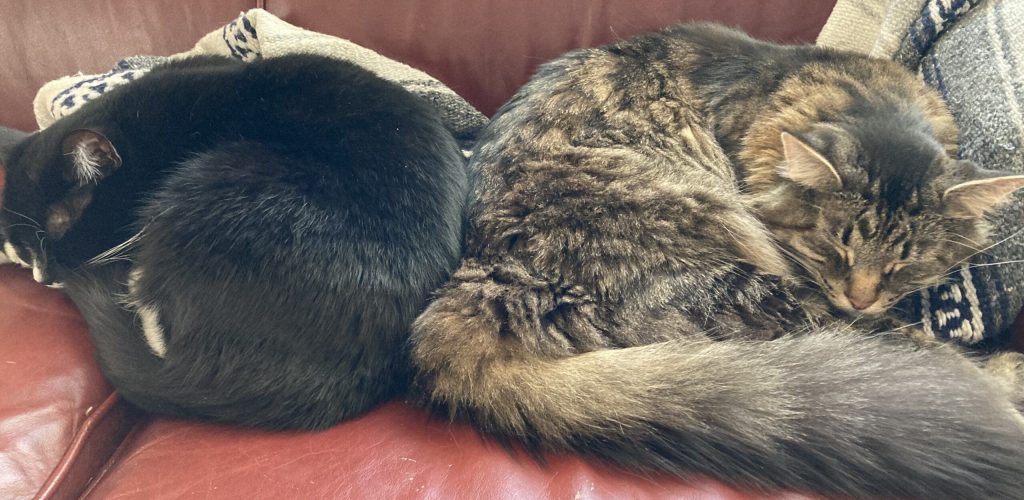
Sushi (left) and Charm (right) enjoying a species-typical activity: snoozing. Photo courtesy of Sami Griffin, Wise Whiskers Training.
In order to know how to appropriately provide our felines with games that will help them thrive, we should know a bit about who they are as a species, yes? There are literally books, journals, articles and research studies all dedicated to the species felis catus. For the sake of time, we will just focus on some of the behaviors that the vast majority of healthy felines engage in regularly. This will help us narrow down our focus on the kinds of brain games that will get that purr motor running.
In no particular order, here is a partial list of the behaviors you may have noticed your domesticated cat engaging in:
Most active at dawn and dusk (crepuscular)
Grooming of self and conspecifics (fellow cats)
Scent marking
Higher altitude perching
Scratching
Kneading
Sniffing
Resting/sleeping
Hiding out in hidey spots
Foraging for all the snackies
Batting or pushing items around by using their paws
Chasing and catching moving objects or “hunting”
This is by no means an exhaustive list and may in fact be just the tip of the iceberg. But there are plenty of behaviors in the above list that can help us develop a plan around meeting the needs of our cats by tapping into their behavioral diversity.
What exactly are “brain games” for cats anyway?
Now that we have a good idea of what behaviors we are going to tap into, we can focus on defining what we mean by brain games. Brain games are just a simpler way of saying activities that encourage thinking, problem solving, choice, control and independence. In other words, using the brain in a way that not only replicates species typical behaviors but also makes the brain work to achieve a desired outcome.
That might sound hard to implement but I promise that it isn’t. Brain games do not need to be overly complicated or cost a lot of money. In fact, you can probably find items already in your home that can get you started. This blog post aims to make it as simple as possible so that you don’t have to spend hours of time or buckets of money on helping your cat live their best life.
Benefits of brain games and mental enrichment
The benefits of enrichment and brain games have been well established by now both in research and in the vast amounts of anecdotal evidence Pet Harmony’s behavior consulting team has collected over the many years we have been in operation.
Here is list of why we highly encourage the folks we work with to incorporate mental stimulation into their cat’s daily repertoire:
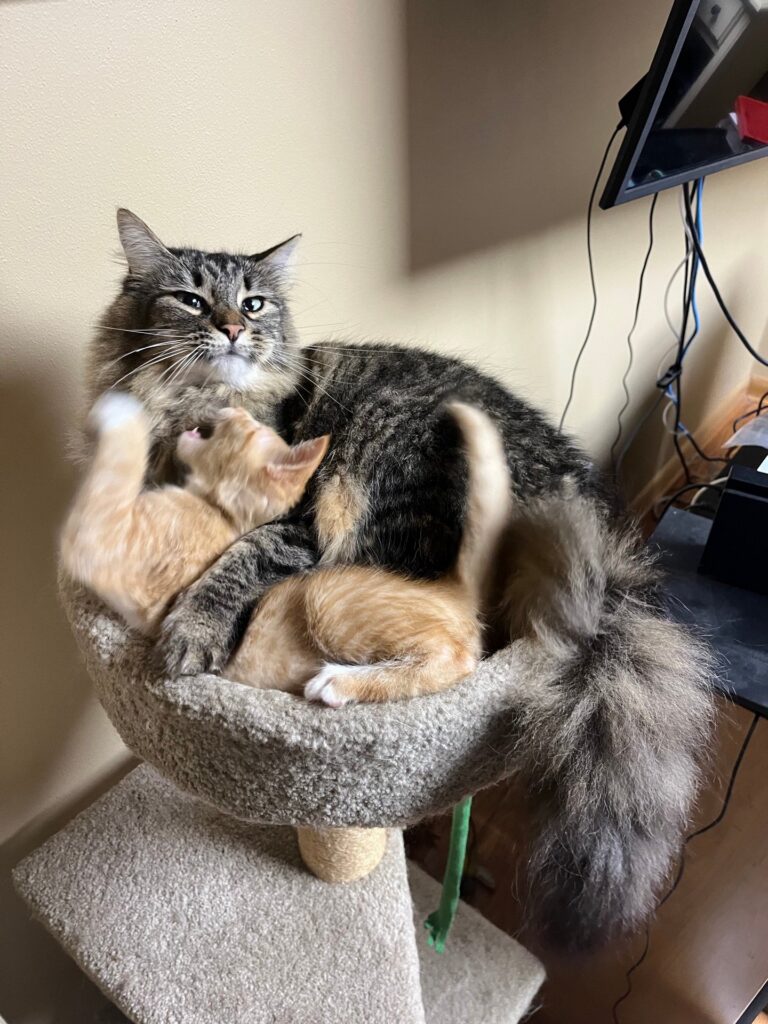
Thorin enjoying (?) a foster kitten. Photo courtesy of Jenna Swiertz Doubek, Silver Linings Companion Animal Services.
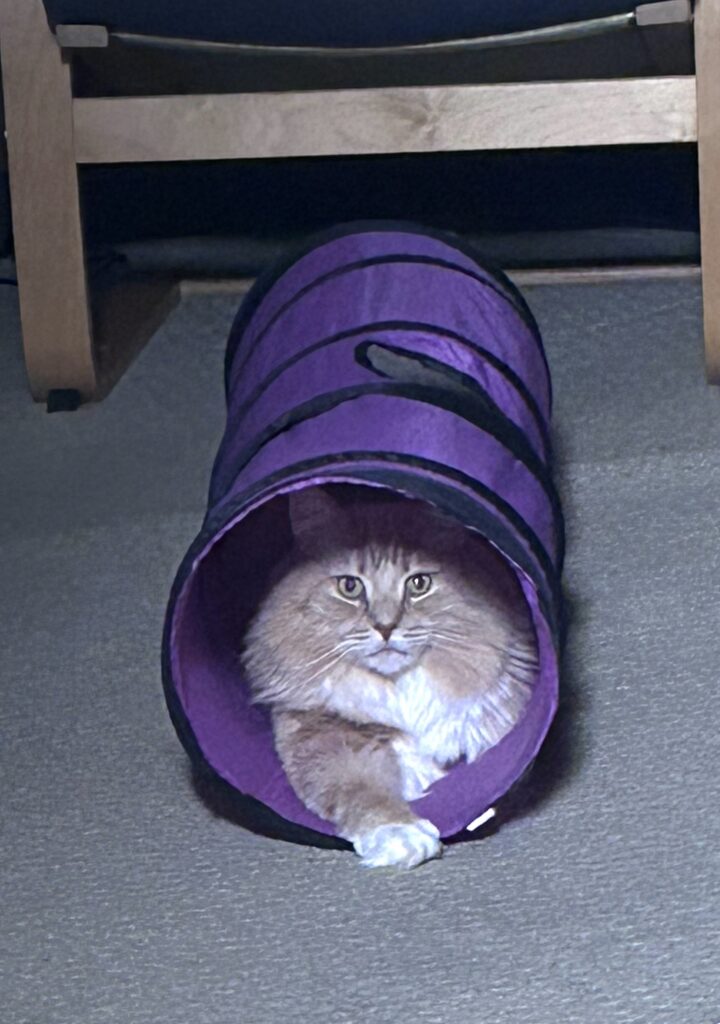
Barnie presiding over his tunnel. Photo courtesy of Cat Chambers, Whole Hearted Dog Training.
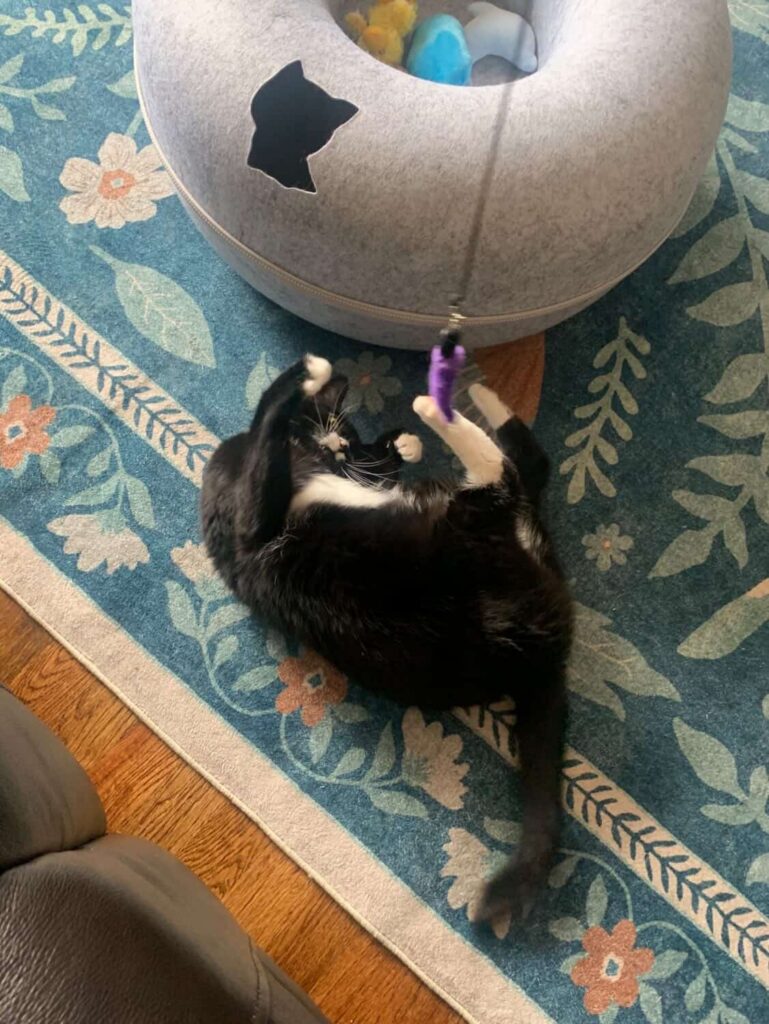
Sushi getting some playtime in with a lure toy. Photo courtesy of Sami Griffin, Wise Whiskers Training
This is your cat’s brain on the hunting sequence
I think the most bang for your buck brain game you can play with your cat would replicate something called the Hunt>Catch>Kill>Feast>Groom>Sleep cycle. This is what is called a modal action pattern (MAP). In order for a behavior or series of behaviors to be considered a MAP, they should meet the following criteria:
They should be innate, meaning they do not need to be taught
They are shared by most members of that species
They are often triggered by a specific environmental cue (i.e., another animal running away)
Once they are triggered, they typically are expressed in an ordered sequence of actions
If we look at our cat MAP above, the ordered sequence of events is broken down into the following specific behaviors: 1. Hunt 2. Catch 3. Kill 4. Feast 5. Groom and 6. Sleep.
Lots of cat guardians know about the “hunt” portion of this sequence. And do a decent job of replicating it in play which is probably why the cat wand toy and laser pointer business is booming. I want to challenge all of you feline loving individuals out there to expand on the hunt portion of the sequence and to start to include the rest of the behaviors in the sequence. Here is how you can do that:
Play with your cat with their favorite wand toy. How you play matters though. The way you move the toy should mimic the way a real bird or rodent would move. Jerky, erratic movements that are moving away from your cat are more likely to kick that modal action sequence into gear than if you fly the wand directly into your cat’s face. Afterall, how many mice do you know that would walk directly into a cat’s face? Unless their name is Ratatouille, I’m guessing none.
Make sure you are moving the toy that is at the current skill level that your cat has. Too hard, they may give up. Too easy, they may get bored.
Let your cat catch and “kill” the toy by kicking, scratching at or biting it. As soon as they complete the “kill” action, place a large, high protein, cat appropriate snack right near the “prey” they just caught and “killed.”
Allow them to eat the snack for as long as it takes them.
You can repeat this sequence for a few more cycles and then pause and observe your cat after they eat the snack.
If they start grooming themselves, then you can continue to observe what happens next. Are they indicating they might like to take a nap or are they indicating they might like to hunt some more?
The reason I (and so many other cat behavior professionals) like replicating this sequence is because while humans did domestic cats as a species, cats still truly carry the vestiges of their feline ancestors deep in their DNA. If we can provide them with species-typical activities (things that are normal for domesticated cats to do), it really is one of the best ways to keep their brains busy but also to meet their needs.
2 more ways to keep your cat’s brain in tip top shape
There are other simple ways to encourage your cat to engage in instinctual behaviors that are components of the predatory sequence.
“Hunting” for snacks
The second way that I love to replicate the MAP we discussed above is so easy, I am almost embarrassed to share it. I said almost, so here it is:
Get about 5-10 of your cats favorite, small crunchy treats
Pick a room of your house that has either tile or hardwood on the floor
Show a treat to your cat.
Place it under your hand and then “flick” it across the floor so that it easily slides across the floor and your cat can track it, chase it, catch it, bite it and consume it.
Rinse, repeat until the treats are gone or your cat starts grooming and indicates they are done.
Pro tip: If your cat has a hard time tracking the moving treat, make it easier in the beginning
I have played this game with more cats than I can count and have maybe met 2 or 3 who are not that into it. The rest? They love it!
Cat whack-a-mole
My last game involves a common cat behavior that cracks me up every time I see it. You know how I can easily lose an hour of my life? Google cats knocking things off of shelves and there is your answer. I say this as someone who does not currently share my life with a cat so I get some of you might not be as amused as I am.
In order for our paw-dextrous cats to have fun that doesn’t include breaking every glass in your house, let’s provide them with another, more human accepted outlet. Food puzzles like this one allow your cat to be as “pawsy” as they like without you having to take multiple trips to Crate and Barrel to replace your drinkware.
If you are into DIYing things you can easily replicate the above puzzle by repurposing an old cardboard box. Save your toilet paper tubes, cut them to the length that will work for your cat and secure them to the bottom of the box. Add treats and viola! Easy peasy, kitty squeezy.
Tricked ya! A bonus section for folks who can’t use food
For the cats out there who have restricted diets, there are plenty of other ways to provide your cat with brain satisfying activities including the following:
Window watching stations
Scent enrichment (new smells, herbs, safe plants)
Environmental changes (new perches, rearranged furniture)
Training simple cues (targeting, sit, stationing). If you haven’t target trained your cat, you really are missing out on some fun.
“Catifying” your space to include tunnels, bridges, hiding spots or even an outdoor “catio” can all be incredibly enriching for your cat and allows your cat the agency to explore their environment in new and safe ways.
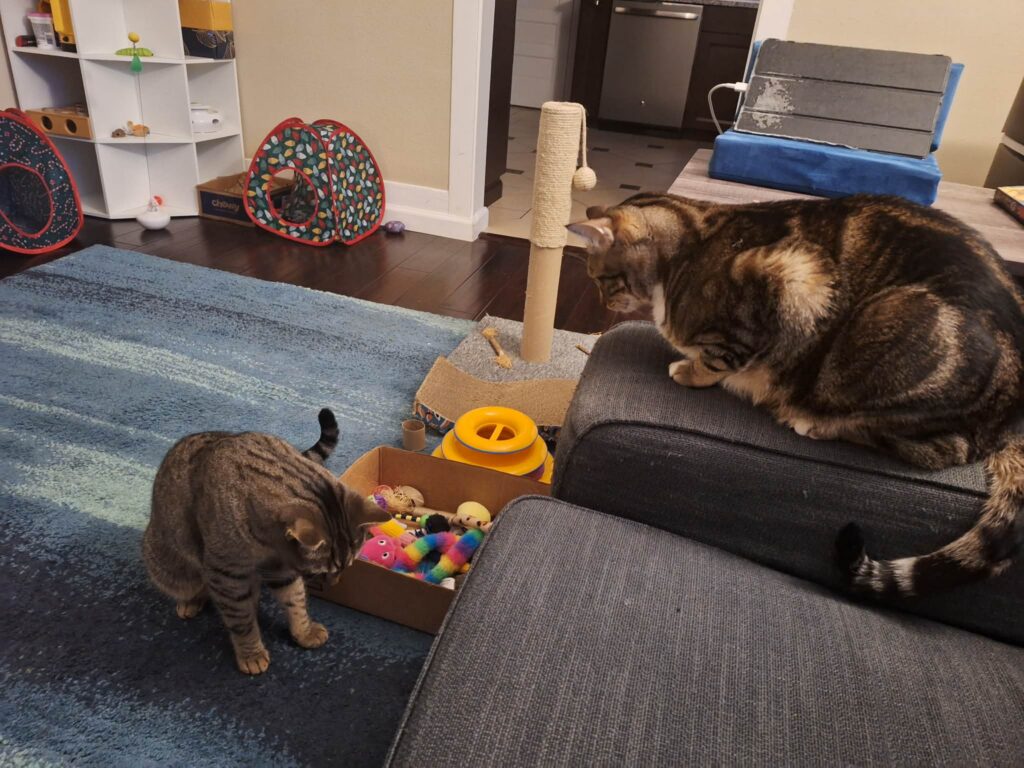
Flash and Cayde waiting for snacks to fall into their foraging box full of stuffed toys. Photo courtesy of Michelle Thomas, Ready, Pup, Go.
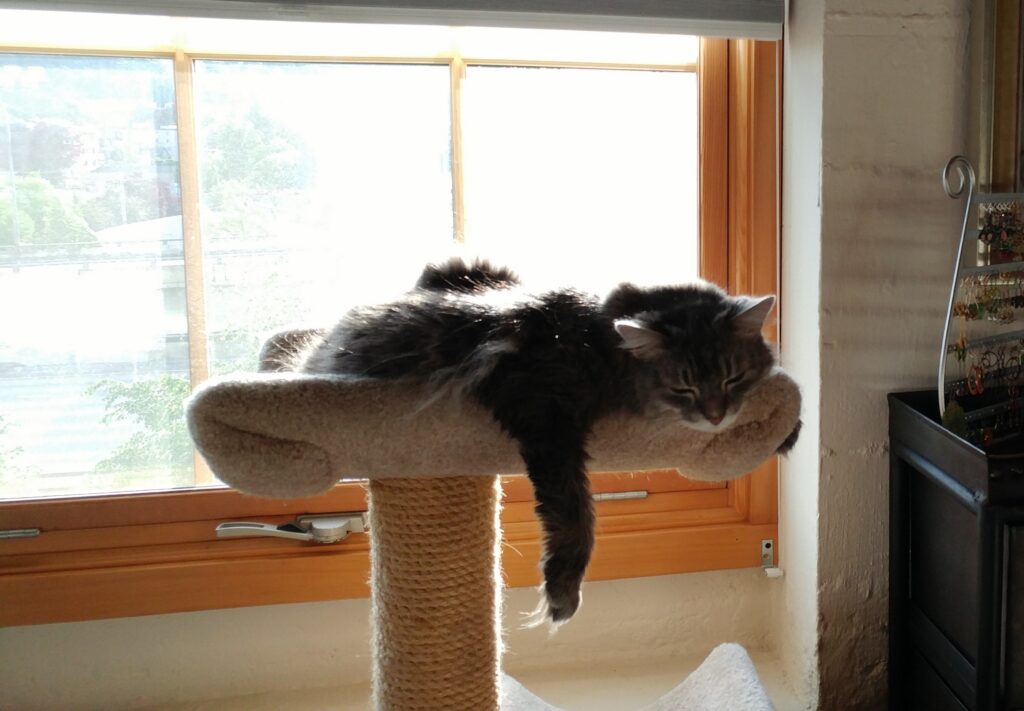
Photo of comfy Jesse courtesy of Shivani Seastone, Paw Potential Training & Behavior
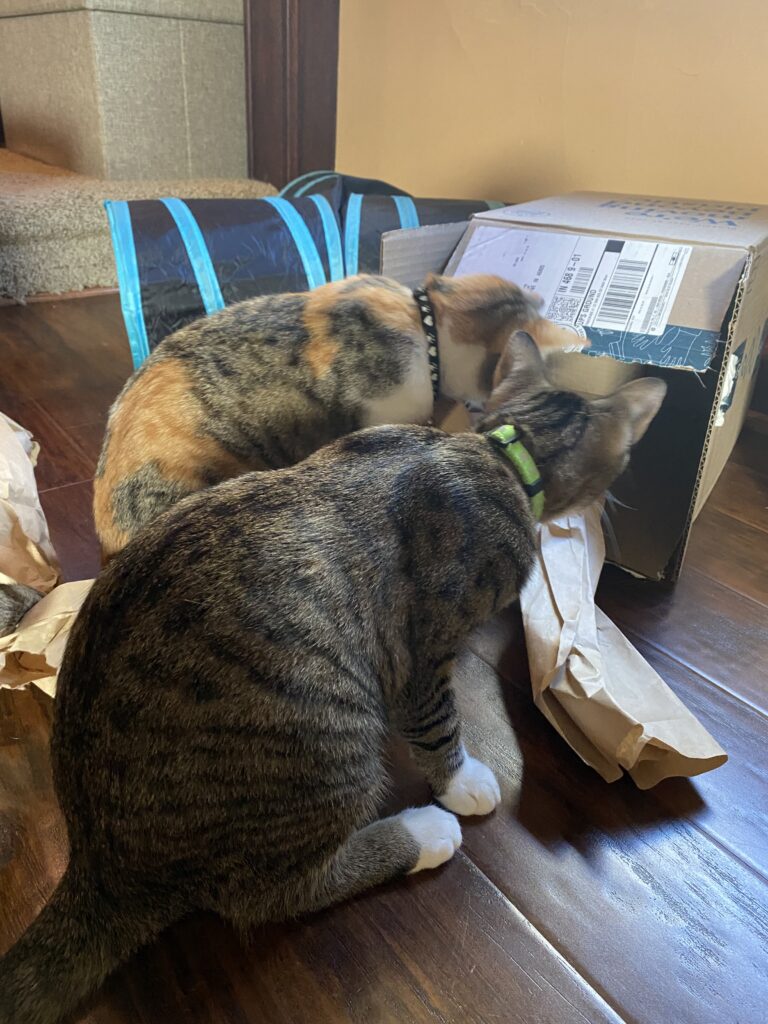
Organa (calico) and Ripley pulling paper (and treats!) out of a box.
Here’s to harmony,
MaryKaye
Now What?
Cats like to have fun too! Small measures can have big impacts so have fun exploring options with them as your guide. Here are some tips to get you started:
Match difficulty to your cat’s experience
Respect individual preferences (food-motivated vs. play-motivated)
Watch body language for frustration vs. engagement
Keep sessions short and positive
Watch for results of the brain games you provided. Enrichment is as much about the outcome as it is the engagement of the activity.
Be curious, creative and have fun! And let us know how it goes!
Looking for more cat related content? This post rounds up other Pet Harmony blogs and podcast episodes that are feline focused.