
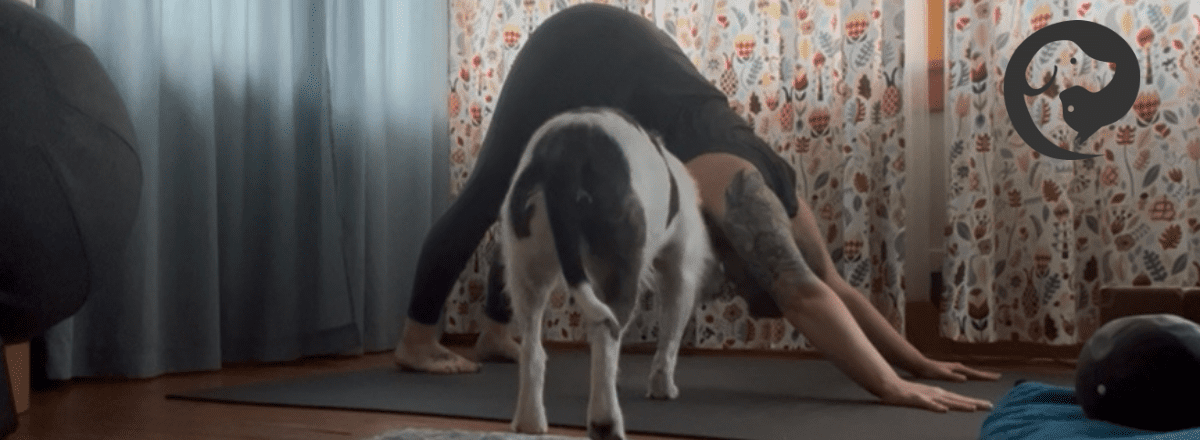
I am lying on the floor on my yoga mat, wriggling like a worm. The speaker in front of me is blasting a percussive din of shrieks. My ribcage expands, I inhale. My exhale vibrates in my chest as a long, controlled breath turns into a hum. In the dim light, I begin to move rhythmically, gently coaxing my joints to undulate through their directions of movement.
I am completing my stress response cycle.
I know that when my yoga practice is over, I will feel lighter. My thoughts are less chaotic. I can settle. I can move on. When we talk about observing outcomes, this is exactly what we mean. Getting on my mat like this feels like coming home. Like I get to come home to my body.
Do I think that everyone should get on the floor and become a worm while mechanical engineer turned industrial musician Author & Punisher threatens to explode their speakers and/or their ear drums? No. Only you (and your neurotype and your learning history, etc.) can decide what welcomes you home.
What we mean when we say “stress response cycle”
I will break this down in the simplest way possible…because that is the level at which I understand it.
Let’s start by defining our terms so we’re all on the same page.
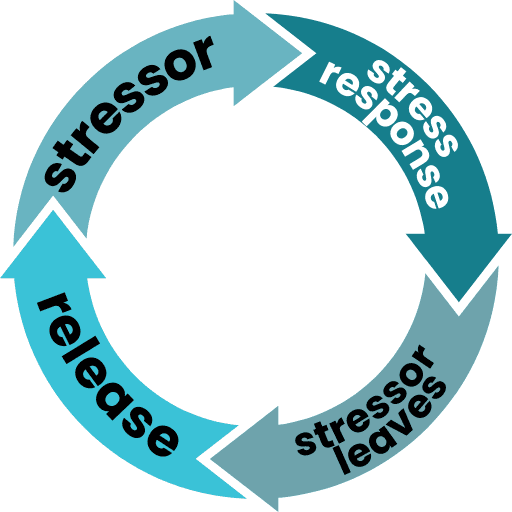
- Stress – The body’s response to a trigger which disrupts or potentially disrupts the status quo.
- Stressor – The trigger (stimuli) that precedes the stress response.
- Stress response – Specific physiological reactions involving the release of chemicals that help regulate the body.
- Distress – A form of stress associated with aversive stimuli, such as anger, fear, or frustration.
- Eustress – A form of stress associated with appetitive stimuli, such as excitement, joy, or eagerness.
When a being encounters a stressor, the body responds. The stress response prepares the body to react in some way. When the stressor is gone, it’s time to release the stress. And that’s the cycle! Keep in mind that stress can be aversive (something you want to avoid) – this is distress. Or it can be appetitive (something you want to engage in) – this is eustress. Either way, stress disrupts the body’s baseline.
One of my biggest takeaways from Emily and Amelia Nagoski’s brilliant book Burnout: The Secret to Unlocking the Stress Cycle was the distinction between stress and stressor. Sometimes stressors don’t go away. But if we don’t have ways to discharge stress, it will impact our welfare and well-being.
A simple illustration of completing a stress response cycle looks something like this:
- Dog is resting comfortably on the couch.
- Person appears at the door with a package.
- Dog jumps up and barks.
- Person drops package on porch and walks away from door.
- Dog shakes off, sniffs around, and …
- Returns to spot on couch.
Before you know it, the dog is once again looking snoozy on the couch.
How do you know what you need?
Understandably, being pummeled by industrial music is not an effective strategy for most(?) people to recover from the effects of the stress response. For the record: it’s not the only way that I release stress, but I don’t know that any of those ways are effective for other humans, either.
So how do I know that I need to spend some time in my yoga room? It’s usually because I experience things like:
- Having less patience with Petey or Big Man
- Avoiding tasks that I usually enjoy
- Feeling stiff and achy
- More decision fatigue than normal
I am aware of my own behavioral baseline and ladder of escalation. If these concepts are new or challenging for you, I really cannot recommend Burnout enough. We know that our pets cannot tell us what they need, and sometimes it takes practice to understand our own needs as well!
Worming around on my yoga mat wasn’t in response to any one stressor, but the combined stress of however long it had been since I had last been welcomed home by my practice. In Burnout, the Nagoski siblings suggest the following categories of activities help humans complete their stress response cycle:
- Physical activity
- Breathing
- Affection
- Laughter
- Creative expression
- Crying
- Social connection
This post provides some great ideas for humans for completing the stress response cycle. (It also astutely clocks zoomies as a way to process stress!)
Helping our pets process stress
As I mentioned, stress is the body’s response to … something. It comes in different forms (distress and eustress), and it is separate from the thing the body is responding to (the stressor).
I’m simplifying here, but I think there are a few keys to supporting our pets through the stress response cycle:
- Observing and learning body language.
- Knowing our pets’ behavioral baselines.
- Knowing our pets’ ladders of escalation (and de-escalation.
- Understanding the outcome of specific activities (to learn when to apply them).
Our pets are individuals, but here are a few common indications that your pet may need to complete their stress response cycle:
- Increased irritability or sensitivity
- Heightened startle responses
- Difficulty settling
- Behavior changes that feel “out of proportion”
- Guarding, avoidance, shutdown, or hyperactivity
How do we know what our pets need?
When I took myself to my mat and put on music, I knew how I wanted to feel when I was done with my practice. It’s something I’ve experienced hundreds of times. Although we cannot know how our pets feel, we can observe their behavior and use their body language to make our best, most informed guesses.
So how do we, as pet and behavior professionals help our own pets process the effects the stress response has on their bodies? Lucky for you, I’ve brought in the entire team to help me with that question!
First, we operate under a few assumptions
- Stress is an unavoidable part of life. That doesn’t mean we just throw our pets into situations we know they are not prepared for in an attempt to help them “get over it.”
- It does mean we have some plans for when we encounter particular stressors, however…
- We can’t plan for everything! Here’s where we rely on things like knowing our pets baseline, and the outcome of enrichment activities and strategies we use with them.
- Our goal isn’t eliminating stress, it’s helping our pets process and recover.
- Every pet completes their cycle differently, and may take on different forms throughout their lives. Enrichment is iterative!
When I looked over the responses from my teammates, some themes emerged in how their households are completing their stress response cycles.
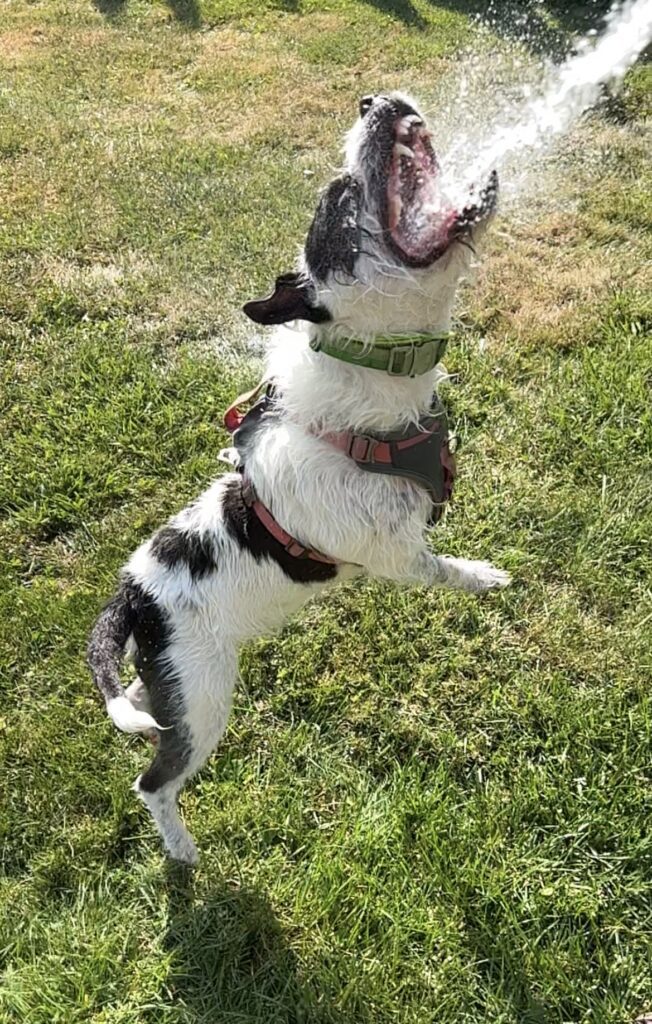
1.Movement/physical activity
- zoomies
- running
- tug
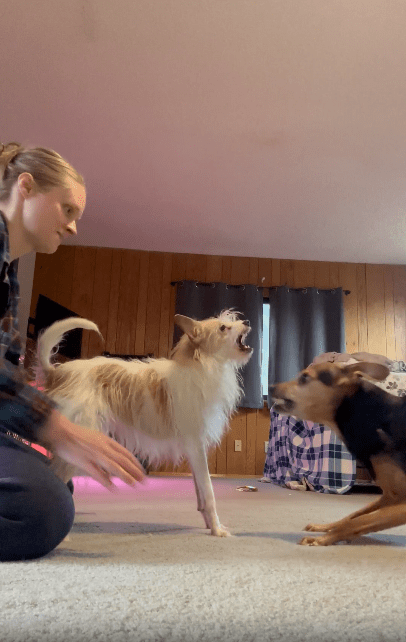
- wrestling
- chasing
- digging
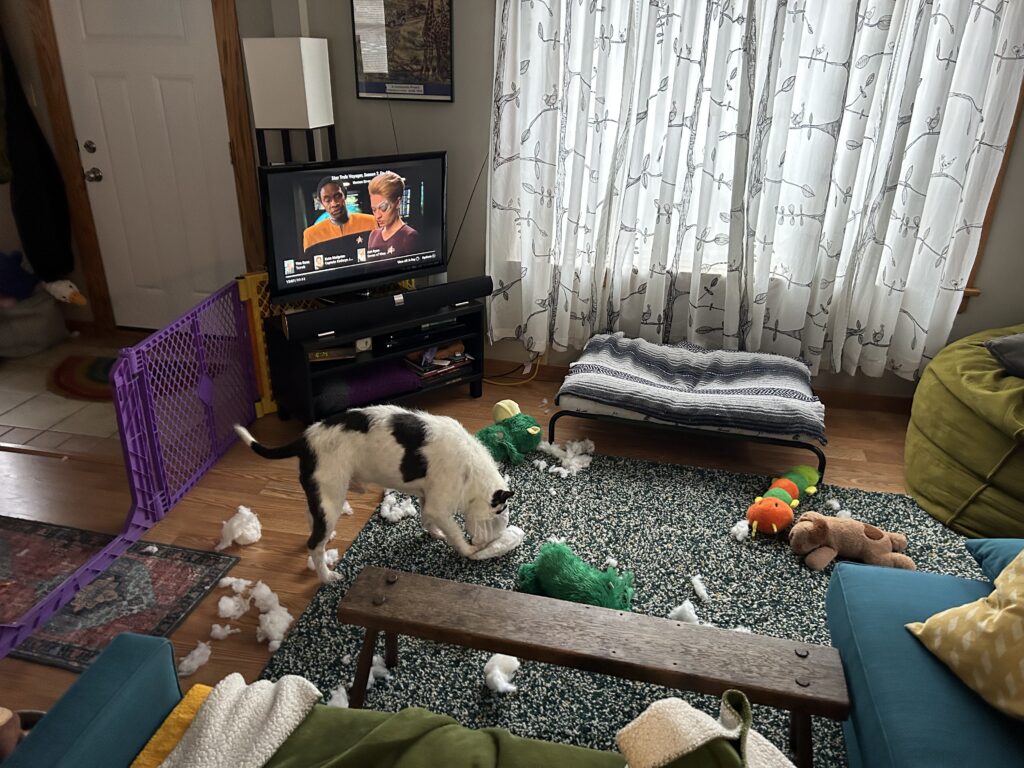
- shredding
2. Appropriate outlets for species-typical behaviors
- destructible toys
- cardboard shreddables
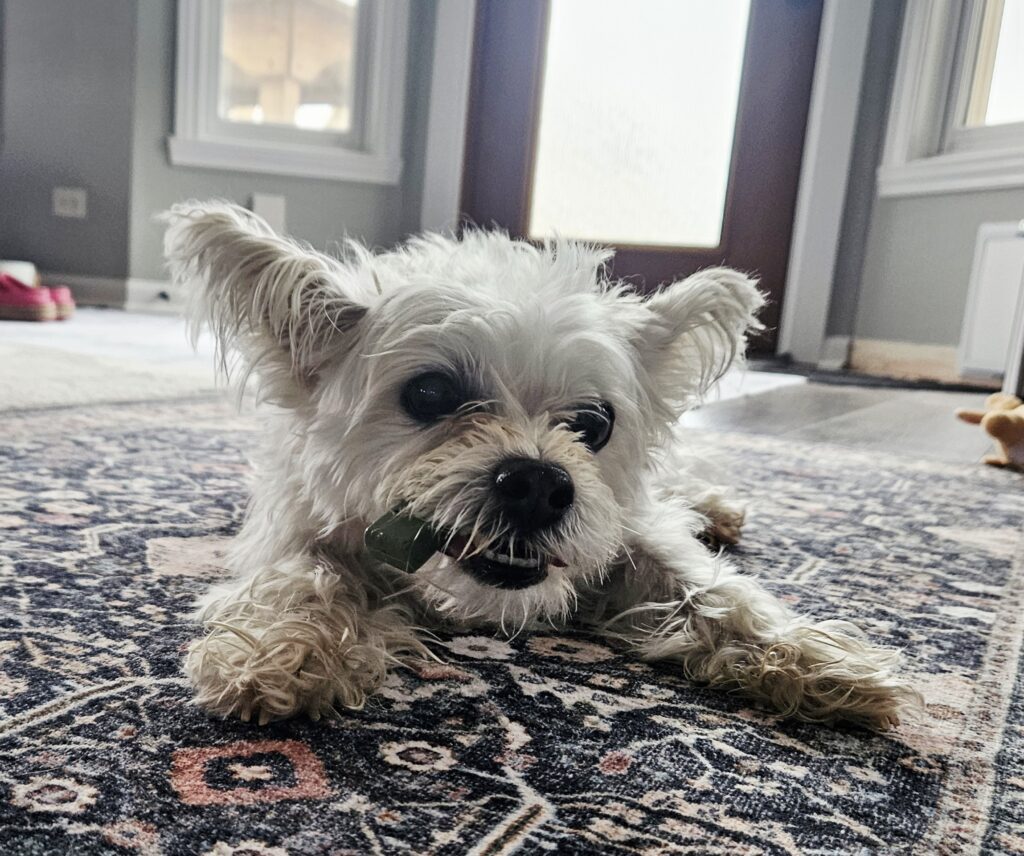
- chewing bones
- foraging
- digging blankets
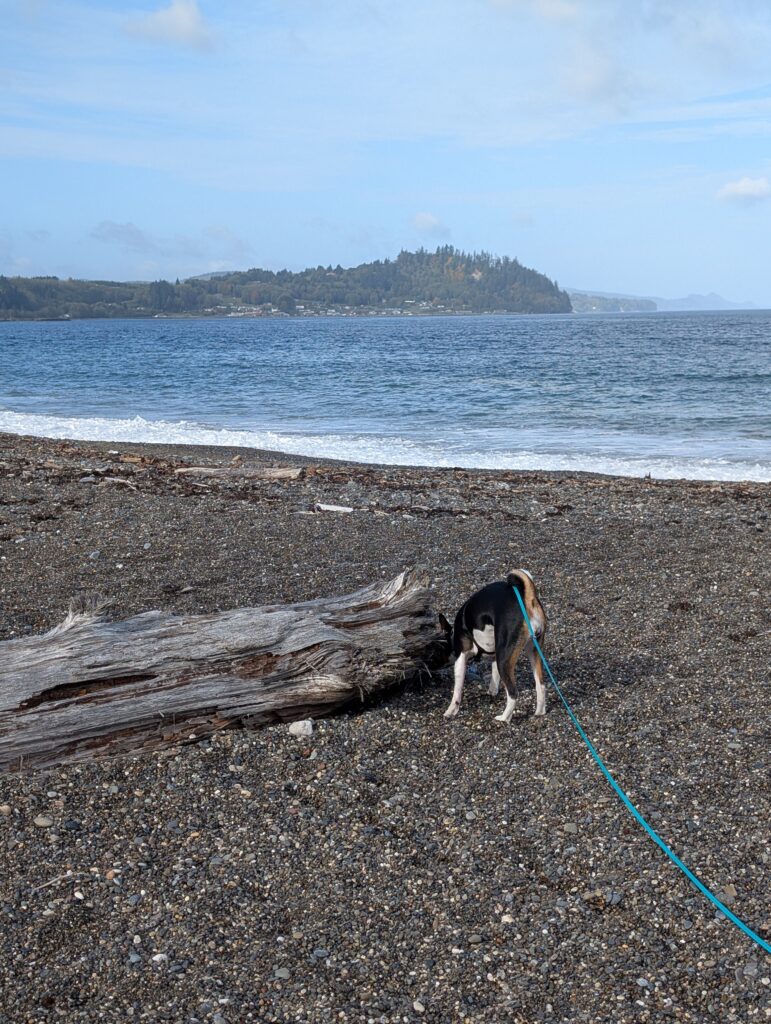
- sniffing activities
3. Transitional activities from higher to lower arousal
- dogs often need a bridge between stress and rest, rather than immediately calming down.
- Movement > chewing/sniffing/licking > settling/resting/sleeping
4. Social support and co-regulation
- massage
- petting
- snuggling
- calm talking
- settling in proximity
- sharing snacks
If you look back at the categories of stress releasing activities from Burnout, you might see some overlap here!
How do we encourage our pets to complete their stress response cycles?
If we had to react in the moment to help our pets with their reaction to every stressor, we wouldn’t get much done. Management and environmental arrangement (antecedent arrangement if you like the technical terms) set our pets up for success. Here are some examples:
- placing toys in multiple rooms
- snuffle mats with treats sprinkled in
- access to shredding materials
- access to things to chew
- sound masking
- safe spaces
- distance and/or visual barriers from stressors
Since we operate under the assumption that stress is part of life, and that every being processes it differently, if our pets express their emotions and process stress in ways that are safe, pose no danger to others, and do not damage items that are important to us, we try not to interrupt them. This might include:
- zoomies
- barking
- howling
- digging
- running/chasing
- destruction
Lest you think all of our dogs are running around like a bunch of maniacs (spoilers: they are), remember that training IS enrichment. All of our pets have skills that help manage stress. Here are some examples:
- flight cue – move away from stressors
- opt-in and opt-out cues – ways to say “yes” or “no thank you” to certain activities
- disengagement skills
- relaxation skills
Finally, we support our pets’ health comprehensively with medical support as needed, including:
- pain meds and physical therapy
- anxiolytics
- flexible medication protocols and situational meds

What does the stress response cycle look like in real life?
And now, without further ado, a glimpse into The Real World: Pet Harmony–where people stop being polite and start getting real.
When we know stressors are coming
Claire: Preparing Olivia for being left alone
“When I know that Olivia is going to have to be left alone, especially at a time of day that is triggering for her, there are a few things I try to make sure we hit:
- Some sort of physical activity: Olivia doesn’t need a lot of physical activity, so even a 20-30 minute walk or play time broken into a few small segments can be enough to meet this need.
- Planned activity while we’re gone: I usually have some sort of puzzle or frozen treat for her to work on while we are gone.
- Sound masking: Because Olivia gets irked by the sounds from outside our condo, I put on some sound masking. This is usually white noise from our fan, or a talk heavy tv show/youtube clip.
- Set up the environment: We set up the house so she has easy access to all of her safe spaces, food/toys, and ensure that there are also quiet spots for her to go if she doesn’t want to listen to the white noise.
- Meds!: Olivia gets a short acting medication to help her through longer periods of separation that allow her to rest while we’re gone.”
Veronica: Nosework class routine
“When I take Sprite to nosework class, she sits in the back middle seat so she has a good view of the drive – this is her preferred spot, otherwise she whines because she can’t see. When we arrive at the facility, we sniff outside leisurely, and she’ll potty if she needs to. She hates other dogs, so when entering the building she’s reinforced for eye contact with me, some LAT depending on what we see, and maybe a flight cue if there’s a surprise dog coming our way. She has her favorite blanky in her crate along with a yak chew to work on while she waits her turn. Often other dogs are barking in their crates, she gets a treat for not barking when she hears it, and I also capture de-escalation when she’s in the crate. I use a treat magnet when it’s her turn to come out of the crate so we can get to the working area smoothly. After we get home, she gets a lickmat or pupsicle and then she takes a nap for all her hard work.”
MaryKaye: Supporting a foster during stressful transitions
“Foster dog came to our home with anxiolytics already onboarded and she’ll remain on them for the foreseeable future. She’s acclimating to an entirely new environment and medication helps support her through that transition.”
Ellen: Contractors disrupting the household
“We have a contractor doing some work, and it is going to be stressful. Full stop, for the whole family. To make it stress-free, we’d need to avoid getting work done at the expense of safety and our dog’s freedom, or go somewhere else to live while it is getting done. Instead, we focus on how we can make this less stressful. We’ve moved our blackout and sound-dampening curtains around the house to reduce the audio and visual triggers. We leverage sound masking. We keep the dogs upstairs in my office while I’m working to increase distance from the thing. It is still stressful, but processing this level of stress is much, much easier than without all that stuff.”
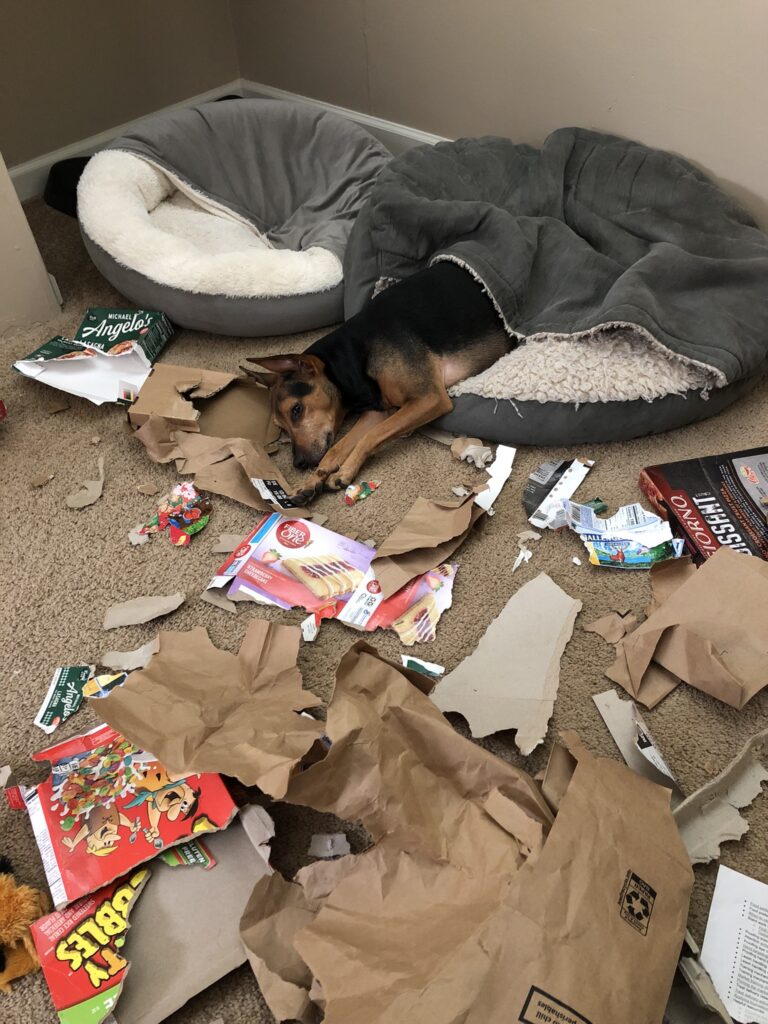
Allie: Preparing destructibles
“One of the ways that Oso de-stresses is by destroying stuff. When we know that he’s going to experience stress – good stress or bad stress – we make sure to have destructibles in his toy box so he has easy access to them. Outside, we make sure there are toys in the yard for the same reason.”
When stressors show up uninvited
Emily: Co-regulating during exciting moments
“For eustress – like, for example, seeing a squirrel – we observe together. I get down at her level and I act interested but calm. I talk to her in a bright, dynamic, but soothing tone, saying things like, “I know, right? How dare that squirrel exist. But she sure is beautiful, isn’t she? I totally get why you want to chase her. That’s an attractive squirrel right there.” I know she doesn’t understand the words and I don’t need her to. I just keep talking in that engaging but calming tone. I also don’t expect her to match my energy at first. I let her be really, really excited and amped up. But after a short time she starts checking in with me more frequently, and I just keep up the calm interest with the soothing tone. She gets progressively calmer, and eventually can just calmly hang out next to me, silently observing the stressor and checking in with me. Eventually, she lets out a sigh and moves on with her life.”
Emily: Teaching opt-out strategies
“First and foremost, we’re working on opt out cues and a flight cue so when something unforeseen happens, she’s learning how to either request that we stop or she removes herself from the situation. Then we move to a quiet space and do scent work until she does a deep sigh. That tells me she’s ready to go back to whatever we were doing.
MaryKaye: Letting dogs express themselves
“When she sees something out the window, she barks—and guess what? I let her. Why do we humans expect dogs not to express themselves when they’re upset? We raise our voices when we’re upset.”
Allie: Learning to ask for a break
“A while ago, I noticed that after a stressful event (again, good stress or bad stress) inside the house, Oso would ask to go outside. He would do his thing out there and when he asked to come back in I noticed that he was less stressed. Going outside and being by himself and getting to be a dog is one of the ways he de-stresses”
Everyday stress processing
MaryKaye: Fonzy ♥️
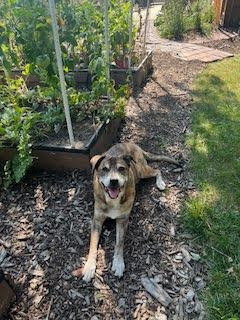
“In the fall we said our goodbyes to our best little old man Fonzy. He was 17 and helping him complete his stress response cycle mostly centered on arranging his environment in a way so that he could comfortably navigate it, both physically and mentally.”
Ellen: Matching activities to arousal
“Higher on the ladder? We do higher-impact movement like tug, sprinting, or chasing treats. As they move down the ladder we switch to licking, sniffing, chewing, and eventually cuddles.”
Emily: Starting the day calm
“Miley is absolutely not okay with me getting out of bed until I give her a full body massage. If I skip it, she gets super amped up, so it’s how we start the day calm.”
Corinne: Shreddable meals
“Opie doesn’t show much behavioral differences on the days he gets 2 walks vs 1 walk vs just outside time, but he IS so much more demanding on days when he hasn’t gotten time to forage and shred. For us, both his breakfast and dinner meals are split between 4-6 shreddables that are hidden through our house and destroyed upon discovery. This also gives him something to do while we are eating dinner, doing dishes, getting ready for school, etc. ”
Veronica: Chewing while waiting
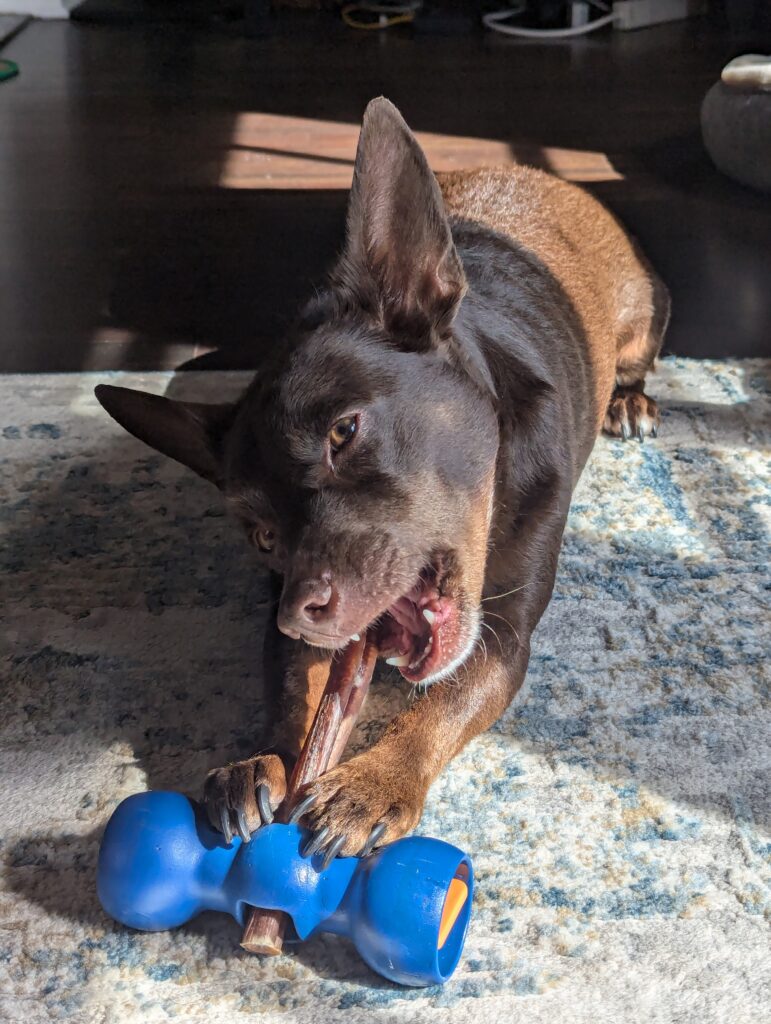
“When I get meals ready, I give Sprite a bone to work on – nylabone, yak chew, antler, etc. It helps get her frustration out that I clearly am taking too long to feed her. And the chewing is much preferred over barking at me.”
The weird (but totally normal) ways our pets decompress
Ellen: Zoomies & howling
“If my dogs get a bout of zoomies, as long as it’s safe I don’t stop it. Instead, we go somewhere they can get it out.”
“My dogs howl and it helps them move through their stress response cycle, so I let them howl.”
Emily: Pain zoomies
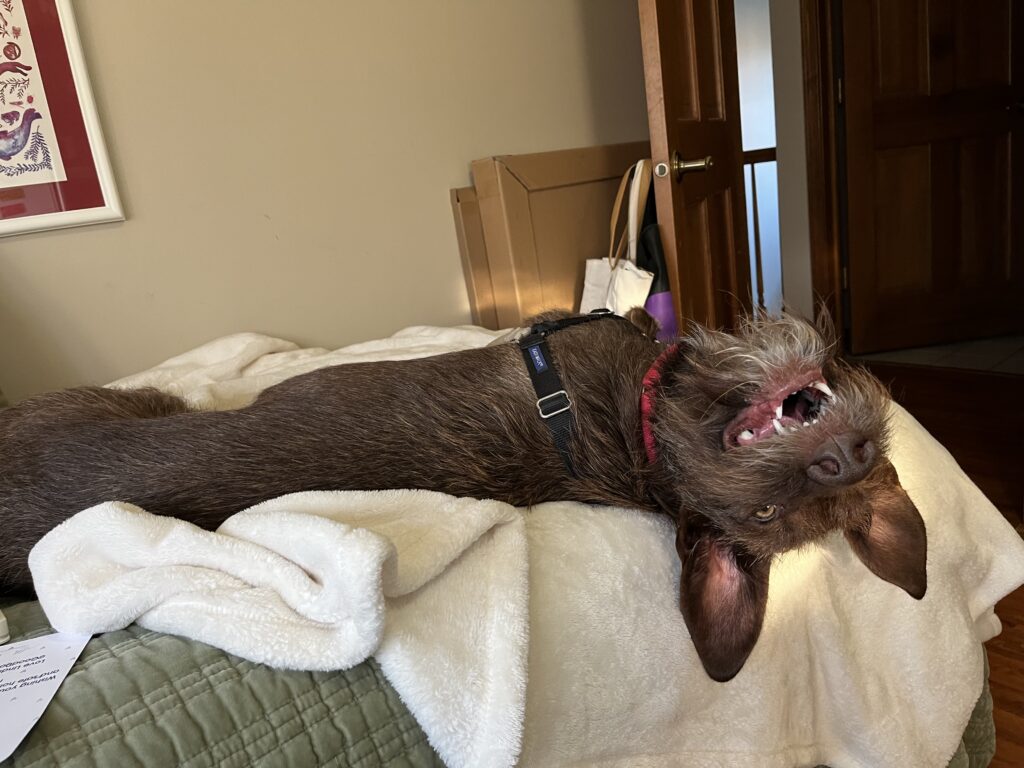
“Miley’s pain response is to get zoomies. One of the first clues I had that she had a UTI when she was a puppy was that she’d yelp, orient towards her backend, and then do zoomies. I didn’t interfere with those zoomies because I could see that it was a coping mechanism for her. And I get it. If I stub my toe or slam my hand in a door, I need to walk it off and shout about it a little bit. Her zoomies are the same thing.”
Corinne: The Tony ritual
“Some nights, Opie will yell at us while we’re watching tv. While it appears like attention-seeking behavior, we’ve learned that it’s him fussing before giving himself permission to lay down. To help him, we accidentally discovered that Tony (not me, it doesn’t work) needs to go act like they’re going to play and wrestle on the ground. Opie will wag his tail, rub his body along Tony, sometimes play with something, but usually after 10-30 seconds will jump on the couch (usually in Tony’s spot regardless of where I am or where Tony was) and nestle in.”
Every being’s stress cycle is different!
Petey the Wondermutt rips down the hallway, grunting like a small, scruffy gorilla. He pauses at the top of the stairs, ears forward. From downstairs, we yell “WORK IT OUT PETER!”
He launches his body down the hall and onto the bed in the office, digging furiously. He presses his face into the blankets and mattress topper and barks sharply. Suddenly, he’s off the bed and charging down the stairs. We chuck a large stuffed dinosaur at his head, which he quickly grabs and shakes. He runs the length of the downstairs carpet runners several times before shaking off and grabbing the toy again. He will chew and pull and work the squeaker out of the toy, then proceed to shred and pull out the stuffing before taking a big inhale, sighing out a long exhale, and settling in his crate.
He is completing his stress response cycle.
In my house, we hoot and holler. We wriggle and writhe. We lift heavy weights and swing kettlebells. We touch grass. We spend time together. We work it out. We shake it off and we settle in. There is space and support for all of our stress response cycles here.
Here’s to zoomies,
Tiffany
Now What?
Need some guidelines for helping your pets process stress? I got you.
- Let them express stress safely.
- Provide outlets for processing.
- Help them transition to calm.
If you need ideas and techniques to help with the stress of your household, reach out!
Copyright 2025 Pet Harmony, LLC. All Rights Reserved.
Terms & Conditions, Privacy Policy
Results are not guaranteed because behavior, human, canine, or otherwise, are not guaranteeable.