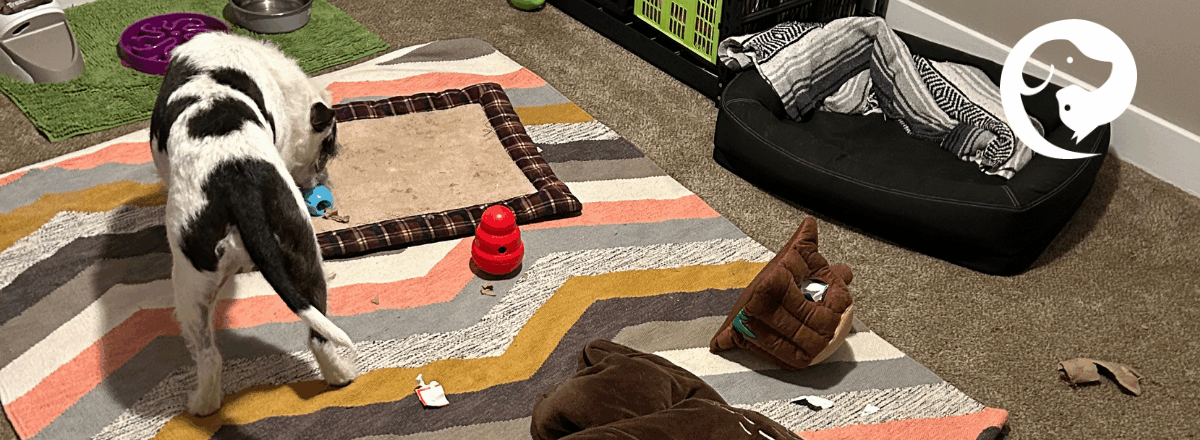
Before we get started on this roundup, let’s consult Canine Enrichment for the Real World (great book, have you heard of it!?) for some insight on foraging, shall we?
Foraging is the act of searching for and working to obtain food. Dogs’ undomesticated ancestors foraged for their food, consuming just about anything that was edible. Feral dogs today are also expert foragers. Most pet dogs will forage if given the opportunity; almost every dog owner has experienced dogs who counter-surf, pre-wash dirty plates in an open dishwasher, and vacuum up the floor of any food items that fall. It turns out that the act of working for and seeking out food is not only satisfying to dogs, it is a fundamental need. As such, it should be used to help enrich their lives and to teach them useful behaviors.
There’s a reason foraging is its own category of enrichment in the book. Dogs are foragers and opportunistic scavengers. In case you’re curious about the difference, foraging is collecting food directly from the environment.
Scavenging is eating food or carcasses that other animals have left behind or discarded (like that irresistible smelling Thanksgiving turkey carcass).
Either way, sniffing around for food is part of who they are. It’s also important to remember that only 17–24% of dogs live as pets in more economically developed countries, and even smaller percentages in less economically developed countries.¹
When we provide opportunities to find and access food, we are often increasing agency, control over the environment, and choices that result in desirable outcomes. Foraging doesn’t look like any single activity. Think of the differences in catching and eating a small mammal in the woods vs. finding and eating a dead fish on a beach vs. sniffing out a hot dog in a bag of trash in an urban environment.
Foraging activities look different in every household, and every team because 1) we’re not here to tell you how to live your lives 2) everyone in the household has their own bandwidth and set of needs, and 3) good enrichment increases welfare and well-being. Depending on the activity and the individual, foraging can provide physical exercise, mental stimulation, independence, calming enrichment, an outlet for instinctual behaviors, or even social interaction. Here are some examples of foraging activities:
- Scatter feeding in the lawn or other outdoor space
- Tumbling a food dispensing toy around
- Searching the house for hidden toilet paper tubes stuffed with bits of food
- Extracting frozen food from inside of a toy
- Snuffling bits of food out of a box stuffed with shredded paper
- Digging around in an old blanket that’s been scattered with food and wound, rolled, or tied up
In this season of bounty, I’ve rounded up a whole mess of blogs and podcasts that provide different examples of using foraging as part of an enrichment plan. How, when, and where to do it, what to look for, and our hottest tips for the brilliant scavengers we share our homes and lives with.
Skill Building: Observation and Outcomes
When we say that enrichment improves welfare and well-being, there should be a way to measure or observe what that means. That doesn’t mean you’ve gotta get out the ‘ol abacus (unless that’s what increases your welfare and well-being), but it does mean that we are collecting data of some sort.
For example, for a dog who is sensitive to sounds, a measure of improvement might be shorter recovery time after hearing sounds they react to. In this example, you might need to learn to observe the behaviors the dog exhibits when getting closer to settling and resting, and figuring out activities that they enjoy that help them settle and rest. Outcomes for the humans in the household are also important. Say the dog in question happily licks frozen peanut butter off of a lick mat and then curls up to rest, but they make so many sounds with their mouth that it grosses their human out. Information was collected, and the eval of that particular trial was…let’s find a different licking-related activity.
These blogs help with building observational skills around body language and the result or outcome of providing specific activities:
- May 2024 Enrichment Challenge: Learn Your Pet’s Baseline – To learn where our pets are having a hard time, we have to know what they look like and how they act when everything is fine. Ellen provides guidelines on how to start those practices.
- November 2023 Enrichment Challenge: Observe Outcomes – Ellen loves to observe. Here she discusses observing how environmental changes affect our pets.
- Sniffari or Sorry, Can’t Party? – Corinne getting real about when enrichment affects a dog and their human in very different ways.
- Every Mistake a Lesson: What Pets Teach Us About Getting It Wrong – Claire’s take on making mistakes and using them to grow.
- July 2023 Enrichment Challenge: Try a New Active Foraging Option – Ellen putting the skills we’ve just discussed to use. The goal here is using foraging to get your dogs up and moving!
- September 2023 Enrichment Challenge: Trial and Eval Calming Foraging Activities – Harnessing those observational skills, Ellen has a list of ways to use foraging to promote settling and resting.
Foraging Activity Ideas
Now that we’ve got the prerequisites out of the way, let’s get into some different ways to forage! Here are some of our favorites:
- Top 8 Enrichment Activities – We love a list! Here are some go-to enrichment ideas from Allie.
- A Plethora of Puzzle Toys – Puzzles are a great way to provide a mentally stimulating foraging opportunity. Claire lists some of our favorites!
- October 2023 Enrichment Challenge: Practice Your Treat Delivery – If foraging activities are new to you and your dog, start simple. Ellen provides different options for delivering food.
- February 2022 Training Challenge – Spice Up Your Scatter Feeding – Scatter feeding is a great starting place for foraging, but it’s also very versatile. Ellen provides options.
- Podcast Episode #112 – Try It: Teach Your Dog “Find It” From Scratch – If you and your dog are new to foraging, Emily walks you through how to teach “find it” to get started with following scent.
When Foraging is a Good Idea
Foraging is a great option when getting out and about isn’t. When weather, age, injury, or behavior challenges are considerations, foraging for the win! Here are a few examples:
- Indoor Adventure Time – Petey and Tiffany are here to show you how to include foraging with other activities when getting outside isn’t possible.
- Too Hot to Handle? Enrichment Ideas for Scorching Summer Days – Claire outlines how to adjust our normal plans and schedules for hot weather, including some innovative foraging ideas!
- Unlocking the Joy: Enrichment Ideas to Aid Dogs’ Post-Surgery Recovery – Emily outlines considerations for a pet recovering from surgery and how we can best meet their needs even while they need more rest.
- Podcast Episode #86 – Q&A: Indoor Enrichment Activities Ideas – Emily and Allie have plenty of suggestions for indoor foraging.
- Episode #128 – Try it: How to Find Indoor Activities for Dogs on Hot Days – Emily guides us through indoor applications of outdoor activities when it’s too hot to be outside.
Foraging as a Problem Solver
Allowing our dogs to use their big, beautiful brains by following their noses isn’t just fun, it’s useful. Meeting species-typical needs is always part of the plan when we’re troubleshooting issues. Here’s how that might look for some specific issues:
- Come on a Counter Surfing Safari with Me – MK reminds us that dogs are, in fact, going to dog. Here’s how providing an outlet for foraging behaviors can prevent the kinds of scavenging we’d rather not see.
- Calming Enrichment for Dogs: Leveraging Long-Term Calming Projects – Ellen outlines the criteria we consider when an activity is part of a behavior change plan.
- Enrichment Activities for Dogs with Separation Anxiety – Foraging and scent work can be part of the plan for separation anxiety too. Ellen shows us what that might look like.
- Episode #111 – Scent Work for Dogs:Enrichment That Supports the Whole Household – Remember, we want to improve welfare and wellbeing for everyone in a household. Allie and Emily break it down.
In this Economy!? (Foraging on a Budget)
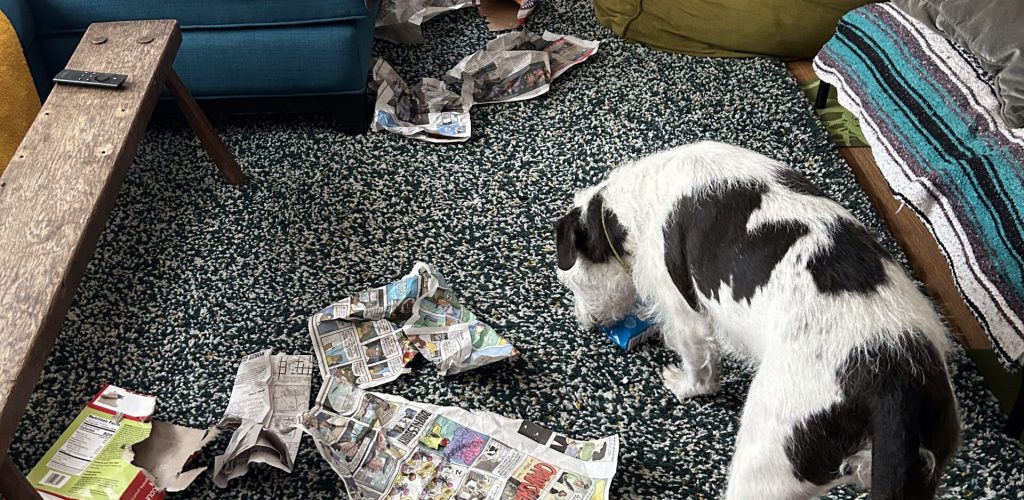
Time, budget, and bandwidth fluctuate. When you and your dog are doing your foraging balling on a budget, we got you:
- 5 DIY Dog Puzzle Ideas for Cheap Canine Enrichment – Sometimes you gotta do it yourself.
- 5 Free, Low-Cost, or DIY Enrichment Ideas for Dogs – Allie and Oso know how to party without spending a bunch of their hard-earned money.
- Trash to Treasure: How We Use Recycled Enrichment to Support Natural Pet Behaviors – This is one of the best blogs on the whole site, in my humble opinion. The whole Pet Harmony team giving you their best ideas and hottest takes on using stuff you were going to throw away as enrichment!
- Podcast Episode #116 – Try It: Budget-Friendly Enrichment from Everyday Items – Emily walks you through the steps of introducing DIY trash enrichment if you’ve never done it before.
What You Gonna Do With All That Junk?
Now that you’ve built your foraging empire, how are you going to store it all? Emily and Allie are here to help! Podcast Episode #69: How to Create an Efficient Enrichment Storage System
And if you’ve had it with foraging, Ellen’s got you: December 2022 Training Challenge: Explore Enrichment Outside of Foraging
Here’s to harmony,
Tiffany
Now What?
You’ve honed your observational skills, you’ve trialed and evaled your foraging activities, and you and your pup are a finely tuned trash factory of fun. Where do you go next? We’ve got plenty of ideas for you over in the newsletter. Sign up for a weekly dose of enrichment inspo!
References
- https://www.sciencedirect.com/science/article/abs/pii/S0168159118305914
Copyright 2025 Pet Harmony, LLC. All Rights Reserved.
Terms & Conditions, Privacy Policy
Results are not guaranteed because behavior, human, canine, or otherwise, are not guaranteeable.