Instead of forcing your reactive dog to “face their fears,” try flight training (teaching them to choose to move away from scary things on cue), which builds agency instead of dread. You’ll get the step-by-step process for pairing a flight cue with rewards and applying it to real triggers, plus an answer to the common worry that moving away might reinforce fear (spoilers: it doesn’t). The real goal isn’t eliminating fear, but building coping skills.
Tag: leash reactivity
7 Tips for Working with Your Leash Reactive Dog
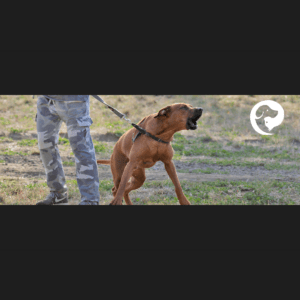
Leash reactivity (barking, lunging, growling at triggers) is usually rooted in fear. We’ll discuss practical tip around building a management plan, learning your dog’s body language, and using distance as your best tool for staying under threshold. You’ll also find guidance on practicing new skills before hitting the sidewalk.
6 Tips for Walking a Reactive Dog
Hey, friends.
This is a popular topic, so I know if you google “Tips for Walking a Reactive Dog”, a ton of things are going to pop up. There are going to be lists that focus on the physical aspects of walking, like what type of harness is best, or proper ways to hold a leash. You find lists that give you great pointers to help you maneuver in a world where you can’t manage your dog’s triggers 100%. You even find lists that include tips to help your dog mimic natural behaviors and movement as much as possible on a leash walk.
So, I’m gonna take a slightly different approach with this one and share things that I pay attention to that help me and my dogs have low stress walks through the neighborhood or at the park.
6 Tips for Walking a Reactive Dog
(aka the indicators you didn’t know to watch out for!)
#1 – Listen for garage doors
Seriously. When I walk my dogs I always keep one ear listening to indicators of triggers–not the triggers themselves, but the things that often tell me that a trigger is gonna happen. Garage doors are one of those things. Especially if you’re walking earlier in the morning, listen for garage doors opening up ahead or behind you. It can help you moderate distance between you and people, dogs, families, scary cars, and a host of other “people just living their lives” triggers.
#2 – Cars pulling into driveways or parking on the street
This is sort of the same vein as the one above. When I’m walking my dogs, I always pay attention to cars that are just now parking and take care to move my dogs away from that area. We never know what is going to come out of the car. It could be an off leash dog, a person speaking loudly on speaker phone, or a whole collection of people just getting home from school.
#3 – The sounds of kids playing
And sure, for Griffey, kids alone are kinda scary, but for things like kids playing in the street or at the park, that may also indicate that there are other things we need to look out for. Like a stray ball coming our way, or a basketball bouncing down the hill.
#4 – Dogs on property signs
I cannot tell you how much I appreciate it when I see signs that there are dogs living in a house. When I know this is the case, I can help Griffey cross the street, or pass the house more quickly. This helps me, Griffey, and the families in the house. Because, while barking at things is a pretty typical dog thing to do, I also know how annoying that can be, so if I can avoid triggering someone else’s dog, heck yeah!
#5 – Learn yards where dogs hang out
This one takes some time, but if you’re walking in a location regularly, learn which yards tend to have dogs in them during walking times. Just like above, I make an extra effort to cross the street to both avoid stressing me and my dogs out, and to give those dogs and families a little extra room.
#6 – Jingling dog tags
Jingling dog tags is another thing I listen for to help manage my distance from other dogs. This helps me to know which houses have dogs, which yards are currently occupied, or if a dog is coming down the street.
Finding your indicators
Can you tell I’m attuned to indicators of other dogs? Consider the things that your pet finds stressful and ask yourself, what may indicate that? The ones I’ve listed here are pretty good for dogs and people, but you and your pet might need something else! Finding early indicators can help you take a more proactive and empowered approach to enjoying walks with your dog instead of feeling like you’re just reacting to the world around you!
Now what?
- Learn your dog’s indicators! While we focused on things outside the house today, you can also look for indicators of stressors/triggers in the house. Things like the smell of smoke before the smoke detector goes off, or the quiet of the washing machine before that last spin cycle are some ideas to get you started!
- Once you know what to look for, you can start putting your management strategies in place to be more proactive and less reactive. When I see someone park their car in the driveway two houses up, I may cross the street, linger, or turn back. It lets us have the space to observe what’s happening instead of walking into the thick of it.
- And of course, if walks with your dog are frustrating, cup draining, and something you don’t look forward to, we’re here to help!
Happy Training!
Ellen
Leash Reactivity Practice… in a Parking Lot?
Leash reactivity (I.E. barking, lunging, growling on leash when seeing another person, dog, car, etc.) is one of the maladaptive behaviors that I help clients with the most. It’s a pervasive issue in our country. When I’m in the beginning stages of working with a client and their leash reactive dog, I often hear myself saying, “the exercises that we’ll do are fairly simple; it’s the implementation that’s difficult.” And, because of that, I almost never have them start out by using those exercises on a walk. Here’s why.
You have to crawl before you can walk.
Have you ever had that dream where you show up for a test but you’ve never attended the class? How did you feel in that dream? Scared? Frustrated? Destined to fail?
Teaching your dog a new behavior modification exercise on a walk is like having them take a test when they’ve never attended the class. We’re expecting them to not only use a brand new skill, but learn a brand new skill, in an incredibly difficult environment when they may or may not be ready and capable of learning. Doing this often leads to frustration on both the human and the canine ends. There are, of course, exceptions to the rule but by and large it’s not as effective or efficient to start out training in this difficult scenario. Slow and steady wins the race.
Your dog isn’t the only learner.
As I tell many of my clients, “If you already knew this you wouldn’t need me.” We often add this pressure onto ourselves that we need to know everything and be instantly good at something. We don’t give ourselves the same grace during our learning process that we would to a child. That pressure can lead us to throw ourselves into situations that we’re not ready for.
I usually find that it takes longer for the human to learn how to do the behavior modification techniques than it does the dog. Though, to be fair, the human usually has more to remember, implement, and sometimes unlearn than the dog does! Plus, ask any teacher: you need to know way more about a subject when you teach it vs. when you’re using it. And if you’re training your dog then you are teaching.
For this reason, I like to move at the pace of whoever is at the earliest step in that particular learning process– regardless of species. For example, I will sometimes do consultations for new adopters who’ve adopted a dog that I or a team I know has worked with in a shelter. I know the dog has been taught a particular exercise and now it’s a matter of teaching their new family how to do it too. We’ll need to work at the human’s pace, as they’re at an earlier step in that particular process than the dog is.
Conversely, take someone who has worked with a leash reactive dog before. They’re adept at doing the exercises from working with a previous dog and just need help transferring those skills to a new one. In this case we’ll need to work at the dog’s pace.
Most frequently, however, I have cases where both the human and the dog are new to leash reactivity exercises. We’ll need to play these by ear and examine skill levels at each step to ensure that all parties are ready to move onto the next task. Each individual moves at their own pace, and that is perfectly okay.
Real-life situations have a lot more variables
Even when both dog and handler have a solid foundation built of their leash reactivity exercises in easier, low-stakes situations, taking those skills straight to a neighborhood walk can still be challenging. There are a lot of variables on a walk and you’re likely to encounter extra-challenging situations, like people popping up from behind corners or exiting their houses, multiple triggers coming from different directions at the same time, barking dogs in yards (especially if they’re on an electric fence and you don’t know if they’re going to stop or go through it), general trigger stacking throughout the experience, and more. It’s much easier to continue working on those skills and exercises in increasingly difficult situations and work your way up to implementing those skills on a walk instead of jumping straight to a neighborhood walk.
Your neighborhood wasn’t designed for leash reactive dogs.
Neighborhood planners don’t keep leash reactive dogs in mind in their design plans and it shows! I always tell clients that distance is their best friend when working with a leash reactive dog; if their dog starts reacting then move away from the trigger until they stop. I frequently hear some protest to that statement in the beginning, along the lines of, “I can be 4 houses down and he’s still barking!” Both statements are true. There’s a distance that exists where your dog will not be reactive towards a trigger and it’s farther than 4 houses away. Your neighborhood planner wasn’t thinking about leash reactivity.
I find that in many cases we can’t start off immediately working in the neighborhood partially because we can’t get the proper distance. Across the street or 4 houses down doesn’t cut it. That’s where parking lots can come in. Specifically, I like using those giant strip mall parking lots that big name pet stores often have (at least in my area!) Park and work in the very back of the lot and you’ll get the distance you need, a more steady stream of triggers to practice with, and fewer surprises as usually people will park near the store and go only from their car into the store and back. (Note: large parks can also get you the distance you need but because people walk more sporadically and erratically in parks I still prefer parking lots.)
What if I have to walk my dog?
Up until this point, I’ve made a big and sometimes untrue assumption: you don’t need to walk your dog. There are many cases I see where this assumption is true. The family has a fenced-in yard that the dog will potty in and we can replace walks with other mental and physical activity while we’re working on the reactivity. In the suburbs that is often the case. However, there are absolutely situations where the family does not have a fenced-in yard that the dog will potty in or doesn’t have a yard at all and an indoor potty space isn’t a viable option. These are more challenging because we can’t avoid walks but we’re also not ready to practice on walks. In these cases we’ll heavily increase the management on walks to avoid triggers as much as possible until we’re ready for this scenario.
Now what?
- Are you someone who’s struggling with working on your dog’s leash reactivity while on a neighborhood walk? Take a few steps back (figuratively) and find an easier scenario to practice in. Your behavior consultant can help you with this!
- Not sure how to work on leash reactivity? Join us for our FREE Roadmap for Behavior Solutions Workshop next week (8/16/21-8/20/21) to take the first step towards your behavior modification journey. Sign up here: https://petharmonytraining.com/roadmap-workshop/
Happy training!
Allie