Decompression Walks: Rethinking What a "Good Walk" Looks Like
Estimated reading time: 9 mins
Which of these options do you think your dog would prefer:
- The same old neighborhood tromp tethered within 6 feet of a human, who gets to choose each turn and step of the route.
- A walk in a more open space with a longer radius from the human, following their nose and sensory input to choose where they meander.
Look, sometimes getting out, going potty, and getting home is the name of the game, so no shame for a quick neighborhood jaunt. Corinne has a great blog that talks about thinking through the purpose of the walk and making the type of walk more predictable. Additionally, we understand that the type of walk I’m about to describe is not always an option for any number of reasons.
What I’m talking about here is when the humans have the bandwidth, and the purpose of the walk is for the dog to get as much out of the experience as possible…my guess is your dog would like option 2, please.
What is a decompression walk?
A decompression walk might look a little different for every dog. But they center the same things:
- Time outside, interacting with the environment
- Freedom of movement (well-fitting harness and long line or off-leash)
- Choice in the route (as much as possible)
- Ability to process and track scents
- Taking a walk that leads to down-regulation and rest
The purpose of a decompression walk is to help your dog relax. This is why we often recommend them for clients working on reactivity. We’re trying to find an environment that is not overstimulating or winds them up.
If we want our dogs to seek out activities and spaces that help them unwind and relax, they need to know how that all feels in their body, and we need to have good observational skills to spot it.
Take some time to watch your dog the next time they are caught up in a good sniff. What is the rest of their body doing? Where are they holding or relaxing tension? Can you tell what type of scent they are processing by what they are doing?
A unique experience
I was introduced to the concept of an animal’s umwelt by Ed Yong’s gorgeous book An Immense World. The term umwelt was coined by German biologist Jakob von Uexküll, and I am simplifying a great deal here when I define it as the way an animal experiences the world based on the available sensory input, which can be wildly different depending on sensory equipment they possess.
Our dogs have an incredible sense of smell (which are covered quite a bit in Yong’s book, thanks to his time with Alexandra Horowitz). The approximately 300 million scent receptors in their noses are backed up with the processing power of a brain powerfully evolved to analyze what those receptors pick up. Our own noses, by comparison, have around 6 million scent receptors, and our brains have a much smaller area (like 40 times smaller!) for processing scent relative to the overall size of our brains. It’s like they’re experiencing a completely different world than we are!
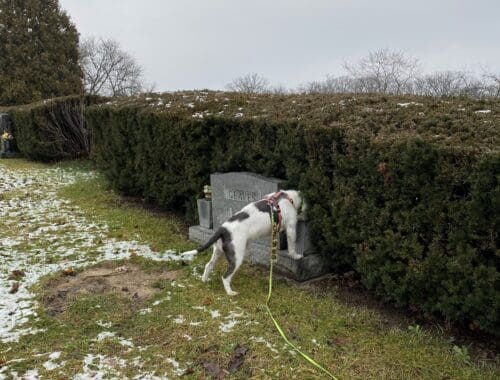
This hedge row is not a particularly interesting part of the cemetery for me, but Petey always takes his time sniffing around, often disappearing inside a hedge like a goblin. I call this “Hedge Patrol.”
One early morning I was out at the neighborhood park with Petey. I bought my house specifically because it was close to this park. Every summer, the good folks of the Allen County Parks Department do an excellent job planting the historic sunken garden with a different beautiful theme. I was admiring the colors of the sunrise and the garden, as I watched Petey intently sniffing a patch of grass near the muddy bank of the nearby pond, a tangle of fishing line and an abandoned container of worms adding to the ambiance.
I noted to myself that as a sighted human, I was processing very different input (and thoughts), and having a very different, but no less valuable, experience than my dog. The bubble of my umwelt had me appreciating something worlds away from whatever it was he was sniffing in the grass.
An opportunity for more agency
In the simplest terms, agency means having some control over what happens next (outcomes). It makes sense that humans make so many decisions for our dogs. We need to keep them safe, fed, bathed, etc. all while having our own lives, and tending to the lives of any other living beings in our care. There are plenty of things they just don’t get a choice in, like what time things happen, what they eat, needing to see the vet, the list goes on.
On a decompression walk, we can provide an opportunity to let our dogs’ senses guide them as they choose where to meander, sniff, graze, maybe dig, roll, and generally do dog things.
There are, of course, reasons we might help guide them in a different direction (to avoid a trigger like leaf blowers, perhaps), or help them to not do a dog thing (like rolling in something dead, especially if we all have to hop in the car after).
As much as possible, the dog decides what is interesting and where to go on a decompression walk.
An across the board activity
In the Pet Harmony Enrichment Framework, when we’re prioritizing enrichment activities for a client’s plan, we look for those that have the biggest bang for our buck. An activity that can cover several enrichment categories…across the board.
A simple stroll in a quiet spot on a long line could provide something like:
- Physical exercise – movement variety on different surfaces at different paces, depending on the environment.
- Sensory stimulation – sights, sounds, textures, scents, and tastes (because you’re bringing treats, right!?).
- Species-typical behaviors – along with their senses, expressing normal dog behaviors has them thriving in their umwelt!
- Social interaction – as Emily likes to remind us, the relationship is the entire point of having a dog in your life, so enjoy some time together.
- Mental stimulation – all that sniffing and processing is good for their big, beautiful brains.
- Calming – remember, we’re trying to find an environment that leads to some chill time – think less like an iron man to run them ragged, and more like a sprawling, educational conference that is also deeply satisfying.
A decompression walk can hit more categories depending on where you go and how you do it. For example, Petey’s usually involves some foraging. I’ll sprinkle some treats in the grass for him to snuffle while I work on picking up his poop, or I’m bent down trying to get a photo of a cool bug, or if we need to take a moment to avoid a trigger. If the walk is off-leash you may cover independence, and if there is a post-walk cleanup situation, some hygiene. Of course we’re always looking to cover safety (being safe from harm) and security (feeling safe from harm), knowing that being alive, leaving the house, and living in the world all involve risk.
Basically, a decompression walk is like enrichment bingo!
How to start taking decompression walks
In my blog How to Simplify Walks With Your Reactive Dog, I cover a lot of tips for setting yourself and your dog up to take decompression walks. From what equipment to bring and ideas for organizing it, to what to look for and reinforce on a walk, to ideas for post-walk activities, these tips are not just for reactive dogs.
1. Look for spaces where you’ll be comfortable following your dog around.
If your dog is following their nose, they might not stick to an available path. If you’re not cool wandering behind mausoleums to investigate groundhog burrows, you won’t want to hang out in cemeteries like me and Pete.
Be sure to consider the season with this one – there are certain spots I avoid when it’s icy because I’m clumsy enough on a good day (thanks, hypermobility!), and I don’t need to slide my way to a concussion following my nimble goat of a dog around in the winter.
2. Think about the types of environments your dog is most comfortable sniffing, exploring, and meandering around.
What about those spaces helps them feel confident and inquisitive? Consider things like:
- Time of day
- Temperature
- Noise level
- Textures/surfaces
- Types of smells they encounter
3. Find spaces that allow your dog to do those things! (And avoid things they struggle with).
For many dogs, this means a quiet spot with enough structures and surfaces to collect interesting (to them) scents, enough space to move around, plus space to move away from anything troublesome (I’m looking at you, Canada geese).
Last year I decided to look for some new cemeteries to add to our rotation, so I hopped on Google Earth/Maps and looked for cemeteries within an hour drive. I wanted to see what else was around before I made a drive out anywhere, so the aerial and street views came in handy. This is how I found a nice open cemetery bordered by corn fields that’s about a 30 minute drive. It’s been a great addition! Bonus: There is a small farm on one side that has an EMU! An interesting way to find out Petey does not care about emus.
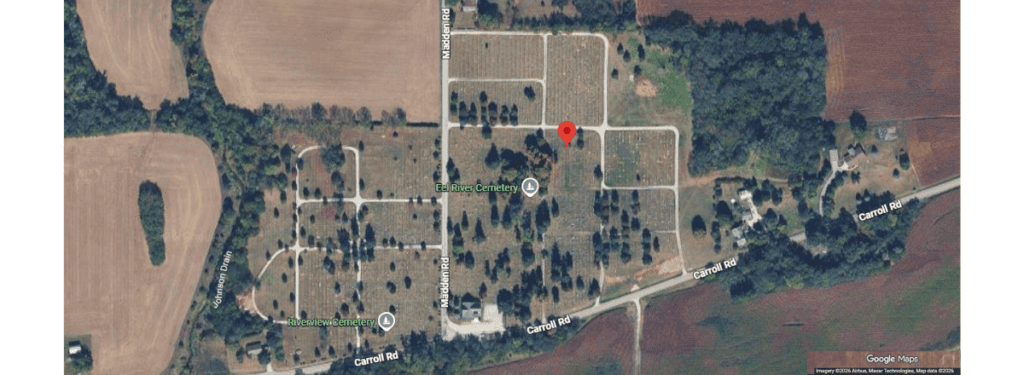
A perfect cemetery: open spaces, plenty of interesting sniffs, and surrounded by corn fields. Screenshot from Google Maps.
4. Make sure you feel comfortable using a longer leash, and invest in equipment that works well for you.
Using a longer leash takes practice! There are many useful skills for walking on a long line, but that’s not the point of this particular blog. As with anything new, it’s worthwhile to practice in a familiar, low distraction environment first.
Deciding what equipment works best for you can take some trial and eval. I personally like a biothane leash, but I think anything over 20 feet gets hard to handle. I’ve also gone through an embarrassing number of treat pouches, and still don’t have one that I consider perfect, but overall I like my current setup.
Get out there and have a meander!
Cemeteries are my and Petey’s well-documented favorite spot for a decompression walk. I asked the team where they like to have a meander in case you need some ideas:
- Veronica: The forest preserve is my kiddos’ favorite spot, but we don’t go there in summer due to the massive amount of ticks. For reasons I don’t fully understand, they also really love looping around the local library. It never fails that I see true smiles from both Preston and Sprite on those walks, it’s delightful. And on regular days when time is tight, we go to local business parks, where it’s usually just us and the geese.
- Ellen: I don’t have a unique answer, we just go to a local park at off hours with lots of escape routes.
- Emily: I let Miley take choose-your-own-adventure walks, where she chooses the direction and sniffs as much as she wants to sniff. Which means that there isn’t one specific area we go to, but the process of getting to wander around wherever she wants and sniff to her heart’s content is decompressing.
- MaryKaye: My answer is same as Em’s and Ellen’s. Big open fields/parks with lots of agency but where we could see stressors coming and use distance as needed.
- Beccy: Sully and I like to go to one of our greenway trails that leads to big open spaces where they play frisbee golf. There are edges of the field with trees and brush, along with the creek for him to stand in and cool off.
- Allie: We used to go to a corporate office park.
- Pro tip: Not all office parks are cool with people walking around, so you should check first before making this a decompression walk destination.
- Tiffany Chen: We live in the dang desert so not much nature to walk around. We go to this huge soccer park. It’s basically a sports complex with soccer fields everywhere. But the paths are huge and not a lot of people go in the mornings so he has plenty of room to roam about.
Here’s to harmony,
Tiffany
Now What?
Make some observations this week:
- What kind of walk helps your dog relax?
- What are the features of that walk (environment, time of day, etc.)?
- What type of walk seems to ramp your dog up and the need extra help (a project, etc.) after?
Compare this information to your own schedule. Can you implement some walks that set your dog up to chill while you are busy or would like to do something on your own?
As always, if your dog has a hard time relaxing, loses their cool on walks, or you need help creating a sustainable enrichment plan, we’re here to help.
PS: Capitalism
Want to support our free, public content? Check out our Amazon shop. It’s full of enrichment and pet care items (that we really, actually use). Our team spends a significant amount of time working on content every week. We love it! But we’re also out here trying to pay our bills.
* Pet Harmony, LLC is a participant in the Amazon Services LLC Associates Program, an affiliate advertising program designed to provide a means for sites to earn advertising fees by advertising and linking to Amazon.com.
Tiffany Holmes, CPDT-KA, FFCP
Tiffany Holmes is a trainer and behavior consultant with Pet Harmony. She is also a mentor in the PETPro mentorship program.
Tiffany is a “recovering technical writer” who gets to put her first career writing instructions to good use for her clients and mentees. She taught group classes for dogs (training) and people (yoga) before joining the original Pet Harmony Mentorship program and landing a job with us.
Copyright 2025 Pet Harmony, LLC. All Rights Reserved.
Terms & Conditions, Privacy Policy
Results are not guaranteed because behavior, human, canine, or otherwise, are not guaranteeable.