
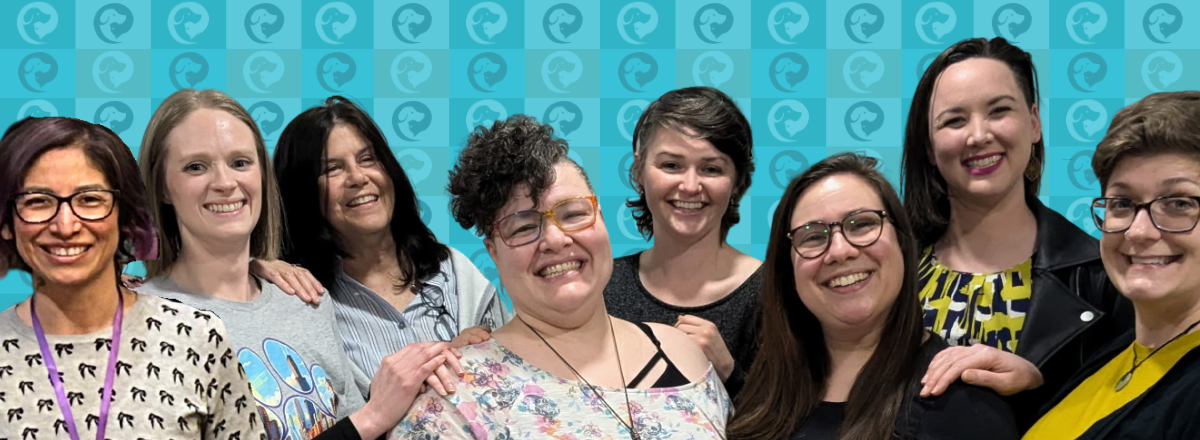
A group of 8 humans against a background of the pet harmony logo.

Becoming Pet Harmony

Every once in a while an inquiry hits our inbox from an aspiring trainer or behavior professional that asks us the best path to get into the field. Working in an unregulated field, where anyone can slap a title like “certified trainer,” “or “behaviorist,” on a business card is tricky. The terminology alone is confusing. Dog psychology? Obedience? How does anyone with a dog know what will be helpful? How does anyone who wants to work with pets know where to start when there is so much conflicting information? 

Unlike other professions, there isn’t a clear-cut answer or a step-by-step process. But sometimes that makes for a more interesting story, and that’s why we’re sharing ours. Whether you’re looking for your own path as a trainer, or you’re about to work with one of us as part of your behavior team, we hope that getting to know us a little better is helpful (and/or fun), and we’re glad you’re here.

TL;DR

Although our paths are varied, here are a few of the common themes I pulled out of our stories that brought ours together here at Pet Harmony:

  • Mentorship: Just like a stray kitten finds a trusted human to follow home, many of us started by finding a mentor to show us the way.
  • Behavior and body language: We all learned about behavior and body language in some way. In college, through a program, a mentor, or by filling our shelves with books, these essential topics inform our practices and allow our team to prioritize welfare and wellbeing.
  • Hands-on experience: Whether in a shelter, vet clinic, or training classroom, we all spent time applying behavior principles and practicing training mechanics. 
  • Curiosity and growth mindset: We’re all lifelong learners. Whether we have college degrees, certifications, or other credentials, we continue to learn and grow. Additionally, we have all brought our individual skills and talents along for the ride, including those from previous lives and careers, which bolsters our next theme…
  • Teamwork: Internally at Pet Harmony or working as part of our clients’ care teams, we know that helping people and their pets live harmoniously means we all have to work together. 

Allie

Well, I was born on a Monday… 

Fast forward 13 years – I wanted a puppy. We had always had 2 dogs while I was growing up and 2 years had passed since we lost one of my childhood dogs leaving us with only 1. It felt like the mourning period was over and it should be time to add another four-legged family member. My parents disagreed with that assertion, saying that they did not want the responsibility of caring for another individual. 

So, in true Allie fashion, I created a PowerPoint presentation and presented to them everything that I would do for the puppy and all that I learned about caring for puppies. They relented, and we adopted an adolescent Newfie mix, Bear. Thanks to Bear and his adoption process, I learned a lot about animal homelessness in the US and decided that I was going to open an animal shelter. Which is obviously a totally normal thing for a teenager to decide to do with their life. 

My local shelters did not allow volunteers younger than 16, so as soon as I turned of age, I started volunteering. The volunteer position was loosey goosey, and I got to do everything from cleaning dog and cat enclosures to helping potential adopters to providing enrichment. I also got my first job at 16 as a veterinary assistant. At 17, I started working at a local pet boutique. 

I went to college for Animal Science at Iowa State University (decidedly not pre-vet). While there, I started a student-run organization called Students Helping Rescue Animals to connect students with local shelters and provide aid through volunteering, fundraising, and educating the student population. That organization still exists today!

I took all the classes I could on companion animals, animal enrichment, and human psychology. I published my honors thesis study on environmental enrichment and its effect on adoption rates for shelter dogs on the ISU Ag Extension website. I had a few summer internships with shelters and sanctuaries, a semester-long internship with the director of a senior citizen facility, and did a whirlwind study abroad about horses in Ireland and the UK. 

After graduating in 2012, I was only able to find part-time work with animals so I had a bunch of part-time jobs: Kennel Technician at a local shelter, Dog Trainer at a local company, Veterinary Assistant at a local low-cost spay/neuter clinic, and assisting my mom in her real estate work. 

One of those jobs finally turned full-time and I became the Program Manager for the low-cost spay/neuter clinic in 2013. This was it! I was going to do the things I needed to do when I opened my shelter! Fundraising, program development, donor relations, volunteer coordination, marketing… and I hated it. So a decade after deciding I was going to open a shelter and taking every opportunity I possibly could to prepare myself for that, I entered into a quarter-life existential crisis, realizing I no longer had that dream. 

In considering what I was going to do with the rest of my life, I found solace in teaching group classes every week for a local dog training company –  the only part-time job I continued when I accepted the full-time position. I just wanted to train dogs. In 2014, I took a full-time dog behavior consultant position with Best Friends Animal Sanctuary in Utah and eventually became the team lead for the dog behavior department. 

I was afforded a lot of opportunities while there: national speaking engagements, TV & commercial appearances, publications. But the most important opportunity was getting to work with hundreds of dogs and several cats with really severe behavior issues. I essentially got a super condensed crash course in behavior modification; what would have taken over a decade to experience, I got in a couple of years. This is also where I met Emily and we started working on Canine Enrichment for the Real World

We decided to move back to Illinois at the end of 2016. I worked contracted training jobs for 1 whole month before deciding that if I wanted to pay my bills and work as a full-time behavior consultant that I should start my own business, and thus Pet Harmony was born. Since then Canine Enrichment for the Real World and its companion workbook came out, we started the Enrichment for the Real World podcast, and I continue to speak and teach. 

Emily

Being the neurospicy person I am, non-humans were my special interest from infancy. My parents loved to tell the story about how my bib had a bunny rabbit on it with a squeaker in its tummy, and when people would squeak it I’d cry and tell them, “Don’t hurt the bunny!” So for as long as I can remember, I wanted to work with animals and cared deeply about their wellbeing. As a child, I thought the only option was to be a vet, so that’s what I thought I wanted to do.

When I was 10, we went on a tour of the Texas A&M vet school, and our tour guide told us, “To get into vet school, they don’t just look for good grades, they look for lots of experience working with animals.” Taking that hyperliterally (because, again, neurospicy), I asked my mom if we could stop by our local shelter when I got home. The shelter told me volunteers had to be 11 years old, so on my 11th birthday I signed up to be a volunteer.

I was a hard worker and very interested in learning more about animals and their care, so one of the vets who offered vet services for the shelter – and who, incidentally, knew my parents from church – invited me to volunteer at his vet clinic. 

So from the age of 11, I started volunteering at that shelter and vet clinic, eventually getting hired as a kennel tech at 15 and then trained up as a vet tech at 17. I also rode horses at a local barn. We couldn’t afford riding lessons, so I mucked stalls in exchange for lessons, and eventually was allowed to groom horses in exchange for lessons. 

The journey I went on through my teens and 20s was long and convoluted and I won’t bore you with the details, but the salient points are:

  • I also ended up working for an aviary, raising and training parrots; I volunteered for one wildlife rehab facility during college and worked for another later in my 20s; I switched to a different stable that used the freedom method and I eventually got to the point where I was able to work with the horses who had behavior issues in exchange for lessons; over the years I became a relief vet tech, which allowed me to work at a wide variety of veterinary practices, including emergency medicine, speciality hospitals, alternative medicine, and exotic medicine; I co-founded and ran Austin Parrot Society; and I served on the board of Wings of Love Avian Rescue.
  • In college I realized that I did not, in fact, want to be a vet. Instead, I double majored in Linguistics and Psychology. Due to health issues and family stuff, I had to drop out two months before I graduated.
  • Because I saw a lot of success working with horses and birds using kinder, more empowering and ethical methods (although admittedly still more coercive and aversive than I am now), I had some weird cognitive dissonance about the difference between how I was working with horses and birds vs. how I was working with dogs and cats, which my brain explained away by believing that predator species needed more coercion and “discipline” than prey species.

By my late 20s, I was in a pretty dark headspace. All I wanted to do was help animals, but it broke my heart to see how we were causing so much fear and aggression. I was told many times over, and believed, that “we have to hurt them to help them.” But it really messed me up. 

Through the avian community, I learned about Dr. Susan Friedman and was interested in learning more from her. Because I had majored in Psychology, I really wanted to hear what she had to say about the application of the behavior sciences to non-humans. So in 2008, I took the first course from her–a free introductory course called “Parrot Behavior Analysis Solutions” or PBAS. That course no longer exists, but in the very first lesson of PBAS I was just sobbing. Everything she said made so much sense, it was so cohesive, and most of all it was such a relief to know that no, in fact, we do not have to hurt them to help them.

I was hooked. I took every course she had available, I dove into every textbook I could find and afford, and I started following around behavior professionals who worked with different species like a stray kitten, not giving them much choice but to mentor me. I just knew that helping humans and animals to better understand each other and work together harmoniously was what I wanted to do with the rest of my life, and I was going to figure out how to do that, by hook or by crook.

But the thing is, my mentors were great, but they never signed up to be mentors and they weren’t set up to give me a comprehensive education. I did the best I could by stray-kittening as many mentors as I could find, reading as many books as I could get my hands on, and just diving in and doing the work with as many species as I had available to me (which, admittedly, was a lot). But I made a lot of mistakes. I had to learn a whole lot of lessons the hard way. My learning curve was a 90 degree angle. And I pro bono’d myself into poverty in the process.

So in 2016 I discovered another passion: helping other behavior professionals get to where I got without having to go through what I went through to get here. Allie and I have been developing and refining our mentorship program ever since then, and with Ellen added to our team we’ve ended up with PETPro, which is a mentorship program that I would have killed to have available to me when I was starting out. Our unofficial tagline is, “We messed up so you don’t have to.” And that truly is my passion: helping people to acquire the knowledge and skills to do this job well without all the painful mistakes I had to make. By doing that, my ability to help humans and non-humans live together harmoniously increases exponentially. And, really, that’s all I’ve ever wanted.

Ellen

Honestly, I got here through chaos, privilege, and a bit of whimsy. I went to college at the University of Washington and lucked out that they had an Animal Behavior program that was supported by both the Psychology and Biology departments. There, I was able to learn from some incredible animal behaviorists and researchers who truly believed in me. After finishing my Bachelor of Science in Psychology, I went on to gain as much diverse experience as I could. I worked as a Procurement Analyst at Boeing (someone stole my sandwich, and that was the last straw), and independent contractor running preference tests in home for dog toys and cat food for large corporations, managed a dog daycare, volunteered in wildlife rehab and at zoological institutions, and was the teaching assistant for the Certificate in Applied Animal Behavior at the University of Washington. 

In 2015, my partner had the opportunity to join a company in Florida, Natural Encounters Inc, and we left the PNW to embark on a Southern adventure. After joining the team at Natural Encounters, I had the opportunity to work on multiple teams, including the show team at Disney’s Animal Kingdom, where we facilitate free flight educational bird shows, and the Ranch team, taking care of the birds at home base, raising baby birds, facilitating professional education workshops, and leading facility tours. In 2017, with the help of Griffey, I completed the Karen Pryor Academy – Dog Trainer Professional course earning my KPA-CTP. 

In 2018, we were ready to return to the PNW, and I joined the team at Ahimsa Dog Training, helping puppies gain life and social skills, leading group classes, and really shifted my focus from my direct training skills to my people coaching skills. Again, with the help of Griffey, I fell in love with canine conditioning and fitness, and worked with Lori Stevens to learn skills to help Griffey, and other dogs, feel comfortable and empowered in their bodies.

Once the pandemic hit in 2020, my partner and I made another move down around Oakland, California. Once there, and with the whirlwind that was 2020 and beyond, things moved quickly. I published in the Journal of Zoological and Botanical Gardens with my mentor Dr. Eduardo Fernandez, and my partner Nathan Andrews; releasing research completed during my undergrad. I completed Julie Naismith’s Separation Anxiety Pro Behavior Consultant program, earning my CSAPBC. I joined the training team at East Bay SPCA, running classes and seeing private clients, and jumped at the opportunity to join Pet Harmony as a Behavior Consultant. 

Since the chaos of 2020, I’ve taken on the roles of Behavior Consultant, Operations Manager, Mentor and Co-Owner at Pet Harmony. In addition to my work at Pet Harmony, I’ve returned to the world collegiate learning as a Teaching Associate with the University of Washington in their Certificate for Applied Animal Behavior. I’ve taught courses on creating safe spaces for pets, presented at conferences on working with clients, and continue to strategically seek out learning opportunities from amazing mentors and teachers.
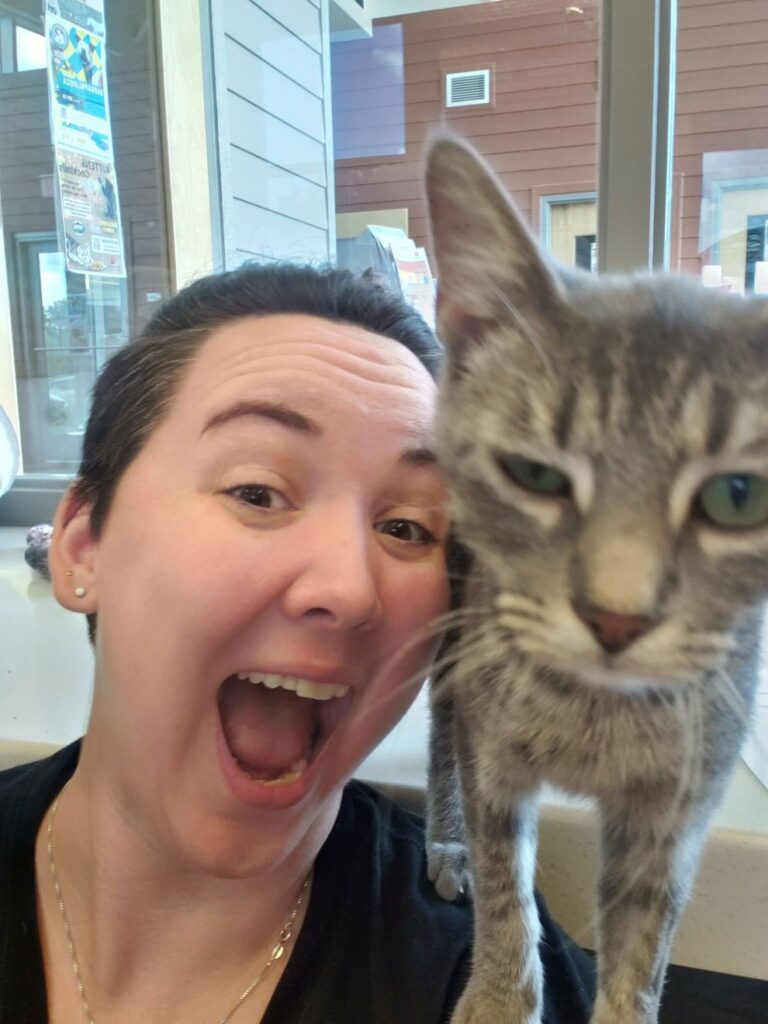
A woman smiling with a cat on her shoulder.
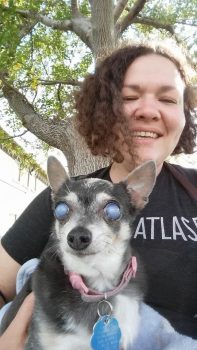
Emily with a sweet old lady
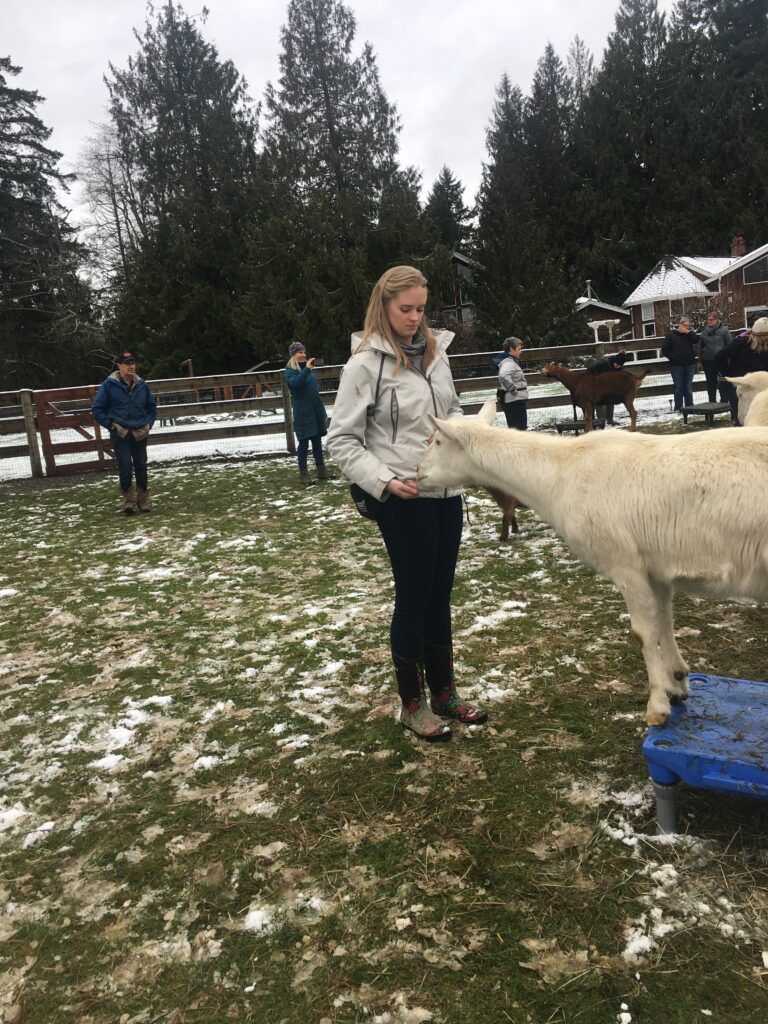
A blond woman in a white coat feeding a white goat.

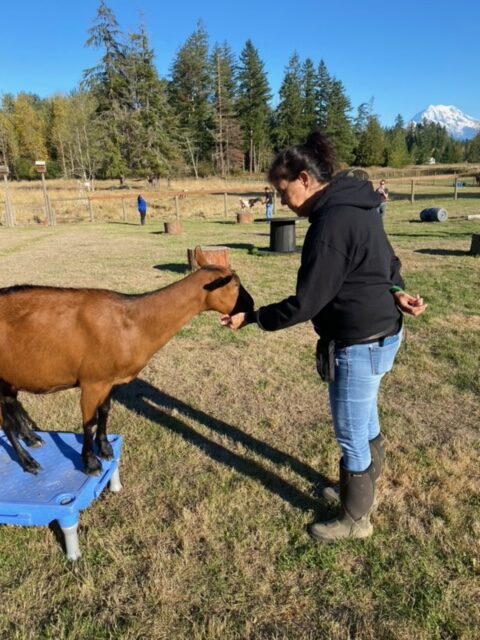
Our fearless leaders, left to right; Allie, Emily, and Ellen. Pet Harmony co-owners and work wives.

Claire

I’ve always been the “animal girl” of the family. I was the neighborhood dog sitter, the kid people called to “come feed the cats while I’m gone,” and the one who would attempt to teach my dog tricks in the backyard without any information or instruction (she was a pro at “Get it!” by the time we were done!)

In middle school, I got really into musical theatre and thought that would be the path I would pursue. I went to college and got my Bachelor of Fine Arts in musical theatre (while walking dogs for some side cash), and after saving some money at home, moved to Chicago to start auditioning!

Cue my quarter life crisis realizing that I didn’t want to live the lifestyle that musical theatre would likely require of me, despite my heart being entirely smitten with it. I sat down, thought about what I truly cared about, and realized it came back to animals, especially dogs and cats. As evidenced by my childhood, I loved spending time with animals and caring for them. I’ve also always been fascinated by behavior. Much of my theatre training was spent analyzing thought processes and what drives people to do and say the things they do. In fact, that was one of my favorite parts! When I realized that there existed a role in the animal world that would allow me to embrace all of those things, I excitedly dove head first into learning everything dog via dog daycares and attempted to connect with anyone who might be willing to mentor me. 

I jumped around to a few different doggy daycares until I ended somewhere where there was a training department that gave me foundational knowledge. During this time, I read Canine Enrichment for the Real World, which guided me to look up Pet Harmony for help with my own pup. It was through further conversations that I learned about the Pet Harmony Mentorship Program, the precursor to PETPro. I got to meet some of my future coworkers there, speak with mentors that helped me to continue growing my knowledge and skills, and join an invaluable trainer community that I’m honored to be a part of today! From time spent there, I was able to formally join the Pet Harmony team. They have been absolutely integral in helping me learn and grow my skills. 

Today, I work with all types of animal behaviors, helping families and their pets feel confident and safe. The best part is that I am in a constant state of learning, which means the job never gets stale! I’m absolutely working my dream job and I’m so grateful for what I do.

Corinne

Look, I just really like brains, I like communicating, I like exploring, and I like connecting with others. While all my kindergartener classmates wanted to be superheroes or work in the Doritos factory, I wanted to be a teacher. As I got older, I became obsessed with music and band class–playing my oboe and mellophone consumed my waking hours. When it came time to apply for college, I felt the internal pressure to prove my intelligence by doing something highly academic while also fulfilling the budding feminist inside of me so I went to the University of Illinois and was a Molecular and Cellular Biology & Gender and Women’s Studies double major so that I could become a gynecologist… but I couldn’t stay away from music classes and ensembles. One day, I eventually stared at myself in the mirror (literally, I was so emo), cried for about 30 minutes straight, and decided to switch majors to Music Education.  

After graduation, I worked at the Walt Disney Company in a few different roles, then got my “Big Girl Job” teaching band at a Grammy-award winning high school, and fell totally in sync with my purpose as a connector. I loved teaching music and I loved how ensembles connected so many people through creating something together. I thought this was what I was going to do for the rest of my life.

So how’d we get here to the animals? Opie Dog! I first started volunteering as a dog walker at our local shelter because I wanted a dog so badly, but couldn’t have one yet. One day, I walked into my regular volunteer shift, the stars aligned, and I met eyes with my soul mate Opie. I called my human soul mate Tony, told him this, and we adopted Opie as a 1 year old. He was filled with joie de vivre, including all the delightfully naughty things. What was going on in this puppy dog’s head?!  I started to consume everything I could about dog training and with every book I read, I started realizing that I can replace “dog” with “freshman” and it all still reads the same.  Training is a way to connect with another learner and it was so similar to teaching my band kids. The humane society connected me with Allie Bender, she took me under her wing (I got to read Canine Enrichment for the Real World as a manuscript!), and I began working as a dog trainer on the side. I studied more, I learned more, I taught group classes, and I spent more time working with behavior cases. After my second kid was born, we decided to take a break from teaching in a brick and mortar school with human brains and now I’m doing behavior consulting with pet and human brains.  

Band Teacher and Pet Behavior Consultant may seem like two different things, but at the core of both is learning, connecting, and growing with others.

MaryKaye

Ask 100 different dog trainers and behavior consultants how they got to where they are and it’s likely that you will get 100 vastly different answers. Here is a part of my story: 

I always had a strong love of and interest in animals, including human animals but I was especially interested in behavior. I was also really obsessed with dogs as a kid. I mean really for realz obsessed as evidenced by the multiple dog books in my little kid library. I toyed with the idea of being a vet but I knew I wouldn’t be able to afford tuition for that many years plus…math. Stick a pin in this one, because I also thought about being an animal trainer but I had no idea how to go about accomplishing that so instead I earned a BA in psychology, because behavior.  

My first job post college was as a case manager in a social service agency that provided services to senior citizens. It was my first real foray into applying how behavior works in the real world. 

When my first born son was old enough to enter preschool, he was enrolled in an early childhood Montessori school. I was once again bitten by the behavior and learning bug and I was smitten by the approach that the Montessori education system utilized to help students learn at the pace that was right for them. So I did the only logical thing I could think of and joined the staff at the school where my son was a learner. I did that for almost two decades, devoting time to both the preschool and kindergarten classrooms as an educator. Truthfully, my years as an educator of young children was incredibly impactful in terms of being able to look at behavior through the lens of curiosity rather than judgment. What a gift to me! 

I started volunteering in animal shelters because, remember, I was a lover of dogs and wanted to get back to spending more time with them. And, hardly shocking to anyone that knows me, it was the dogs who were struggling the most in the shelter system that I was drawn to. I went on a learning rampage and started attending every local seminar, webinar and any other opportunities my brain could muster in an attempt to make life even just a little bit easier for the dogs who were exhibiting the most complex behaviors. 

Remember the pin I told you about at the beginning of our wee little journey (the one about being an animal trainer?) It only took me a few decades to discover that there are actually people and programs out there that you can utilize to help you reach your goals. One of those people was none other than Allison J. Bender. I am not embarrassed to say that I quite literally stray kittened her and she was instrumental in helping me forge my path as a trainer and consultant on the Pet Harmony team. I knew what I wanted and she helped me with the how. And here I am, several years later working to help clients and shelters address complex behaviors and growing and learning alongside a team that is incredible! 
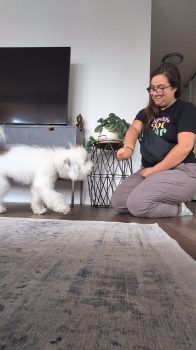
A woman kneeling on the floor next to a small white dog.
A woman holding a small dog in a santa outfit.

From left to right: Claire, Corinne, and MaryKaye

Veronica

How it started: Bachelor of Science in Business Administration. After that I was in employee benefits consulting for a few years, because, why not? While challenging, it was not personally rewarding for me. But it did provide a strong foundation of customer service skills and appreciation for “complete counseling.” 

Middle: I’ve been in veterinary medicine since 2009. I did this on a whim, starting off as a receptionist for a specialty vet hospital after leaving my consulting job and wanting to start over. Once I saw what the nursing staff was doing, I was hooked. I wanted to know all the things and how to care for sick animals. I became licensed after finishing tech school in 2013.

Later: I’ve spent most of my vet med career in emergency & critical care and in management roles. I’ve always had an interest in behavior because of my pets’ behavioral issues. I took classes and webinars to learn how to better support them through their struggles.

Now(ish): I switched to veterinary behavior after the pandemic. The pandemic was hard on vet med staff, I was ready for something new. I started working for Insight Animal Behavior Services and flourished with all the new concepts I was learning. I also saw the need for science based trainers with a true understanding of maladaptive behaviors. After getting my KPA-CTP I felt there was still something missing, so I joined PetPro. It was the missing piece I was looking for. It embraced the client’s journey and treated the animal as a whole. Then one day the stars aligned, and I joined the Pet Harmony team. 

Tiffany

How I managed to live most of my adult life without a dog is beyond me. But I rented and moved around a lot and wanted to be responsible or whatever. Until that fateful day in November of 2018 when I found a scruffy little staffy with sad eyes staring back at me on Petfinder…but since everyone else so graciously started at the beginning, I will too.

I grew up in the middle of a corn field in Ohio, where my brother and I ran wild with every type of pet you could imagine. Cats, bunnies, chickens, hermit crabs, hamsters, racoons, a goat named Spunky, a pony named Topper, and a handsome German shepherd-malamute mix named Sam. I spent my career shadow day in middle school following around my vet. Like so many people who grew up in the 80’s/early 90’s, I thought I wanted to be a marine biologist. I spent the first couple of weeks of my summer break my junior year snorkeling in the Florida Keys as part of a marine biology class I had taken. My very first job was walking dogs and cleaning dog and cat kennels at a local vet clinic that also did pet boarding. 

But I had allergies. And I couldn’t do math. And life happened. And college happened. I spent half of my time with the English majors of Bowling Green State University over in East Hall, and the other half in the spectacularly retro Life Sciences building with the bio majors, and caring for reptiles and amphibians in the herpetology lab. Before I started grad school, I got an internship working with a bunch of herpetologists with a small branch campus of a major university based in Fort Wayne, Indiana. (Side quest: I met the love of my life here when all 6’ 6” of him came striding into the office, muddy from catching snakes, wearing a thrifted “World’s Greatest Grandpa” shirt. He was the most beautiful thing I had ever seen.)

But animals would have to wait. Armed with a Master of Arts in Scientific and Technical Communication, I wanted a career and health insurance or whatever. I spent 17 years working around the Midwest with engineers and software developers writing training, specs, manuals, and assorted instructional content. I decided that earning a living and having a passion for something could be two different pursuits, so I studied to become a yoga teacher and started doing that on the side. But those degrees (and the student loans I’m still paying off), didn’t guarantee anything. Like other elder millennials, my career weathered two major economic crises, and I was laid off both times. I learned to pivot, and picked up some teaching experience as an adjunct instructor of composition and technical writing.  

During lockdown in 2020, I had some time to think. Petey and I spent a lot of time in the woods, and Big Man and I spent a lot of time putting together puzzles and discussing how we might navigate a career change. I began shadowing a trainer locally and teaching group classes. I enrolled in what was then called the Pet Harmony Mentorship Program so I could stray kitten the heck out of Emily. I learned the fundamentals of behaviorism, the mechanics of training, how to speak dog (body language), and, of course, the Pet Harmony Enrichment Framework. I worked for my spot in the program by helping review the work of other mentees in the first stage of the program. When the Mentorship Program emerged from its cocoon as PETPro, I got a magical email from Emily one night with the subject “Would you like to work for us?”

In my work with Pet Harmony, I have the opportunity to apply every bit of my life experience into an absolute dream job; something I truly thought would never be possible for me. It looks something like this:

  • Tech writing and instructional design skills – As Content Lead, I manage the blog, lead quarterly content meetings to generate topics, edit and upload content for the blog and podcast, and edit and moderate social media posts for our Social Media Manager (hey Twinfany!). I also help create presentations because I’m the weirdo on the team who enjoys making Powerpoints, and Allie allows me to indulge my creative delusions of being a graphic designer by giving me fun projects. Additionally, I get to help with a lot of back-end stuff in our learning management system, as I have years of experience learning new software quickly to write instructions.
  • Teaching skills (from both adjunct college stuff and yoga) – As a mentor in PETPro, I lead applied office hours. Often my topics revolve around writing, document usability and accessibility, or creating resources. I also hold office hours for self-care, and like to teach the occasional yoga class for folx in the program.
  • Training and behavior skills – Obviously I wouldn’t be here without my experience as a trainer. I see clients as a behavior consultant, which I believe I have Petey to thank for just as much as any coursework I have completed. Life with a pet who is on a complex behavior journey brings its own lessons. I understand the struggles of other humans on this journey on a different level, including the limited bandwidth, the need for creative solutions, and the additional support required. I also get to see the enrichment framework in action, as our life requires its ever-evolving, iterative application to ensure the needs of the beings in our household are met. 
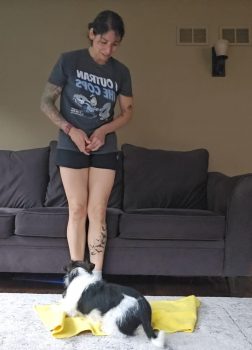
unnamed
IMG_0613

From left to right: Veronica and Tiffany

Teamwork Makes the Dream Work

I know I’m not the only member of this team that credits the rest of the team with helping them become the trainers, consultants, mentors, and human people they are today. Since I’m curating and posting the blog, I get to speak for all of us when I encourage anyone interested in doing what we do for a living to find your people. Be a stray kitten. Trial and eval. Build your network. Lean on your community. Meet your needs. Working in an unregulated field is tricky, but it also brings together curious, compassionate, creative humans, and I feel like the luckiest person in the world to be part of this team.

Here’s to harmony,

The Pet Harmony Team

Now What?

If you’re a pet professional looking for your community, check out PETPro. If you’re a pet parent looking for help from people who care as much about working with you as you do about finding workable solutions for the issues you and your pet are having, we’re here to help.

Copyright 2025 Pet Harmony, LLC. All Rights Reserved.

Terms & ConditionsPrivacy Policy

Results are not guaranteed because behavior, human, canine, or otherwise, are not guaranteeable.

A grey dog with long, floppy ears sitting next to a human at a computer.

Troubleshooting Pet Behavior

Troubleshooting Pet Behavior: How to Work Smarter, Not Harder

A grey dog with long, floppy ears sitting next to a human at a computer.

Arrgghhhh! What is going on?! Why is my pet doing this thing they’ve never done before?! 

Hang in there buddy, take a breath. You likely already have the skills to work through this– or at least to get you started on a plan. 

This blog’s all about troubleshooting, so get your thinking caps out for how this can work for you. We’re going to be drawing upon the skills, observations, and resources that you’ve already collected so you can work smarter, not harder, towards your goal. If you can take your observations and apply our enrichment framework, you can troubleshoot without starting from scratch. Let’s do this!

When a new behavior pops up, it can cause panic and frustration for us as caregivers. If you’re like me, you may quickly spiral from “my dog is pulling out his tail hair” to “my dog is depressed and he hates his life and I’m not doing enough for him and I’m failing him as a parent and I’m embarrassed that I’m a consultant who doesn’t know what to do.”  Speaking on behalf of a friend, of course. But new behavior is not necessarily a catastrophe. 

There are so many reasons our pets might show new behaviors, they’re just learners, after all, like you and I. Behavior might happen because of new stress, change in developmental periods, something physical/medical going on, a change in the environment, really anything! The most important thing we can do as the humans who help to mitigate the environment for our pets is to switch modes. When you’re seeing a new behavior, practice observing with curiosity. Here’s how.

Step 1: Observe body language and context

The important thing here is to take out any words that make assumptions on how your pet is feeling, but rather describe what you are observing/seeing. Act like you don’t know this pet, you have no idea what makes them tick or thrive, and you’re not utterly obsessed with their smushy little faces.

Instead of: “Daisy was scared and angry that George entered the room,” try to articulate your observations like, “Daisy was laying down grooming her legs with her belly facing the room when George approached from behind. Daisy flipped onto her feet, ducked her head away from George, lowered her ears, crouched and walked slowly towards the scratch tree and then jumped up and hid in her box.”

I like to pretend that I’m a scientist when I do this. I focus on documenting when it happens, where it happens, how often it happens, and who/what is a part of the environment when it happens. 

Remember, you’ve gotta observe with your senses, not your stories.

Step 2: Identify possible causes

Now we can rope in your expertise as this pet’s champion of all champions. This is a time where you reflect on everything you’ve observed objectively and combine it with all the things you think to be true about them. Here’s the three common causes we typically see with new behavior expressions (note, that these can interact with each other as well):

  • Medical: pain, illness, GI upset, allergies, ear infection, age-related changes
  • Environmental: noise, guests, construction, new routines
  • Emotional: stress, fear, frustration, boredom, overstimulation

We can’t assume that we know what is the cause, but thinking of these possible issues can give you more questions to ask yourself/your vet/your consultant to hone it in.

Step 3: Mitigate the problem

Say it with me now: management, baby, management! Before we can solve the problem, we’ve got to see if we can reduce the likelihood of the behavior recurring (and thus, being practiced or, if medical, creating bigger problems). Our goal for this step in troubleshooting our problems is to help our pet feel better as soon as we can. If this mitigation works, then we’re able to know what is contributing to the issues and can plan our next steps (if any, because sometimes this can fix the problem!).

  • If medical: vet check, meds, supplements?

  • If environmental: sound masking, gates, move safe space, window film?

  • If emotional: safe spaces, calming activities, reduced access to triggers?

Step 4: Adjust the enrichment plan

You know what we’re gonna say, using enrichment helps with behavior issues, but don’t forget, that doesn’t mean you’ve got to plan extravagant forage fests all over the apartment and give a thousand food puzzles. Enrichment means meeting needs to increase welfare and wellbeing. When you’re trying to figure it out, go back to our Enrichment Framework –list, prioritize, plan, and reassess (here’s a free guide if you haven’t practiced it yet). 

But this is where we can go astray! You don’t necessarily need some new finagled product that doesn’t already fit into your lives. Think about what you already are doing. Think about the outcomes that you’ve already seen with that. Reassess if you can use it at a different time, in a different way, or for a different purpose. 

  • Already do foraging? Can you try before or during a time that your dog is currently struggling?
  • Already use management? Can you try it in a different location?
  • Have you given shredding in the past but forgot it was awesome? Reintroduce it?
  • Temperatures changing in the house? Adjust safe space with cooling/warming tools?

Step 5: Know when to call in reinforcements

And while this is my last tidbit, your reinforcements are certainly not your last resort. The fact that you even have reinforcements is something to celebrate (but if you’re feeling alone in this, please know that you can reach out to us through the comment section here or our socials to connect). This support system comes in so many different shapes and sizes. You’ve got your vet team for medical or supplement guidance. You’ve got your behavior professional for a set of objective eyes on your issue and lots of options to offer in tweaking your plan. You’ve got your family, your community, your friends, etc for implementation help and an understanding ear or relief valve. 

Still feeling a bit lofty?

Let’s try to put it into practice with a case: Your cat suddenly starts eliminating out of the litterbox.

  • Observe: when/where it happens, what body language you see
  • Identify: possible triggers (new litter? Day of week? Change of environment noises?)
  • Mitigate: clean/change litter box, add a new one near the accidents, visit vet
  • Enrich: prepare litter box, timing of stress reduction exercises, medicate if needed
  • Call in: vet or trainer if it persists or increases frequency

You already clean your litter box. You already monitor the environment noise level. You already make choices for litter texture and depth. You already had all of these tools. It’s just about observing and tweaking what you’re already doing to see how that impacts behavior. 

Use what you already know. Observation. Enrichment. Management. Support Options.

Working smarter, not harder is not just about your training and enrichment strategies, but it’s also about leaning on your abundant support system and expressing your perspective with others in all of this so you’re not holding onto the burden of caregiving alone. You are enough and you do a lot. Your pet(s) are lucky to have you.

Here’s to harmony,

Corinne

Now What?

Create a “Troubleshooting Checklist” from what you’ve learned today with an issue that’s already weighing on your mind. Drop a comment with your pet’s behavior that’s inspiring you. 😉

Copyright 2025 Pet Harmony, LLC. All Rights Reserved.

Terms & ConditionsPrivacy Policy

Results are not guaranteed because behavior, human, canine, or otherwise, are not guaranteeable.

Every Mistake a Lesson: What Pets Teach Us About Getting It Wrong

There are many, many things I love about being an animal trainer and behavior consultant, but my absolute favorite part is that I am constantly learning. Working with pets is one surprise after another, both good and bad. 

But there are hard emotional parts, too. One of the things that breaks my heart the most in this profession is when meeting with pet parents whose pet is struggling, and they ask “Is this because I did *insert thing here*?” 

Is my dog leash reactive because I let them greet too many dogs/not enough dogs/the wrong dogs? Does my pup have separation anxiety because I left them alone too much/not enough/when they were too young/when they were too old? 

We can question ourselves all day, wondering if this event caused that behavior, but the reality is, we may never know what caused our pet to have the behavior issue they have. It could have been a single event, many events, and/or their development during critical periods, including when they are still in utero! 

Because we can’t ask our furry friend why men wearing hats upsets them so much, we can only speculate. Instead of beating ourselves up over what could have caused an issue, focus on investigation, getting curious, and what you can do about it! Whether you are on a pet professional learning journey, or a pet parent learning journey, don’t be afraid to acknowledge the mistakes and see what you can learn from them!

Mistakes Happen—Here’s What I Learned from Mine

When I first got my pup Olivia at 10 weeks old, I was not yet a dog trainer or behavior consultant. I knew that was the route I wanted to take, and I studied lots of reputable resources, spoke with other dog professionals, and did all I could to try to prepare myself for raising the perfect dog.

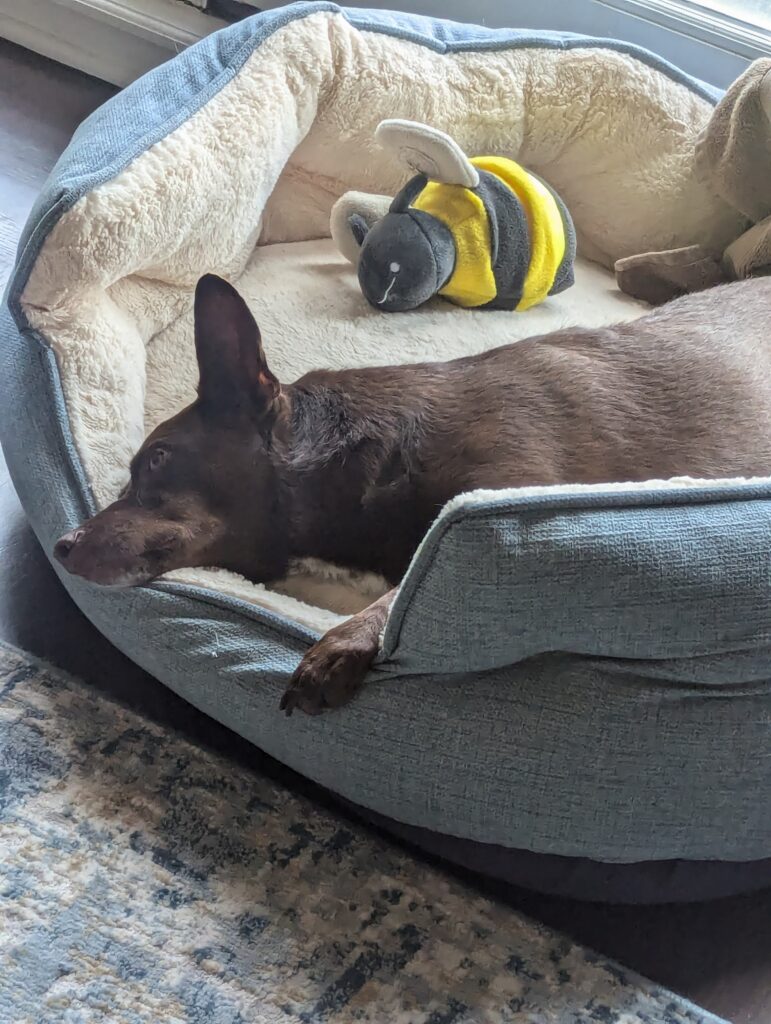
A brown dog resting in a soft bed next to a small stuffed bee toy.
A very cozy Olivia: teacher of lessons, mistress of comfort, taker of naps.

If you’ve read any of my other blogs or seen any of my social media content, you are well aware that my dog, Olivia, has a slew of behavior issues, from leash reactivity to separation anxiety to sound phobia and more. I often think back to choices I made in the first year of Olivia’s life and cringe. I pulled her along on walks because I was frustrated she sniffed so much. I took her outside on the 4th of July to watch the fireworks with me until she panicked and ran to go back inside. I didn’t slowly acclimate her to periods of time alone and would get frustrated when I would put her in her crate during the day and she would cry. The list goes on. I even look back at old video clips and see moments where I point at the screen and go “There! Why didn’t I realize that behavior wasn’t normal? Why didn’t I DO something about it?”

The answer is I WAS doing something about it! It may have not been what I would do now, but I also didn’t have the knowledge and experience that I have now. I was doing the best I could with the information I had at the time. I spoke with my vet, with other trainers, I beefed up my own knowledge with courses and conferences and reading. So when a client says to me “Did I cause this?” my heart always breaks a little.

It is rare that I have ever encountered a person who was not acting with the best intentions for their animal. Instead of analyzing every decision you have ever made for your furry family member, time is better spent by acknowledging that though our actions may (or may not!) have had an impact on our pet’s behavior, we are continuing to learn and work towards bettering their wellbeing. 

Learning That “Fine” is a Four-Letter Word

One issue I very frequently run into is that because an animal is capable of executing a behavior, the human counterpart assumes that it must reflect their internal state. For example, because my dog is capable of sitting and watching a dog pass them in close proximity, they are “fine” with dogs being near them. In reality, what we are often seeing is that the dog is shut down, is offering a “performance” of the behavior, or we will see a delay in their signs of discomfort once they are out of the situation. 

A shut down dog has become so helpless in the situation that they won’t react to almost anything. And just because a dog can give a behavior when asked, doesn’t mean they are calm emotionally. I have seen dogs be able to sit and watch a dog at a distance while practically vibrating from how overstimulated they are. Or maybe your dog can sit still and act calm while watching a dog pass by, but as soon as you release them, they bolt and “sled-dog” pull you all the way home. In any of these situations, the dog is not emotionally regulated. They are still experiencing huge feelings and are unsure how to cope with it.

I’m familiar with these situations because it’s what I do for a living! I wouldn’t expect a dog parent to recognize these signs, especially when we are conditioned to put our dog’s obedience as the primary focus of training. I sometimes surprise clients when they learn their dog is expressing discomfort in contexts where the humans understood them to be fine. However, now that we know, we can explore how to increase our dog’s sense of security and agency, and therefore create positive behavior change.

Professional Lessons I Learned at Home

As a professional trainer and behavior consultant, I have also made many mistakes. Like any profession, you occasionally are going to get cases that test your abilities and knowledge and cause you to scratch your head. Now I know when I am hitting that point and am able to consult my mentors or refer to a parallel professional like a veterinarian, veterinary behaviorist, or other knowledgeable trainer/consultant.

One thing I am reminded of time and time again is how dogs almost always tell us what they want or need, we just have to learn how to listen. When dealing with Olivia’s leash reactivity, I had to try a lot of different things to find what helped her: 

  • What equipment was she the most comfortable in? 
  • What length of leash worked best for her? 
  • What kind of areas did she prefer to walk and sniff in? 
  • What places/times of day did walks feel safe and secure? 
  • What skills did she need to learn to feel safe and secure?
  • Did we need to go on a walk every day? 

The way I measured the outcomes of these trials was noting how Olivia acted before, during, and after her walks. I wanted to see that she could calmly engage with the environment around her, but still was capable of responding to me when I would ask her to check in. I wanted to see a looser body and less hypervigilance. And I wanted to see that when we returned home, she was able to settle and rest comfortably. If I didn’t see one of these things, I made an adjustment on the next walk. In fact, I’m still making adjustments!

It’s also important to note that there are factors in our dogs’ comfort levels that we won’t be able to directly identify. They may be feeling unwell or they may have slept badly the night before, causing them to have a particularly hard day. The best thing we can do is look at our pup’s body language. This is the loudest way they can tell us what they are feeling. The more we can respond appropriately to our dog’s feelings when they show us, the less likely they are to continue to escalate the undesired behavior.

The Role of Curiosity and Compassion in Moving Forward

When we see our pets performing a behavior we don’t like or understand, the first thing we should do is ask why they are performing the behavior. What is the function? Are they trying to get access to something, or make something go away? Is this a behavior they have done before, or is this a new development? 

Next, note down the following:

  • What body language are they displaying before, during, and after the behavior?
  • What happened in the environment before, during, and after the behavior occurred?
  • Is this behavior actually a problem? (That depends on your household, but sometimes what you’re seeing is normal dog behavior!)
  • When was the last time your dog went to the vet? 
    • Many behavior changes can be linked to a medical cause. If your dog is struggling with a new problem behavior, it’s a good idea to consult your vet.

Focus on objective questions and observations. A question like “Is my dog mad?” can’t be answered factually because we can’t ask the dog. A question like “What behavior/body language is my dog showing?” turns the focus to what you can observe. Noting that a dog is growling, barking, lunging, and air snapping is factual and informative. 

We use observable data to begin answering the functional questions about behavior. Armed with more information, we can change one piece of the puzzle at a time. Based on your observations, what did you find out? How does that impact what you will try next?

Lessons That Stick: How to Continue Building

I find that when clients have begun to see good progress on the behavior front, they often are fearful of pushing too far and setting back the progress that they have made. We are always looking for a balance between keeping our dogs feeling safe and secure, and continuing to build their resilience and skill application. The truth is, there is no concrete answer to the question of how and when to move on to the next, more challenging step in your dog’s behavior plan. No matter how perfect our timing, how solid the skills we’ve taught, or how exact we have set up the environment, there will always be errors. 

So much is out of our control. Dogs will come charging at you from out of thin air, a loud noise will happen right as you are finally getting your dog to potty after the 4th of July, and you will give your dog a treat right as they start barking. Just as we understand that our dogs make mistakes and have big feelings, so should that compassion extend to yourself as a human being who is doing their best. The best we can do is consider the dog in front of us and observe their body language and responses in the environment. I’ve found that once you have good foundational skills on board, our pets are often more forgiving than we think!

Remember, no one is perfect. I remember tugging on Olivia because she wasn’t loose leash walking with me at 14 weeks old! There is no point in obsessing over past mistakes and whether or not they put you where you are today. The only way forward is, well, forward! Reach out to a professional to help you get some outside insight as to what your pet is experiencing and what you can do about it. You will never regret learning more for, with, and about your dog.

Here’s to harmony,

Claire

Now What?

When working through a behavior issue with your pet, make a list of questions you have about the behavior. Even if you don’t yet have all the answers, this will put you on the right track to identifying the function of the behavior and what we can do to help!

Whether it’s a mistake you’ve made or one you’re afraid of making, we’re here to help without judgement! Don’t be afraid to reach out to a trainer or behavior consultant for assistance.

Copyright 2025 Pet Harmony, LLC. All Rights Reserved.

Terms & ConditionsPrivacy Policy

Results are not guaranteed because behavior, human, canine, or otherwise, are not guaranteeable.
Humans and dogs walking on a trail. Text reads: Things we wish our clients would tell us

Things We Wish Clients Would Tell Us

You know how there’s a ton of different fireworks and each of them shoot up and explode a little differently? Some shoot up in a massive steady stream, but then just fizzle out. Some shoot up with a faint jagged line, then explode in a massive flower, a boom whose impact resonates in our chests. Others explode in a canopy, the golden willow branches hanging forever in the sky, resisting decay.

If you’ll indulge me and my band director-style analogies, these fireworks are a lot like behavior. The events leading up to the impact may or may not match the explosion we see and expect, but we can’t take it for granted, it’s a part of the whole. It takes a knowledge of the whole firework choreography to anticipate, prepare, and create the firework display, much like it takes the knowledge of the whole pet’s and family’s life to create a behavior modification plan.

That means we pet behavior consultants have a lot of questions to ask you.

Look, we know our intake form at Pet Harmony is. . . a lot. . . but that form gives us an understanding of your voice, your concerns, your experience, your family, but it’s just a starting point. It starts creating the hazy constellation that makes up the lives of you and your pet–maybe the hesitancy of eating breakfast seems kinda normal, but it can brighten that dim star to better understand, say, why sounds can be scary.

So what do we, as pet behavior consultants, wish you would tell us during a behavior consultation? How can you bring it up in a proactive and professional way? I’d love to get the convo started. The sections that follow discuss a few things we want to know about your furry (or feathery or scaly or slippery…) besties and the ways you live together.

1. Your favorite things about them

Your pet is more than their behavior problem. Sure, that’s the tough thing that brought us together, but we know that they are more than that. Oftentimes, at some point in a bundle of sessions, my families will say something along the lines of “See! Why can’t he be this relaxed when Grandma comes over!” or “I wish the neighbors saw this side of Fluffy!” or “Isn’t he just a goober once the rest of the world calms down?!” and I want you to know that we believe you and we know. 

We love to hear all the great things you love about your pet, even if it seemingly has nothing to do with the issues we’re working through because sometimes we can incorporate that into our plan, but at the very least, it helps us to understand our learners and build connections. If you love watching your pet hang out in their safe space during game night, but they’re skittish with every firework BOOM when it’s just you at home, we can see if there’s anything in that safe zone that we can transfer to firework prep.

2. The kinda annoying things too

Yeah, but those things matter too. A lot of times my clients worry about “bogging me down” with the things that aren’t huge pain points, but are kinda annoying. “Trembling during fireworks,” takes precedence over “steals my used tissues,” but when we’re creating a plan, those scavenging tendencies can help to shape our plan to reduce stress, meet their needs, and analyze when it’s being done to clarify if there is a function to the frivolities beyond just play.

3. When our suggestions sound good but don’t fit your lifestyle

You can expect that if you’re working with a behavior consultant, we’re going to come in with a host of different management tools and handling maneuvers that we’ve tried and had success with, but we’re humans too. We have biases and live our lives with personal experiences that shape our consulting. If sound masking is a good management tool to block neighborhood noise and summer firework events and you don’t mind the din of brown or white noise, WHOO HOO! If sound masking sounds amazing but brown noise makes your head spin (or makes your Opie Dog search for the “fly” that is actually the speaker’s vibration on the shelf…), tell us. If we don’t have an option that feels right, we have a team of incredible consultants that thrill in the craft of modifying enrichment strategies.

4. If you just want a management tool for now, or to work on a trained skill

So often I find myself assuming that clients are ready and expecting to build training skills once we’ve got our initial management plan ironed out and are reading body language, but sometimes that’s not the case. Maybe the management tool (e.g., baby gate) is serving the function it needs to right now and your household would benefit from maintaining that rather than building or scaffolding skills for future exposure to XYZ. Maybe you are going on vacation and this is the only time you could schedule a session, but you don’t plan on doing anything until you return. Maybe the medication protocol helps your pet get snoozy during the nights with anticipated fireworks and there aren’t residual effects, great! 

You know your time, bandwidth, and availability better than we ever could, and you know your pain points better than we ever will. If a management tool is in place, doing its job, sustainable, and meeting everyone’s needs, that’s cool!

5. If the plan is having unintended consequences, good or bad.

We’ve said it before and we’ll say it again but if something can have an effect, it can have a side effect. Typically, when we start enrichment plans, we do so given the information we have and given the desired outcomes, but it’s all educated assumptions, people! Are the shreddables actually jacking them up? Tell us! Is the foraging getting in the way of resting? Tell us! Is the afternoon snacky causing some new attention-seeking behaviors? Tell us! Is something totally different popping up and you have no clue why? Tell us!  We’re here to discover it together.

Where does that leave us?

There are so many things that I love about working with pets, but one of the top things by far is creating a connection with the families. You all know these furry creatures in and out– the things that set them apart from any other animal as well as the things that may set them off. You gush over their cuddles, or their cute play bows, or their floppy ears, or their bushy tails, and you talk about how even when they’re in the trenches with some tough feelings, they can melt your heart with one head tilt. You love these animals so much and want everyone else to see these sweet creatures that you live with (or get glimpses of). 

However, once we, the pet behavior consultants, get on the team, it’s usually when some of their not-so-desirable behaviors are affecting the household’s quality of life. We start the deep dive into understanding the circumstances surrounding these behaviors to help improve the quality of everyone’s lives and sometimes it feels like we need to examine all the things we need to “fix” and forget the things we need to celebrate.

Behavior is multifaceted—medical, environmental, emotional. Together, we assemble the puzzle pieces to make the picture. There are no “wrong” answers or “wrong” concerns, we’re here to synthesize it all and create a plan that’s right for you. Let’s work together to help your pet feel safer this summer.

Here’s to harmony,

Corinne

Now What?

A couple of thoughts as summer continues to speed on by:

  • If you’re thinking about getting support, book a consultation now before the end-of-summer shenanigans ramp up.
  • When prepping for your session, complete your intake form thoughtfully and honestly. We want to get to know y’all!

Copyright 2025 Pet Harmony, LLC. All Rights Reserved.

Terms & ConditionsPrivacy Policy

Results are not guaranteed because behavior, human, canine, or otherwise, are not guaranteeable.
A picture of a human hand holding a dog paw. Text reads: Cautious But Committed: Managing Risk When the Human is Risk Averse

Cautious But Committed: Managing Risk When the Human is Risk Averse

It’s Okay to Be a Little (or a Lot) Scared

Ok, I’m just going to come right out and ask. Do you identify with any, some, most, or all of these statements:
Your pet is exhibiting behavior that is impacting their and your quality of life.
You’ve started to work with a behavior professional and they have discussed the strategies that will help you work toward your goals.

You’re excited and ready to get started!

You start the plan.

At some point you become terrified and have the following thoughts:

  • What if I get it wrong?
  • What if my mistakes have a big impact and I set my pet and myself up for failure or a setback?
  • What if I accidentally trigger the behavior I am working on?
  • What if the consequences of the choices I make are irrevocable?
  • What if…
  • What if…
  • What if…something bad happens?

Thought spirals are enough to make anyone feel undone but they are especially impactful for those of us who are a tiny bit scaredy cat in a world that spends billions of dollars a year to tell us we should “just do it.”

It is normal, common and pretty typical to have some built in reservations about life’s risk. Evolution has made sure that we are hard wired to, you know, stay alive, and assessing risk is an instrumental part of that. It can be a precarious dance between what is reasonable risk or tolerable risk vs. a hard ”no, that’s just too scary right now.” Jumping out of an airplane, I’m talking to you.
My goal for this blog post is for you to be able to assess and navigate risk while still supporting your pet’s progress and taking care of your own emotional well being too.

What Is Risk, Really?

In the simplest of terms, risk is the possibility of something bad happening. With risk comes uncertainty, and living with uncertainty can make any living creature hella uncomfortable both physically and emotionally.

We all do risk assessments, probably multiple times a day, even when we are unaware. Do you ever cross the street? Drive a car? Go swimming with no lifeguards on duty? Eat food that might be just a wee bit past its prime? These are just a few examples of risks we assess on any given day without even realizing that we are doing it. Let’s be honest, some risks just don’t carry the same weight or we are so used to performing certain tasks without anything bad happening, that we hardly give it any thought at all. Our learning history has steered us to a point of feeling safe enough most of the time that we continue to live our lives, which is a very good thing indeed.

When it comes to the skill of behavior modification, there are several factors that can make us feel unsure or unsafe. There is, of course, the real possibility of actual physical harm coming to us, our loved ones, our pets or even the public at large. There is also the emotional toll or the level of stress we can feel if we are concerned about getting something “wrong.” And wouldn’t it be so much easier if we only had to navigate “real” risks as opposed to the risks we imagine in our heads? Because whether a risk is real or perceived the outcome is likely the same: fear and anxiety for the individual experiencing it. If you would like to listen to a great podcast episode that goes into greater detail, give this one a go: Assessing Risk for the Safety Enrichment Category.

Why Your Fear Makes Sense

To be human is to experience some level of fear and/or anxiety. Fear is an adaptive feature of being and staying alive. It keeps us moving when we need to move away from danger. You are not weak because you are afraid. Your body was designed to notice stimuli, make a lightning fast assessment of it and then respond accordingly. This is what living creatures do multiple times per day.

But just because it is a normal feature of humaning doesn’t mean that it can’t get in our way sometimes or make us feel stuck. The hard wiring feature of making quick risk assessments can convince us that there is a bad thing lurking around the corner even if there is not. I am not going to go into all the reasons why that is, but I am going to assume that if you are still reading, you identify with some of these points.

When it comes to modifying behavior, it honestly makes sense that your fear overrides your training plan sometimes. It’s much more common than you might think. Reasonable fears include:

  • Being bitten by your pet
  • Your pet hurting someone else
    Your pets getting into an altercation and hurting each other
  • Being judged by others as you work through the behavior modification process
  • Making a mistake and setting yourself, your pet, or the plan up for a regression in behavior

Part of tackling the behavior modification journey includes being able to identify if your fears are reasonable, communicating your fears to your behavior professional, and helping them troubleshoot how to navigate and mitigate those fears.

How to Assess Risk—For Real

There is risk and then there is RISK, you know? Some risks are gut feelings or imagined and some carry significantly more weight or have evidence to back them up. Here are some quick ideas for assessing the difference between risk, RISK, or something that we conjured up by way of the amygdala hijack:

  • Do you recognize within yourself a learning history or past experiences that makes risk taking more scary for you than it might be for other people? Thoughts aren’t facts and we need to be able to differentiate between the two.
  • Is the fear or worry something that is a gut feeling or is there evidence or data to back it up? Evidence or data might include:
    • An actual bite history or history of injury to people and other animals
    • Patterns of behavior that happen or have happened with enough frequency to make you certain that the behavior will likely be repeated
    • Identifying and understanding your pet’s body language and thresholds and knowing what their stressors or triggers are. Multiple stressors will inherently increase the level of risk.

The next step is to do a risk assessment for yourself which can include the following strategies:

  • Identifying the potential risks
  • Analyzing the likelihood of them happening
  • Analyzing the impact they will likely have if they do happen
  • Planning for eventual scenarios so that you can be prepared with an appropriate action
  • Taking calculated risks that have a low potential for anything bad to happen

Any behavior professional worth their weight in gold knows how to help clients feel empowered to make decisions that work for them and their pets. This includes navigating your current level of risk tolerance. It is extremely important to let your behavior consultant know that you are nervous about navigating the waters of behavior change so that they can help you steer the ship until you are ready to take the helm.

A good consultant will:

  • Go at the pace at which you’re comfortable and not force you to do something you aren’t ready for yet.
  • Know how to break skills into smaller steps to build up your confidence
    Give you a clear outline about whether you should push, drop, or stick based on how you are feeling and how your pet is responding and feeling.
  • Be honest with you about how behavior change works and tell you, unequivocally, that behavior change and progress is not linear. Ever. Regressions are a normal (and expected) part of the process. Which means you aren’t failing and more than likely it’s not your “fault.” Doesn’t that make you feel better already?

Safety Plans Aren’t Failure—They’re Freedom

More likely than not one of the first things a behavior consultant will talk to you about is using management. As we say in the biz, management is a work smarter, not harder strategy. It is used to arrange the environment in such a way that it addresses safety concerns quickly and effectively. Arranging things so that an undesired behavior is less likely to occur is a win for everyone, including your pet. Management strategies can include the following:

  • Using protected contact for pets who bite or cause injury
  • Gates to keep pets out of areas they can’t have access to or to keep pets away from infants, toddlers and young children especially when supervision can not be provided
  • Teaching your pet to love their muzzles so one can be used appropriately and effectively
    Leashes to contain pets so they don’t have access to things that they find stressful

A good behavior consultant will take you, your pet, and your household into consideration when they are helping craft sustainable management strategies. The more open and honest you are about communicating your needs and your pet’s needs, the more they can be creative in helping you create strategies that work for, not against, you.

Your Feelings Matter in the Training Plan

It’s also immensely important that your feelings and experiences are included as part of your pet’s behavior modification plan. If you find that you feel anxious each time you are trying to practice a strategy when your consultant isn’t there to guide you, please share that. Part of the job is to help you figure out a way to implement the behavior change in a way that feels comfortable for YOU, not just your pet. You are a huge part of the journey and in order for progress to be made, you have to feel confident with implementing the strategies. If fear is holding you back, there are things a good consultant can do to help you.

It is not a sign of weakness if you confide your fears or risk aversion to your consultant. If they shame or ridicule you, run far and run fast. They are not cut out for this job. Humans matter too and your feelings are just as valid as your pet’s. Being vulnerable is hard but not impossible and being brave about your experience is a good first step towards practicing calculated risk!

Here’s to harmony,

MaryKaye

Now What?

Are you still feeling a little bit scared? That’s ok! I feel that way sometimes too! Here are some actionable items or information that I hope you will take away from this post: 

  • Baby steps are still steps and still wins worth celebrating.
  • Safety and risk tolerance are in the eye of the beholder and no one is better or more “right” because they like jumping out of planes.
  • Faster isn’t necessarily better but neither is staying stuck and stagnating. The answer: communicating your anxieties or fears with your behavior professional so they can support you. Remember, you are a team! 
  • Try practicing the following strategies: 
    • Working under your threshold so that you can build confidence in a way that feels good for you
    • Practicing in low-stakes environments or taking small calculated risks with the guidance of a professional
    • Journaling or recording training sessions can go a long way towards challenging the reality of how training sessions have gone versus the imagined scenarios you may have created in your head
    • Asking for support from professionals who know that behavior change is not just about your pet’s experience but about yours as well 

Remember, you are not broken. If you live or share your life with a pet that exhibits undesired behaviors and you are ready to take the plunge into unfamiliar territory even when you have doubts, you are quite brave indeed!  Pet Harmony would love to be a part of your journey so don’t hesitate to reach out to find out how we might be able to help you and your pets live more harmoniously at a pace that feels right for both of you.

Copyright 2025 Pet Harmony, LLC. All Rights Reserved.

Terms & ConditionsPrivacy Policy

Results are not guaranteed because behavior, human, canine, or otherwise, are not guaranteeable.
What My Clients Taught Me About Enrichment: Lessons from the Human Side

I love animals, but that’s not why I’m a behavior consultant. Now, don’t get me wrong, I delight in the furry besties I meet and am fulfilled by seeing their growth (and, let’s be honest, when a pup with stranger danger cuddles up on me, I’m on top of the world). But in all honesty, one of the most fulfilling things for me as a consultant is to make connections with the humans and to see how everyone’s behavior contributes to a household.


Enrichment is for Everyone

When we say “enrichment” means “meeting needs”, of course we’re talking, in part, about the animals we’re working with, but enrichment cannot truly do its job if it’s not addressing the needs of the whole household. My goal as an effective consultant is not simply to teach my clients about behavior and then dictate instructions on how to change it, but to allow time for my clients to respond and connect this information to their lives. We cannot expect an enrichment plan to work if it’s only addressing one side of the equation.

If you have worked with a consultant (or if you are one yourself), you know the importance of setting up the environment to help the learner be successful. A dog can’t steal a stick of butter off the counter if there’s no butter on the counter (Anyone else? No, just me?). We talk about how management of the environment helps to prevent undesirable behaviors from being practiced and encourage the desirable ones. It’s one of the cornerstones of what we’re asking families to do. But who controls that?

The humans.

And that’s a lot to ask!  The humans are in charge of a lot of the physical management plans, and while this will help our pets be successful and can give the humans actionable tasks to not feel so helpless while we onboard skills, it also impacts the everyday lives of everyone in the house. 

So now let’s think about going into a new session– the humans already have the stress of worrying about their pet’s behavior, the stress of making decisions to support their pet’s success, the stress of reorganizing/reconfiguring their every day lives to support their pet’s success, and now you gotta step over the d*mn baby gate!?! It is so stinkin’ hard.

Y’all know this by now– these things affect how we function. Being a caretaker is harder when you have unmet needs.

Here are some real conversations with families that I work with that have humbled my confidence in giving advice and have reminded me to collaborate, not pontificate.

Client: My dog sometimes barks on walks!

Me: Let’s find alternative physical and mental exercises to do instead at home so they aren’t exposed to the triggers before onboarding skills!

Client: But the walks help me to feel balanced, and we always walk to my best friend’s house where my dog loves romping around in their big backyard.


Client: My dogs sometimes redirect on one another when we walk them together and one of them gets spooked.

Me: Well, walk them separately!

Client: But our schedules are really tight, it’s super stressful, one dog gets anxious when she’s left alone, and they can’t go out in the backyard because they also react to our neighbor who already doesn’t like their barking


Client: My pup gets really rowdy in the evenings, but is able to relax if she’s gotten long walks or has been romping around at day care.

Me: It sounds like when her physical needs are met, she’s able to relax more. Let’s make sure to get 15-20 minutes of a good romp each day in your backyard.

Client: When I’m able to play, she’ll just stare at me and I can’t find anything that she’ll do; or sometimes she’ll get so rowdy that she starts biting and pulling at my shirt!


Stop, Collaborate, and Listen

It’s through listening to my clients’ stories, needs, desires, etc., that we make a collaborative enrichment plan that meets everyone’s needs. We consultants dedicate our brains to problem solving, but we don’t necessarily have the answers. Our conversations create the scaffold to give clients the freedom and creativity to find their own solutions.

Here are a few examples of clients making their own discoveries:

  • Practicing a relaxation protocol with the dog on the couch next to the human helped one client because the pup always got up after the session to lay on the couch with her.
  • While carrying a Gatorade bottle (specifically), one client’s pup could walk without picking up trash because he liked to hold the bottle in his mouth.
  • Shreddable enrichment was TOO much fun for one pup, as he was observed being more excited after the activity, which was supposed to help him settle and rest.
  • Wearing a specific shirt helped a dog relax. The coverage and texture was juuuust right!

These people are amazing. They know and love their pets so much and can tap into more than I ever could because of their extraordinary bonds. They want their animals to succeed, but many are nervous about making the “wrong” choice. It’s so exhilarating to see them use the foundations of understanding behavior modification as a grounding method to making decisions they weren’t originally confident making.

They’re coming to us for pet parent tips, but they’re teaching me tips as this pet’s parent.


Making Connections

So how are they doing this? When we work through the Enrichment Framework with a client, we discuss and list behaviors the family appreciates and likes (desirable), and those that they do not appreciate and don’t like (undesirable). We think about why those behaviors happen. Sometimes, they are just normal [insert animal here] things (aka: species-typical behavior). Even normal behaviors can be undesirable sometimes (ever been annoyed that somebody was chewing?). We think about options for solutions that allow us to improve the lives of everyone in the house. 

Are you stuck with some undesirable behaviors? My advice is to list those out and discover which of those is species-typical behavior. How can we let them be the doggiest dogs, the cattiest cats, the bunniest bunnies, the birdiest birds they could ever be and how can we do that in a way that works symbiotically with the family.

Dog likes to dig and the only available dirt is in the flower beds. ➡️ Can we dig in blankets at home instead of dirt, and find an outdoor space to walk sometimes where digging is okay?

Cat likes to scratch the couch. ➡️ Can we find something with that same texture to add to the cat tree? 

Rabbit likes to nibble on rubbery cords. ➡️  Can we use hard cord covers and give a safe alternative with a rubbery texture?

Bird likes to screech at dusk. ➡️ Can we add some ambient music to mask the sounds for the humans while the bird performs species-typical behaviors, or give the humans some noise-cancelling earbuds?

But here’s the important part that you’re probably tired of hearing by the end of this blog: you need to then ask yourself “does this solution decrease/increase my welfare/enjoyment?” We’ve got to hit a balance between honoring the pet’s needs and respecting human comfort, because our stress levels, in turn, affect how we can care for our pets.

If you’re struggling right now, we know. It’s hard. Let’s think of ways how we can simplify our routines to create sustainable practices so that we can better serve ourselves and our pets. We’re here for you!


Now What?

  • Delight in what you have already learned from your pet– believe it or not, it’s a lot!
  • Reflect on things you do with your pet that’s good for you too– enrichment really is for everyone!
  • Share with us a story of something surprising your pet taught you, we’d love to hear it. Comment below or email info@petharmonytraining.com. 
  • If you’re feeling stuck, you’re not alone. Reach out if you’d like us to join your team to help brainstorm an enrichment plan that works for everybody.

Here’s to harmony,

-Corinne

5 Signs Your Pet Needs Professional Help


I’m very much a Do-It-Yourself person– so much so that I consider it a fault. I will absolutely try to do something by myself and learn a new skill if I think that I can. I see this with a lot of my clients, too. They originally tried to tackle their pet’s maladaptive behaviors by themselves and eventually found their way to getting professional help. 

In many of those situations I wish that they’d contacted a professional sooner. Sometimes that’s because they’ve tried something that has actually worsened the behavior or because they waited until it was more serious or dangerous before getting a professional involved. But there are other times I wish they’d contacted a professional sooner simply because it’s easier to change a behavior that’s been happening for less time. Well-established habits are harder to change. 

I then occasionally get cases where someone has just adopted an animal and reaches out to our team immediately. In those situations we’re almost always asked, “Do you think it’s too soon for us to see you? Should we wait a bit?” Our answer is usually a resounding, “no, it was a great decision to involve us so quickly!” 

So, as someone who is a staunch DIY-er, who tries to tackle problems without additional help, but also recognizes that getting a professional involved sooner rather than later can be beneficial, I thought it’d be helpful to discuss some key signs that would cause me to recommend someone seek professional help for their pets’ behavior. 

  1. Safety is on the line. This could be the safety of you, your pet, another human, or another animal. If any individual’s safety is at risk you should immediately seek the help of a behavior professional. 
  2. It’s a behavior you haven’t dealt with before or dealt with recently. It’s much better to learn something from a professional the first time around instead of trying your hand at something you’re not experienced with. And, if you haven’t dealt with this particular issue recently, chances are that there are now more effective or empowering ways to work with the behavior and it’s time to update your skills. This field is constantly growing and evolving and that’s a good thing!
  3. You’re not making progress. If you’ve been working on your pet’s behavior for a few months and you’re not making any progress, it’s time to call in a professional. Save yourself the time and hassle by getting help. 
  4. You’re having to resort to more forceful tools and methods. It’s a myth that certain animals need more forceful tools or methods. We work with aggressive animals of all shapes and sizes for a living and can do so in a way that’s empowering and empathetic towards our animal learner. If you’re stuck and finding yourself reaching towards more forceful tools and training methods, it’s time to get help from a behavior professional who can keep you working in a way that is effective, ethical, efficient, and empowering.
  5. You want to make sure you’re doing something well and as efficiently as possible. There are plenty of things that I choose to muddle through myself, knowing that it would be more efficient if a professional did it. However, there are other things that I want done well the first time and don’t feel that I can afford the mistakes that come with learning (like our business taxes). If you feel that way about your pet’s behavioral and mental health, then look for a professional sooner rather than later. 

Now what?

Happy training!

Allie