

A woman in front of a sheer white curtain holding a mask in front of her face.

Understanding Impostor Syndrome in Animal Behavior

Understanding Impostor Syndrome in Animal Behavior

A woman in front of a sheer white curtain holding a mask in front of her face.

Ok, I have a serious question that is going to sound like a setup for a Jerry Seinfeld joke: what’s the deal with Impostor Syndrome, amirite?? It feels like everyone has it these days. It feels like it comes up in almost every conversation. In PETPro, almost every new mentee mentions it in their intake form as something they want to get rid of. So, ok, let’s talk about it.

First of all, what is it? The tricky thing about terms that enter pop culture is that they aren’t well defined, and like any construct they can mean different things to different people. Here are just some of the interpretations I’ve seen surrounding this phenomenon:

  • The original framing introduced by psychologists Pauline Clance and Suzanne Imes in 1978 in their work with high-achieving women described it as persistent self-doubt, fear of being exposed as a fraud, and the inability to internalize success.

  • In some contexts, it is discussed as a pattern of thought related to the ego involvement in understanding cognitive bias, anxiety, and perfectionism. By this definition, impostor syndrome is described as overpreparation or procrastination; fear of failure; difficulty accepting praise; attributing accomplishments to external factors like luck, privilege, or good timing; and perfectionistic self-standards.

  • In other contexts, it is described as a byproduct of marginalization in inequitable systems. This lens emphasizes the impact of microaggressions, stereotypes about competence and social identity, lack of or underrepresentation, being “the only one in the room” from a marginalized group, and inequitable treatment in the workplace as the primary causes of impostor syndrome, and describes it as a reaction to context rather than a reflection a person’s belief in themself.

  • In still other contexts, it has been observed to happen when people are changing careers or undergoing any other major transitional period because the adjustment to new environments, standards, and responsibilities can be disorienting. And that disorientation can cause people to question their abilities and achievements.

  • And finally, there are many anecdotal reports of people describing impostor syndrome as a component of a mental health diagnosis such as anxiety disorders, panic disorders, OCD, BPD, etc. And there are still others that describe impostor syndrome as false humility, a valid assessment that they genuinely do lack the skill to be attempting certain tasks, a function of (learned) helplessness or perhaps just a robust punishment history, a type of social signaling where you “beat people to the punch” by critiquing yourself before they have the chance to, and who knows what else. 

I haven’t met everyone, so I haven’t heard everyone’s use and definition of the term. But the thing is, all of those are valid descriptions of the lived experience of a subset of people who have referred to their experience as “impostor syndrome.” Which means that “impostor syndrome” isn’t just one thing.

And to be sure, some of these descriptions lie far outside my wheelhouse. I am not qualified to be anyone’s mental health professional, for example. And as far as creating more equitable systems, that is in my wheelhouse but is also the work of generations. I play only a small role in large, complex, iterative social change–certainly not something that I can address in the span of a blog article.

Fortunately, however, there is a core component of impostor syndrome that I can absolutely address here: How do I know if I’m actually good enough to do this job?

What Is Impostor Syndrome in Animal Training?

By far and away, the majority of people in the animal behavior fields who talk about having impostor syndrome have these things in common:

  • They have taken a ton of continuing education but still feel like they’re missing something.
  • They feel like a fraud every time a case doesn’t go as planned or a client is unhappy or unresponsive.
  • They feel like everyone else in the industry is a lot more successful than they are.
  • They’re afraid to ask for help because people in our industry can be absolutely vicious.
  • They can’t tell if they have impostor syndrome or if they actually have the Dunning-Kruger Effect and they just don’t know that they have no business charging people for their services.
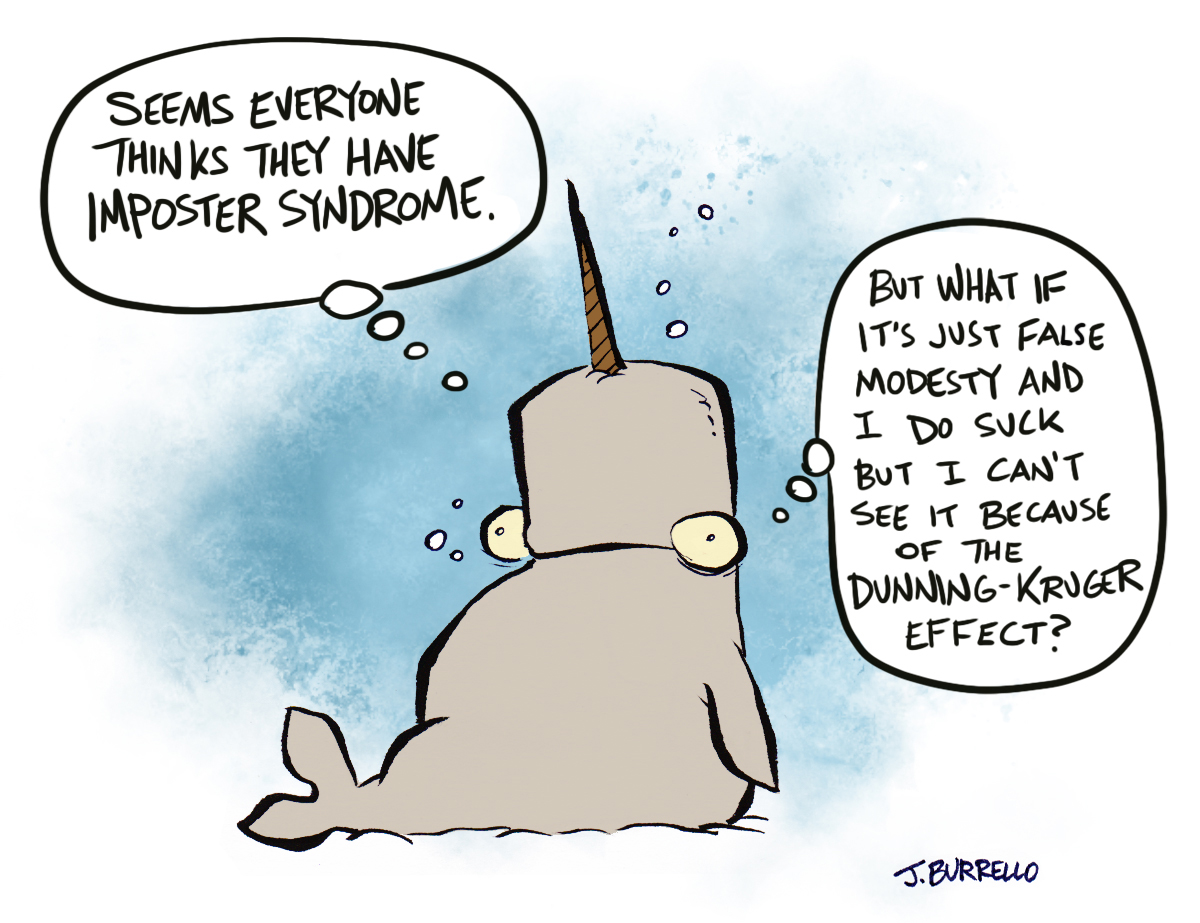
A cartoon narwhal with two thought bubbles. They read: Seems everyone thinks they have imposter syndrome. / But what if it's just false modesty and I do suck but I can't see it because of the Dunning-Kruger Effect?
The Overthinkable Eleanor by J. Burrello https://biginsanehappy.com/

And y’all? This describes the overwhelming majority of people I’ve interacted with in our industry. So you’re not alone and, no, you don’t suck, but you do need to change your mindset.

In last week’s blog, I talked about how important building strong foundations are and how to go about doing that. If you haven’t read that article yet, it’s probably a good idea to pause here, go read it, and then come back.

I’ll wait for you…

You back? Great. Let’s keep going.

If your brain works anything like mine does, you might be thinking, “Ok but in that other blog you said it takes time and repetition. So what am I going to do in the meantime? Do I just have to suck until I’ve done this long enough to not suck? Should I be charging people if I suck? Maybe I should just pro bono myself into poverty like Past You did, right, Emily?”

Friends, please don’t make the mistakes that Past Me did. Learn from my mistakes so you don’t have to repeat them.

I’m going to tell you something that one of my mentors told me, and then we’ll talk about how to strike the balance between impostor syndrome and the Dunning-Kruger Effect.

My mentor was probably sick of being stray kittened by me, so she gave me my first client that she wanted me to take on solo. Without her, OMGS. I panicked and I was like, “But I’m such a newbie and I don’t know enough and I’m definitely gonna mess this up!” My mentor replied, “Emily, you know more than your client does, so anything you teach them will be an improvement on their current situation.” Remember that, y’all. It’s important. Regardless of where you’re at in your learning journey, you know more than your clients do about animal behavior

That was the beginning of my journey to understanding that I was falling for a logical fallacy called a false dichotomy: the options aren’t “either I suck or I’m awesome” or “either I handle this case perfectly or I ruin it beyond repair.” You can be awesome and also have skill gaps. You can rock a case and still make mistakes in it. You can help a client in some ways and be wholly unequipped to help them in others. All of those things can be true at the same time.

Skill Gaps, Boundaries, and Cognitive Biases

If you’re afraid that you have gaps in your knowledge and skills, spoiler alert: you totally do. And that doesn’t make you an imposter, it just makes you human. Everyone has gaps in their knowledge and skills. Of course, people with deep expertise have fewer, but even they still have gaps. 

And y’all, I’ve said it before and I’ll say it again: pursuing higher education is not going to change that. There are a grand total of two people I’ve met who have a masters or a doctorate in one of the behavior sciences, who wasn’t already an animal trainer beforehand, who I would ever consider hiring or even referring to. Why? Because even though academic education has enormous value in very specific contexts, and it has the potential to help people cultivate profound knowledge and skill in those specific contexts, it doesn’t – and, by definition, can’t – teach people the wide breadth of knowledge and skills that animal behavior professionals need to do their jobs well.

But even more relevant to this conversation, depth of knowledge in specific areas doesn’t get rid of the gaps, it just changes what gaps we’re more susceptible to. People who have depth of knowledge in a particular field or skillset are more susceptible to some cognitive biases than people who are less experienced. These cognitive biases include:

  • Ego involvement in understanding – The more a person has learned, the more likely they are to start attaching their self worth to their ability to Know All The Things and Be The Expert. This can actually make it harder to learn new things and even harder to revisit things you already think you know.
  • The Halo Effect – When someone has depth of knowledge and skill in one particular area, they are more likely to overestimate their knowledge and skill in related areas. We see this all the time with people who have a PhD in one of the behavior sciences (or even related biological sciences) overestimate their expertise in parallel fields and therefore veer way outside their lane without realizing it.
  • The Law of the Instrument – When someone has depth of knowledge and skill in one particular area, they are also more likely to overestimate the value of their area of expertise while undervaluing parallel disciplines. The common adage that describes this cognitive bias is: “When all you have is a hammer, everything looks like a nail.” But while that phenomenon is true across all levels of expertise, what The Law of the Instrument looks like in people with deep expertise is more like, “Because I am an expert in hammers, they are the most important tool and all other tools are ancillary to hammers.” That mindset can inhibit further growth and learning by stunting interdisciplinary collaboration. 
  • It can also look like academic snobbery, where people truly believe that academia is the only valid path to acquiring the knowledge and skills requisite to do any given job. And that mindset hurts literally everyone, including academia.

To be clear, my point in bringing this up is NOT to bash academia or any pathway that leads to deep expertise. Like I said before, advanced degrees have enormous value in specific contexts, and if they help you reach your clearly operationalized goals, you absolutely should go for it.

The point is that continuing to collect more and more education is not going to make your impostor syndrome go away. Or if it does, it’s probably because you’ve fallen prey to one or more of the cognitive biases listed above, which obviously is not a good solution.

The goal is to change your mindset about having gaps in your knowledge and education. Because having knowledge and skill gaps isn’t the problem–pretending they don’t exist is.

When you understand that all of us will always have knowledge and skill gaps, and the goal is not to reach this point of perfection where we have nothing more to learn and we are experts at everything we attempt, suddenly life becomes a lot easier. Instead, the goal is to cultivate an awareness of where those gaps are and what to do about them.

Ethical Practice

The way to operate in this field (or any field, for that matter) ethically and constructively, gaps and all, is to incorporate the following practices into your routine:

    • Self assessment of qualifications – If you’re not sure whether or not you are qualified to take on a case, ask yourself the following questions:
      • Do I know what information I need to gather for this type of case, and what questions I need to ask to get that information?
      • Do I know the contingencies for when I get those answers and what that means in terms of how I need to change my approach or strategy?
      • Do I have an internal database of experience – or do I have a mentor whose database I can rely on – for what it looks like to move through cases like this one?
    • Plan to pivot – When you’ve taken a case and encounter something you’re not sure about or are struggling with, ask yourself the following questions:
      • What are the specific skillsets that I lack in order to be more successful in this case?
      • Who has the knowledge, skill, services, and/or scheduling availability that I lack whom I can either consult with, refer out to, or bring onto my client’s support team?
      • Are these gaps in knowledge and skill within my wheelhouse and therefore something I should learn, or does this situation lie outside of my niche and therefore I should cultivate more connections with people with this area of expertise?
    • Leverage learning opportunities – If you’ve identified knowledge and skill gaps that are in your wheelhouse, make them your priority focus in your continuing education plan (as opposed to just chasing all the continuing education shinies that may or may not be relevant to the cases you want to focus on in your career in the hopes that more education will make you feel more confident).
    • Be honest with yourself, your clients, and your colleagues about your boundaries – So many people in our industry are afraid to reveal any weakness or uncertainty to their clients for fear that they’ll be thought of as incompetent. But in actuality, (reasonable) clients appreciate honesty and clarity in communication. Get into the habit of telling your client things like: 
        • I don’t know, but let me confer with some colleagues and I’ll get back to you.
        • As we’re working together more I’m seeing xyz behaviors that tell me we could benefit from bringing someone with a different area of expertise onto your support team. 
        • You and your pet would benefit from xyz service, which is not something I offer. Let’s bring someone onto your support team who specializes in that service.

This is what ethical practices look like–and they’re also the practices that are most likely to make your impostor syndrome feelings sit down and shut up.

Imposter Syndrome Thrives in Silence (and Shrinks in Community)

All of that said, there’s one other facet of our industry that can really turbocharge impostor syndrome, and that’s isolation. We work in a very isolating profession, and it’s made even more isolating by how we collectively show up (or don’t) for each other on social media. 

If you feel afraid to put yourself out there…yeah, that’s reasonable. It’s rough out here on these streets. And when you have nothing to compare your business to other than all the social media posts of everyone else appearing to be awesome at their job, it’s reasonable to feel like maybe you’re the only person in the whole industry who is actually, truly, a fraud.

This is one of many, many reasons that belonging to a safe, supportive community is so important. If you’re in a community and you’re not sure whether or not it’s safe and supportive, it probably isn’t. When you’re in one, you know it.

So if this resonates with you, make that another goal in your continuing education plan: find or create a safe, supportive community where you can go to commiserate with people who understand what it’s like; where it’s safe to be vulnerable because you know that your community will reciprocate with their own vulnerabilities; where you can ask super basic questions without fear of being shamed and you can ask really hard questions without fear of being shut down; where you can bring your work to get constructive, supportive, reinforcing feedback; where you can share your wins and celebrate with each other; where mistakes are celebrated as a part of learning rather than treated as character flaws. 

When you realize you’re not alone but are, in fact, one of many, impostor syndrome disintegrates. 

Reframing Imposter Syndrome as a Signal, Not a Stop Sign

And having said all of this, it will probably never fully go away. It is bound to pop up from time to time. Even as I am writing this I can think of several times where I’ve felt like a fraud in very recent memory. As in, like, last week.

The difference is that I have learned how to reframe how I think about impostor syndrome when it happens to me: What if feeling like an imposter means you care? After all, when I’m choosing my mentors, colleagues, friends, and students in this industry, I stay as far away as possible from the folx who act like they’re experts, get defensive and play the victim when they receive constructive feedback, and demonstrate no interest in continuing to learn and grow. I’d much rather surround myself with people who feel genuinely concerned that they aren’t meeting their clients’ needs and can do better. So I’ve learned to apply that to myself, too. When I am gripped by feelings of inadequacy, I thank myself for caring enough to want to do better. And then I figure out what I need to learn in order to do better.

Instead of letting impostor syndrome hold you back, use it as a tool to help you move forward. Embrace the discomfort and use it as an opportunity to reflect, take responsibility for your gaps, and figure out how to grow.

And remember, growth doesn’t always look like shooting ahead. It often looks like strengthening your foundations. So if you’re having a hard time figuring out what new things you need to learn, reflect on what things you already know that you might need to learn more deeply. Ask yourself:

  • What foundation needs strengthening right now?
  • What support would help me feel steadier?
  • What skills could use more fluency and/or generalization?

Foundations Are Built, Not Proved

Remember: if you’re focused on trying to prove yourself to yourself or anyone else, your inner critic will always be able to punch holes in that proof. Building a strong foundation for yourself isn’t about proving your expertise or your worth or your competency. It’s about building knowledge and skills in a way that supports your learning journey rather than punishing it.

Don’t be afraid of that cyclical learning process we discussed in last week’s blog article. Remember that quote from Ken Ramirez: advanced training is basic training done really well. Just keep plugging away at it and your foundations will get really strong over time.

And take care of yourself, please. You can’t help anyone if you burn yourself out by beating yourself up. The best way to do better at your job is to give yourself the support you need to stay in it for the long haul.

Here’s to harmony,

Emily

Now What?

Want more tools for battling impostor syndrome? We’ve got you covered.

And of course, if you’re looking for mentorship and community, feel free to join us in PETPro!

Copyright 2025 Pet Harmony, LLC. All Rights Reserved.

Terms & ConditionsPrivacy Policy

Results are not guaranteed because behavior, human, canine, or otherwise, are not guaranteeable.

You Have to Practice Before the Test

When I’m giving a client a new activity, I always tell them to practice first in scenarios where they’ll be more successful. For example, practicing loose leash walking or the flight cue inside. Or Look at That or a greeting strangers protocol with faux triggers or people they know. Every now and then, someone will come back to me with:


I tried what you said to do and it didn’t work.


After some sleuthing, we sometimes find that the problem is that they tried to use it in a more difficult situation before they or their pet were ready. That happens to all of us (myself included!) at some point! But, if we go straight to testing without practicing, we usually fail the test. 


Practice makes perfect

This cliche applies to behavior modification: practice makes perfect. Well, as close to perfect as we can expect from a living, breathing individual with free will. The situations in which we want to use our pet’s skills are usually higher stress situations, either due to excitement or distress. I liken this to a “test”, where you’re expected to perform skills you’ve been learning in a higher stress situation. But the only way to do well in that type of situation is to practice a lot in easier scenarios that gradually build in difficulty. 

Imagine we plucked someone off the street, told them the basics of brain surgery, and then asked them to perform brain surgery on someone. Show of hands of who’d like that person to operate on them? That’s a hell no from me! I want someone who’s gone through school, practiced on cadavers, and has operated on a bunch of people before me. I want someone who’s practiced. 

Teaching our pets something once or twice and then asking them to perform it in a high-stress situation is like asking someone we’ve plucked off the street to perform brain surgery. It’s just not going to go well. And, if through luck it does, it’s not going to be predictably replicable. We need to practice in easier situations that gradually build in difficulty in order for them to succeed. 


What do easier situations look like?

This will be different depending on the skill or maladaptive behavior we’re talking about and where the pet is in their learning journey. In general, easier situations can look like something as simple as you and your pet training in your living room without anyone else around or it can look like a watered-down version of the situation you’re working up to. You have a lot of options when it comes to an easier situation. In general, choose a scenario where you’re pretty sure your pet will be successful. 

Keep in mind that “easier” is subjective, and is based on current skills. Calculus is easy for someone with a Ph.D. in math but it’s hard for a 3rd grader. Staying still is hard for a puppy but is easy for a service dog. The goal is to practice in situations that gradually increase in difficulty but for each step to still be easy for your pet’s current skill level.


Now what?

  • Determine what an easier situation looks like for a skill you’re trying to teach. 
  • Start practicing! If your pet is doing well, keep practicing. If they’re not doing well in that situation, that means it’s currently too difficult for them. Go back to the drawing board to figure out what would be easier for them and try again. 


Happy training!

Allie

A scruffy grey dog lying on a floor with a pillow. An opportunity for resource guarding.

What’s Ab/Normal with Resource Guarding?

A scruffy grey dog lying on a floor with a pillow. An opportunity for resource guarding.

What's Ab/Normal with Resource Guarding?

Estimated reading time: 7 mins

Resource guarding can be scary. Seeing your sweet pet suddenly turn into a snarling mess over a chewy or their food dish is concerning. But while it’s concerning, one of the questions that I hear more with this behavior than with others is: Is that normal?

IS that normal?

Most people would call leash reactivity abnormal. Or light chasing or excessive tail chasing are usually thought of as abnormal (and they are). The behaviors that the average person labels as abnormal are usually the ones that they don’t see as frequently, whereas the average person would likely say it’s normal for dogs to bark at the mailman or to be afraid of thunderstorms. Normal and desirable are not always one in the same. 

The answer to this question when it comes to resource guarding is a favorite answer in the animal training community: it depends. Guarding in and of itself is normal, however, there are ways that it can present which are abnormal. As with most things in behavior, it’s not so black and white. 

Guarding is normal

We all guard or protect things we find valuable. Human examples can include something like hiding the chocolate from the rest of your household or locking your door. Humans are incredible at guarding their stuff; we have billion dollar industries devoted to helping us resource guard better. When it comes to our children and pets, though, we often expect them to relinquish their valuables much more so than we would do ourselves. But I digress. That’s a whole ‘nother topic. 

In short, guarding is a normal, natural behavior. It’s how our ancestors survived and it’s unrealistic to expect an individual to never guard something in any circumstance ever. That said, there are healthy guarding interactions and unhealthy guarding interactions. I think this may be more what people are after when they ask about resource guarding being normal: is this particular situation abnormal vs. the entirety of the behavior. Let’s take a look at some healthy and unhealthy examples. 

Healthy examples of resource guarding

Two criteria that I’m looking at when I’m looking at how concerning a resource guarding scenario is are:

  • The guarder’s communication (i.e. body language, like growling) is reasonable for the threat level
  • The other individual reacts appropriately by deferring to the guarder

Here’s what this can look like.

I'm good, thanks

Fido has a bully stick and is happily munching away. Rover comes over and starts sniffing the bully stick that Fido is munching on. Fido shows his teeth and growls. Rover walks away. 

In that situation Fido’s communication was reasonable in that he warned Rover to leave his bully stick alone when Rover stuck his nose into the situation (literally). Rover deferred and listened to Fido’s communication by walking away. Neither dog escalated the situation. No harm no foul in this scenario.

Dogs communicate!

While this may seem concerning because Fido is growling, remember that growling is simply a form of communication. It is also natural, normal, and healthy in appropriate situations. For example, no one would likely have an issue with their dog growling at an intruder. It’s not an inherently “bad” thing. We have a whole blog post about why growling is okay and what to do about it.  

One note: “appropriate” and “reasonable” are in the eye of the beholder. There’s not necessarily a hard and fast rule when it comes to what is reasonable in a situation and there are several factors to consider. 

Unhealthy examples of resource guarding

It should come as no surprise that the criteria for unhealthy guarding is just the opposite of that for healthy (plus one more):

  • The guarder’s communication (i.e. body language, behavior) is unreasonable for the threat level
  • The other individual continues pestering the guarder or escalates the situation
  • There are a lot of guarded things

Let’s look at a few examples of unhealthy guarding behavior:.

An inappropriate escalation

Fido is happily munching on his bully stick again. Lola comes over and starts sniffing the bully stick that Fido is munching on. Fido shows his teeth and growls. Lola attacks him. 

Hoo boy, not a good situation here. Fido is again showing appropriate warning signs for this particular threat, but Lola is having none of that and instead of deferring, ends up escalating the situation. 

Rude dude

Let’s look at another example, which is similar but not as severe:

Fido is once again happily munching on his bully stick. Petey comes over and starts sniffing the bully stick that Fido is munching on. Fido shows his teeth and growls. Petey backs up a few inches, then immediately resumes sniffing the bully stick. Fido once again shows his teeth and growls. Petey continues backing up and immediately resuming sniffing the stick. 

This is not as severe as the situation with Lola, of course, but poor Fido can’t eat his bully stick in peace! Petey is being pretty rude by not respecting Fido’s request for space.

Over the top

Let’s give Fido a rest and we’ll look at another example. 

Helga is happily munching on a bully stick. Rover walks past her, about 4’ away, on his way to the water bowl. Helga lunges forward and bites him. 

In this example, Helga’s reaction is not in line with the threat level. Rover is pretty far away and presumably ignoring her and the item while he’s on his way to the water bowl. 

The stress of guarding everything

Let’s look at one more scenario. Peggy and Billy were told that Colonel Sanders was a resource guarder when they adopted him, but didn’t expect it to be anything like this! He growls if someone approaches his food or water dish, a chewy he’s working on, his bed and crate, and now Peggy whenever Billy approaches. Peggy and Billy are doing their best to avoid these scenarios, but it’s proving to be very difficult and they’re now worried about what else will set him off. 

In the above scenario, Colonel Sanders is guarding a lot of things: food, water, high-value items, space, and people. While guarding in and of itself is normal, this poor kiddo is likely stressed quite a lot of the time because of how many different things he guards. And, some of those things are not as manageable as others, like people guarding. Though he’s sticking with just warning signs and Peggy and Billy are doing their best to respect his request for space, we would still label this as unhealthy if only because of how stressed everyone is in this situation. Usually when I see pets like Colonel Sanders they often have other anxiety issues as well.

Final Note

One last note while looking at abnormal and normal guarding scenarios: while I used pets in almost all examples, you could easily trade out a pet for a human in each of them. Humans often escalate guarding situations, like Petey or even Lola. We often also exacerbate resource guarding by trying to prevent it. More info about that here. 

Here’s to harmony,

Allie

Now What?

If you’ve seen resource guarding with your pet, think back to one of those situations. Do NOT illicit resource guarding for the sake of observation. Was your pet’s response reasonable for the threat? Did the threat (which may be you) respond appropriately? Which above scenario fits most closely with the situation you’re thinking about? Now you may be able to answer for yourself if your pet’s guarding seems normal or abnormal. 

If your pet is displaying guarding behavior, manage the situations so as to not illicit the behavior. This can be as simple as picking up toys that your pets fight over or feeding pets in separate rooms and picking up the bowls when they’re done. Item guarding is often quite easy to manage. 

Learn your pet’s body language. There are more subtle signs of guarding going on before the growl; we just need to know what to look for. This blog is a great place to start if bites are a concern in your home.

If you have a pet displaying abnormal guarding behavior, we’re here to help.

PS: Capitalism

Want to support our free, public content? Check out our Amazon shop. It’s full of enrichment and pet care items (that we really, actually use). Our team spends a significant amount of time working on content every week. We love it! But we’re also out here trying to pay our bills. 

*  Pet Harmony, LLC is a participant in the Amazon Services LLC Associates Program, an affiliate advertising program designed to provide a means for sites to earn advertising fees by advertising and linking to Amazon.com.

Copyright 2025 Pet Harmony, LLC. All Rights Reserved.

Terms & ConditionsPrivacy Policy

Results are not guaranteed because behavior, human, canine, or otherwise, are not guaranteeable.

December 2020 Training Challenge: Holiday Safety

It’s time for our last training challenge of 2020! Keeping with our holiday and enrichment theme from last month, this month’s training challenge is inspired by the “Safety” chapter of our book, Canine Enrichment for the Real World


Create a holiday safety enrichment plan


Holidays often bring about a lot of décor changes within our homes and some of those changes are safer than others. Plants like poinsettias and mistletoe are toxic to our furry family members (and us). Candles and wagging tails present fire hazards. Extra candies around the house make for prime counter surfing targets. 

Then there are those holiday decorations that aren’t necessarily dangerous in and of themselves, but that we still need to include in holiday safety plans, like Christmas trees. Or things like decorations with sentimental value that need to be protected from our pets rather than the other way around. And that’s just the decorations!

Here are 7 tips to creating your holiday safety enrichment plan:


  1. Manage during meals. Just like we talked about last month with Thanksgiving, sometimes management during family meals is the easiest solution. Set up the environment to keep your pet out of the kitchen or in another room entirely during holiday meal prep and eating if need be.
  2. Manage stranger danger issues. Holiday parties are not a great time to work on your pet’s stranger danger issues. This is probably not as much of a problem with this year’s holidays, but something to keep in mind for the future. Put your pet completely away so that you don’t have to worry about anyone’s safety while you’re celebrating. They’ll be happy to be away from the festivities, too.
  3. Keep ornaments, lights, and tinsel off the bottom branches of your tree. All can pose as hazards, whether ingested, tangled up in, or knocked off by your pet.
  4. Keep candles out of reach. This is easier said than done for those of you with cats in your home. 
  5. Keep hazardous gifts out of reach. Make a note of any gifts (especially food items) that are hazardous for your pet to get into and ask anyone else sending gifts if their presents should be kept out of reach too. 
  6. Watch the wires. Make sure that wires are well-hidden from pets who are prone to chewing. 
  7. Exercise pens are a Christmas tree’s best friend. Do you have a dog who’s a little too interested in your tree? Put a free-standing baby gate or exercise pen around your tree. Here’s the link to our Amazon storefront where you can find the exercise pen that we like (also pictured below). Disclosure: This is an affiliate link. We receive a small commission for purchases made through these links at no extra cost to you. This helps us continue to put out free content to help you and your pets live more harmoniously!


There are, of course, many other things that you may want to include in your holiday safety enrichment plan and each person’s plan is going to look different depending on how they celebrate during this time of year. We’d love to hear what’s included in your plan!


Now what?

  • Decide how you’d like to create your holiday safety enrichment plan. Does it make sense to create it as you decorate? Are there parts you need to plan for before you start?
  • Gather any management tools you need. Pick up baby gates, exercise pens, and the like before you need them. 
  • Discuss your pet’s holiday safety enrichment plan with your entire household and anyone else who is visiting your house. Make sure that everyone is on the same page to limit slip-ups. 
  • Be prepared to tweak your pet’s plan based on how it’s going. The best plans are dynamic. 
  • Share your plan with us on Facebook and Instagram @petharmonytraining 


Happy training & happy holidays!

Allie

The Behavior Modification Journey Part 2: I Tried a Program, but…

Last week I talked about how the behavior modification process is a journey: a journey someone may not be ready to take. With this two-part post series, I wanted to specifically address those folks who aren’t yet ready to take that journey. 

Those of you who read last week’s post (check it out here if you haven’t already), you know that this article is written without judgment. Last week I mentioned that I also wouldn’t be ready for some behavior modification journeys and I’d be a hypocrite if I judged those who currently find themselves in that situation. 

I simply want to provide some relief for those folks who aren’t yet ready to work with us or those who find themselves in a “failed start” situation by outlining some of the common scenarios I see and offering advice. Last week’s post was for folks who haven’t yet tried a program. This week we’ll get into the failed start situation for people who have tried a program already. 

Let’s dive right in!


I started a program but my life changed and I can’t continue.

We’ve all been here, right? We start something with the best of intentions and then our lives are suddenly flipped upside down. The whole of 2020 has been like that. The good news is that because management is one of the first steps in creating a behavior modification program for an individual, you probably already have quite a few management tools and tricks up your sleeve. Lean on those as much as needed to keep everyone safe and to prevent your pet from being able to practice the unwanted behavior. 

You may have some behavior modification techniques in your toolbox as well if you’re further into the program. It’s okay to take a break and get back into your program when life allows for it. Be sure to communicate these intentions with your consultant. We wonder about those clients who seemingly fall off the face of the earth and like to know that you and your family are okay.


I tried a program but didn’t understand how much work it would be on my part.

We’ve also all been here, right? I feel like every time I start a new-to-me project I quickly learn how much more is involved than I expected. Sometimes that causes me to indefinitely shelve that project. Sometimes I’ll take the time to go through all the extra hoops I didn’t anticipate in order to finish it. The point is, it’s hard for us (or at least me) to fully understand what’s involved until I’m in the thick of it. 

I see this with clients, too, because there’s no magic wand when it comes to behavior modification; just good ol’ hard-fashioned work. Sometimes people aren’t in a position to devote what they need to or would like to with a program. Like the previous scenario, the good news is that you probably have some management options that can keep everyone safe and keep the behavior from worsening until you’re ready to fully commit to the program. 

Once again, be sure to communicate with your consultant. Sometimes we as consultants get overzealous and provide a plan that’s not feasible within someone’s lifestyle. When you let your consultant know that you can’t do everything in your plan, they can help you distill down the most important pieces and shelve things that can be focused on later. Often I find that doing so helps someone continue on with their plan with the knowledge that the timeline will be extended by paring back action items. Sometimes we agree to keep it at a management plan for now and they come back when they’re ready. There’s no shame in that, either. 


I tried a program but admittedly didn’t put in all of the work.

This one is very similar to the scenario above, but I wanted to include it because there are reasons other than time constraints that cause people to not put in as much work as they’d intended into their pet’s behavior modification plan. I’d argue that time is one of the less-likely reasons, actually, but that’s perhaps a post for another day. 

If you’re not putting in the work that you want to or intended to, think about why that is. Don’t allow yourself to fall into the “not enough time” rut. There are many times where clients will tell me that they didn’t have time to do something, but in looking at their plan I asked them to work on two separate things for 2-3 minutes 3-4x/week. We all have 2-3 minutes to spare each day for something we prioritize; the “not enough time” trope doesn’t work here. The question then becomes, “what’s the real reason?” 

I find a myriad of reasons when I take that deep dive with my clients into figuring out what their roadblocks are. Sometimes they don’t remember why they’re doing something and so decided it wasn’t important. Sometimes they tried it a few times and it didn’t go like it did when we practiced. There are a lot of other reasons that I’ve found over the years. 

The important part is that if you find yourself in this position, where it’s truly not a time issue when you’re being honest with yourself, to think about what the real issue is or ask your consultant to help you suss that out. When your consultant knows the real issue they will be better able to help you. If someone tells me it’s an issue of time but really was an issue of my explanation, I will decrease the time expectations but not change my explanation. That isn’t helpful to my client. Your consultant can only help you if you share your real challenges with them. 


I tried a program but it was too challenging.

“Too challenging” can take on a lot of different forms: the exercises were difficult to implement or perform, there were a lot of moving pieces to remember, and so on. Like the above scenarios, this too is one where you should speak with your consultant (noticing a pattern?) There are several ways to achieve the same or similar results and troubleshooting is necessary for any behavior modification plan. 

Your consultant will be able to break steps down further, help you practice to better perform the exercises, or change exercises entirely if you’re struggling with them. The most important part is to be specific with what in particular is too challenging. It doesn’t help to throw up your hands and say, “I can’t do this because I’m not a professional trainer.” That’s true for most of our clients! You don’t need to be a professional trainer to make it through your plan. You do need to tell your consultant exactly what’s challenging, though, in order to be successful. 


I tried a program and I didn’t get along with the consultant or like the material, techniques, etc.

You need to click with your consultant and their program. You can be working with a really competent, well-known consultant but if you don’t get along with them then you might not be as successful as you could be. It’s okay to acknowledge that you would prefer to work with someone else. 

Let your consultant know that you’re not going to continue with them and make sure to include in your search for your next consultant specifically what you are looking for. Do you want someone who responds primarily over the phone or email? Someone who works well with kids? Someone who is capable of giving you some tough love or a kick in the pants when you need it? Each consultant has strengths and weaknesses and it’s important to find someone who complements your needs.

On the flip side, we see a lot of clients who come to us because they didn’t like the program or techniques a previous professional was asking them to use. There are various reasons why that could be and many of them come down to the different training philosophies that arise due to our unregulated field. There are, of course, other reasons that fall more into the above categories, too. 

The salient point for this category is that if you don’t agree with or believe in the philosophy governing your behavior modification plan then you likely won’t make as much progress with it. When people aren’t fully on board with their plan they’ll cherry pick the parts they like and ignore the rest. We’ll talk more about why this is detrimental in a few weeks, but for now just trust me when I say that you’re not going to be as successful by doing that. 

If you find that you’re not on board with your behavior modification plan or the philosophy behind it, talk with your consultant and be upfront about this. They can explain to you why they’re doing what they’re doing and should be able to back it up with actual, peer-reviewed scientific studies or references containing those studies. If you’re still having trouble getting on board, it’s time to find someone else. 


I tried a program and it truly didn’t work even though I did everything as the consultant said to and worked extensively with them to troubleshoot my plan.

There are many scenarios that can fall into this category– too many to talk about in the span of this article. I want to make it clear, though, that there are scenarios that absolutely don’t fall into this category (hence all of the qualifiers in the heading). Some of those include when people cherry pick parts of their plan and ignore the rest, practice something for only a couple days or weeks and give up if it doesn’t work without asking for help troubleshooting, or work with a consultant only once when they’ve been told their plan will need multiple sessions. Those scenarios fall into one of the above categories. 

This category is specifically for those people who have been working in earnest with a consultant, following their behavior modification plan to a T, and their consultant acknowledges that all of that is true. Now, I’ve unfortunately seen consultants who will put the blame on a client who truly is following the entirety of their plan instead of recognizing that the plan isn’t working. But, if your consultant can’t give you clear, concrete examples of areas that need to be better followed then this situation may apply. If so, it’s time to find another consultant who has more expertise in the areas you’re needing help in. 

A couple notes for folks in this category. One note: experience does not equal expertise. Someone may have fewer years of experience but have more expertise in a particular area. The second is that progress and success can be defined differently for different people. If your expectations are unrealistic (and a consultant should tell you that) then there may be no plan out there that will get you what you’re looking for. Be honest with your consultant as to what your expectations are so they can tell you if that’s reasonable. There are some factors that contribute to behavior that are simply not modifiable. 


I started a program but I just can’t do this anymore.

The behavior modification journey is challenging. It’s longer than the average person anticipates and it’s more work than many people anticipate. Not only that, but it’s usually quite emotionally taxing for families to go through. This becomes even more prevalent when it’s a journey that someone didn’t sign up for or expect to go on. 

I have many conversations with my clients about the human side of things. I explain to them that at a certain point regressions are going to feel even worse than it did in the beginning, even though their pet’s behavior regresses to a point that’s still better than it was. I offer exercises that can help with those feelings like they’re stuck or helpless. 

Not infrequently, I have conversations that involve letting them know that they don’t have to do this. We talk about other options. Occasionally I’ll have this conversation with someone during our first session to let them know that we will work through a behavior modification plan but that at any point in time they can make the decision that this pet isn’t the right fit for them and they’re not the right fit for the pet. I tell them that I will support them regardless of that decision. I’ve worked in shelters longer than I’ve worked in behavior and I’ve seen how damaging trying to force something or someone to fit can be. I don’t wish that for my clients or the animals involved. 

If this is you, know that it’s okay. Loving someone sometimes means knowing that someone else could provide more of what they need than you can. This is an incredibly difficult decision and we should all be a lot kinder to each other when it comes to these decisions. If you’re in a place where you feel like you can’t continue, talk with your consultant. They can lay out the different options. I won’t lie; for many cases the options aren’t great and the better options are usually not immediately available. Your consultant should be able to modify your plan in the meantime to help provide you with some relief while you’re deciding what to do. 


Now what?

  • Have you experienced a failed start with a program like one of the above scenarios? It’s okay. We’ve all had similar experiences; now’s not the time to beat yourself up. Think about your experience and be honest with yourself as to what went wrong. Which category speaks most to your situation?
  • If you’ve identified that you need a break before continuing your behavior modification journey, make sure to let your consultant know and ask what management strategies you should be doing in the meantime to keep everyone safe and to lessen the chances of the behavior worsening as much as possible. We understand that life gets in the way sometimes and will be here for you when you’re ready to resume. 
  • If you’ve identified that you are ready to continue the behavior modification journey, talk with your consultant about how they can better help you to do so. Or, you may choose to find a new consultant altogether. Search for and speak up for what you know you need. Don’t be afraid to seek help from a consultant offering remote services if you can’t find someone who fits the bill in your area. We have loads of testimonials of people who’ve been able to overcome serious behavior challenges with their pets who we’ve never met in person. Email us at info@petharmonytraining.com if you’d like to set up a session with one of our consultants.


Happy training!

Allie


We Don’t Know What We Don’t Know


Every now and then when speaking with a prospective or new client they’ll tell me:


“I don’t know what to do. I’ve tried everything already!”


I’ll ask them to describe to me what they’ve already tried. Often the list is quite long and I understand why they made the above statement. But, here’s the thing. We don’t know what we don’t know. And, even if we did try something, that doesn’t mean that it wouldn’t work without some troubleshooting. We shouldn’t let not knowing what a professional can do for us keep us from reaching out.


Everything to you is not everything to me

Think about a time when you started learning something new. In the beginning, it seemed pretty simple and straightforward, right? It seemed like you could easily master this new skill in no time. Then you took a deep dive into different aspects of this topic and realized that it’s not so simple and straightforward. There’s a lot of nuance. There are a lot of related topics that you probably needed to learn about in order to better hone your skill. The more you learned the more you realized how much there was to know.

Animal behavior is the same way. Just because you don’t know of another way to do something doesn’t mean that it doesn’t exist. It just means that you don’t yet know how to do it. When people tell me they’ve tried “everything”, it really means that they’ve tried everything that they know to do or have researched. That doesn’t mean it’s everything that I know. Everything to you is not everything to me. 


Troubleshooting is key

Occasionally I get a new case where someone is already doing the exercise that I was planning to recommend to them, but they’re telling me that it’s not working very well. Do we immediately try a new exercise? No! I first ask them to show me what they’re doing (even in a remote session) or send me a video of them working on it if they’re not able to demo live. 

Watching them perform the exercise is often where that aha moment happens and I find myself saying, “That’s why it’s not working! It’s an [insert training mechanic here] problem.” As with most things, the devil’s in the details. Let’s take counterconditioning for example. Counterconditioning is a specific scientific term that essentially means associating a scary thing with an awesome thing in a way that scary predicts awesome so it can become awesome in and of itself. That’s a diluted definition and we’d actually need to see the scary thing become awesome for it to count, but you get the gist. 

Every now and then someone will tell me that they’re working on counterconditioning with their pet. However, when I ask them to demonstrate what they’re doing they are not actually counterconditioning. There are a lot of ways to do it incorrectly and there are only a few ways to apply it correctly. Once we tweak how they’re doing the exercise we’re able to make more progress with it. 

Perhaps the problem in implementation is not in their mechanics, but in their setup. Let’s say someone is implementing a counterconditioning exercise in a situation where their pet is too stressed to learn (hello, mountain lion brain!) While technically we can still do that and make progress, there are ways that we can change the setup to make it easier. Once again we can tweak how they’re doing the exercise so they’re able to make more progress with it. Even if someone’s tried “everything”, it doesn’t mean that troubleshooting isn’t necessary.


It hasn’t been long enough

One last note on “trying everything”. Many times when I hear this statement I see someone who’s tried a lot of different things for only a few days at a time. Think about how long it took you to learn something new or, better yet, to develop a new habit. It was a lot more than a few days. The same is true for our animals; change takes time and a whole lot of practice. Trying something for just a few days doesn’t count. 


Now what?

  • Do you find yourself not reaching out for professional help because you don’t know what they could recommend that you haven’t tried already? Reach out! Chances are that they know of something you haven’t seen before or can help you troubleshoot what you’re already doing. We offer services worldwide; email us at info@petharmonytraining.com to set up your first session. 


Happy training!

Allie

5 Signs Your Pet Needs Professional Help


I’m very much a Do-It-Yourself person– so much so that I consider it a fault. I will absolutely try to do something by myself and learn a new skill if I think that I can. I see this with a lot of my clients, too. They originally tried to tackle their pet’s maladaptive behaviors by themselves and eventually found their way to getting professional help. 

In many of those situations I wish that they’d contacted a professional sooner. Sometimes that’s because they’ve tried something that has actually worsened the behavior or because they waited until it was more serious or dangerous before getting a professional involved. But there are other times I wish they’d contacted a professional sooner simply because it’s easier to change a behavior that’s been happening for less time. Well-established habits are harder to change. 

I then occasionally get cases where someone has just adopted an animal and reaches out to our team immediately. In those situations we’re almost always asked, “Do you think it’s too soon for us to see you? Should we wait a bit?” Our answer is usually a resounding, “no, it was a great decision to involve us so quickly!” 

So, as someone who is a staunch DIY-er, who tries to tackle problems without additional help, but also recognizes that getting a professional involved sooner rather than later can be beneficial, I thought it’d be helpful to discuss some key signs that would cause me to recommend someone seek professional help for their pets’ behavior. 

  1. Safety is on the line. This could be the safety of you, your pet, another human, or another animal. If any individual’s safety is at risk you should immediately seek the help of a behavior professional. 
  2. It’s a behavior you haven’t dealt with before or dealt with recently. It’s much better to learn something from a professional the first time around instead of trying your hand at something you’re not experienced with. And, if you haven’t dealt with this particular issue recently, chances are that there are now more effective or empowering ways to work with the behavior and it’s time to update your skills. This field is constantly growing and evolving and that’s a good thing!
  3. You’re not making progress. If you’ve been working on your pet’s behavior for a few months and you’re not making any progress, it’s time to call in a professional. Save yourself the time and hassle by getting help. 
  4. You’re having to resort to more forceful tools and methods. It’s a myth that certain animals need more forceful tools or methods. We work with aggressive animals of all shapes and sizes for a living and can do so in a way that’s empowering and empathetic towards our animal learner. If you’re stuck and finding yourself reaching towards more forceful tools and training methods, it’s time to get help from a behavior professional who can keep you working in a way that is effective, ethical, efficient, and empowering.
  5. You want to make sure you’re doing something well and as efficiently as possible. There are plenty of things that I choose to muddle through myself, knowing that it would be more efficient if a professional did it. However, there are other things that I want done well the first time and don’t feel that I can afford the mistakes that come with learning (like our business taxes). If you feel that way about your pet’s behavioral and mental health, then look for a professional sooner rather than later. 

Now what?

Happy training!

Allie

June 2020 Training Challenge: Determine Where Your Dog Falls on the Sociability Chart

As y’all know, this year’s training challenges are inspired by different categories of enrichment that we illustrate in our book Canine Enrichment for the Real World. This month’s challenge is inspired by one of the chapters we get a lot of questions about: social interaction (chapter 8). The challenge is:

Determine where your dog falls on the sociability chart

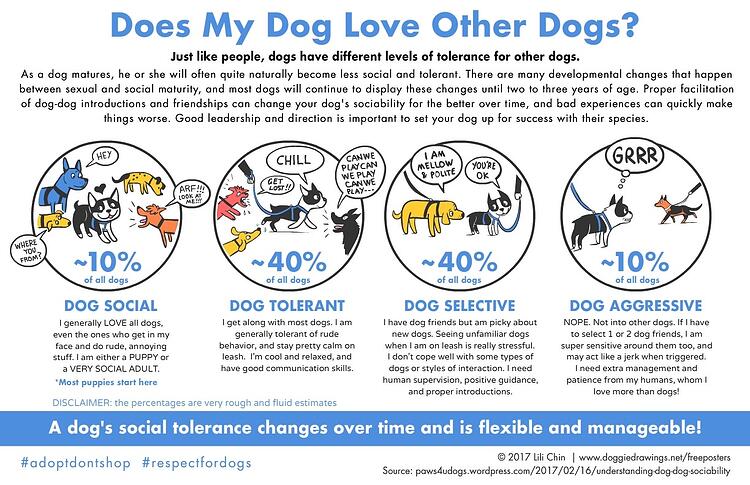
Emily and I like this chart (replacing the term “aggressive” for “solo”) illustrating the different levels of sociability. 

Created by the amazing Lili Chin

One of my favorite things about this chart is that it clearly shows that far fewer dogs “love all other dogs” than American culture would have us believe. There’s this really pervasive myth in our culture that dogs should love everyone and everything, regardless of how the other individual is acting towards them. We expect them to be perfect all of the time. I don’t know about you, but that sounds not only exhausting but also impossible. 

There are far more dogs who fall in the “Dog Tolerant” and “Dog Selective” categories. And that’s okay. Just like humans, there are dogs who don’t get along with everyone. There are those who have their friends and prefer to hang out with only them. There are those who have a large group of friends and others who have a small group. And all of that is okay, just like it is for humans. We’ve been domesticating them for a long time to hang out with us, not necessarily with other dogs. It’s only been in the last decade or so that we’ve seen a greater push for dogs to all play together.

When you’re going through this chart, take a step back and think about where your dog’s sociability is today, not when they were a puppy or even 6 months ago. Most puppies and adolescent dogs fall into the “Dog Social” category (though not all do). As they age, they usually leave that category and fit more accurately into another option. Needs and desires change with age and we should respect their current wishes instead of trying to adhere to who they used to be. I’m sure we would all ask others to do the same for us. 

Additionally, it’s possible for sociability to change based on experience. I unfortunately have people reaching out to me fairly regularly because their dog has become selective or reactive (or even solo) after being attacked by or in a fight with another dog. Even one traumatic experience can change how they feel about new dogs as a whole.

So, it’s possible for a dog’s sociability to decrease, but how about increase? Sure. Behavior modification can help with that. One of the types of cases we work with most frequently is helping reactive dogs feel more comfortable around other members of their species. However, this behavior change can only be to a certain point. Learning history is only one factor that contributes to overall behavior. There are things that we can’t control or change, like age, genetics, and primary socialization periods. It’s unlikely that a dog in the “Dog Aggressive/Solo” category will move all the way up to the “Dog Social” category. We should set our sights on increasing sociability to the “Dog Selective” category instead, and I recommend having a behavior professional help you do that to make sure the process goes safely and smoothly.

The overall goal of this challenge is to be able to make more effective enrichment decisions based on where your dog’s sociability lies. Another myth that’s quite pervasive is that we need to be “socializing” our dogs with other dogs in order for them to live happy, fulfilling lives. But that’s only true for a certain subset (and it’s not actually socialization from a behavior standpoint after a certain age [I talk a bit about that here])! We should absolutely set up playtime for our “Dog Social” dogs and allow our “Dog Tolerant” and even some “Dog Selective” dogs to play with their friends in scenarios that they enjoy. But we can also meet social interaction needs by interacting with humans, especially for our “Dog Aggressive/Solo” and “Dog Selective” pets. I’ve met many dogs who are perfectly happy and well-enriched by interacting with humans alone. 

Here are some options for activities that dogs can do together:

  • Playtime (like well-run dog parks, daycares, boarding facilities, or just setting up a playdate in your yard)
  • Walks & hiking
  • Swimming
  • Training together (and at a distance for our “Solo” and “Selective” friends!)

And activities for dogs to enjoy with their humans:

  • Physical exercise games, like fetch and tug
  • Mental exercise games, like scent work and hide and seek
  • Training (especially trick training!)
  • Cuddle time for those who enjoy it
  • Walking & hiking

Now what?

Happy training,

Allie

What I Wish Someone Told Me When I First Started Studying Animal Body Language

Last week I wrote a post about the “freeze” option our pets have while over threshold and mentioned that it often gets written off as “fine”. You can read that article here if you haven’t yet. This week, I want to focus on a reaction that I often see when people first learn about this: the prelearning dip. 

Waaay at the beginning of the Pet Harmony blog, I talked about “prelearning dips.” You can read the full article here, but the Cliffs Notes version is that a “prelearning dip” happens when we receive new information that competes with information we previously had, so we reject the new stuff. It’s one of the reasons why providing facts, stats, and scientific studies in an internet argument doesn’t usually work in persuading the other person. We all go through these dips and sometimes we hang out in that dip for a while instead of reconciling the new information and updating our knowledge base. I know that I have!

Often, when I talk about the “freeze” option to clients I see them having a bit of a prelearning dip as this new information – that their pet is uncomfortable, stressed, and/or anxious – is incompatible with what they thought was happening– their pet being “fine.” That’s a really difficult piece of new information to reconcile. In a session, I’ll let my client work through that and ask me as many questions as they need to to reconcile instead of pushing them, but I wanted to take the time to talk to y’all about this particular situation more in-depth. And, more importantly, let you know that this is a normal part of the learning process. 

Prelearning Dips & Learning Body Language

I regularly give presentations about animal body language. After every presentation, there is at least one person – without fail – who is concerned about their pet displaying many of the stress signals that we discussed in the seminar. This happened so frequently that I included an entire slide in my updated presentation saying that, “not all stress is bad stress” to allay some of those fears and questions I was routinely getting. 

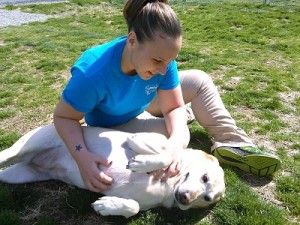
Good stress vs. bad stress is a topic for another day; the point of this anecdote is that there are a whole lot of feelings that come up when people first start studying animal body language. Guilt, anxiety, confusion, wonder, excitement: I’ve seen it all! And a very common occurrence is that of the prelearning dip. This happens because, for some people, I’ve inadvertently shattered their beliefs about their pet. They might think that their pet loves belly rubs but I challenged that by describing a “tap out” (pictured below).

This dog’s ears are held low and back against the head, mouth is tight, and body looks stiff. All signs that this is a tap out instead of a belly rub invitation!

They might think that their dog loves getting kissed on the top of the head, but I challenged that by putting all of the signals they see from their dog in that situation into the “distance-increasing” category. 

Dog kiss
This dog’s ears are super far back and low against the head, body stiff, mouth closed tightly, head turned away, and it looks like the tail might be tucked as well.

They might think that “freeze” is a sign of “fine”, but I challenged that by stepping on a mini soap box about how not-okay it is for animals to be shut down. 

Scared puppy
This dog’s ears are low and back against the head, tail down, body stiff, and slightly crouched. The weight distribution on the hind legs (leaning back) may be for balance instead of a stress signal.

The list goes on. 

The biggest thing that I want to tell folks who I see struggling to reconcile this new information with the information they previously had is: it’s okay. It’s okay to go through a pre-learning dip! We’ve all been there before and will be there again. It’s okay to take some time to sift through new information and noodle it over. It’s okay to reframe how we think about our pets based on this new information; they’re still the same individual they were before and we won’t love them any less. It’s okay. 

If you’re one of the majority of people who has or is struggling with a prelearning dip as you learn more about your pet’s body language, know that you’re not alone. It’s okay to learn new things and even learn that you were wrong about a certain aspect of your pet. We all do the best that we can with the information that we have in the moment; and when we learn better, we do better. The most important thing is to keep learning.

Now What?

  • Have you started studying your pet’s body language? If not, get on it! If everyone knew how their animal communicated we would live in a very different [and I think better] world. Here are some resources to help you (these are Amazon affiliate links. We receive a small commission for purchases made through these links at no extra cost to you. This helps us continue to put out free content to help you and your pets live more harmoniously!)
  • Think through your learning journey in regards to animal body language. What’s something that you’ve learned from multiple reputable sources that you’re still hung up on? Why do you think you’re having a prelearning dip about that particular thing? What ideas do you currently have that have to change in order to reconcile the new information?
  • Talk to an expert about your prelearning dip. Tell them about the hangup you’re having and why you think you’re having it. Many times hangups happen because there are kernels of truth in mostly untrue ideas or statements; it’s hard to piece together what is and is not factual in those situations. An expert can help you do that more proficiently! 
  • If your prelearning dip is happening as a way to keep guilt at bay, you’re not alone. All of us at some point have been told to do something or train in a way that wasn’t LIMA-friendly towards our animals. And oftentimes, prelearning dips are a way for us to not have to deal with the emotions that come along with that. Remember, we all do the best that we can with the information that we have at hand. Let yourself feel those difficult things and then move on, knowing that you’re on the path to knowing better and doing better. 

Happy training!

Allie

When Should We Be Concerned About “Fine”?

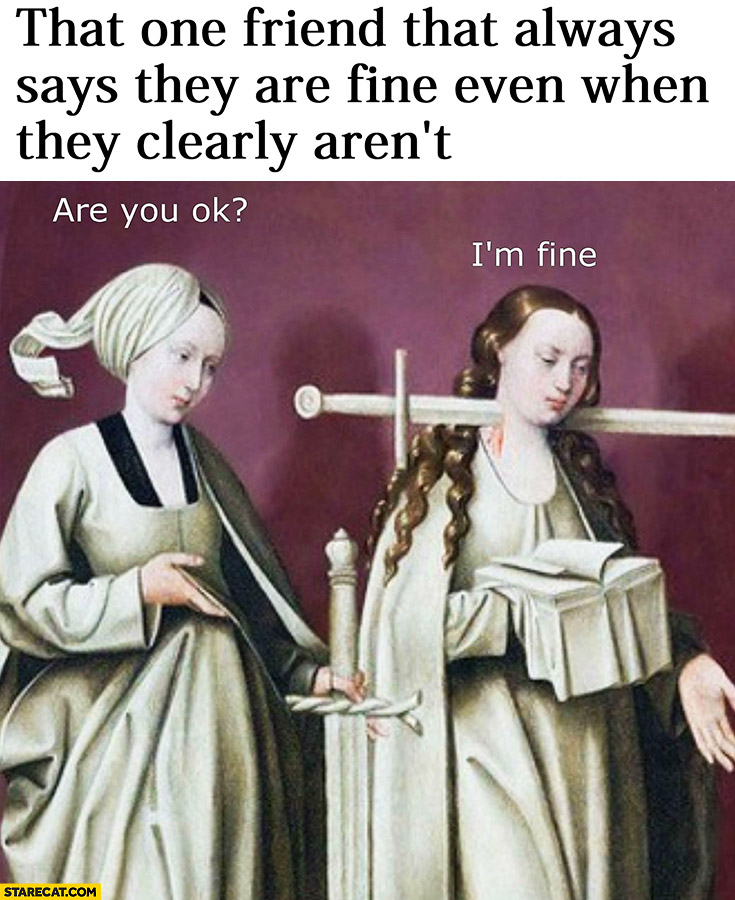
I’ll admit, I’ve had an issue with the word “fine” for longer than I’ve been involved in animal behavior. The reason for that is fairly perfectly summed up in this meme:

But I digress. Onto how this relates to animal behavior!

Something I hear frequently is:

“I don’t get it. He tries to bite people normally but is totally fine when they take him in the back at the vet clinic!”

When I hear this, I ask my client more questions about that scenario: what sort of body language do you see at the vet? Does your pet seem fearful or is he totally happy and excited to be there? It’s almost always the former. In that case, I have to break some bad news to my clients: their pet is not actually fine. 

A bit about thresholds

We’ve talked about thresholds before in our “Does Your Pet Have Mountain Lion Brain?” post. Essentially, it’s that line in the sand where under threshold your pet is okay and above threshold they’re in fight-or-flight mode (this is an overly simplified version; I recommend Eileen Anderson’s blog post to learn the nuances). However, our pets have more options than just fight or flight when they’re over threshold. Freeze is a third option. 

What does “Freeze” look like?

A quick note before we continue: there’s also a body language signal that we refer to as “freeze”. That type can be a bit different than the “freeze” option over threshold that we’re currently talking about. 

Over threshold, “freeze” looks like when a rabbit spots you crossing their path. They get very still, as if they’re saying, “If I don’t move then you can’t see me and won’t eat me!” This is true for our pets, too. Freeze looks like a stiff stillness. One of my favorite resources to help my clients understand this important distinction between “fine” and “freeze” is this video from Eileen Anderson (note: while shut down and freeze are technically different, the concepts are similar enough for our purposes at the pet parent level):

https://www.youtube.com/watch?v=5CyH0RHWYsU&t
Thank you Eileen for letting me link to your video here!

As you can see, there are very subtle differences between “fine” and “freeze”. It’s easy to see why many people don’t spot what’s happening! 

Why is “Freeze” Not Fine?

At this point when I’m talking to my clients, they often ask me if this is really a big deal. Their pet is not actively aggressing, nor running away, and the clinic staff is able to do what they need to do for the health of their pet. Why is that not okay? The answer is dependent on who you ask. 

From the human point of view, everything is okay. We’re able to perform the tasks we needed to to keep the pet physically healthy and we were able to do so safely. It’s a win-win for the humans! From the pet point of view, however, it’s definitely not a win-win. They’re still scared and over threshold, which can feed into other aspects of life. For instance, a client recently told me that her dog had major regressions in all of her anxiety-related behaviors, including light/shadow chasing, reactivity, and aggression, after she came back from a tooth extraction, even though there were no negative reports from the clinic. Behavior doesn’t happen in a vacuum; many seemingly unrelated things do impact one another. 

Experiencing these traumatic (again, from the point of view of the pet and not the human) and unavoidable events can lead to learned helplessness. This is a state where an individual has learned that nothing they do affects their outcome so they choose not to do anything when put into stressful situations. I mentioned the vet clinic, but I also see this happening at groomers and even at dog parks and doggy daycares. 

There’s a whole host of negative mental and physical side effects from learned helplessness, from disrupted sleeping patterns to increased anxiety-related behaviors. We talk a ton about this in our book in the Agency chapter if you’re interested in this topic. In short, “freeze” is definitely not okay from the point of view of the pet’s mental and behavioral health. 

What can I do?

The good news is that your pet will tell you when they’re uncomfortable and, in most situations, we can advocate for them! The above video excellently showcases different dogs in this shut down state but it’s up to us to learn our own pet’s body language to know what it looks like for them. 

When you see your pet entering that zone, take a moment to assess the environment and situation. What is your pet responding to? I’ve been using a vet visit as an example but this can happen in other situations, too. For instance, when I first adopted Oso he would choose “freeze” during thunderstorms. How can you manage the environment in that moment to alleviate your pet’s stress? 

And, of course this wouldn’t be a training and behavior blog without recommending training! When you know what is making your pet uncomfortable you can work on helping your pet feel more comfortable in those situations. Above I stated that when I first adopted Oso he would freeze during thunderstorms; that’s because we worked through that fear using counterconditioning and he is no longer as frightened of them. There’s no reason for him to freeze because it’s not that scary. That is the true win-win. 

Now what?

  • Continue learning your dog’s body language and stress signals. Here are a couple books to help you with that (these are Amazon affiliate links. We receive a small commission for purchases made through these links at no extra cost to you. This helps us continue to put out free content to help you and your pets live more harmoniously!)
  • When you see your pet choosing “freeze”, assess the environment and situation to determine what the triggers are. Make a note of those. 
  • Work with your behavior consultant to determine the best course of action for working through your pet’s fears. While it’s possible to do this on your own, your behavior consultant should help you do this in a way that is effective, ethical, efficient, and empowering so that you don’t have unintended consequences down the road. 
  • Work through your pet’s behavior modification plan and see those true win-wins roll in!

Happy training!

Allie