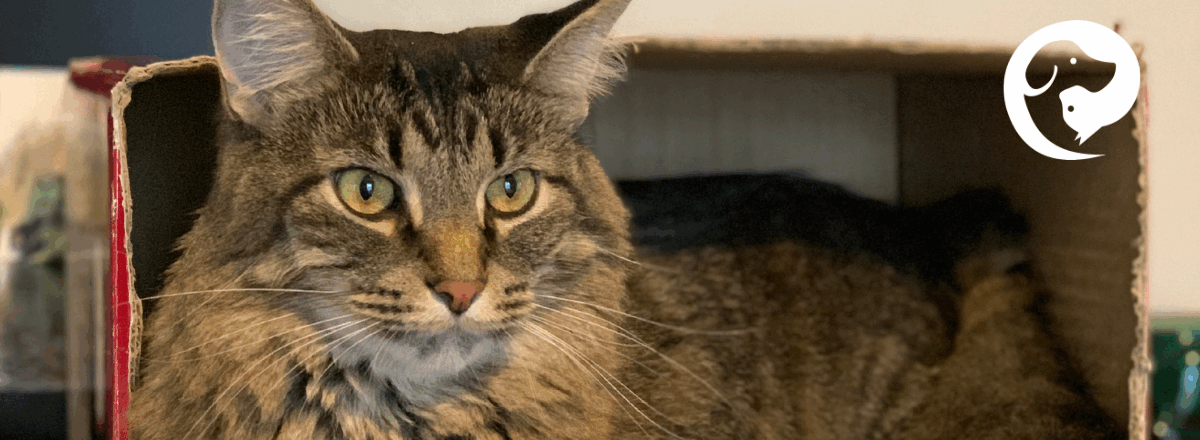


A fluffy cat resting inside of a cardboard box.

Why Your Cat Needs a Safe Space (and How to Build One That Works)

Why Your Cat Needs a Safe Space (and How to Build One That Works)

A fluffy cat resting inside of a cardboard box.

Cats, like other sentient beings, can get anxious and/or overwhelmed by their environment and the other beings in it from time to time. And like other sentient beings, if they don’t have a way to escape that chronic stress, it can impact both their physical health and their behavioral health. When I worked with clients I used to tell them that the sustained pressure of living with chronic stress will eventually come out somehow: through explosion, implosion, sublimation, or learned helplessness. 

  • Explosion looks like conflict-seeking behaviors–like cats fighting each other.
  • Implosion looks like self-harming behaviors–in cats, that often looks like overgrooming to the point of damaging their coat and sometimes even their skin.
  • Sublimation looks like acting out in seemingly unrelated ways–like peeing in your boots.
  • Learned helplessness in cats often looks like a loss of personality and behavioral diversity, just doing the bare minimum to take care of themselves and stay alive.

One of the most impactful things we can do to alleviate that chronic stress and prevent any of those kinds of harm from happening to our kitties is create a dedicated safe space just for them. Whether you’re bringing home a new cat, managing a multi-pet household, or simply supporting a shy or anxious kitty, a well thought out safe space can be the difference between a stressed out cat and one who feels confident enough to explore the world around them and genuinely enjoy their life.

At Pet Harmony, we believe in setting up environments that support the behaviors we want to see. So let’s talk about what a feline safe space looks like, why it’s so powerful, and how you can create one that meets your cat’s unique needs.

What Is a Safe Space for a Cat?

A safe space is a quiet, cozy, and low-traffic area where your cat can retreat, decompress, and feel in control of their surroundings. Think of it as your cat’s personal sanctuary—free from stressors, full of comfort, and of course full of opportunities for cats to meet their own needs.

A safe space can be a whole room – like a guest bedroom – or a designated nook—like a cozy corner with a tall cat tree and a hiding spot. The key is that your cat feels safe there, and that security often comes from choice, control, and predictability.

Why Your Cat Needs a Safe Space

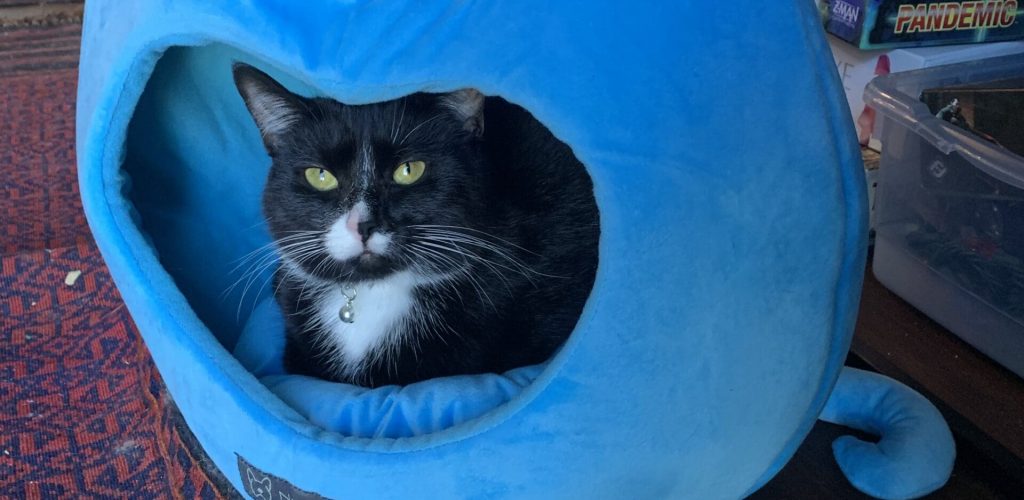
A black and white cat peers out from inside a plush blue fabric hut that is shaped like a creature. It has eyes and the cat enters through the open mouth.
Sushi resting inside her cozy creature. Photos of Sushi and Charm (on the blog title image) courtesy of Sam Griffin (Wise Whiskers Training).

Cats as a species are both predators and prey, which means they can have a tendency to be hyper-aware of their surroundings and therefore can be really sensitive to everything that’s happening around them. Changes in routine, unfamiliar guests, renovations, or even a new smell can be enough of a stressor to set them off kilter.  

On top of that, interpersonal dynamics among cats or between cats and other species can be pretty subtle and hard for us to notice, but can function as significant chronic stressors for them. I had a client where the only sign of conflict between two cats was that one would give the other a hard stare when she tried to approach the litter box, water bowl, or food bowl that the first cat was guarding. That look was enough to cause major distress in the second cat that resulted in a urinary tract infection and persistent inappropriate elimination, even after the infection was resolved. I’ve also worked with multiple clients where the source of the cat’s chronic stress was a mystery until we discovered that a stray cat was marking their territory in their yard.

The take-home point is that the source of a cat’s stress isn’t always immediately obvious to us, and they will do better if they have the ability to move away from their stressors on their own. A safe space gives them the choice to step away and complete their stress response cycle.

How to Set Up a Cat-Friendly Safe Space

Let’s break this down into manageable steps so you can set your cat up for success.

1. Choose the Right Location

Pick a quiet area away from high foot traffic, loud appliances, or busy windows. If you live in a bustling household, a guest room or home office with a door that can close is ideal. If space is limited, try using a tall piece of furniture, curtain dividers, or even a modified closet. If the other pets in your home are contributing to the cat’s stress, make sure their respective safe spaces are separated from each other.

2. Add the Essentials

Here’s your feline-friendly checklist:

  • Hiding spot: A box, covered bed, or carrier are usually good options to trial and eval.
  • Vertical space: A cat tree, shelf, or wall-mounted perch are good, but ideally your cat’s perch will be the highest thing in the room–otherwise, you may find that your cat is just using the vertical space you gave them to access a space that you maybe didn’t want them to access.
  • Litter box: In a discreet but accessible spot. Preferably with a ramp or low point of entry so they don’t have to climb a high barrier to get in and out of it.
  • Food and water: Placed at a distance from the litter box.
  • Toys and enrichment: Interactive toys, puzzle feeders, or a wand toy can all be good options, but if your cat doesn’t currently play with toys you may want to do a play preference test to find out what your cat enjoys. Give them things that they can use to entertain themselves without needing your involvement.
  • Comfortable bedding: Something warm and soft that smells like them.

Pro tip: Let your cat choose where they feel safest within that space—observe and support their choices.

3. Make it Smell Familiar

Scent is a huge part of how cats experience security. Place a used t-shirt, blanket, or towel with your scent in the area. If you’re welcoming a new cat, you can try using synthetic feline pheromones like Feliway to help ease the transition, but if you have something of theirs from their previous home that smells like them, that would be ideal.

4. Limit Unwanted Access

Let your cat know this space is theirs. Keep dogs, kids, or other cats out, especially if your feline is stressed or new to the home. Respect their boundaries—this isn’t the place for unsolicited cuddles or surprise visits.

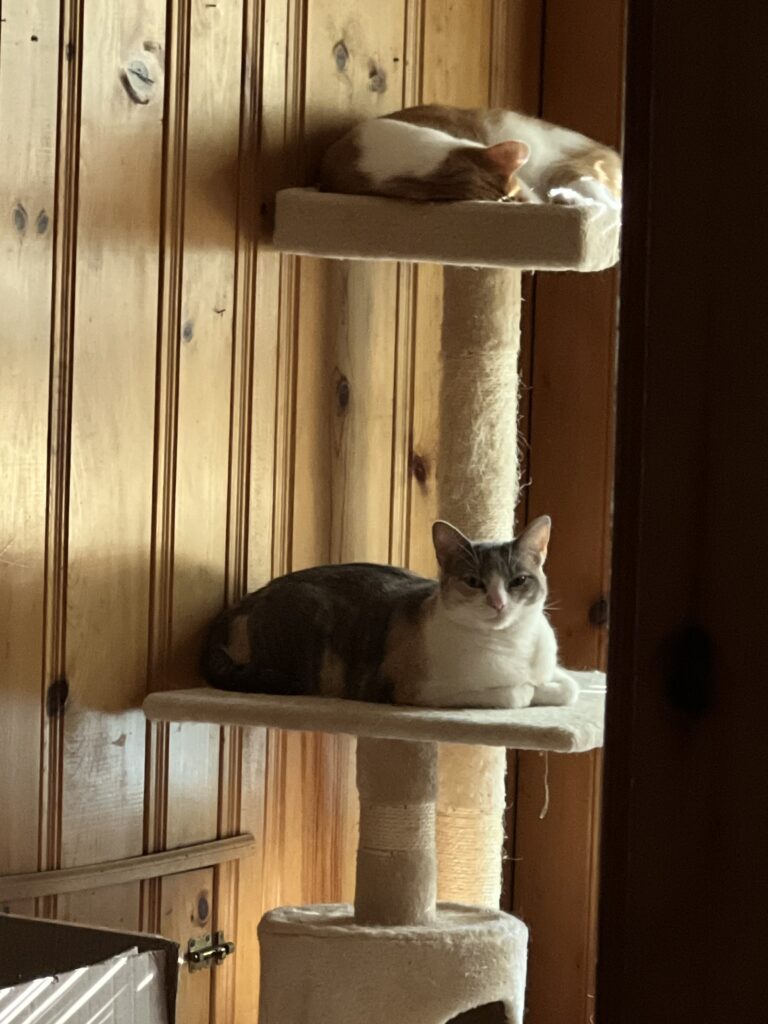
An orange and white and a calico cat perched on different spots on a cat tree, resting comfortably.
Kronk (upper level) and his sister Yzma (lower level) resting on the cat tree in their private area, away from the main part of the house. Photo courtesy of Eric Graf.
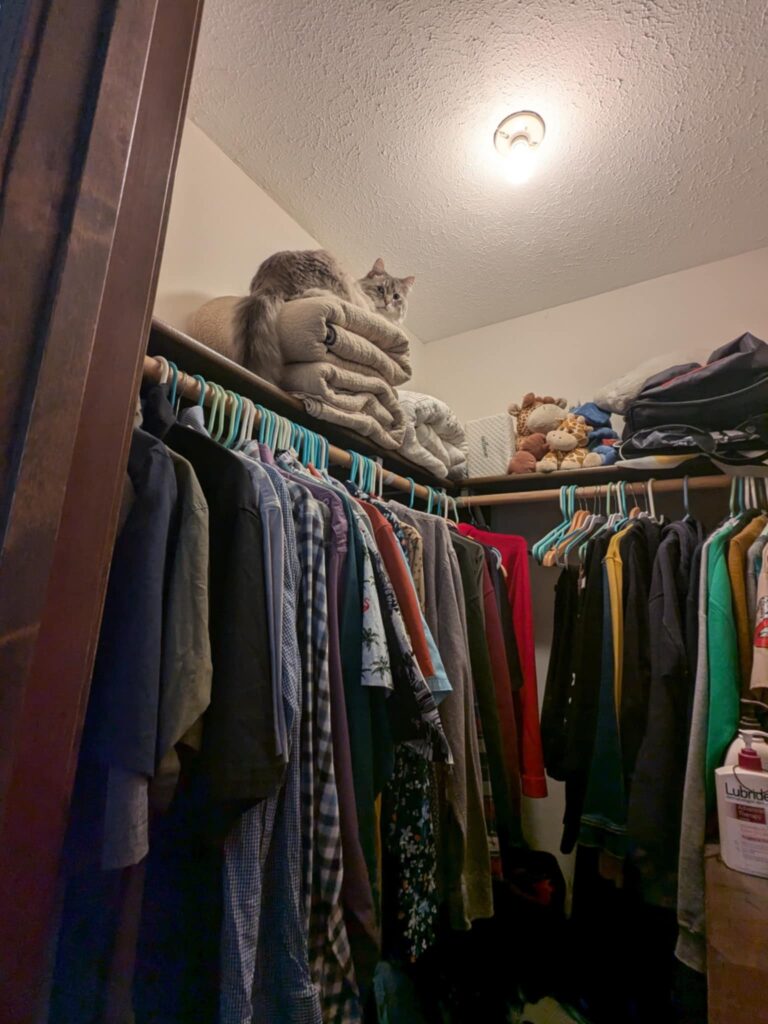
A handsome fluffy cat resting on top of a folded comforter on a high shelf inside a closet.
Finn The Cat (his given full name) has chosen a high shelf inside a closet to be away from his dog brothers and sister. He asks his person to help him onto his cozy perch. Photo courtesy of Jordan Bradley (Click to Communicate).

What a Safe Space is Not

Creating a safe space doesn’t mean isolating your cat or punishing them by locking them away. The goal is to offer choice and control, not confinement. Think of it as empowering your cat to engage with the world at their own pace. times that may mean giving them the ability to come and go from their safe space as they please. When that isn’t an option, the next best thing is to figure out your cat’s cues for requesting to go in and out of their space and facilitating their requests. If even that isn’t an option – because we’ve all got lives and we can’t be watching our pets 24/7 – keep an ear out for when your cat is asking to leave their safe space, so they never feel trapped there.

Safe Spaces and Behavior Goals

If you’re working with a behavior professional to address your cat’s distress – like reducing fear, reactivity, or inappropriate elimination – a safe space is often the foundation of your plan. Why? Because learning only happens when an animal feels safe. And just like us, cats can’t thrive if they’re constantly on edge.

If you’ve been following us for any amount of time you have almost certainly heard us say this: Behavior is communication. If your cat is hiding, hissing, or avoiding someone in your household, they may be telling you they don’t feel safe. Meeting that need is the first step toward changing their behavior and improving their physical, behavioral, and emotional health.

Final Thoughts

Whether you’re welcoming a kitten or supporting a senior cat through a big life change, creating a safe space is a gift of agency and care. It tells your cat, “You’re safe here. You’re in control. You get to choose.”

And from that foundation, trust grows. Confidence builds. And your relationship with them blossoms.

Here’s to harmony,

Emily

Now What?

Need help setting up the perfect safe space for your cat—or navigating behavior challenges? Our team at Pet Harmony offers personalized, evidence-based support to help your pet thrive. Let’s make life easier for you and your feline friend.

Copyright 2025 Pet Harmony, LLC. All Rights Reserved.

Terms & ConditionsPrivacy Policy

Results are not guaranteed because behavior, human, canine, or otherwise, are not guaranteeable.

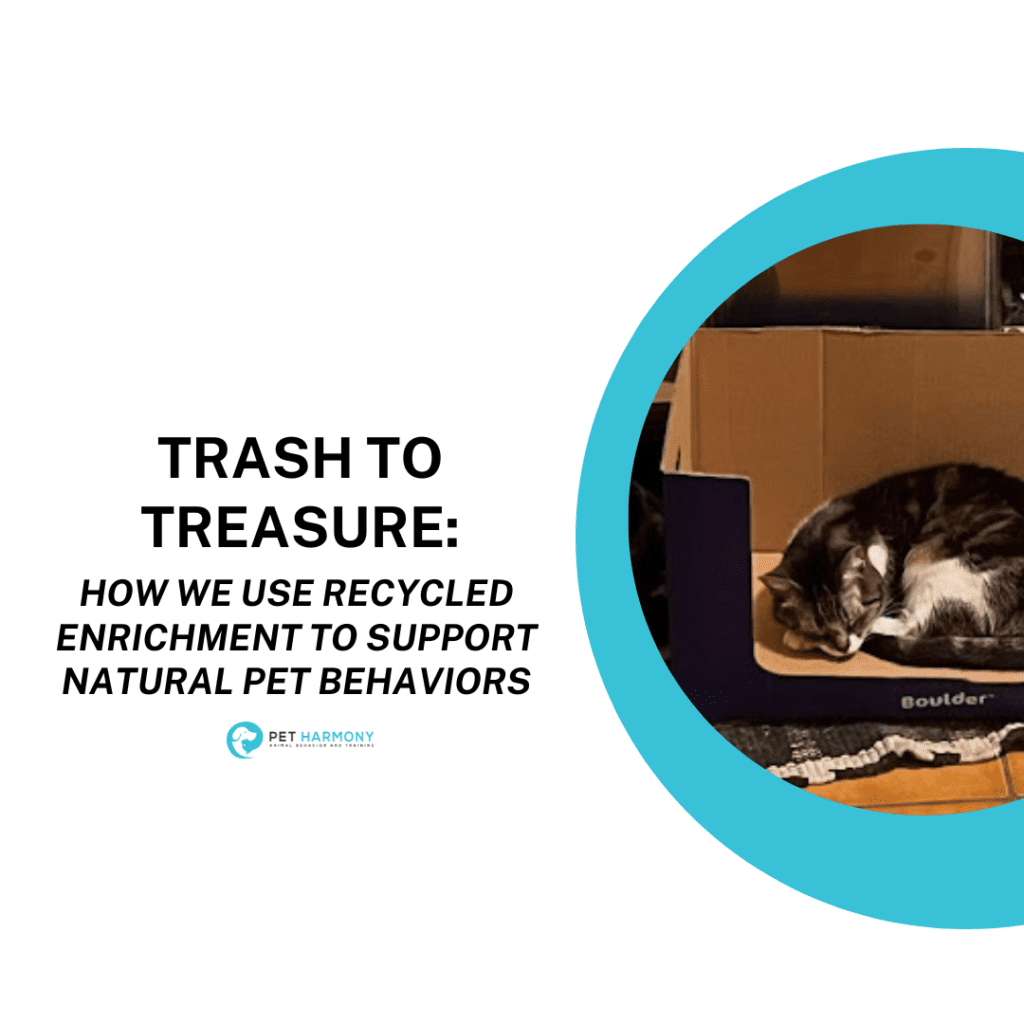
Image with a cat sleeping in a cardboard box. Text reads: Trash to Treasure: How We Use Recycled Enrichment to Support Natural Pet Behaviors

Trash to Treasure: How We Use Recycled Enrichment to Support Natural Pet Behaviors

It’s a beautiful spring day and I’m sitting at the Firefly Coffee House finishing my house-made bagel with peach spice cream cheese schmear (yes, it was good). As I finish scraping the cream cheese out of the small plastic container, I think to myself “I wish Petey was here…” You see, one of my dog’s most important roles in our home is cleaning out items bound for the recycling bin. My next thought was…how unhinged of me would it be to put this in my car so I can take it home to Peter? 

In this week’s episode of Enrichment for the Real World, Emily (who would undoubtedly encourage my cream cheese trash caching impulse) discusses exactly how to introduce your pets to the world of DIY pet enrichment. If you’ve never given your pet this type of activity, I suggest you give it a listen! 

We’ve covered this topic on the blog in different ways over the years, so if you are unsure why we are all handing our trash over to our pets, here are some great places to start:

As discussed in most of these blogs as well as on the podcast, any time you provide your pet a new activity, watch them. See how they work on the item. If they ingest non-food items, your trash enrichment opportunities will look different, or they may not be an option for your pet. 

Related: If you provide your pet with an item that previously contained food, make sure you read the ingredients so you know it is safe for them. Here is a reference with common ingredients and household items that can be dangerous: Potentially Dangerous Items for Your Pet – US Food & Drug Administration

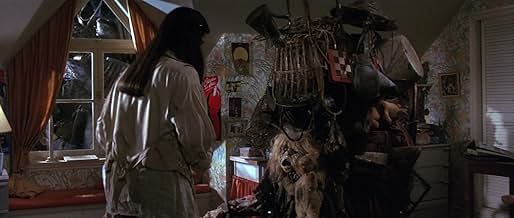
The Junk Lady: What's the matter, my dear, don't you like your toys?

Sarah: It's all junk!
Junk Lady from the movie Labyrinth found on IMDB https://www.imdb.com/title/tt0091369/characters/nm0117350/
The Junk Lady: What's the matter, my dear, don't you like your toys? Sarah: It's all junk! Junk Lady from the movie Labyrinth found on IMDB https://www.imdb.com/title/tt0091369/characters/nm0117350/

Creative Ways to Use Recycled Materials for Enrichment

In a Pet Harmony first (probably?), the whole team is here to share the actual ways we utilize materials that are on their way to the recycling (or trash) bin to encourage species-typical behaviors with the pets in our homes. 

If the number of blogs we have (and that list up there isn’t even all of them) that discuss using trash for enrichment doesn’t tell you how common and important these practices are in our households, seeing the overlap in the way we are all using these items might. Here are some of the most common materials and activities I saw in submissions from the team: 

  • Toilet paper / paper towel tubes: Tuck the ends in on a tube and suddenly it’s a tiny paper pocket. Chuck some treats in there and you can:
    • Just hand it over and watch your pet pull the tube apart to get to their snack.
    • Hide them around – now you have an activity that encompasses scentwork, foraging, and dissecting (tearing apart).
    • Put them inside other items, much like the next point…
  • Box in a box in a box / nesting doll boxes: That’s it. Just stuffing food/treats inside of boxes and then putting boxes inside of other boxes. 
  • Takeout containers: These items come with bonus flavors / scents since they just had food in them!
  • Plastic food containers: Ditto on these. Yogurt, cottage cheese, cream cheese, peanut butter…anything your dog can have that comes in a container also comes with a potential activity. Toss them the container and let them clean it out before you chuck it in the recycling/trash bin.

Ellen’s blogs on Budget Friendly Enrichment Options and Explore Variety Through a Cardboard Box describe these activities in more detail. 

Why Recycled Enrichment Supports Natural Pet Behaviors

Species-typical behaviors are at the core of enrichment. Ensuring that ANY species living in captivity have outlets for behaviors that are normal and innate is a basic component of welfare. Learning your pet’s species-typical behaviors allows you to find creative but budget-friendly ways to meet their needs. In the sections that follow, you will see how our team uses items described in the previous section (and more!) to allow the species they live with to engage in behaviors that meet their individual needs. Spoilers: it’s not just foraging!

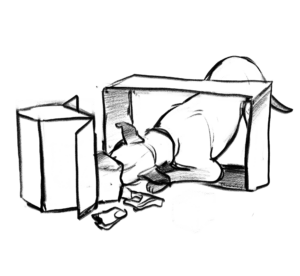
Sketch of a dog climbing through an open box and putting their head into another
A sketch of ghost the dog maneuvering through some box obstacles. Drawn by the talented Taylor Duffy.

Here are a few examples of species-typical behaviors that we are supporting with, well, junk: 

  • Emily’s eclectus parrot, Cah’ya, gets curled up plastic straws as a stand-in for another bird to preen 
  • Taylor’s dogs get to move, stretch, and balance with box obstacle courses
  • Bundini the bunny gets to dig and burrow even though he lives indoors at Emily’s house thanks to large cardboard boxes
  • MaryKaye’s 17 year old senior citizen (dogizen?), Fonzy, can still shred and dissect like a young pup thanks to toilet paper tubes 
  • Ellen re-stuffs toys with old scraps of fabric so Griffey and Laika never run out items to dissect

We Love Trash

The time has come! Let’s dig into the trash stash and see what the team gets up to at home. I suggest you put on this inspiring song by Oscar the Grouch while you read. 

Emily, Copper, and Miley (plus Bundini the rabbit and Cah’ya the eclectus parrot)

The dogs have their own recycle bin where we put any cardboard or plastic trash that is safe for them to destroy and they get to choose what they want to pull out.

Medium and small cardboard boxes get turned into “russian nesting dolls,” by which I mean I put packing paper and dog treats into the largest box, put the next largest box inside it, then put packing paper and dog treats into that box, put the next largest box inside it, and so on.

Paper towel rolls and toilet paper rolls get stuffed with balled up pieces of packing paper and dog treats for the dogs, packing paper and cage mix for Cah’ya, and hay and alfalfa pellets for Bundini. 

Large cardboard boxes get set aside for Cah’ya so she can turn them into her “nest”. She regularly destroys her nests, which allows me to replace them with the next box.

I have a wacky whirly tool for the times when I end up with a plastic straw. I try to avoid straws whenever possible, but when they happen I can use the wacky whirly tool to turn the straw into a springy coil. When I’ve collected enough of them, I tie them all together and hang them in the bird room for Cah’ya to allopreen and/or shred them. The added benefit is that when she’s done with them and they eventually have to be thrown away, they no longer pose a risk to wildlife in their springy-coil state!

Scraps of fabric from any fabric project I’ve got going on end up as bird toys – again for allopreening or shredding – or as knotted tug toys for Miley, my puppy.

Everyone once in a while we get a really gigantic cardboard box – usually when we buy a new piece of furniture or other household item – and I’ll use it to make Bundini’s “burrow.” Since he lives in our house he can’t physically burrow underground, so I cut rabbit-sized holes on either side of the gigantic box, stuff the box full of hay, and let Bundini burrow in the hay in the box. Like Cah’ya, he eventually destroys his burrow boxes, which allows me to replace it with the next gigantic box.


Claire and Olivia

Any possible boxes that are received are always a go to. I also use paper towel/toilet paper rolls, packing paper, and paper bags – especially from takeout! Since she’s on the smaller side, if we get a large box, I will fill it with treats and paper, and encourage her to get inside of it and rummage which she loves.

I like to also use toys Olivia hasn’t paid attention to in a while and stuff all the trash into those. 

I’m a big fan of letting Olivia sniff “safe trash” outside because she loves to sniff and check it out for a while. I think it also builds her confidence.

We also were gifted a nice comforter in a plastic carrying bag and it ripped on the side, so she would crawl into it and roll around which I found hilarious. I left it there forever to entertain her.


Tiffany Chen and Sihtric

I like to collect recyclables like cardboard boxes, paper towel tubes, paper bags, and the packing paper from Chewy boxes. I stash them in a big bag in the kitchen. On days when it’s too hot or windy here in Las Vegas to take Sihtric for a walk, I go straight to that stash. I’ll stuff the boxes and tubes with treats, then pile everything into a big box for him to dig through. If I’m feeling a little extra, I’ll toss in a chew and a Toppl filled with canned food.

Shredding and sniffing are his favorite things, so he really takes his time with it. I love this setup because it’s super low effort on my end, and while he’s busy with his box, I get to do my own thing. Afterward, he’s usually passed out, which tells me his needs are met!


MaryKaye and Fonzy

Senior dogs love to get down and dirty in the trash too! While my 17 year old pooch may not have the teeth and jaw strength for super thick cardboard boxes anymore, he can still shred a toilet paper roll or paper towel tube with the best of them!

I am a little more discerning about the materials I give to him so that I can help him be successful and not get overly frustrated. The things that have proven to be most successful for him include cracker boxes, brown paper delivery envelopes and the aforementioned paper toilet and paper towel tubes. He also loves treats wrapped up in “gently used” wrapping paper so we have a saved pile of used wrapping paper at the ready when he is looking for something fun to do. While senior dogs’ physical abilities may change over time, you can still meet their needs by finding the right kind of trashy treasures! 

Ellen, Griffey, and Laika

I’m constantly looking for ways to use what I already have to make homemade pet toys from recyclables. It is one of the ways that I can practice some creativity and stretch my brain while taking care of my dogs. But, to be honest, when it comes to day-to-day life with my dogs, I keep it pretty simple. I stick with a couple tried-and-true options:

  1. I use a small, dog-accessible bin next to my desk specifically for my scrap paper. Sometimes my dogs get fed up with me doing the human work thing, and their default is to go over, pull out some paper, and give it a good ol’ shred. I always make sure there is something in there for them!
  2. I use scraps of old rags, shirts, socks, old stuffed toy carcasses… You know the kind, to create foraging boxes. It’s cheaper than buying all new stuffed toys, it keeps the mess better contained, and it lets my pups use their nose, rip and shred, and eat all at once.
  3. The good ol’ treat wrapped in paper, wrapped in a box, wrapped in paper, wrapped in a box, in a box, in a box, in a bag, stacking doll of destruction. This one is the most time and effort for me both in building and clean up, but I love watching my dogs use their muscles to get through all the layers.


Corinne and Opie

I love Opie more than anything in the whole wide world, but if I have to hear him scream at me with boredom after the kids have gone to bed I’m gonna lose my ever-loving mind. The solution for us (which also completely eradicated him chewing on our baseboards and gives us something to occupy him during kids’ bedtime) is to split his meals into shreddables (literally any thickness, he’s so talented!) and hide them around the house. We usually do 5-6, but I’m not afraid to divide it into 8-9 if I see the glimmer in his eye. Coffee cups, takeout bags, newspapers, ads, return envelopes, toilet paper tubes, paper towel tubes, children’s artwork (*gasp* I ask first…usually), anything!


Allie and Oso

There are a few ways that I incorporate recyclables into Oso’s enrichment plan. I use them to create his DIY destructible toys which primarily serve two functions:

  1. Fun and boredom relief
  2. Stress-relief (from good stress or bad stress- he chooses to shred regardless of what the big feeling is)

We also have a little bucket next to our garbage can for Oso-safe recyclables that he can pull out when he wants. It’s so cute to watch him grab one and trot away as if he found a treasure. 


Taylor, Ghost, and Eden (plus Took and Lilith the cats!)

Some of our favorite trash items are Aldi boxes and paper bags, fiber egg cartons, paper towel rolls and toilet paper rolls, craft paper, extra napkins, and sometimes things like tires, unoccupied lime scooters, bricks, extra wood, etc. 

For the cats, Took and Lilith love all the paper and boxes that come with grocery shopping. We change the landscape of the kitchen and office from time to time a little by experimenting with different boxes. Some they gravitate to and others get quickly moved along to the recycling. 

We are building skills for our younger cat Lilith to learn to explore a little for her food, so small cardboard pieces help make up pseudo-slow feeders. 

For the dogs we go a little sillier with our trash! We love cardboard and egg cartons for the fun find it games, and food puzzles too. But sometimes the “trash” gets a second life in confidence building games. Here are some examples: 

  • Foot targets out of wood and grip tape for our fitness practice
  • Old tires or different surfaces (pre checked for any scary things) for investigating and standing on
  • Crumpled up napkins for added difficulty in their “shreddables” 
  • Old towels for rolled up treats puzzles and find it games 
  • Obstacle courses made of different materials and surfaces to play with getting on and over (sometimes they even move!?) 
  • Surface library (different textures, angles, heights) from leftover tiles pieces, yoga mats, blankets, plastic, etc.
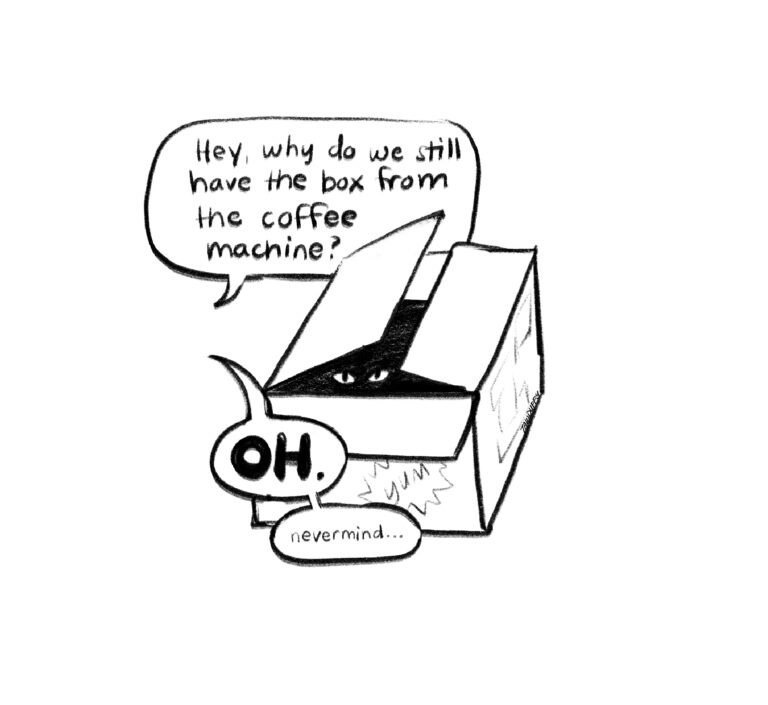
Sketch of a box with the lid slightly ajar. The inside is dark with two eyes peering out. Quote bubbles float above and below the box that say: "Hey, why do we sill have the box from the coffee machine?" "OH, nevermind..."
A cat doing top-secret cat activities inside of a box. Drawn by the talented Taylor Duffy.

Tiffany Holmes and Petey

One of Petey’s favorite snacktivities (that’s an activity that includes a snack, obviously) is searching for hidden destructibles. I discuss this in detail in Indoor Adventure Time, but we also play this outside in our small back yard as well. The rules are simple: I put some food in some sort of containers that he can pull apart and destroy, I hide them, and he sniffs around to find and dissect them so he can get to his snacks.

His other favorite is having his dinner (which is kibble) out of a takeout container that has remnants of the takeout inside. Pizza boxes and the small white paper containers with flaps at the top that tuck in to close (as in Chinese takeout boxes with no metal handle) are top tier.

Trash is an important part of one of Petey’s safe spaces as well! When my mom gifted us toilet paper and paper towels from Costco, Petey benefitted not only from the cardboard tubes, but the giant boxes as well. When he needs to move away from hollering out the window, I’ll cue him to his room, chuck a handful of treats into his giant snuffle box full of packing paper, and he dives right in.


And Now for the Dramatic Conclusion

If you ever cut out and/or decorated windows and doors in a giant cardboard box and turned it into a playhouse as a kid, you’ve felt the joy of homo sapiens’ species-typical behaviors in the form of play!  

So the next time you find yourself looking at a package or box and thinking “this is a good one for enrichment, I better save it,” we say: you’re welcome. 

And for anyone who read this far: I DID bring home that little plastic cup with leftover peach spice schmear and give it to Petey, and he loved it.


Now What?

Did our dedication to trash spark any ideas for you? If you’re ready to begin setting up your own trashrichment, but aren’t sure how to keep all of this extra junk around, here are a couple of ideas from the team:

  • Keep the biggest, nicest, thickest boxes and use them for storage
  • Have an open bin with safe items for your pets to access like Emily and Ellen
  • Save the big boxes for big snuffles–throw in packing paper or other paper items and throw in some treats

If the creativity is flowing and you want to learn more, sign up for our weekly newsletter for more tips, info, and events!

Here’s to harmony (and trash) !

Tiffany (Holmes) & the Pet Harmony Team

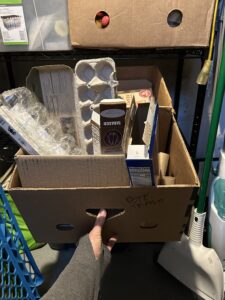
A hand pulling a large cardboard box off a shelf to see inside. It is full of other cardboard and plastic materials. There is writing on the box that says "Pete Trash."
Petey's trash treasures are stored in a big cardboard banana box on a rack in the basement.

What My Clients Taught Me About Enrichment: Lessons from the Human Side

I love animals, but that’s not why I’m a behavior consultant. Now, don’t get me wrong, I delight in the furry besties I meet and am fulfilled by seeing their growth (and, let’s be honest, when a pup with stranger danger cuddles up on me, I’m on top of the world). But in all honesty, one of the most fulfilling things for me as a consultant is to make connections with the humans and to see how everyone’s behavior contributes to a household.


Enrichment is for Everyone

When we say “enrichment” means “meeting needs”, of course we’re talking, in part, about the animals we’re working with, but enrichment cannot truly do its job if it’s not addressing the needs of the whole household. My goal as an effective consultant is not simply to teach my clients about behavior and then dictate instructions on how to change it, but to allow time for my clients to respond and connect this information to their lives. We cannot expect an enrichment plan to work if it’s only addressing one side of the equation.

If you have worked with a consultant (or if you are one yourself), you know the importance of setting up the environment to help the learner be successful. A dog can’t steal a stick of butter off the counter if there’s no butter on the counter (Anyone else? No, just me?). We talk about how management of the environment helps to prevent undesirable behaviors from being practiced and encourage the desirable ones. It’s one of the cornerstones of what we’re asking families to do. But who controls that?

The humans.

And that’s a lot to ask!  The humans are in charge of a lot of the physical management plans, and while this will help our pets be successful and can give the humans actionable tasks to not feel so helpless while we onboard skills, it also impacts the everyday lives of everyone in the house. 

So now let’s think about going into a new session– the humans already have the stress of worrying about their pet’s behavior, the stress of making decisions to support their pet’s success, the stress of reorganizing/reconfiguring their every day lives to support their pet’s success, and now you gotta step over the d*mn baby gate!?! It is so stinkin’ hard.

Y’all know this by now– these things affect how we function. Being a caretaker is harder when you have unmet needs.

Here are some real conversations with families that I work with that have humbled my confidence in giving advice and have reminded me to collaborate, not pontificate.

Client: My dog sometimes barks on walks!

Me: Let’s find alternative physical and mental exercises to do instead at home so they aren’t exposed to the triggers before onboarding skills!

Client: But the walks help me to feel balanced, and we always walk to my best friend’s house where my dog loves romping around in their big backyard.


Client: My dogs sometimes redirect on one another when we walk them together and one of them gets spooked.

Me: Well, walk them separately!

Client: But our schedules are really tight, it’s super stressful, one dog gets anxious when she’s left alone, and they can’t go out in the backyard because they also react to our neighbor who already doesn’t like their barking


Client: My pup gets really rowdy in the evenings, but is able to relax if she’s gotten long walks or has been romping around at day care.

Me: It sounds like when her physical needs are met, she’s able to relax more. Let’s make sure to get 15-20 minutes of a good romp each day in your backyard.

Client: When I’m able to play, she’ll just stare at me and I can’t find anything that she’ll do; or sometimes she’ll get so rowdy that she starts biting and pulling at my shirt!


Stop, Collaborate, and Listen

It’s through listening to my clients’ stories, needs, desires, etc., that we make a collaborative enrichment plan that meets everyone’s needs. We consultants dedicate our brains to problem solving, but we don’t necessarily have the answers. Our conversations create the scaffold to give clients the freedom and creativity to find their own solutions.

Here are a few examples of clients making their own discoveries:

  • Practicing a relaxation protocol with the dog on the couch next to the human helped one client because the pup always got up after the session to lay on the couch with her.
  • While carrying a Gatorade bottle (specifically), one client’s pup could walk without picking up trash because he liked to hold the bottle in his mouth.
  • Shreddable enrichment was TOO much fun for one pup, as he was observed being more excited after the activity, which was supposed to help him settle and rest.
  • Wearing a specific shirt helped a dog relax. The coverage and texture was juuuust right!

These people are amazing. They know and love their pets so much and can tap into more than I ever could because of their extraordinary bonds. They want their animals to succeed, but many are nervous about making the “wrong” choice. It’s so exhilarating to see them use the foundations of understanding behavior modification as a grounding method to making decisions they weren’t originally confident making.

They’re coming to us for pet parent tips, but they’re teaching me tips as this pet’s parent.


Making Connections

So how are they doing this? When we work through the Enrichment Framework with a client, we discuss and list behaviors the family appreciates and likes (desirable), and those that they do not appreciate and don’t like (undesirable). We think about why those behaviors happen. Sometimes, they are just normal [insert animal here] things (aka: species-typical behavior). Even normal behaviors can be undesirable sometimes (ever been annoyed that somebody was chewing?). We think about options for solutions that allow us to improve the lives of everyone in the house. 

Are you stuck with some undesirable behaviors? My advice is to list those out and discover which of those is species-typical behavior. How can we let them be the doggiest dogs, the cattiest cats, the bunniest bunnies, the birdiest birds they could ever be and how can we do that in a way that works symbiotically with the family.

Dog likes to dig and the only available dirt is in the flower beds. ➡️ Can we dig in blankets at home instead of dirt, and find an outdoor space to walk sometimes where digging is okay?

Cat likes to scratch the couch. ➡️ Can we find something with that same texture to add to the cat tree? 

Rabbit likes to nibble on rubbery cords. ➡️  Can we use hard cord covers and give a safe alternative with a rubbery texture?

Bird likes to screech at dusk. ➡️ Can we add some ambient music to mask the sounds for the humans while the bird performs species-typical behaviors, or give the humans some noise-cancelling earbuds?

But here’s the important part that you’re probably tired of hearing by the end of this blog: you need to then ask yourself “does this solution decrease/increase my welfare/enjoyment?” We’ve got to hit a balance between honoring the pet’s needs and respecting human comfort, because our stress levels, in turn, affect how we can care for our pets.

If you’re struggling right now, we know. It’s hard. Let’s think of ways how we can simplify our routines to create sustainable practices so that we can better serve ourselves and our pets. We’re here for you!


Now What?

  • Delight in what you have already learned from your pet– believe it or not, it’s a lot!
  • Reflect on things you do with your pet that’s good for you too– enrichment really is for everyone!
  • Share with us a story of something surprising your pet taught you, we’d love to hear it. Comment below or email info@petharmonytraining.com. 
  • If you’re feeling stuck, you’re not alone. Reach out if you’d like us to join your team to help brainstorm an enrichment plan that works for everybody.

Here’s to harmony,

-Corinne