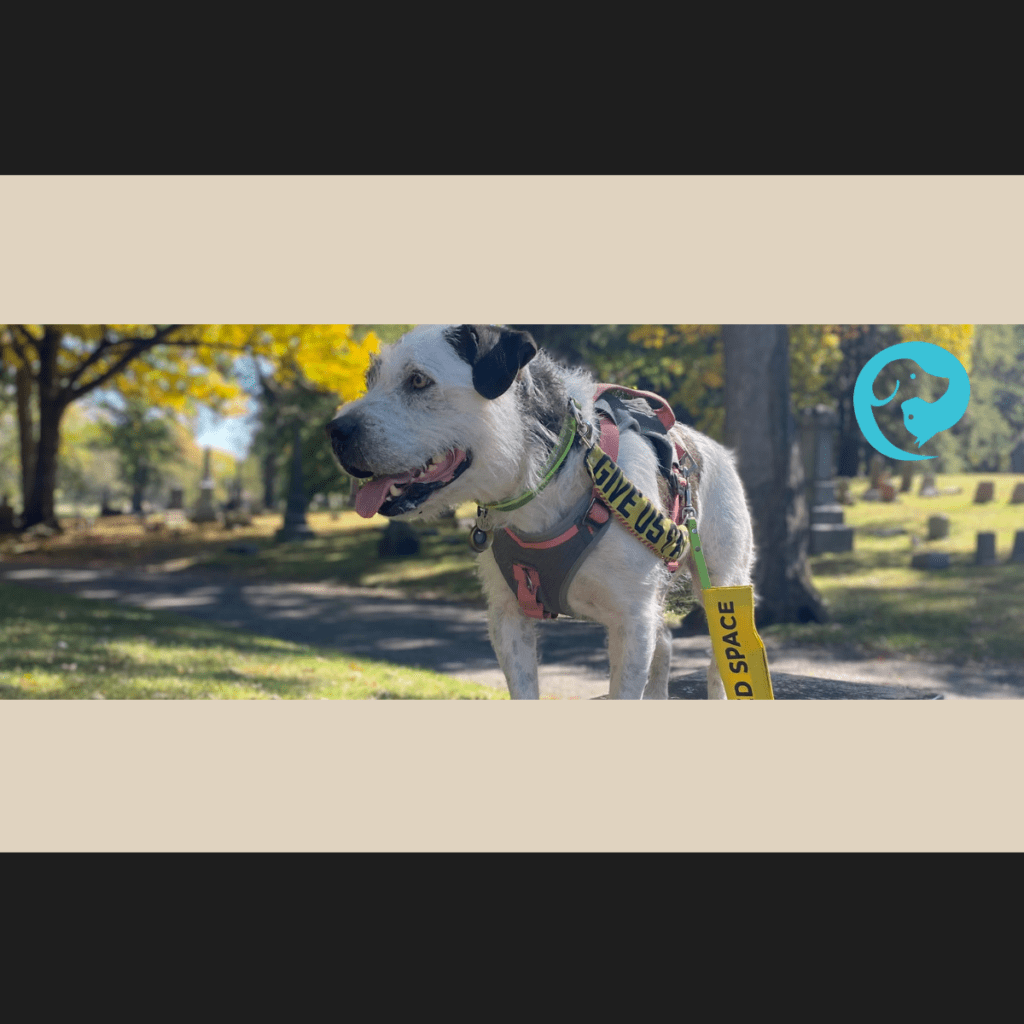
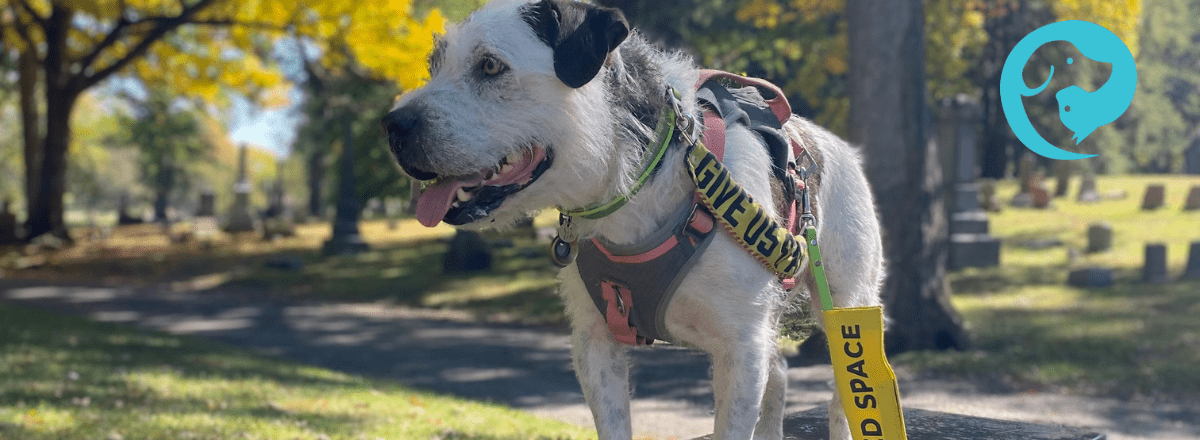
A scruffy white and dark grey dog standing in a cemetery. He is wearing a yellow leash flag that says "I need space."

Life Lessons and Support for Behaviorally Complex Pets

Life Lessons and Support for Behaviorally Complex Pets

A scruffy white and dark grey dog standing in a cemetery. He is wearing a yellow leash flag that says "I need space."

Content warning: Brief discussions of aggression toward humans and dogs, and behavioral euthanasia.

Please Ignore Us

My house sits next to a small apartment building. As in my driveway is right next to some of their front doors. The building has pretty frequent turnover, and when I see someone new moving in, I try to catch them so I can introduce myself, tell them that they may see or hear my handsome scruffy bestie (Petey the Wondermutt), and to deliver some very important instructions. “If you see me getting into the car with my dog: please ignore us. He’s not friendly.” I’m glad that I am a very direct communicator, because I know that making statements like “my dog is not friendly,” is not easy for everyone

A couple of years ago, a friend of Big Man’s was staying with us (let’s call him A). These visits are very carefully orchestrated events, and I wrote about the logistics of how we do that in this blog. Having slept in the room where Petey spends a lot of his time (because it’s also my office), A commented that our home life is a bit like a running sitcom gag: we have a dog, but nobody’s ever seen him. 

You know that song “Minding My G**d*** Business”? That’s very much how Peter prefers to operate. And being an introvert myself, living with Petey has really allowed me to lean into my hermit tendencies. 

In truth, caring for a dog with complex support needs, particularly one that has a history of dog and human directed aggression, is isolating. I know very few people who understand the work that goes into managing a household like mine. And although I know plenty of people who would do anything for their dogs, not many know what it’s like to alter their life in significant ways in order to help them thrive and keep everyone safe. 

Let me give you a few examples of what I mean:

  • Big Man and I do not travel together during the holidays. There isn’t a good way for us to bring Petey, and we don’t have a trusted place to keep him in our absence.
  • Going to the vet always involves sedation. This means we’ll put off going unless it’s time for a yearly exam or if it’s absolutely necessary. Vet trips also require prep and recovery time. 
  • Our home is a “gated community.” We have permanent management solutions in place all around the house, including window film and blinds, a divider gate that closes off the living room, and baby gates that live upstairs and at the basement doorway. 
  • The three of us are never in the same room together. There are many reasons for this. Hence all the gates.
  • Petey only walks in the neighborhood when we can get out very early in the morning, which means in the summer only, when the sun will grace us with its presence around 6 am. All other walks require a trip in the car, which means they take longer and only happen roughly twice a week.
  • Our home is basically Stinky Pete’s Enrichment Emporium. Meds, supplements, snacks, stashed recyclables, puzzles, bowls, food dispensing toys, stuffies, fitness equipment, you name it. We even revamped the back yard to serve as a sensory garden. Since getting out and about is not possible daily, we have to meet his needs in other ways.

Finding Professional Support

The first time I remember wondering if something was up with Petey, we were snugged up together on the giant beanbag in my living room. Big Man approached to join us, but just as he bent down, Petey’s scruffy body flew straight up at his face, growling deeply. We had seen other behavior like this, but chalked it up to him being very new to our household. For example, a week or so after he came home, a group of Big Man’s friends came in to play D&D. Petey was quiet as they walked in, but when they approached and bent to greet him, he lunged forward quickly, growling and barking. A group of unknown men, many with beards, in winter clothes, we just figured it was all a bit too much for him. Don’t get me started on the number of things I’d do differently if I knew anything about anything when Petey came home…

We quickly had a vet and a trainer on our team, we were learning valuable life skills together, but the incidents didn’t get better with time. If you want to make someone who is struggling with their dog’s behavior feel real bad, just show them a bunch of those videos where terrified dogs start to come out of their shells and are seemingly healed just by the presence, patience, and love of their human. Trust me when I say that if love alone could have helped Petey feel better, he would be an ambassador for his species (whatever kind of creature he may be). But, much like our expectations of our dogs, that’s not realistic. 

After charging his first vet and muzzle punching his chest, Petey was already on his first anxiolytic when he attacked another dog in daycare while being boarded in 2019. This was our  impetus for seeing a veterinary behaviorist. I had just bought a house, so the expense was overwhelming at the time.

I remember the day I brought Petey home from the shelter and called to tell my mom I got a dog. The first thing she asked me was “what color do you want his blanket to be?” Crocheted afghans are her gift of choice for any life event, and Petey currently has several of his own. I am lucky enough to have family as a built-in support system throughout my life, and even luckier that they’re also animal lovers. So it came as no surprise that my parents and brother have been nothing but affirming and encouraging in our journey to support Petey. Having the means to do so, my parents funded our first appointment with Dr. Rigterink.

In our first couple of appointments, I saw Petey lunge and snap at his new doctor, and deeply growl at a child he spotted through the window in the parking lot. I’ll never forget Dr. Rigterink tilting her head and asking me “what’s that all about?” My body turned into the shrugging emoji, and I think she was relieved to find out that Big Man and I are child-free. 

These aren’t the only incidents I could tell you about, or even the most harrowing. But they are among the events that helped my little trio of a family create a path together. 

An open waiting and exam area with rugs, a couch, and enrichment items.
Dr. Quinn's clinic in Huntington, Indiana. Designed to make people and pets more comfortable.
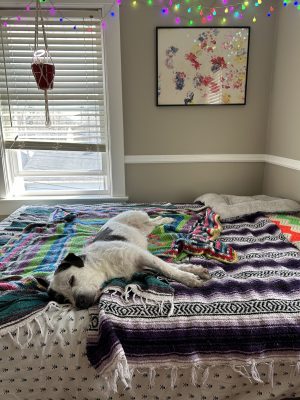
A scruffy white and dark grey dog on top of a colorful crocheted blanket.
Petey snoozing on top of one of his many blankets from Meemaw.

An Extended Village

One thing I wish I had known when we started on this journey is that there is a lot of trial and eval. From meds to walk routes to vet clinics, we have been through iterations of our enrichment plan with Petey. Working with a VB led us to our first Fear Free primary veterinarian. The clinic setup was better than where we saw our original vet, but it wasn’t our final destination. That honor goes to Dr. Quinn. I wrote a bit about her practice and our process for getting Petey to the vet in this blog.  I know I am enormously privileged to afford the care that we have for Petey. Building a core team of primary vet and VB set the foundation for our work with him.

I’m sure it is shocking to learn that my emails to Dr. Rigterink were long, detailed, and infused with humor and love for my scruffy bestie. She told me I should start a blog, and I think of this any time I get to write about him now. I did not start a blog, but I did start using Instagram as a way to catalog our adventures together, share them with people who wanted to love him from afar, and eventually to build a small community of like-minded people who center meeting needs and welfare and wellbeing in their life and work with pets. I have known many of these people for years at this point. As I entered the field as a pet professional myself, I had to start introducing myself as “Petey’s person” when I would encounter them in professional settings. 

One of the most important connections I’ve made in the years since Petey came home is his Auntie Jordan. I’m assuming becoming friends with someone whose dog sees the same VB as yours must be a lot like parents of human children becoming friends through their kids. Aside from our communal care team members, Jordan is also a trainer. She now lives with three dogs, and is one of the only people I know whose household management system is more complex than my own. After meeting up to eat meatballs in Ikea in 2021, she made her way up the length of Indiana to spend a weekend in my home attending a virtual conference with me. Since then, she’s been party to nearly every anxiety spiral I’ve been on in the past 5 years, and I like to think I do an okay job reciprocating that role for her when she needs it. I truly don’t know what I’d do without her. 

What I’m getting at here is that there are some challenges we face as humans where knowing other humans going through the same thing is extremely valuable. Valerie’s blog from last week echoes this, and provides wonderful resources.  In this blog, I wrote about the importance of community for trainers and behavior professionals as we navigate the often murky and often lonely path that is our unregulated industry. Along with our vet team and the friends who live inside of my phone, having a Jordan on MY support team has been incredibly impactful. I wish that every person living with a pet with high support needs could have one (not mine, though, she’s spoken for).

House a Home

I share my life with a man of science. The outdoor kind, not the technology kind. Depending on the season and weather, you may find Big Man crawling in a creek looking for endangered mussels, encased in Carhartt and wielding a chainsaw to cut fire line in the snow, attending a symposium on beavers, waist deep in a bog “botanizing,” or setting up a sheet in the woods to attract moths in the night. His experience with animals is vast and varied.  He’s participated in trapping and tagging bears for research. He has worked with two species of rattlesnakes. He spent a summer tracking endangered birds on the side of a volcano in Hawaii. But he was just as unprepared for the behavior we encountered with Petey when we first adopted him. As the “spare human” of the house, his relationship with Petey is different than mine, but no less important. 

The most important support we receive in our household happens right inside our home. There have been times that Big Man and I were not on the same page with how to proceed with Petey. Sharing the responsibility of caring for a pet with complex behavior issues is not easy. I’ve wrestled with everything from guilt to resentment. We’ve had many hard conversations over the years, including the one that ends with “if we can’t help him, he can’t go back to the shelter.” We’ve had to talk about behavioral euthanasia in very frank terms. And no matter where we are in our story, we are always monitoring quality of life, for Petey and for us. This is the reality for families like ours.

Anyone who has known me for longer than three seconds knows about Petey. His cartoon image lives on my water bottles, phone, laptop, and car, because I’ll slap a sticker on just about anything. But it takes longer than that to find out that Big Man is a ding dong who loves his dog. After returning from a wildlife conference recently, Big Man told me he had been showing some colleagues photos of Petey. Remember when I said he’s more at home in a creek than with technology? Imagine my delight as I pictured him opening his flip phone to show a group of people the tiny screen featuring this creature he is pals with (most of the time). I’ve always known that Big Man has my back, and I’m lucky he’s got Petey’s too.
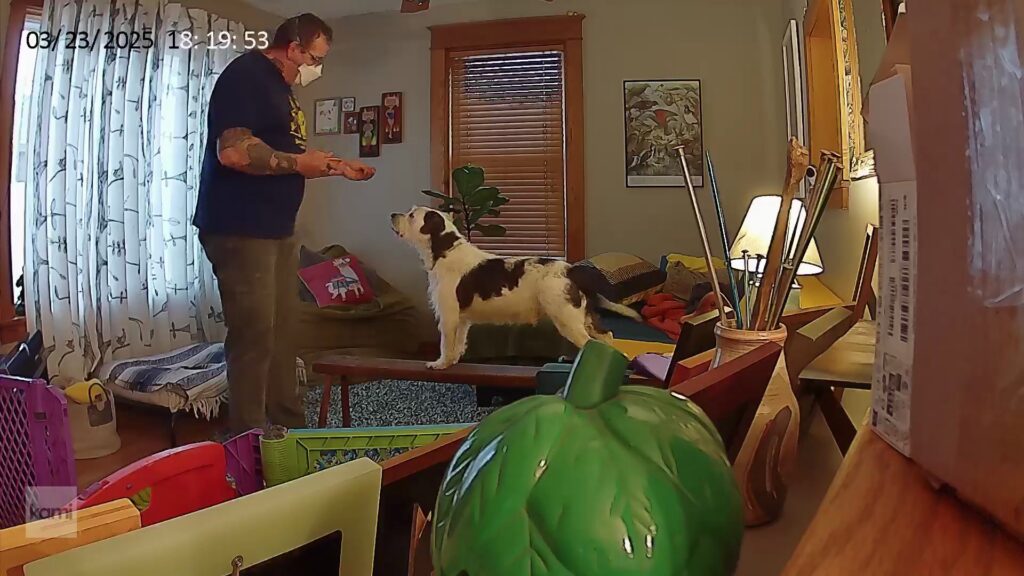

A tall man in a mask standing in front of a scruffy white and dark grey dog. Petey the dog is standing on a narrow bench. He and Big Man are working on training.
Petey and Big Man working on fun skills that get Petey's body moving. (Big Man is masked because I had Covid at the time).
Two white women with their arms around each other standing in front of a purple ClickerExpo background.
Tiffany and Jordan at Clicker Expo 2025.

Lessons Learned

If you are struggling with your pet’s behavior: I see you. I know it’s hard. And I hope you have people in your life to lean on. Please check out this blog if that has not been your experience. 

My life with Petey has been overwhelmingly filled with empathy and encouragement. There are moments I have experienced as a professional where I’ve been asked not to discuss our life together. That adjusting my life to fit a dog who struggles might indicate I am not an effective trainer. I have found the opposite to be true. Being open and honest about our realities has provided me opportunities I could not have imagined, such as participating as a demo team at Clicker Expo. I’ve been told by other professionals that they feel encouraged and validated in their own approach to living a joyful life with their pets.

I was not the only one with the honor of representing Petey in a Clicker Expo presentation this year. For Allie’s talk about protected contact, Big Man agreed to contribute a video showing off Petey’s and his Find It skills. After I captured the video and popped it into the presentation template for Allie, I watched it several times with tears in my eyes. Nobody who watched that video knows the years we’ve worked together on helping everyone in our house feel safe, or the experiences that led us there. They just saw my handsome boys working together. 

The lessons I’ve learned in my time with Petey have informed and enriched me in life-changing ways. Long may my creature reign; I will be Petey’s person until the day I die.

Here’s to harmony,

Tiffany

Now What?

Our content theme for the month of February has been community. Building and caring for our communities is more important now than ever. Check out these related blogs if you are in need of or want to contribute to a network:

Copyright 2025 Pet Harmony, LLC. All Rights Reserved.

Terms & ConditionsPrivacy Policy

Results are not guaranteed because behavior, human, canine, or otherwise, are not guaranteeable.
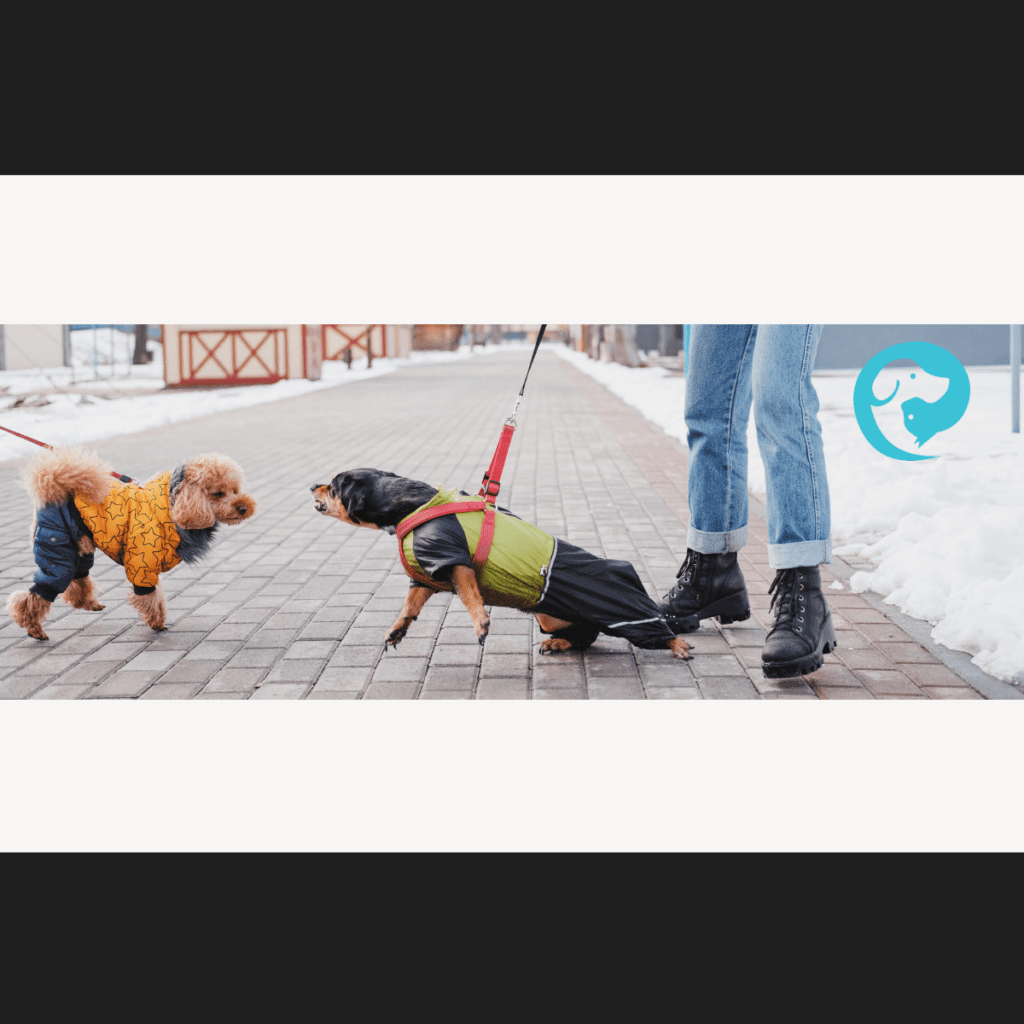
A small black dog in a coat lunging with teeth bared, looking at a small poodle in a coat.

There is No I in Team, but There is a U in Community

There is No I in Team, but There is a U in Community

A small black dog in a coat lunging with teeth bared, looking at a small poodle in a coat.

You are walking your reactive dog and you are both doing your very best. You have your high value treats in a treat pouch, you have a leash sleeve alerting others that your dog needs space. You are hypervigilant and constantly scanning the area for potential triggers that will send your dog into an over threshold rage. Someone on their phone, paying no attention to you or your dog, walks towards you head on and your dog starts barking and lunging. You already feel bad and deflated. And to top it off, the stranger gives you a side eye and says “Get your dog under control!” which makes the entire situation sting even more. Sound familiar?

Maybe your dog has separation anxiety and cannot be left alone safely. You are working with a Board Certified Veterinary Behaviorist to manage behavioral medications and a Behavior Consultant to help with day to day training. You have not been out of the house for longer than 10 minutes in over a year without a pet sitter or sending your dog to day care. The entire endeavor is costly both financially and emotionally. You try talking to friends and family members about your struggles, hoping for a safe space to share. Instead you get unsolicited advice and feedback- “Just let them cry it out.” ”If I were you I would get rid of that dog,” and other ideations of similar sentiments. These conversations further solidify that you are alone on this journey and there is no one out there that understands your situation. Or is there?

Social Prescriptions for Loneliness

If we zoom out for a moment, from the guardians and trainers of animals with big feelings, to our broader society as a whole, there are some alarming trends. A recent study by the American Psychological Association shared that among more than 3,000 U.S. adults, 69% say they needed more emotional support in the past year than they received. This loneliness epidemic is concerning for our mental health as well as our physical health. The same APA study shared that “Survey data also revealed that those who experience high levels of loneliness were more likely to also be struggling with their physical and mental well-being than those with low loneliness levels.”  It’s like loneliness is the tip of the iceberg, and without actively moving away from it, it can take you down just like the Titanic. 

Studies continue to prove the positive link between social connection and longevity. Having relationships with friends and family can literally help you live longer! I think it is also important that we normalize the feeling of loneliness. We must be able to recognize and verbalize the feeling before we can work towards healing. As Jeremy Nobel said in this Harvard article “Loneliness is a biological signal indicating that we need human connection, just like thirst is a signal telling us that we need water. I’ve never met anyone embarrassed about being thirsty, so why are we embarrassed about being lonely?”  He discusses doctors giving “social prescriptions” for loneliness, meaning that instead of medication, the patient is supposed to find ways to spend time with others.

My challenge to you is to create your own social prescription. Find ways to fill that need for human social connection and community. Sound like a daunting task?  Don’t worry – social workers are the givers of resources so I cannot end this blog without doing so!  Take a look at the resources below to help build your own village!

You have the tools, now it’s time to try them out!


Your Friend,

Valerie

Copyright 2025 Pet Harmony, LLC. All Rights Reserved.

Terms & ConditionsPrivacy Policy

Results are not guaranteed because behavior, human, canine, or otherwise, are not guaranteeable.
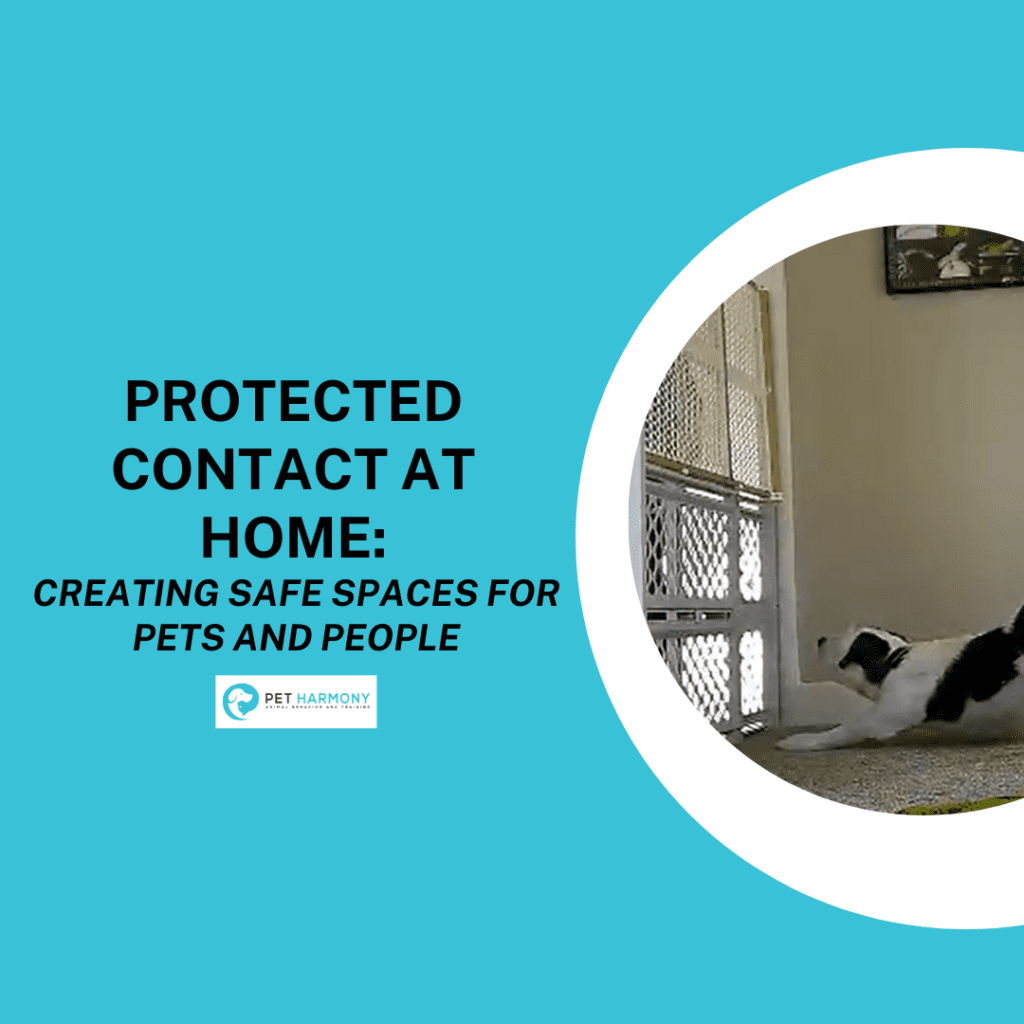
White and dark grey dog stretches in front of a baby gate. Text reads: Protected Contact at Home: Creating Safe Spaces for Pets and People

Protected Contact at Home: Creating Safe Spaces for Pets and People


Content warning: This blog includes brief discussions of aggressive behavior toward humans.

When I was a young intern during my undergrad years, my cubicle neighbor and I joked about “the walls between us.” Even though they didn’t go all the way to the ceiling, they were high and thick enough to cause deeply silly misunderstandings when we’d try to talk, or enough of an obstacle that when we’d toss things over they’d go rogue and bonk somebody on the head or end up in their coffee. I think about that sometimes as I’m attempting to hurl a pizza crust over the modified x-pen that blocks off my living room and it ends up on the floor just out of reach of my dog Petey, and I have to go hand it to him instead. 

Over on the podcast, Emily and Allie discussed training aggressive dogs this week. In proper Pet Harmony fashion, they started by defining their terms. “Aggressive dog” is not a particularly accurate label, and is not favored by our fearless leaders. It is, however, a commonly used label in the field. So let’s start off here by defining our terms so we’re all on the same page.

  •  Aggression: Relying on fight over flight in periods of high stress. The “fight” here includes behaviors such as growling, barking, snarling, lunging, muzzle punching, snapping, or biting. These behaviors are meant to make others move away (aka distance-increasing behaviors). They are observable actions that a dog uses based on their underlying emotions or inner experiences, which cannot be observed, obviously. 
  • Management: Arranging the environment, to the extent it is possible, for the safety and comfort of all individuals sharing the space. In pet homes, management refers mostly to setting up an animal’s environment to prevent the rehearsal of unwanted behaviors. 
  • Protected contact: Using management strategies to limit the amount of physical contact it is possible for pets to have with other individuals (humans or non humans). Physical barriers such as gates, crates, and doors, or fences are the most common implements used for protected contact. 
  • Free contact: No barriers or other strategies for preventing contact. Pets are free to interact with others.
  • Semi/partial-protected contact: The pet can still make physical contact with humans within a certain radius or while wearing protective gear. Leashes and muzzles are the most common implements used for semi- or partial-protected contact.  

I consider myself, among other things, to be Petey the Wondermutt’s Stimulus Curator (meaning when possible I carefully choose what he is exposed to). Living with a dog who fits the definition of aggressive, it is a job I take very seriously, and protected contact through management is a big part of our enrichment plan. 


Why use management?

Humans use management strategies all the time, even if we don’t think of it that way. If you try not to go grocery shopping when you’re hungry, you’re managing your environment to prevent the rehearsal of unwanted behaviors: coming home with a half-eaten pack of oreos and a dusting of crumbs in your car from hollering at fellow drivers with a mouth full of dry cookies while you were hangry, for example. We also use semi-protected contact when we do things like blocking our shared calendars, closing the office door, and putting in noise cancelling earbuds when we want to let other humans know they do not have access to us. Changing the environment to change behavior. Simple, right? 


Observe with your senses, not your stories

Observations and outcomes guide our enrichment plans, and because safety and security are aspects of enrichment, they also guide our management plans. As Allie writes in this blog, some strategies for management and protected contact can be lifelong endeavors based on your observations, outcomes, and assessment of and/or aversion to risk. 

I’m not willing, for example, to risk a bite to my parents (or anyone, for that matter). I have a learning history of Petey using aggressive behaviors when people approach us–both toward the approaching human and myself. This includes an unfortunate incident where he jumped high enough to snap in another human’s face while they were standing fully upright. One of a number of incidents seared into my brain that fuel my own risk aversion. 

I have observed that when he can see and hear someone coming into our home, he barks, growls, lunges, and paces around. When my parents visit, if I want him to be comfortable, which can be observed as settling and resting, I can simply put him upstairs in his room with a long-term calming project with some kind of sound masking (music, brown noise, box fan, or a combination). He has access to multiple surfaces of different temperatures and textures where he can rest and not worry about the people in our house.

Am I sad that my parents will never be able to meet my sweet, handsome boy in the flesh? Yes. I am very close to my parents. My mom’s own love of animals had a huge impact on the way I interact with the various beings I choose to share my life with. When I see her snuggled up with the beautiful goober that is my brother’s dog, I do wish she could love and appreciate Petey the same way. That she could experience the warm perfection of his velvety ears, or feel his heavy noggin perched on her leg, or hear him gently snoring next to her on the couch.

But it is more important that both Petey and my mom feel safe in my home, and for that reason, their brief interactions will only ever happen with a barrier between them. As Emily and Allie mention on the podcast, when working with aggression, sometimes free contact is never our goal. 


As I mention in this blog, the people close to me appreciate Petey in different ways. My mom has a Petey sticker on the helmet she wears when she scoots around on her electric scooter, and Peter and his cousin Skittles trade places on the lock and home screen of her phone frequently. 


Risk and reward

What if I told you that we DO have guests stay in our house sometimes? It’s true! 

Allie has a saying when she talks about using protected contact as part of a behavior change plan. “Move at the pace of the least comfortable individual.”

There are a couple of humans savvy enough to have gazed upon the elusive staffy-muppet cryptid that is Peter in real life, and his Auntie Jordan is one of them. A behavior professional herself, we are both comfortable with her ability to watch Petey’s body language and modify her own. When she visits, Petey still stays in his area behind a double gate, but I will set her up in the living room behind an x-pen and let Petey come downstairs to go outside. He can see her sitting in the living room, and she can look at how cute he is out of the corner of her eye. She also has to walk past his room to get to the room she stays in. I set up the Treat ‘n Train (a remote treat dispenser) in his room and place the remote on a hook in the hall. When she needs to venture upstairs, she’ll either boop the Treat ‘n Train or toss some treats into his room on her way by. 

It’s a big deal for me to have someone I trust enough to let him out while they are in view.  If you will remember, Petey has a history of redirecting his aggressive behaviors toward whoever is closest to him, which is often me. So the least comfortable individual in my house is often…me.  

Two baby gates placed one on top of the other in a hallway with a blanket over both gates for a visual barrier.
When guests are in our home, we use two baby gates with a blanket on top for a physical and visual barrier.


Safety, security, and protected contact

I mentioned that Petey struggles with unknown humans moving toward us when he is on leash, but he also struggles inside our home with movement in and around his personal bubble, and will use the aggressive behaviors I listed earlier to communicate how he’s feeling. Because we live in a 100+ year old home, there are many narrow spaces that make for some tricky grumble and growl zones. Moving around in our house can be pretty complicated when we are all home, so the management setups we use, along with the training we’ve done with Pete, allow us to de-escalate tension around the house. They also add a layer of predictability into the life of a dog who thinks humans moving around are sus. 

Scruffy white and dark grey dog laying on a mat chewing a bully stick safely behind a baby gate.
A baby gate in the hall gives Petey access to two rooms upstairs. Here he is working on a long term calming project (chewing a bully stick).

Here are a few ways we use management and protected contact strategies in our household to help everyone feel and stay safe:

  1. Order of operations – We’ve figured out if we move in and out of spaces in a predictable order, Petey is less likely to struggle. If we can’t be predictable in our movements, Petey is behind a gate.
  2. The trash tent phenomenon – It is not uncommon for dogs who have issues with people in their space to also have body handling and resource guarding issues, and that is the case with Petey. When we first started working with our wonderful VB, she suggested that Petey have a space for chewing high value items. We got a pop-up x-pen that was meant for small dogs, and started using that as a tent for him to chew in. Today, we use it mostly for giving him things to shred, hence the trash tent moniker. We have developed skills around cueing Petey into a number of safe spaces to work on long term calming projects or chewing. 
  3. Moving and grooving – We have an arsenal of cues that help us move and station Petey away from us so that we can also move and avoid conflict. This includes cueing him into safe spaces, such as behind the gate in the living room. This is where our Treat ‘n Train is generally stationed. It allows us to boop snacks to him and stations him at the far end of the living room.
  4. Say what you mean – We also have cues to let Petey know what is about to happen in predictable ways. For example, when I put him in the car I say “clip” before I clip him into the car, then “zip” when I zip up the side of the seat protector. 
  5. Roger that – Anyone who is in the house has to know where Petey is at all times. After Big Man had surgery to repair a torn bicep tendon, we got some walkie-talkies so we could quickly check in (complete with CB slang). We usually just text or call each other, or use predictable cues aimed at the humans in the house, like hollering “coming down!” before we descend the stairs with Petey. 
  6. Well would ya look at that  – There is a cutout in the wall between our kitchen and living room. We often use this “drive through window” to play look at that while one of us moves around. If I’m moving around, Big Man will stand in the kitchen and cue “where’s Tiff?,” let him look, and hand him a treat when he looks back. We often play this as Big Man leaves out the front door, which is a place where Petey has had many big feelings.
  7. Party time, excellent  – Petey is muzzle trained (aka his party hat), and wears a harness with a handle on it. Gear + predictable cues + cooperative care training + meds join forces when we visit the vet and have a well-established routine of stationing Petey with his shoulder pinned to the wall (with my leg), and me holding his harness handle and feeding him while the fabulous Dr. Quinn stealthily delivers the sedation injection.
A white and dark grey dog pokes his head through an opening in a wall. The opening is framed with wood trim and there is a vase of flowers on the ledge next to him. Dog supplies appear on the shelf in front of him.
Petey sidles up to the “drive through window” in the kitchen.

If all of this sounds like a lot of work; it is. But Petey didn’t choose to struggle the way he does any more than I chose to have migraines or asthma or my own struggles with anxiety. We are responsible for a complex, sentient being with an unknown background, and we love and care for him the very best way we can while keeping everyone safe. And “the walls between us” don’t stop us from having fun.

Here’s to harmony!

Tiffany


Now What?

Predictability and management are useful strategies for any pet, not just aggressive dogs! Can you think of some situations where your pet struggles with being startled or upset? Is there a way you can set up the environment differently? If not, can you add a predictable cue that might help them feel better? For example, if your dog growls when you walk past them in the hall, try bowling some treats or a toy (something they’ll get up and go after) into the closest room. Say something like “coming through!” Practiced enough, “coming through!” could be a cue for your dog to get up and move and feel better about you coming through the hall.

Could you use some help tweaking your management plan? We’re here for you! Sometimes it takes some extra support to figure out what will work. It certainly has taken a village for us. 💖

White and dark grey dog playing tug with a very tall man. There is a colorful gate between them and the man holds a toy over the gate so the dog can grab it.
Pete and Big Man play tug with a stuffed ear of corn over the gate. We do live in the Midwest, afterall.