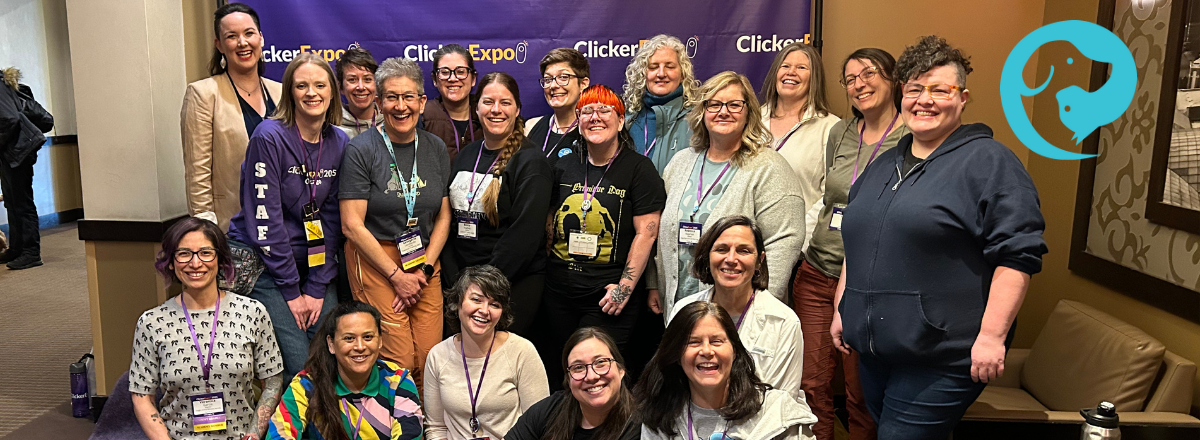
I was nervous about being the person half of a demo team (along with Peter the Wondermutt, obviously) for Ellen’s recent and fabulous talk on creating safe spaces at Clicker Expo Live. I texted with my trainer bestie to get my head on straight. I come from a long line of anxious humans, so my family could understand my nerves, but only another trainer would understand the pressure we put on ourselves to execute and explain perfectly what we’ve worked on with our own pets in front of a bunch of other professionals.
Having a support system of other people who work in your field, or at the very least who work for the same organization you do, is a normal part of most jobs. Unions, trade societies, and professional associations exist, in part, to provide a supportive community for people who work in different industries. In my previous career, I was a member of the Society for Technical Communication. That membership helped me land my first professional job after grad school working for a civil engineering firm in Michigan. But there are no real equivalents in animal training.
If you’ve been following us for any amount of time, you may have seen us mention that the pet training / behavior industry is unregulated. This means there is no clear process for how and what to learn, what competencies to develop and demonstrate, and what kind of assessment process qualifies you to work as a professional. Sure, there are plenty of letters you can add after your name from programs created by individuals and organizations, but unlike other professions, there is no standard path forward for declaring yourself a dog (or other animal) trainer or behavior consultant, starting a business, and charging people money for your services. It really feels like we’re all just out here figuring it out on our own sometimes!
Even as we plan and execute the obvious aspects of our work (sessions with clients, making training plans, group classes, day training, etc.) there’s loads of admin work (helloooo blog writing!), physical and mental wear and tear, keeping up with continuing education, the logistics of running a business. All while trying to, you know, have a life. Working in animal welfare can expose us to the crueler side of nature / human nature. Most of us have very few people in our day to day lives that understand how we do what we do. It can feel really isolating. Many trainers and behavior consultants are solopreneurs. The line between business and personal life is blurry at best.
As I pondered the role and importance of community for industry, I tapped our PETPro members to speak to their own experiences, and their responses showed me some common themes around the realities of working in this field.
“Community means that there is somebody who’s got my back…it doesn’t matter if I’m struggling with a them problem or a me problem or just an everyday head scratcher, there’s somebody around that can lend a hand, ask a significant question, or provide a much needed reframe, share a similar experience or just tell me I’m not alone. Community gives me that spark I need to fire my engines so I can get myself through…whatever it is…life. And probably best of all, when I’m not in need they give me extra reasons to smile.”
– Leeann Webster, Dog Done It, Virginia
Community as Essential Infrastructure
Making a living as the owner and sole employee of your own business means you miss out on water cooler moments and the shared language of a workplace with co-workers. Not to mention service industry jobs, which training falls under, are overwhelmingly undervalued. Add in the fact that anyone can say they are a trainer, start working in your area, and suddenly end up social media famous; you can understand why burnout, imposter syndrome, spiraling anxiety over executing perfect plans are such common themes among groups of trainers.
“When I was in corporate, I often complained about having coworkers always pinging me, asking for a call, asking for a question, asking to chat, because dammit, I’m trying to get my never-ending work done so I can log out!! I took for granted the water cooler talk (virtually or in-person), somewhere you know you can take your “Yo, you’ll never guess what this client is trying to pull,” without having to explain all of the background. If I wanted to talk about work to someone, I felt like I had to explain so much to make it make sense that it just wasn’t worth it.”
– Julia Alexander, Speak Dog Services, North Carolina
Many trainers get their start working under another, or by completing a program. But depending on their mentors, they may not be in contact with many other trainers. For example, you may mentor under a trainer or complete a program that is out of state or online. Networking and conferences are not always priorities for the individuals in charge. And when you factor in the MANY methodologies used in the name of training, there may not be other trainers that are ethically aligned with you in a given area.
“In this specific industry where there are so many approaches to dog training, this community [PETPro] (and others like Animal Positive Coalition and Pet Professional Guild) help to advance professional development, provide a support network and keep us honest and accountable when it comes to ethical, professional pet services.”
– Nedra Woodward, Nedra’s Wags, Maryland
This makes building referral networks and opportunities for collaboration difficult. As in many other professions, it is impossible to be an expert on every aspect of training and behavior. There are many niches to be filled, particularly as pets develop and age. Puppy socialization, basic manners, sports, rehabilitation, cooperative care, tricks, the list goes on. Behavioral concerns such as separation anxiety, reactivity, stereotypic (repetitive) behaviors, and more, are not areas that every trainer or consultant has experience with.
“It’s taken me a long time to be able to grow some of those relationships and be able to talk through cases together, but I feel there can still be an underlying stigma out there when people ask for help and insight, fearing that they don’t know everything. We will never know everything and learning from each other, feeling safe to discuss and know who and when to refer out is crucial. I want to be that safe space for people.”
– Lindsay Dellas, Good Dog Happy Dog, California
“It takes a village” isn’t just a silly old adage applied to raising children. Our society idealizes individualism, and to our detriment. Humans are social animals with the capacity for communication and cooperation. And yet we learn to see others in our field as competition rather than collaborators. Set aside for a moment that capitalism makes all of this even messier than it needs to be. But specialists exist in other fields for a reason. We cannot take on every case, nor should we. Having a network of trusted related and parallel professionals is one excellent sign that a trainer has their clients’ best interests in mind.
Beyond Networking
One of my favorite parts of being a mentor in the PETPro program is seeing the wins that we are all sharing throughout the week. Hitting a financial goal, getting referrals from a new vet clinic, a client was able to leave their house to see a movie for the first time in years, a successful trainer talk at a library. Then there’s the stuff that only other trainers understand: a member’s dog had a successful vet visit, a blog post that was scary to write got a great reception from readers, a tough client sent unsolicited great feedback because their dog is doing well. And there’s always room for the silly stuff: taking the time to dance in the kitchen when going to the gym is hard, songs about poop, and our pets being adorkable.
“At a minimum, community means being able to share celebrations when they happen… and getting support when things are hard from other people that have ‘been there, done that.’”
– Elissa Chasen, Paws Together, Wisconsin
“I think that safety is the bedrock of what makes PETPro so amazing – there is something about getting to know the little things about the members, how folks show up in meetings, the funny things they say or getting to know their companion animals.”
– Abbie Duchon, Abbie Duchon Professional Dog Training, New York
In the program, we talk a lot about building safe spaces, and this work extends to humans. We work with households for whom safety is a major concern. We have difficult conversations with humans who are struggling to reconcile their quality of life and their pet’s. We listen to the emotional toll that caregiver burden can take on people. Having a safe place to find support and resources is important in building a sustainable career in this field.
“Community is everything. In order to keep being a great animal welfare provider, I have to be around people who are different [from] me, who have different skillsets and backgrounds. Other people can be guideposts for me in my work, help me identify places I can improve, and keep me on the path of constantly bettering myself. Community also helps hold us up when we are feeling down, and helps remind us to take care of ourselves.”
– Sami Griffin, Wise Whiskers Training, Colorado
“…a place that I can go talk about work things — the good and the bad — where I feel seen, heard, supported, supporting, and most importantly, not judged.”
– Julia Alexander, Speak Dog Services, North Carolina
One important aspect of community that I found our members mentioning was the need for a soft place to land with new ideas, to ask questions, to receive guidance and advice, and, as so many in the program like to say, to bring the ingredients of their “noodles,” and half-formed thoughts to the group.
“I love that I can be open about my brain gremlins and say something like the above and know I won’t be judged for it…There’s such freedom in finding a community who can accept you just as you are.”
– Kelly Cordell-Morris, Tails We Win, Petworth, UK
Beyond Networking
There is an unfortunate reality in pursuing a vocation you are passionate about, and that is that your interest and skills must translate in some way to making money. It feels gross. And it leads many to undervalue their own services, work long hours, and neglect their own needs. Any trainer, regardless of methodology, will tell you that they got into the field because they love animals.
And how can we create sustainable, ethical careers in animal welfare if we cannot support ourselves? A community should remind you that you cannot continue to help animals if you don’t remember to meet your own needs. Even as a yoga teacher, I don’t think I truly learned the application of self-care until I saw it through the lens of enrichment.
“It’s also given me insight into how I can help myself, taking care of my own health and learning about self care that will have ripple effects and ultimately help those I care so deeply for around me.”
– Lindsay Dellas, Good Dog Happy Dog, California
“I discovered I love singing! Joining a choir came about through the enrichment platter and trying to find something that hit the music itch but also had some accountability because of the way my brain works. I would never have imagined I’d need it as much as I do, it makes such a difference to my mental health.”
– Kelly Cordell-Morris, Tails We Win, Petworth, UK
As animal lovers and professionals, we learn about species typical behavior, again forgetting that humans are a social species, and that community is an important part of who we are.
Better Together
Who do you reach out to when you are nervous about a professional obligation? I’m grateful to have a circle of friends and colleagues to holler at when anxiety is buzzing in my brain. To remind me that I don’t need to earn rest, or that I should probably drink some water, or to point me in the right direction when my plans got me a little lost. There’s a proverb of apparently unknown origin that goes: “If you want to go fast, go alone; if you want to go far, go together.” Trainers and behavior professionals who are committed to science-based practices that center on increasing welfare and well-being need networks and communities to do their jobs, to grow as humans and professionals, and to take care of themselves and each other.
What Community Means to Me:
Caring
Opportunities for growth
Mistakes met with compassion, not judgment
Moments of “aha!”
Unconditional love
New friendships
Intellectual curiosity
Teammates in this journey called life
You help me become a better person
– Cat Chambers, British Columbia, Canada
Here’s to harmony,
Tiffany
Now What?
If this post spoke to you directly, I encourage you to check out PETPro.
If someone in your life has an interest in training and behavior and is looking for their community, we’d love to hear from them over at @petharmonypro on Instagram, or send along our website, where they can sign up to get our info guide.
If you are looking for resources to support people who live with or work with pets with complex support needs, stay tuned. We have blogs this month that focus on pet care teams and support systems.
Copyright 2025 Pet Harmony, LLC. All Rights Reserved.
Terms & Conditions, Privacy Policy
Results are not guaranteed because behavior, human, canine, or otherwise, are not guaranteeable.