
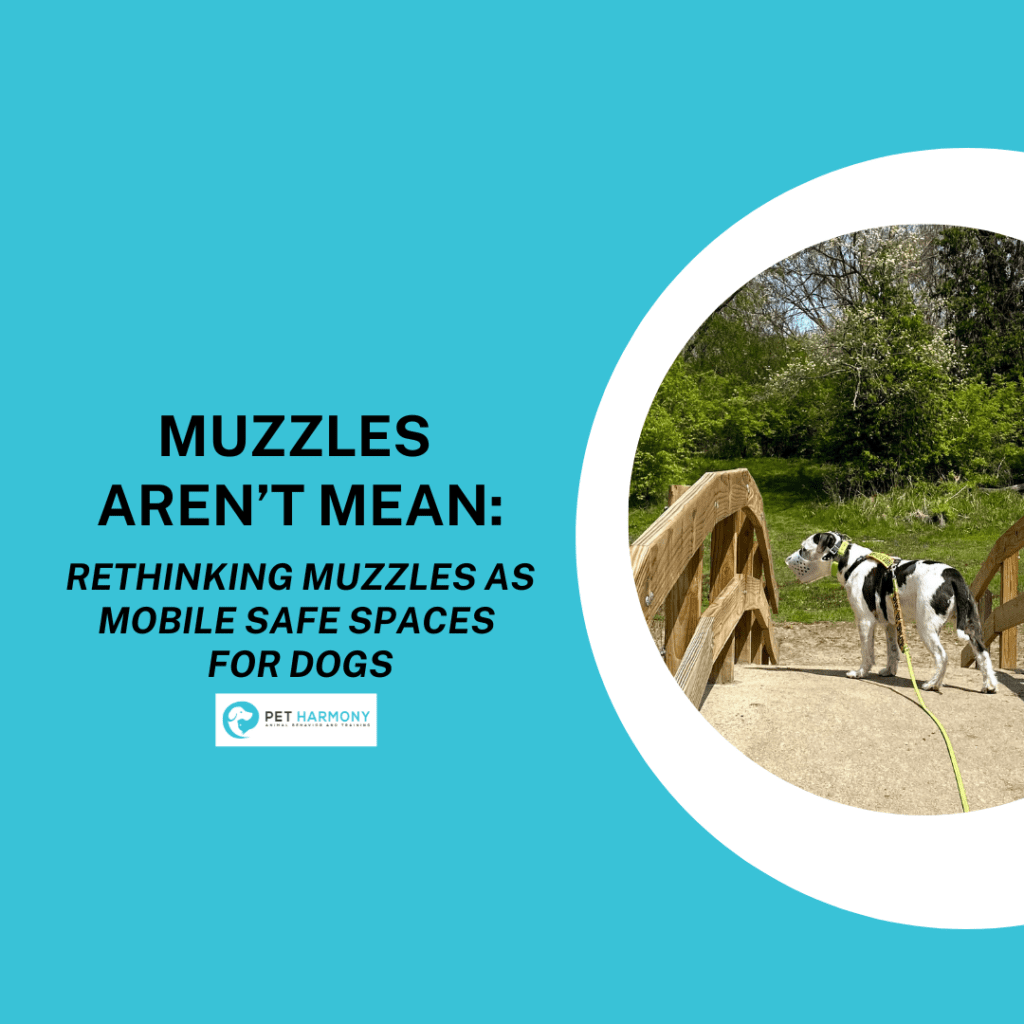
Photo of a dog in a muzzle standing on a bridge with greenery in the background. Image text reads: Muzzles Aren't Mean: Rethinking Muzzles as Mobile Safe Spaces for Dogs

Muzzles Aren’t Mean: Rethinking Muzzles as Mobile Safe Spaces for Dogs

“Wait, You Want Me to What?”

“How do you feel about the idea of muzzle training?”  

This is a question I ask my clients a lot. And as you can imagine, because of the dog muzzle stigma that plagues us, the responses I get can vary a lot. 

Some families:

  • feel that good ol’ pet parent guilt, you know the one I’m talking about, about the fact that their dog needs a muzzle.
  • are worried that people will think that their dog is “aggressive.”
  • struggle with the idea that muzzles don’t address why he feels the need to bite, so why bother?
  • are STOKED about the idea of it. They have wanted to do it for a long time, but didn’t know where to start.
  • are worried that it is a punishment for their dog.
  • know their dog already has a hard history with muzzles, and are scared that we can never make progress.
  • think my dog will never let me put a muzzle on them.

Whether we’re working with a dog that is a known bite risk, a dog that is working toward cooperative care, a dog that picks everything up on walks, a dog with a history of eating everything in sight (food or not), or we’re looking to build general life skills, training dogs to wear a muzzle can be an incredible addition to the plan. Because muzzles are beneficial for a number of reasons, not just for dogs who are a known bite risk. 


Why Muzzles Get a Bad Rap

Socially, at least in the United States, muzzles carry a lot of stigma. Whether these influences are through unintentional imagery and language, intentional systematic institutions, or salacious rage bait for the masses, at the end of the day, we need to look at impact over intent, and the impact of all of these things has been huge.

The associations that folx have with muzzles and their meaning have taken on this big nightmare shadow lurking over them and their pets, and it’s whispering things like, 

“Muzzles are only for bad dogs.” 

“You’re failing as a pet parent.”

“Your dog is beyond help.”

In an effort to improve everyone’s welfare and well-being, pet parents take on slaying this shadow nightmare monster and everything else to keep everyone happy, healthy and safe. 

The good news is, none of that is true. So, let’s talk about what muzzles really are about.


What Muzzles Really Are: Tools for Safety and Comfort

For me, muzzles are up there with crates, baby gates, car seats, leashes, harnesses… the rest of the gear that we use to keep both ourselves, our dogs, and the community safe. 

So, instead of thinking of muzzles as a Hannibal Lecter mask, think of them as a party hat. I know, that’s a big mindset shift, but believe me, muzzles can be FUN. They can be a tool to create a mobile safe space for our pet. A thing that tells them, “Hey, I promise, to the best of my ability, nothing terrible is going to happen to you. It is all going to be okay.” A thing that indicates our intentions and predicts expectations for them. Under some contexts, it may function like the medical cue that Lisa Clifton-Bumpass talked about in her podcast episode

While we often think that muzzles are all about restriction, and start rolling through the things our dogs “can’t” do, a properly fitted muzzle, used correctly, under the right conditions, can open the world up in entirely new ways. It may allow for safe exploration in the world. It may allow for more choice, control, and agency in veterinary procedures. It may allow for everyone to breathe easier. It may even allow for less restriction, as a proper muzzle helps increase safety. 

*Please note, I’m not saying that a muzzle gives you freedom to put your dog in situations where they feel the need to bite.*

In general, a properly fitted muzzle should: 

  1. Allow for a full pant 
  2. Allow for eating 
  3. Allow for drinking 
  4. Avoid excess rubbing 
  5. Prevent biting

The specific criteria for what each family needs from their muzzle will change with each situation. For example, I need Griffey to be able to find and collect treats off the ground while wearing his muzzle. But when I’m looking for a muzzle for a dog that chronically finds and swallows rocks, I’m going to look for a muzzle that impedes collecting things off the ground. 

Along with the basic fitting criteria, I have another set of criteria that I’m working toward to make sure that the muzzle brings joy, rather than the nightmare shadow monster. We want the muzzle to be a party hat. We want the dog to hear the cupboard open, or the jingle of the buckle, and come running with a big ol’ smile on their face. I want the dog to be so insistent that the person almost struggles to put the muzzle away. 

Here are some of our rules for engagement:

  1. We go at the pace of the least comfortable being in the room. Both the human and the dog need to be comfortable. 
  2. The dog does the work, they put the muzzle on, we don’t put it on them.  
  3. The muzzle = WONDERFUL things. 
  4. The muzzle is a cue for us to pause and think twice before doing anything the dog doesn’t like, not a cue to do whatever we want.
  5. We get creative to find ways for the dog to do their favorite things while wearing the muzzle. 
  6. We are going to work on both our dog being safe in hard situations, AND build a plan to help them feel more comfortable. At the end of the day, we don’t want to put our dogs in a situation where they feel the need to bite.

When we take the time to do an intentional, positive introduction to muzzles, we can see joy and excitement in our dog’s body language. We can see that their eyes light up, they get wiggly, they smile, and they push their way into the hat. We can see that it lays a beautiful foundation for a bunch of other skills.

For Griffey, his extensive muzzle training made teaching him to get laser therapy a breeze. 


Kindness, Not Control

Muzzles are for all dogs. Not “bad” dogs, or “aggressive” dogs, or because of “bad” pet parents.

Muzzles are a way to increase safety. Muzzles are a way to help everyone in the room breathe. 

Muzzles let some dogs go on walks. 

Muzzles let some dogs participate in their veterinary care rather than have things done to them. 

Muzzles let some dogs get the space they need while in the world. 

Muzzles let some dogs enjoy hikes without the risk of eating sticks. 

If we aren’t seeing the muzzle increase feelings of safety and security for everyone, that someone is still holding their breath, then we have more work to do. We’re asking ourselves and our pets to be in situations we aren’t ready for yet. And that is okay! We don’t know what we don’t know until we get the opportunity to learn. 

At the end of the day, remember, our goals for muzzles are to increase safety and security, to enable our dogs to do things that fill their cup and meet their needs, and to empower them and us. 


FAQs About Muzzle Training 

How do I introduce a muzzle without stressing my dog out?

That’s a great question! The answer is slowly, thoughtfully, and gradually. We want the muzzle to be paired with lots of wonderful things. We want to go at the pace of the dog, so some dogs are going to need to start with playing “find it” in the room with the muzzle on the counter, other dogs are going to be ready to shove their face right into the thing as long as the straps are out of the way. 

For some great resources, check out The Muzzle Up Project. 


What does cooperative care look like when muzzle training?

Muzzle training is a FANTASTIC first step into cooperative care. When we’re talking about “cooperative care” or “care with consent,”, we’re looking for our pets to be an active participant in their care.

We can teach our pets to say, “Yes, silly human, you may now clip my toenails.” 

We can also teach our pets to say, “Hey, whoa, that’s too much,” without the need for them to use their teeth. 

Teaching our pets a “Go ahead” and “Whoa, Nelly” are important to build that communication, and we can start that with muzzles. 

By ensuring that our dog is the one moving toward the muzzle, putting their own face in, giving them a chance to say “no, please don’t do the straps,” or “yeah, you can proceed,” we’re building that two-way communication between us. 

Our goal is for our pets to have all the choice, control, and agency we can safely provide. 


Can my dog really learn to like their muzzle?

Yes, yes, yes, yes! I know it may be hard thing to imagine, but yes! Dogs can learn to LOVE their muzzle. Sara McLoudrey nicknamed Griffey, “The Muzzle Monster” while working on his training.  We took the time to pair the muzzle with WONDERFUL things, to give him the option to take it off when he needs, to put it on when he wants, and to practice all sorts of behaviors while in it, and he adores his muzzle.


What are some common mistakes to avoid in muzzle training?

Mistake #1: Going too fast. 

Slow down. Seriously. Your expectations should be lower than what your dog is currently capable of. If your dog isn’t ready to take a step toward the muzzle, your expectation should be that your dog can rest or play in the same room as a muzzle, not that they are going to put their face in it. 

Mistake #2: Waiting until safety is on the line. 

Most folx don’t start muzzle training until we already have a safety risk on the line, a bite has occurred, the dog has already had to have foreign object surgery. Start now. You never know what life will throw and you, and in the event your dog needs a really, really hard vet visit, having a well-trained and very loved muzzle can make the experience so much smoother. 

Mistake #3: Only using the muzzle when the icky thing is happening. 

Once we teach our pet to love the muzzle, we HAVE to keep practicing. If we only pull the muzzle out for icky things, the muzzle is going to become icky. If you already have a dog that is comfortable in their muzzle, make an effort to practice wearing it at least once a week to maintain the trust account in the muzzle. 

Mistake #4: The muzzle isn’t fitting quite right. 

Remember, your dog should be able to take treats, drink water, and fully open their mouth in a full pant in their muzzle. Depending on your needs, you may or may not need to make additional adjustments or invest in a custom-fit muzzle to increase comfort. We don’t want the muzzle to rub on the bridge of the nose, around the cheeks, or in the throat. If your muzzle is used, at most, for 5 minutes at a time, rubbing will be much less of a concern than for pups who need the muzzle for longer excursions in the woods or will be wearing a muzzle during high-demand activity, like dog sports. 

Mistake #5: Making it all about food. 

Yes, food is powerful. Yes, we can use food to help pair the muzzle with wonderful things. But at the end of the day, I haven’t worked with a single family where the only goal for the dog is to stay in one place and eat treats while wearing the muzzle. Make an effort to have your dog practice other things they love while in the muzzle. Have them practice moving their body, have them practice lying down, wearing the muzzle on walks, while wresting, etc.


Isn’t putting a muzzle on my dog taking away their choice?

Yeah, sometimes. But not all choices are choices that we should be allowing or making. Our pets aren’t able to see the long, long, long chain of events a singular choice may mean for them.

For example, a pup with a history of eating foreign objects should not be left to eat anything and everything in the name of “choice.” That can result in incredibly invasive veterinary procedures that aren’t fun for literally anyone. A pup with clinical challenges with eating foreign objects also shouldn’t be relegated to a barren room, with nothing to do other than wait for their person to come spend time with them. 

With the facilitation of the muzzle, they can’t eat the rocks, sticks, or poisonous plants on a hike, but they can go out, sniff things, watch critters, be with their family, and enjoy so many other opportunities. 

I spoke with a family a couple of days ago that uses a muzzle for lure coursing with their pet. Their dog has a history of biting the lure, and that can be really, really dangerous. Instead of saying, “No lure coursing for you until you stop biting the lure”, they opted to teach the pup to lure course while wearing a muzzle. Now the pup gets to do one of their favorite activities, and do it safely. 

As I have said before, the point of the muzzle isn’t to take away the dog’s choice and then do whatever we want or put the dog in uncomfortable, aversive, or dangerous situations. If you’re thinking, “But doesn’t the muzzle impede the dog’s ability to protect themselves?” 

My question to you is, “How do we adjust things so that your dog isn’t in a situation where they feel the need to protect themselves?” And you don’t need to have an answer; that’s why behavior consultants are here. To help you get creative!


Can I use treats when my dog is wearing a muzzle?

Yes! Any muzzle you choose should enable your dog to eat, and with some skill building, allow you to deliver treats safely. I’ve used squeeze tubes, longer treats, and practiced different eating skills with my clients. 


In Closing

If the different situations and contexts for which muzzles are used is surprising to you, you’re not alone! We’re all out here working against the stigma, and the more ways we integrate and normalize their use, the more useful they become. 

Here’s to harmony,

Ellen


Now What?

Muzzle training can, and should be, fun, compassionate, empathetic, and effective. It isn’t something you need to try to tackle alone if the idea of muzzle training sends a pit in your stomach. We love integrating the needs of everyone involved in a dog’s muzzle training, so reach out if you need help!
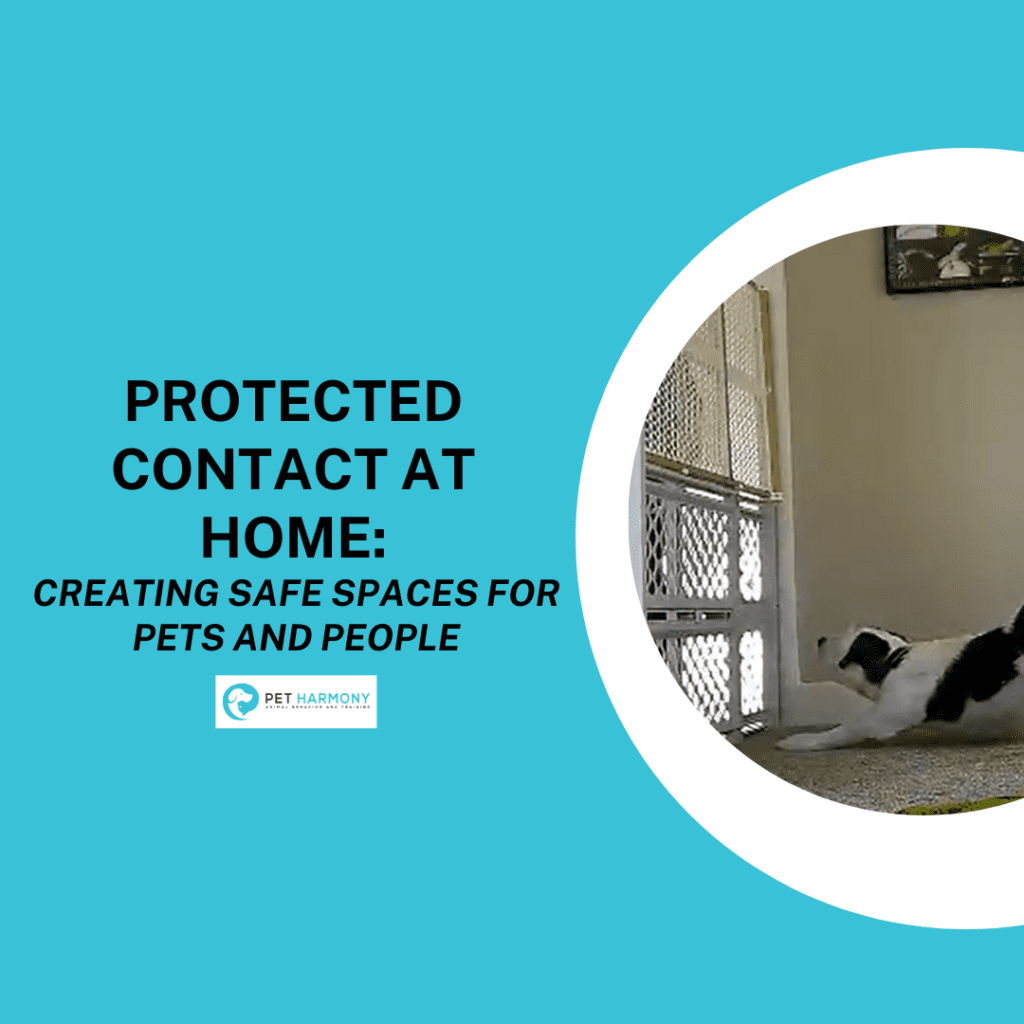
White and dark grey dog stretches in front of a baby gate. Text reads: Protected Contact at Home: Creating Safe Spaces for Pets and People

Protected Contact at Home: Creating Safe Spaces for Pets and People


Content warning: This blog includes brief discussions of aggressive behavior toward humans.

When I was a young intern during my undergrad years, my cubicle neighbor and I joked about “the walls between us.” Even though they didn’t go all the way to the ceiling, they were high and thick enough to cause deeply silly misunderstandings when we’d try to talk, or enough of an obstacle that when we’d toss things over they’d go rogue and bonk somebody on the head or end up in their coffee. I think about that sometimes as I’m attempting to hurl a pizza crust over the modified x-pen that blocks off my living room and it ends up on the floor just out of reach of my dog Petey, and I have to go hand it to him instead. 

Over on the podcast, Emily and Allie discussed training aggressive dogs this week. In proper Pet Harmony fashion, they started by defining their terms. “Aggressive dog” is not a particularly accurate label, and is not favored by our fearless leaders. It is, however, a commonly used label in the field. So let’s start off here by defining our terms so we’re all on the same page.

  •  Aggression: Relying on fight over flight in periods of high stress. The “fight” here includes behaviors such as growling, barking, snarling, lunging, muzzle punching, snapping, or biting. These behaviors are meant to make others move away (aka distance-increasing behaviors). They are observable actions that a dog uses based on their underlying emotions or inner experiences, which cannot be observed, obviously. 
  • Management: Arranging the environment, to the extent it is possible, for the safety and comfort of all individuals sharing the space. In pet homes, management refers mostly to setting up an animal’s environment to prevent the rehearsal of unwanted behaviors. 
  • Protected contact: Using management strategies to limit the amount of physical contact it is possible for pets to have with other individuals (humans or non humans). Physical barriers such as gates, crates, and doors, or fences are the most common implements used for protected contact. 
  • Free contact: No barriers or other strategies for preventing contact. Pets are free to interact with others.
  • Semi/partial-protected contact: The pet can still make physical contact with humans within a certain radius or while wearing protective gear. Leashes and muzzles are the most common implements used for semi- or partial-protected contact.  

I consider myself, among other things, to be Petey the Wondermutt’s Stimulus Curator (meaning when possible I carefully choose what he is exposed to). Living with a dog who fits the definition of aggressive, it is a job I take very seriously, and protected contact through management is a big part of our enrichment plan. 


Why use management?

Humans use management strategies all the time, even if we don’t think of it that way. If you try not to go grocery shopping when you’re hungry, you’re managing your environment to prevent the rehearsal of unwanted behaviors: coming home with a half-eaten pack of oreos and a dusting of crumbs in your car from hollering at fellow drivers with a mouth full of dry cookies while you were hangry, for example. We also use semi-protected contact when we do things like blocking our shared calendars, closing the office door, and putting in noise cancelling earbuds when we want to let other humans know they do not have access to us. Changing the environment to change behavior. Simple, right? 


Observe with your senses, not your stories

Observations and outcomes guide our enrichment plans, and because safety and security are aspects of enrichment, they also guide our management plans. As Allie writes in this blog, some strategies for management and protected contact can be lifelong endeavors based on your observations, outcomes, and assessment of and/or aversion to risk. 

I’m not willing, for example, to risk a bite to my parents (or anyone, for that matter). I have a learning history of Petey using aggressive behaviors when people approach us–both toward the approaching human and myself. This includes an unfortunate incident where he jumped high enough to snap in another human’s face while they were standing fully upright. One of a number of incidents seared into my brain that fuel my own risk aversion. 

I have observed that when he can see and hear someone coming into our home, he barks, growls, lunges, and paces around. When my parents visit, if I want him to be comfortable, which can be observed as settling and resting, I can simply put him upstairs in his room with a long-term calming project with some kind of sound masking (music, brown noise, box fan, or a combination). He has access to multiple surfaces of different temperatures and textures where he can rest and not worry about the people in our house.

Am I sad that my parents will never be able to meet my sweet, handsome boy in the flesh? Yes. I am very close to my parents. My mom’s own love of animals had a huge impact on the way I interact with the various beings I choose to share my life with. When I see her snuggled up with the beautiful goober that is my brother’s dog, I do wish she could love and appreciate Petey the same way. That she could experience the warm perfection of his velvety ears, or feel his heavy noggin perched on her leg, or hear him gently snoring next to her on the couch.

But it is more important that both Petey and my mom feel safe in my home, and for that reason, their brief interactions will only ever happen with a barrier between them. As Emily and Allie mention on the podcast, when working with aggression, sometimes free contact is never our goal. 


As I mention in this blog, the people close to me appreciate Petey in different ways. My mom has a Petey sticker on the helmet she wears when she scoots around on her electric scooter, and Peter and his cousin Skittles trade places on the lock and home screen of her phone frequently. 


Risk and reward

What if I told you that we DO have guests stay in our house sometimes? It’s true! 

Allie has a saying when she talks about using protected contact as part of a behavior change plan. “Move at the pace of the least comfortable individual.”

There are a couple of humans savvy enough to have gazed upon the elusive staffy-muppet cryptid that is Peter in real life, and his Auntie Jordan is one of them. A behavior professional herself, we are both comfortable with her ability to watch Petey’s body language and modify her own. When she visits, Petey still stays in his area behind a double gate, but I will set her up in the living room behind an x-pen and let Petey come downstairs to go outside. He can see her sitting in the living room, and she can look at how cute he is out of the corner of her eye. She also has to walk past his room to get to the room she stays in. I set up the Treat ‘n Train (a remote treat dispenser) in his room and place the remote on a hook in the hall. When she needs to venture upstairs, she’ll either boop the Treat ‘n Train or toss some treats into his room on her way by. 

It’s a big deal for me to have someone I trust enough to let him out while they are in view.  If you will remember, Petey has a history of redirecting his aggressive behaviors toward whoever is closest to him, which is often me. So the least comfortable individual in my house is often…me.  

Two baby gates placed one on top of the other in a hallway with a blanket over both gates for a visual barrier.
When guests are in our home, we use two baby gates with a blanket on top for a physical and visual barrier.


Safety, security, and protected contact

I mentioned that Petey struggles with unknown humans moving toward us when he is on leash, but he also struggles inside our home with movement in and around his personal bubble, and will use the aggressive behaviors I listed earlier to communicate how he’s feeling. Because we live in a 100+ year old home, there are many narrow spaces that make for some tricky grumble and growl zones. Moving around in our house can be pretty complicated when we are all home, so the management setups we use, along with the training we’ve done with Pete, allow us to de-escalate tension around the house. They also add a layer of predictability into the life of a dog who thinks humans moving around are sus. 

Scruffy white and dark grey dog laying on a mat chewing a bully stick safely behind a baby gate.
A baby gate in the hall gives Petey access to two rooms upstairs. Here he is working on a long term calming project (chewing a bully stick).

Here are a few ways we use management and protected contact strategies in our household to help everyone feel and stay safe:

  1. Order of operations – We’ve figured out if we move in and out of spaces in a predictable order, Petey is less likely to struggle. If we can’t be predictable in our movements, Petey is behind a gate.
  2. The trash tent phenomenon – It is not uncommon for dogs who have issues with people in their space to also have body handling and resource guarding issues, and that is the case with Petey. When we first started working with our wonderful VB, she suggested that Petey have a space for chewing high value items. We got a pop-up x-pen that was meant for small dogs, and started using that as a tent for him to chew in. Today, we use it mostly for giving him things to shred, hence the trash tent moniker. We have developed skills around cueing Petey into a number of safe spaces to work on long term calming projects or chewing. 
  3. Moving and grooving – We have an arsenal of cues that help us move and station Petey away from us so that we can also move and avoid conflict. This includes cueing him into safe spaces, such as behind the gate in the living room. This is where our Treat ‘n Train is generally stationed. It allows us to boop snacks to him and stations him at the far end of the living room.
  4. Say what you mean – We also have cues to let Petey know what is about to happen in predictable ways. For example, when I put him in the car I say “clip” before I clip him into the car, then “zip” when I zip up the side of the seat protector. 
  5. Roger that – Anyone who is in the house has to know where Petey is at all times. After Big Man had surgery to repair a torn bicep tendon, we got some walkie-talkies so we could quickly check in (complete with CB slang). We usually just text or call each other, or use predictable cues aimed at the humans in the house, like hollering “coming down!” before we descend the stairs with Petey. 
  6. Well would ya look at that  – There is a cutout in the wall between our kitchen and living room. We often use this “drive through window” to play look at that while one of us moves around. If I’m moving around, Big Man will stand in the kitchen and cue “where’s Tiff?,” let him look, and hand him a treat when he looks back. We often play this as Big Man leaves out the front door, which is a place where Petey has had many big feelings.
  7. Party time, excellent  – Petey is muzzle trained (aka his party hat), and wears a harness with a handle on it. Gear + predictable cues + cooperative care training + meds join forces when we visit the vet and have a well-established routine of stationing Petey with his shoulder pinned to the wall (with my leg), and me holding his harness handle and feeding him while the fabulous Dr. Quinn stealthily delivers the sedation injection.
A white and dark grey dog pokes his head through an opening in a wall. The opening is framed with wood trim and there is a vase of flowers on the ledge next to him. Dog supplies appear on the shelf in front of him.
Petey sidles up to the “drive through window” in the kitchen.

If all of this sounds like a lot of work; it is. But Petey didn’t choose to struggle the way he does any more than I chose to have migraines or asthma or my own struggles with anxiety. We are responsible for a complex, sentient being with an unknown background, and we love and care for him the very best way we can while keeping everyone safe. And “the walls between us” don’t stop us from having fun.

Here’s to harmony!

Tiffany


Now What?

Predictability and management are useful strategies for any pet, not just aggressive dogs! Can you think of some situations where your pet struggles with being startled or upset? Is there a way you can set up the environment differently? If not, can you add a predictable cue that might help them feel better? For example, if your dog growls when you walk past them in the hall, try bowling some treats or a toy (something they’ll get up and go after) into the closest room. Say something like “coming through!” Practiced enough, “coming through!” could be a cue for your dog to get up and move and feel better about you coming through the hall.

Could you use some help tweaking your management plan? We’re here for you! Sometimes it takes some extra support to figure out what will work. It certainly has taken a village for us. 💖

White and dark grey dog playing tug with a very tall man. There is a colorful gate between them and the man holds a toy over the gate so the dog can grab it.
Pete and Big Man play tug with a stuffed ear of corn over the gate. We do live in the Midwest, afterall.