Separation Anxiety in Dogs and Why Progress Isn’t Linear
Estimated reading time: 9 min
Helping a dog with Separation Anxiety is hard. Being a dog with Separation Anxiety is hard. Separation Anxiety is just hard.
It is stressful, it is heavy, it comes with a high caregiver burden, and I’m seeing it impact my client’s own health outcomes. The tax of supporting a pup with separation anxiety is high. And while each situation and family is unique, there are some unifying experiences for my clients. For me, as a specialist in Separation Anxiety, an important part of supporting families is normalizing those unifying experiences and acknowledging the harm they are experiencing when they get to me.
When Being Alone Is Hard
Most families dealing with Separation Anxiety feel trapped and isolated while they try to eliminate or minimize their dog being home alone. I see families who reduce or nearly eliminate their connection with others to support their pet. In 2023, the US Surgeon General declared the US is in a loneliness epidemic. Loneliness and isolation are incredibly dangerous for humans, and are often a common outcome for families with dogs struggling with Separation Anxiety.
There is often a high financial burden to support a dog with Separation Anxiety. Coordinating and receiving consistent support from Veterinary Behaviorists, Behavior Consultants, daycare, and pet sitters adds up. Medication protocols can be expensive. Repairing or replacing damaged items or structures from a dog struggling home alone can snowball.
Many families experience immense overwhelm and cognitive drain. Coordinating round-the-clock care, timing medication protocols, creating so much consistency, predictability, and scheduling around life is exhausting. It’s common for me to see that clients stop trying to do the things that fill their cup because it comes with so much prep work, they just don’t have it in them.
And many of the pet parents I work with feel immeasurable guilt about their complicated feelings about their situation. It is hard to love your pet and resent not being able to go on vacation. It’s hard to build secure connection, when all you, as the person, need is some space. It’s hard to invest so much in helping your pet, and still not see the finish line at the end.
The impact of Separation Anxiety on both dogs and people is almost beyond words. When a family trusts me to help them, I take that responsibility extremely seriously, because this isn’t only about the pet’s quality of life; it is also about the person.
I know I started this blog with a lot of doom and gloom, but it feels gross to talk about everything we can do without acknowledging the massive cloud of sorrow. So, let’s get into what separation anxiety is, how I and the rest of the Pet Harmony team approach working with families on it, and what you can expect on the journey.
What Is Separation Anxiety?
First, we need to establish what Separation Anxiety is. Separation Anxiety refers to a diagnosis typically provided when a pet experiences anxiety when away from their person and/or home alone.
And I’m gonna split a few hairs here. Because I am not a veterinary professional, I cannot diagnose, and the scope of what I work with includes so many more challenges, I prefer to use Separation Related Problem Behaviors (SRPB). My views have been largely shaped by this 2020 paper.
Under the umbrella of SRPBs, we cover a much broader spectrum of behavioral challenges, underlying emotions, and a wider array of conditions.
If we were to break it down, we’re looking at:
- Separation-Related: Behaviors relating to, or occurring under conditions of separation, isolation, and confinement
- Problem: Things that are either undesirable to the human and/or indicate an impact to welfare and well-being of the pet
- Behaviors: Observable actions indicative of the two above conditions
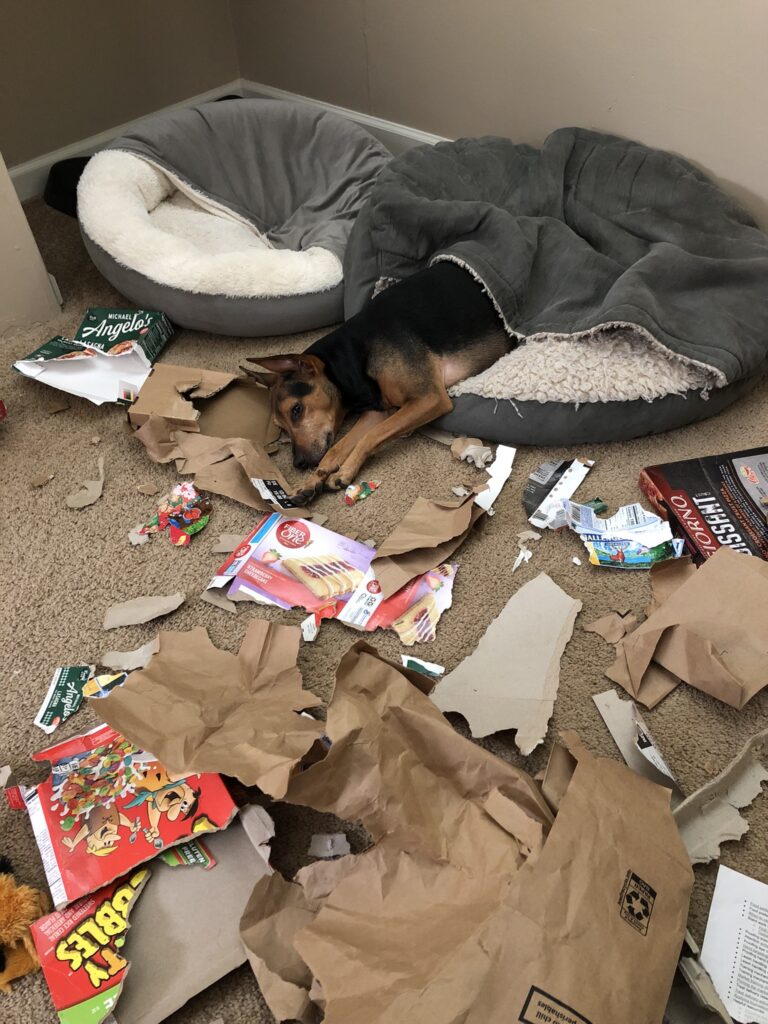
So, while a dog that has a jolly ol’ time shredding the couch while their person is gone wouldn’t fall under “Separation Anxiety”, they sure would fall under Separation-Related Problem Behaviors.
A dog who demonstrates no anxiety or fear, but large frustration about being behind a barrier, may not fall under “Separation Anxiety,” but would fall under SRPB.
While the behaviors we see when a pup is home alone can give us insight into their experience, there are some common things amongst these pups:
- Destruction of exit points or around exit points (doors, doorframes, walls near doors…)
- Destruction of large objects or home structures (other walls, couches, furniture…)
- Vocalizations ranging from whimpers to barking/howling
- Restlessness, agitation, pacing
- Inappropriate eliminations (pooping or peeing inside)
- Destruction of small/medium-sized objects (pillows, backpacks, shoes, books…)
- Barking at things outside (auditory or visual)
- Sound sensitivity or noise phobia
Do Dogs Grow Out of Separation Anxiety?
I love a question that looks simple, and has so, so, so many layers. In general, the answer is no.
For most dogs who struggle with SRPBs, without intentional, directed efforts, you aren’t going to see things improve; in fact, you may see them get worse.
Being home alone, with subpar coping skills, doesn’t teach us coping skills; it teaches us that being home alone without good coping skills is the worst. Improvement and learning need to happen outside of the situations where we need it first. Once we can demonstrate skill in easier situations, we add additional challenge.
If you were to take a second grader, plop them down in a college lecture hall with advanced calculus, no amount of sitting and staring at the page is going to teach them calculus.
If, instead, we teach math level by level through advanced calculus, we may see that the same (now adult) person can do advanced calculus in a college lecture hall, a local coffee shop, on a train, on a plane, and more.
Our Approach to Separation Anxiety
There are a few things that are absolutely critical when we’re working with families and pets experiencing SRPBs. (I mean, these are true for any issues, really…)
First, our primary goal is that we aren’t sacrificing welfare or well-being for anyone in the family unit. This means when families come to us, we may spend a couple session just finding a way to make living with this more sustainable.
I have too many incredible families that are losing themselves to support their pet, and it doesn’t have to be that way. I tell my clients, I never want you to be in a situation where you’re asking, “Do I go get medical care, or stay home to prevent my dog from being home alone?” Because I’ve seen it too often.
So, we may discuss game plans for unmanaged absences. We may do some searching for viable pet sitters, daycares, or alternative care options with the family. And we get started on building skills to help the pet complete their stress response cycle, cope with stress, and recover quickly and seamlessly.
We put skills in place so that hard isn’t the end of the world. Hard doesn’t need to be catastrophic. We can do hard things. We just need the skills, on both ends of the leash, to navigate challenges.
Once we know how to handle a curve ball, we know how to help the pet process stress, and we’ve seen that the pet is more comfortable with everyday life, then we may start working on getting the person out and about on the town.
Where I see most plans fail is jumping too quickly into trying to teach the dog to be home alone, instead of building life skills to build resilience. If the plan only works when you’re “perfect”, it’s a bad plan.
Helping pets with SRPBs is the long game.
Why Separation Anxiety Progress Isn’t Linear
I don’t know if I can think of anything where progress is truly linear, and yet, we often expect it to be. When we’re working on teaching a pet to be home alone, our goal should be to raise the baseline expectation, not to chase personal records (PRs). Not every day can be a PR.
For most families, the thing that crushes them is the inconsistency. One day, the dog can do 90 minutes, then the next, they may be a wreck. So, if instead of chasing the next highest time, we can stabilize and say, “He may be able to 90-minutes, but he’s for sure done 60-minutes 30 times.” It gives the family a way to predict outcomes.
So, what leads to that inconsistency? Often, it isn’t inconsistent; we just haven’t been tracking the right variables.
Things like trigger stacking from stimuli that are just life for us, but a thousand papercuts for them, can be the difference between resting in their bed and struggling. When we see that inconsistency, that’s a cue to get curious and explore what we haven’t learned yet.
I’ve worked with dogs where being uncomfortable home alone is the earliest sign of a medical flare.
I’ve worked with dogs where they couldn’t be home alone one day a week because the garbage man was terrifying.
I’ve worked with dogs where they’d have monthly regressions, and it turns out, they were having reactions to one of their monthly medications.
I’ve worked with dogs where they’d be great in the off-season, but storm season required a different plan.
Some days are going to be hard. That’s just life. And that’s why we put such an emphasis on resilience and stress recovery skills. Pet parents can make themselves sick trying to predict every hard day, and your life with your pet is more than a spreadsheet and a tracker.
What Progress Really Looks Like
Instead of chasing personal records, let’s look for those small wins along the way. Because a PR followed by a crash, really, is no way to live.
When we’re working with families, we’re looking for:
- Faster recovery after stress
- Empowered clients who say, “I got this” after a hard day
- Increased flexibility around routine changes
- Longer periods of comfy home alone
- Sustainable practice plans
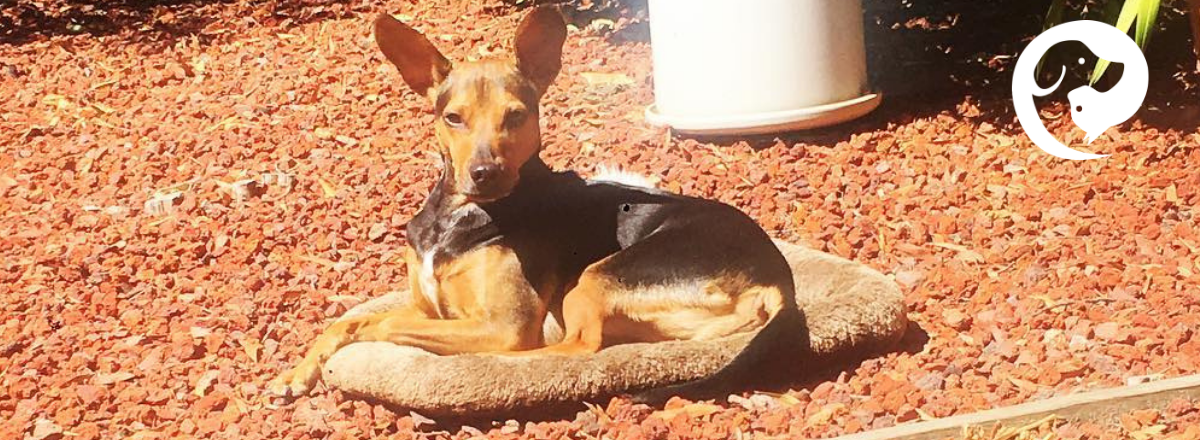
- Pups who meet their own needs, like finding sun spots while their person is in the basement
- Management plans that don’t drain the human
The little wins along the way may seem like a big deal, but you’d be surprised by the big quality of life increases that come with small wins:
The first time a client goes to get the mail, comes back, and realizes they haven’t done that without a meltdown in years.
Or the first time a client comes to a session and their pet is sleeping soundly in the other room.
Or the first time a client can just go get a prescription.
Or the first time a client watches their pet de-escalate while home alone.
Or the first time I get that recording of a dog breathing deeply on the couch while their person is at the gym.
Those little moments in life make a huge difference in quality of life.
Progress Over Perfection
Part of what we do with clients is help with the setbacks, because we can’t guarantee much, but we can guarantee there will be ebbs and flows. Setbacks can feel terrible, but they are normal. They don’t erase the progress you’ve made, and they give us an opportunity to practice those recovery skills.
Remember when I said part of the progress is empowered clients? Most of my clients need the opportunity to prove to themselves that they can help their pet get back on track after a surprise challenge.
No, setbacks aren’t fun, but they sure are a part of life.
Helping dogs with Separation Anxiety or SRPBs takes time. It just does. It is a lot of skills wrapped up into one big label, and skills take time to learn, practice, and master. But just because it can be the long game, doesn’t mean there aren’t ways to speed it up, and my biggest recommendation is to get someone on your team that can give you a tailored plan. One that accounts for your welfare and well-being, gives you an outline of what to expect, and can connect you with the people who will make this journey a little less lonely.
Here’s to harmony,
Ellen
Now What?
Living with a dog with separation anxiety is hard. Full stop. I could end this section here. I’ve talked about my own experience with this here, and here, and here.
Having a team to help you isn’t a flaw, it isn’t a failure, and you aren’t supposed to do everything alone. If your plan isn’t accounting for your welfare and well-being, I’m worried for you. It doesn’t have to be that way. I know it feels heavy, and like it is all on your shoulders, and asking for help is hard. But you’d be amazed at what a couple of people in your corner can do.
If your household is struggling with Separation Anxiety or SRPBs and are looking for help, we’re here for you.
Copyright 2025 Pet Harmony, LLC. All Rights Reserved.
Terms & Conditions, Privacy Policy
Results are not guaranteed because behavior, human, canine, or otherwise, are not guaranteeable.