
Ok, I have a serious question that is going to sound like a setup for a Jerry Seinfeld joke: what’s the deal with Impostor Syndrome, amirite?? It feels like everyone has it these days. It feels like it comes up in almost every conversation. In PETPro, almost every new mentee mentions it in their intake form as something they want to get rid of. So, ok, let’s talk about it.
First of all, what is it? The tricky thing about terms that enter pop culture is that they aren’t well defined, and like any construct they can mean different things to different people. Here are just some of the interpretations I’ve seen surrounding this phenomenon:
The original framing introduced by psychologists Pauline Clance and Suzanne Imes in 1978 in their work with high-achieving women described it as persistent self-doubt, fear of being exposed as a fraud, and the inability to internalize success.
In some contexts, it is discussed as a pattern of thought related to the ego involvement in understanding cognitive bias, anxiety, and perfectionism. By this definition, impostor syndrome is described as overpreparation or procrastination; fear of failure; difficulty accepting praise; attributing accomplishments to external factors like luck, privilege, or good timing; and perfectionistic self-standards.
In other contexts, it is described as a byproduct of marginalization in inequitable systems. This lens emphasizes the impact of microaggressions, stereotypes about competence and social identity, lack of or underrepresentation, being “the only one in the room” from a marginalized group, and inequitable treatment in the workplace as the primary causes of impostor syndrome, and describes it as a reaction to context rather than a reflection a person’s belief in themself.
In still other contexts, it has been observed to happen when people are changing careers or undergoing any other major transitional period because the adjustment to new environments, standards, and responsibilities can be disorienting. And that disorientation can cause people to question their abilities and achievements.
And finally, there are many anecdotal reports of people describing impostor syndrome as a component of a mental health diagnosis such as anxiety disorders, panic disorders, OCD, BPD, etc. And there are still others that describe impostor syndrome as false humility, a valid assessment that they genuinely do lack the skill to be attempting certain tasks, a function of (learned) helplessness or perhaps just a robust punishment history, a type of social signaling where you “beat people to the punch” by critiquing yourself before they have the chance to, and who knows what else.
I haven’t met everyone, so I haven’t heard everyone’s use and definition of the term. But the thing is, all of those are valid descriptions of the lived experience of a subset of people who have referred to their experience as “impostor syndrome.” Which means that “impostor syndrome” isn’t just one thing.
And to be sure, some of these descriptions lie far outside my wheelhouse. I am not qualified to be anyone’s mental health professional, for example. And as far as creating more equitable systems, that is in my wheelhouse but is also the work of generations. I play only a small role in large, complex, iterative social change–certainly not something that I can address in the span of a blog article.
Fortunately, however, there is a core component of impostor syndrome that I can absolutely address here: How do I know if I’m actually good enough to do this job?
What Is Impostor Syndrome in Animal Training?
By far and away, the majority of people in the animal behavior fields who talk about having impostor syndrome have these things in common:
- They have taken a ton of continuing education but still feel like they’re missing something.
- They feel like a fraud every time a case doesn’t go as planned or a client is unhappy or unresponsive.
- They feel like everyone else in the industry is a lot more successful than they are.
- They’re afraid to ask for help because people in our industry can be absolutely vicious.
- They can’t tell if they have impostor syndrome or if they actually have the Dunning-Kruger Effect and they just don’t know that they have no business charging people for their services.
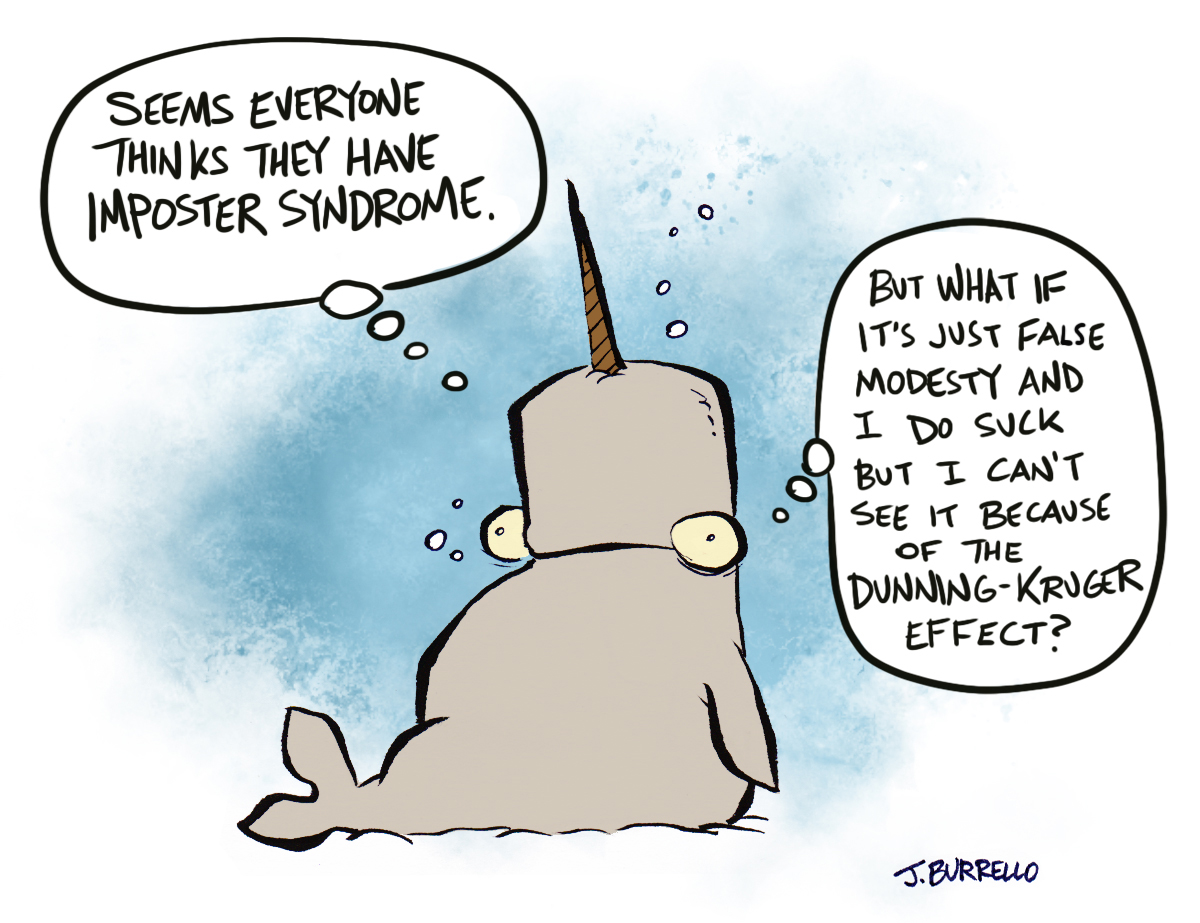
And y’all? This describes the overwhelming majority of people I’ve interacted with in our industry. So you’re not alone and, no, you don’t suck, but you do need to change your mindset.
In last week’s blog, I talked about how important building strong foundations are and how to go about doing that. If you haven’t read that article yet, it’s probably a good idea to pause here, go read it, and then come back.
I’ll wait for you…
You back? Great. Let’s keep going.
If your brain works anything like mine does, you might be thinking, “Ok but in that other blog you said it takes time and repetition. So what am I going to do in the meantime? Do I just have to suck until I’ve done this long enough to not suck? Should I be charging people if I suck? Maybe I should just pro bono myself into poverty like Past You did, right, Emily?”
Friends, please don’t make the mistakes that Past Me did. Learn from my mistakes so you don’t have to repeat them.
I’m going to tell you something that one of my mentors told me, and then we’ll talk about how to strike the balance between impostor syndrome and the Dunning-Kruger Effect.
My mentor was probably sick of being stray kittened by me, so she gave me my first client that she wanted me to take on solo. Without her, OMGS. I panicked and I was like, “But I’m such a newbie and I don’t know enough and I’m definitely gonna mess this up!” My mentor replied, “Emily, you know more than your client does, so anything you teach them will be an improvement on their current situation.” Remember that, y’all. It’s important. Regardless of where you’re at in your learning journey, you know more than your clients do about animal behavior.
That was the beginning of my journey to understanding that I was falling for a logical fallacy called a false dichotomy: the options aren’t “either I suck or I’m awesome” or “either I handle this case perfectly or I ruin it beyond repair.” You can be awesome and also have skill gaps. You can rock a case and still make mistakes in it. You can help a client in some ways and be wholly unequipped to help them in others. All of those things can be true at the same time.
Skill Gaps, Boundaries, and Cognitive Biases
If you’re afraid that you have gaps in your knowledge and skills, spoiler alert: you totally do. And that doesn’t make you an imposter, it just makes you human. Everyone has gaps in their knowledge and skills. Of course, people with deep expertise have fewer, but even they still have gaps.
And y’all, I’ve said it before and I’ll say it again: pursuing higher education is not going to change that. There are a grand total of two people I’ve met who have a masters or a doctorate in one of the behavior sciences, who wasn’t already an animal trainer beforehand, who I would ever consider hiring or even referring to. Why? Because even though academic education has enormous value in very specific contexts, and it has the potential to help people cultivate profound knowledge and skill in those specific contexts, it doesn’t – and, by definition, can’t – teach people the wide breadth of knowledge and skills that animal behavior professionals need to do their jobs well.
But even more relevant to this conversation, depth of knowledge in specific areas doesn’t get rid of the gaps, it just changes what gaps we’re more susceptible to. People who have depth of knowledge in a particular field or skillset are more susceptible to some cognitive biases than people who are less experienced. These cognitive biases include:
- Ego involvement in understanding – The more a person has learned, the more likely they are to start attaching their self worth to their ability to Know All The Things and Be The Expert. This can actually make it harder to learn new things and even harder to revisit things you already think you know.
- The Halo Effect – When someone has depth of knowledge and skill in one particular area, they are more likely to overestimate their knowledge and skill in related areas. We see this all the time with people who have a PhD in one of the behavior sciences (or even related biological sciences) overestimate their expertise in parallel fields and therefore veer way outside their lane without realizing it.
- The Law of the Instrument – When someone has depth of knowledge and skill in one particular area, they are also more likely to overestimate the value of their area of expertise while undervaluing parallel disciplines. The common adage that describes this cognitive bias is: “When all you have is a hammer, everything looks like a nail.” But while that phenomenon is true across all levels of expertise, what The Law of the Instrument looks like in people with deep expertise is more like, “Because I am an expert in hammers, they are the most important tool and all other tools are ancillary to hammers.” That mindset can inhibit further growth and learning by stunting interdisciplinary collaboration.
- It can also look like academic snobbery, where people truly believe that academia is the only valid path to acquiring the knowledge and skills requisite to do any given job. And that mindset hurts literally everyone, including academia.
To be clear, my point in bringing this up is NOT to bash academia or any pathway that leads to deep expertise. Like I said before, advanced degrees have enormous value in specific contexts, and if they help you reach your clearly operationalized goals, you absolutely should go for it.
The point is that continuing to collect more and more education is not going to make your impostor syndrome go away. Or if it does, it’s probably because you’ve fallen prey to one or more of the cognitive biases listed above, which obviously is not a good solution.
The goal is to change your mindset about having gaps in your knowledge and education. Because having knowledge and skill gaps isn’t the problem–pretending they don’t exist is.
When you understand that all of us will always have knowledge and skill gaps, and the goal is not to reach this point of perfection where we have nothing more to learn and we are experts at everything we attempt, suddenly life becomes a lot easier. Instead, the goal is to cultivate an awareness of where those gaps are and what to do about them.
Ethical Practice
The way to operate in this field (or any field, for that matter) ethically and constructively, gaps and all, is to incorporate the following practices into your routine:
- Self assessment of qualifications – If you’re not sure whether or not you are qualified to take on a case, ask yourself the following questions:
- Do I know what information I need to gather for this type of case, and what questions I need to ask to get that information?
- Do I know the contingencies for when I get those answers and what that means in terms of how I need to change my approach or strategy?
- Do I have an internal database of experience – or do I have a mentor whose database I can rely on – for what it looks like to move through cases like this one?
- Plan to pivot – When you’ve taken a case and encounter something you’re not sure about or are struggling with, ask yourself the following questions:
- What are the specific skillsets that I lack in order to be more successful in this case?
- Who has the knowledge, skill, services, and/or scheduling availability that I lack whom I can either consult with, refer out to, or bring onto my client’s support team?
- Are these gaps in knowledge and skill within my wheelhouse and therefore something I should learn, or does this situation lie outside of my niche and therefore I should cultivate more connections with people with this area of expertise?
- Leverage learning opportunities – If you’ve identified knowledge and skill gaps that are in your wheelhouse, make them your priority focus in your continuing education plan (as opposed to just chasing all the continuing education shinies that may or may not be relevant to the cases you want to focus on in your career in the hopes that more education will make you feel more confident).
- Be honest with yourself, your clients, and your colleagues about your boundaries – So many people in our industry are afraid to reveal any weakness or uncertainty to their clients for fear that they’ll be thought of as incompetent. But in actuality, (reasonable) clients appreciate honesty and clarity in communication. Get into the habit of telling your client things like:
- I don’t know, but let me confer with some colleagues and I’ll get back to you.
- As we’re working together more I’m seeing xyz behaviors that tell me we could benefit from bringing someone with a different area of expertise onto your support team.
- You and your pet would benefit from xyz service, which is not something I offer. Let’s bring someone onto your support team who specializes in that service.
- Self assessment of qualifications – If you’re not sure whether or not you are qualified to take on a case, ask yourself the following questions:
This is what ethical practices look like–and they’re also the practices that are most likely to make your impostor syndrome feelings sit down and shut up.
Imposter Syndrome Thrives in Silence (and Shrinks in Community)
All of that said, there’s one other facet of our industry that can really turbocharge impostor syndrome, and that’s isolation. We work in a very isolating profession, and it’s made even more isolating by how we collectively show up (or don’t) for each other on social media.
If you feel afraid to put yourself out there…yeah, that’s reasonable. It’s rough out here on these streets. And when you have nothing to compare your business to other than all the social media posts of everyone else appearing to be awesome at their job, it’s reasonable to feel like maybe you’re the only person in the whole industry who is actually, truly, a fraud.
This is one of many, many reasons that belonging to a safe, supportive community is so important. If you’re in a community and you’re not sure whether or not it’s safe and supportive, it probably isn’t. When you’re in one, you know it.
So if this resonates with you, make that another goal in your continuing education plan: find or create a safe, supportive community where you can go to commiserate with people who understand what it’s like; where it’s safe to be vulnerable because you know that your community will reciprocate with their own vulnerabilities; where you can ask super basic questions without fear of being shamed and you can ask really hard questions without fear of being shut down; where you can bring your work to get constructive, supportive, reinforcing feedback; where you can share your wins and celebrate with each other; where mistakes are celebrated as a part of learning rather than treated as character flaws.
When you realize you’re not alone but are, in fact, one of many, impostor syndrome disintegrates.
Reframing Imposter Syndrome as a Signal, Not a Stop Sign
And having said all of this, it will probably never fully go away. It is bound to pop up from time to time. Even as I am writing this I can think of several times where I’ve felt like a fraud in very recent memory. As in, like, last week.
The difference is that I have learned how to reframe how I think about impostor syndrome when it happens to me: What if feeling like an imposter means you care? After all, when I’m choosing my mentors, colleagues, friends, and students in this industry, I stay as far away as possible from the folx who act like they’re experts, get defensive and play the victim when they receive constructive feedback, and demonstrate no interest in continuing to learn and grow. I’d much rather surround myself with people who feel genuinely concerned that they aren’t meeting their clients’ needs and can do better. So I’ve learned to apply that to myself, too. When I am gripped by feelings of inadequacy, I thank myself for caring enough to want to do better. And then I figure out what I need to learn in order to do better.
Instead of letting impostor syndrome hold you back, use it as a tool to help you move forward. Embrace the discomfort and use it as an opportunity to reflect, take responsibility for your gaps, and figure out how to grow.
And remember, growth doesn’t always look like shooting ahead. It often looks like strengthening your foundations. So if you’re having a hard time figuring out what new things you need to learn, reflect on what things you already know that you might need to learn more deeply. Ask yourself:
- What foundation needs strengthening right now?
- What support would help me feel steadier?
- What skills could use more fluency and/or generalization?
Foundations Are Built, Not Proved
Remember: if you’re focused on trying to prove yourself to yourself or anyone else, your inner critic will always be able to punch holes in that proof. Building a strong foundation for yourself isn’t about proving your expertise or your worth or your competency. It’s about building knowledge and skills in a way that supports your learning journey rather than punishing it.
Don’t be afraid of that cyclical learning process we discussed in last week’s blog article. Remember that quote from Ken Ramirez: advanced training is basic training done really well. Just keep plugging away at it and your foundations will get really strong over time.
And take care of yourself, please. You can’t help anyone if you burn yourself out by beating yourself up. The best way to do better at your job is to give yourself the support you need to stay in it for the long haul.
Here’s to harmony,
Emily
Now What?
Want more tools for battling impostor syndrome? We’ve got you covered.
And of course, if you’re looking for mentorship and community, feel free to join us in PETPro!
Copyright 2025 Pet Harmony, LLC. All Rights Reserved.
Terms & Conditions, Privacy Policy
Results are not guaranteed because behavior, human, canine, or otherwise, are not guaranteeable.