
Trick or (go Find a) Treat in Your Safe Space!

A harvest moon settles in the sky shining brightly through the hazy clouds. The house is warm and toasty with the smell of chili wafting through the kitchen. A candy bowl perches proudly on the hall table waiting to be emptied.  A deep wind blows– Fido pulls his ears back. A shadow creeps past the window– Fido lifts his head. The crunch of tiny feet on leaves– Fido sits up tall and begins to pant, his ear high and attentive. The footsteps get closer to your front door and Fido closes his mouth to halt all inefficient movement beside the twitch of his curious nose. The footsteps stop. . . he lowers his head. The whispers echo. . . he slowly inches forward.  The door bell rings. . . “TRICK OR TREAT!!!” (and Fido bumbly runs to the door knocking over the candy bowl and you to greet the visitors who are surely only here to see him and not get their loot).

Sound familiar? 

Whether it’s Lock, Shock, and Barrel, the UPS person, a solicitor, or just a family member that wasn’t thinking, these people ringing the doorbell can put your pup into a spiral of exuberance/fear and it can be hard to reign them back into their thinking brains. My suggestion is to give them something TO do when they hear the doorbell to provide comfort, predictability, management, and a new learning history. Let’s teach them that:

DOORBELL = GO TO SAFE SPACE!


If your dog already has a cue to go to their safe space, now might be the perfect time to experiment with this new doorbell cue (if they don’t have a cue yet, why not try it with this!). This is known as a cue transfer, and the order it’s taught is:

New cue > old cue > [behavior] > reinforcement


You may have already done this accidentally with other things.  Maybe you taught sit with just a lure, which became the hand signal, and then you added a verbal cue.

“Sit” [new cue] > hand signal [old cue] > butt contacts floor > treat


After enough consistency, you might be able to say “sit” and the pup would put 2+2 together and put his butt on the ground before you even do the hand signal. Cue transfers like this happen all the time even without our conscious effort, but knowing how to do it intentionally is a super helpful tool.

That means that for this cue transfer we’ll do:

Doorbell [new cue] > “go to place” [old cue] > goes to place > treat (or other reinforcement)


Let’s put it together, people! Here’s the steps I would use in a 3-5 min training exercise (modifying as necessary):

  1. Get a bunch of yummy treats and one long term calming project.
  2. Practice “go to your place” for a few reps to create some behavioral momentum. If you haven’t taught this yet, start close to their safe space, lure them on the target, mark, reward.
  3. Either using an audio doorbell sound or your brother (to give him something useful to do) staged outside, sound the doorbell, give the old cue, and wait for behavior to reinforce.
  4. Once you’ve all done it with at least 80% accuracy, you can try to wait a little longer in between the sound of the doorbell and the old cue to see if he offers the behavior you want to see, in this case, going to his place. This is how you phase out the old cue!
  5. When you’re finished with your last rep, reward the pup with a long term calming project to transition him to relaxation.


It sounds pretty simple right? It can be! But it also can be less straightforward than you’d expect.  If you’re hitting some speed bumps, consider the following:

  • Does your body position to his safe space affect his behavior?
  • Do you really say “go to your place” or is the cue actually leading him there (doesn’t matter if it is, you’ll just need to start with the cue that he knows)?
  • Is there already a strong/over excited/aversive learning history with the doorbell that needs to be addressed before using it in a training exercise?
  • Is his safe space a space he actually chooses to go to?
  • Is his safe space too far/too close to the door?


…and probably a million more things that could be affecting clean training. Once you get this down, it’s time for proofing the behavior to the impending distractions that come after the “going to placing” (read more about proofing here).

With that being said, I love having the doorbell be a cue to do something that is incompatible with what we don’t want him to do (rush the door) as a practiced tool in our toolbelt. I also love that for the fearful kiddos it could also become a flight cue to his safe space if people coming over makes him uncomfortable. 

For Halloween, it’s super helpful to get the pup safely to a place that helps everyone be successful (pro tip: also add a physical barrier because Halloween is a TOUGH night for these kiddos who just don’t understand why Spidermen keep coming to their door making their parents squeal). 

Trick or Treat (and treat and treat and treat and treat)!


Now What?

Think about what Halloween (or similar holiday/gathering if this isn’t a practice where you live) looks like in your household. Consider what gaps you’d like to work on before the event happens to help everyone feel prepared. It might mean training, it might mean management, it might mean something else totally different!


Happy Training! 

Corinne
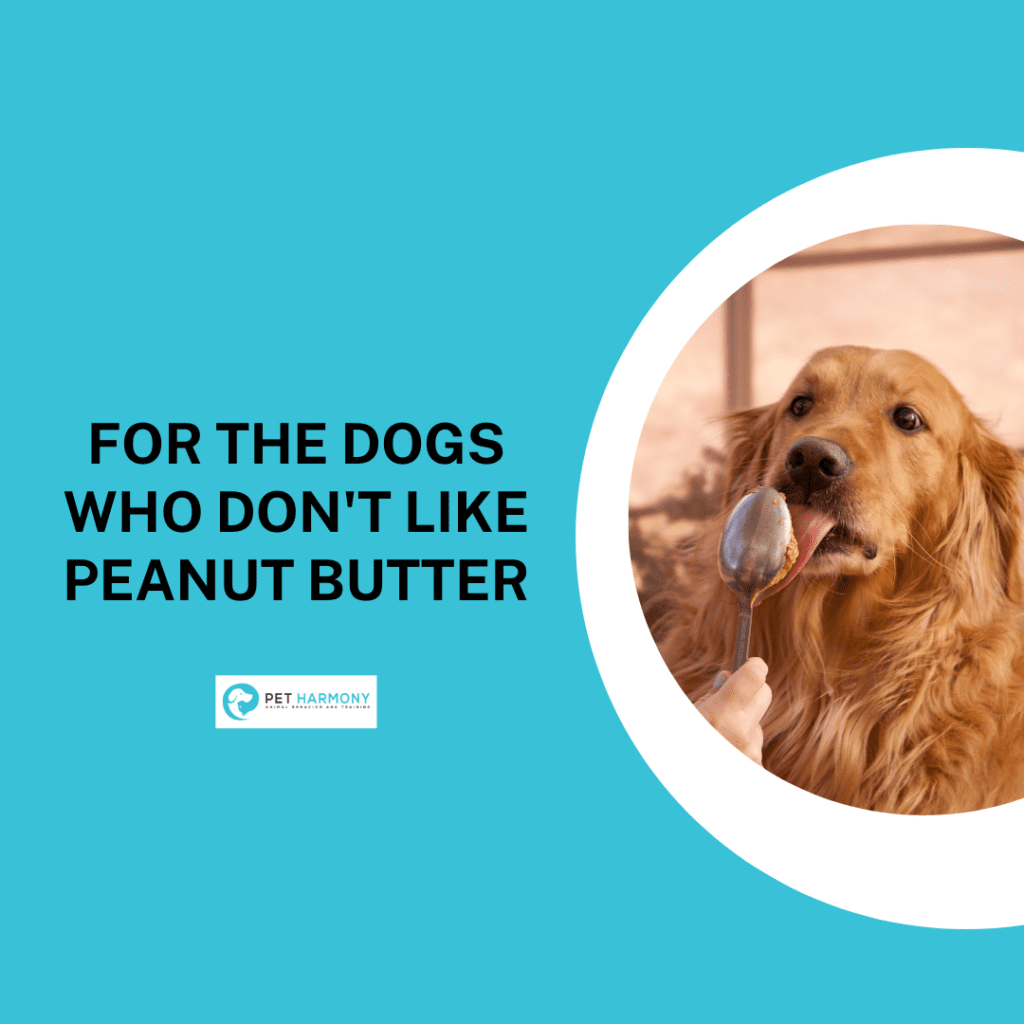
For the Dogs Who Don’t Like Peanut Butter

When it comes to our pups, there are many things we’ve been conditioned to assume they love. We have all seen the classic cartoons with a dog drooling over a steak and burying the remaining bone in the backyard for later enjoyment. Every canine should beg for belly scritches, bark at the mailman, and chase a thrown tennis ball. We have the token set of toys and treats that “all dogs love!” But what happens if they don’t show the level of enthusiasm we’ve been taught to expect? If I had a nickel for every time I recommended a client’s dog try a frozen lick treat and they’ve said “We tried that, but they don’t like peanut butter so it won’t work”…well, I would have a lot of nickels!

And there are reasons for it! Most pet stores have a large array of toys, food, and treats available to choose from. However, the prevalence of a few “standard” items like Kongs and Milk Bones can make it seem like all dogs must LOVE these things, right? The reason some items have become so standardized as things our pets love are because many pets do, in fact, enjoy them! However, we have likely all experienced a dog that just doesn’t seem to fit the mold in one way or another. If we want to find out what our pets truly enjoy we have to conduct a preference test. But if they can’t verbally tell us what they like, how will we know? Well, it’s all in the way we present it.

Check out the how-to steps for preference testing below (in this example, I am using dog-specific items/activities, but this same process of preference testing can apply to all species! You can also try this same process with just food! Here’s an excellent video of Allie showing that process here):

01. Prepare three different options for your pup. For my dog Olivia, I may prepare a snuffle mat, a shreddable cardboard box, and a frozen Toppl with treats inside.

02. In a calm, familiar environment, place all three activities in a space and settle yourself somewhere within eyesight. 

03. Observe your dog and try to answer the following questions:

    • Do they check each activity before getting started with one? 
    • Do they just choose whatever is closest to them? 
    • What order do they work through the activities?

04. Repeat this process with the same assortment of items two more times on different days. Take note of what your dog picks, in what order, and how much time they spend on each activity. 


Once you’ve conducted your test, you can explore options to combine activities! Olivia enjoys chewing a bully stick, so I may put her bully stick inside a paper bag, inside a folded up cardboard box. She not only gets to problem solve and shred, but it ends with her getting to settle in with a chew.

There are additional factors to consider when it comes to preference testing for our pets:

    • Environment – Have you ever noticed that when no one is home, your dog will chew on their bully stick until it’s gone, but when a friend comes over and you offer your dog the bully stick, they completely ignore it? The environment is likely too exciting at this moment for your dog to focus on their chew.
    • Energy Levels – If you notice your dog tends to do one activity right before they take a nap, like chewing on a chew toy, they might not be able to perform that activity when they’re bursting with energy!
    • Order of activities – Similar to energy levels, sometimes dogs need a de-escalating (or in some cases, escalating) order of activities to be able to focus on each activity.
    • Different activities serve different functions! For many dogs, sniffing, chewing, licking, and shredding have calming effects. Activities like puzzle feeders, treat dispenser balls, and physical activities like fetch or flirt pole are typically more energizing. However, dogs are still individuals! For my dog Olivia, shredding tends to be an activity that energizes her, while licking a frozen treat tends to make her sleepy. If I wanted to burn some energy when she’s excited that one of my friends is visiting, I would give her a box to shred. This gives her an appropriate outlet to engage with when she isn’t sure what to do with her excitement. If we’ve just returned from a short walk and I need to hop on a zoom call, I would give Olivia a frozen Toppl to work on transitioning her from wide awake to nap time.

Knowing what your dog’s favorite activities are and how they serve them is a tool every pet owner should have, and will help you build your pet’s enrichment menu! It can be quite a fun discovery too. Try to get creative and let your dog show you what they love!


Now What?

Find three treats or activities your pet enjoys and follow the preference testing steps! Try variations of each activity or treat to see if there’s any changes in preference when you try, say, squeeze cheese vs. applesauce!


Happy training!

Claire

The Stigma of Using Treats (AITA?)

Alright y’all, am I the asshole? 

I went to see a mobile vet with my newly adopted dog, Eden. He was (and still is) cute, fluffy, and came with a bite record towards people and dogs. Body sensitive, healed injuries to his front legs, and the softest fur I’ve ever touched. It’s a confusing dichotomy. 

When Eden and I stepped into the camper-turned-vet-clinic, there was the wonderful veterinarian we had been working with–but also another person I didn’t know. He was present the whole time, and, I learned later, turned out to be the owner of the area where the vet regularly parks. At the time, I had no idea what his purpose there was. Was he shadowing? Or driving the vet? Was he just a really lazy assistant? No clue. Not my focus as long as he didn’t try to interact with Eden. 

Eden needed to get vaccines and a check up before being officially adopted. I let him go onto a lifted up platform, and started handing him treats. I wasn’t interested in timing or markers, I was simply handing him treats with regularity. He ate, tentatively. The vet started to go over his back. As she looked him over, the additional person suddenly said, “Stop giving him treats.”

I said “No, thank you,” and kept handing my dog treats. 

I wasn’t expecting a comment about it, or what to take from that interjection, or why he thought I cared about his opinion? He said nothing for a while. Eden continued to eat food and eye the veterinarian, but let her do her thing. We went through the exam without any issues and when the vet was done the treats went back in my pocket. 

Later, while the vet was getting Eden’s medication refilled and his forms completed, I felt this punch of guilt about my response. Had I been rude? Was this guy trying to help and I just shut him down? Or (more of a hit to my pride) did he think I was inexperienced and didn’t know what I was doing? 

So I said hello to the person and launched into explaining my purpose for giving Eden so many treats.

“If he stops eating, I know he’s over threshold and more likely to bite. That’s why I gave him all those treats during a situation like this. If he stops eating we’ll likely need to pause or consider putting a muzzle on.” 

The guy shrugged and we made small talk about something related to the camper, since I had zero idea who he was still. The veterinarian gave me Eden’s refills and his paperwork and we left and went home. And then it hit me how absolutely rude the guy’s comment had been to comment about it at all. “At least ask me why,” I said to Eden… and also to my partner when I got home… and also to my mom when I called home… and to my best friend over dinner. It wasn’t bothering me, obviously. 


Well??? Who’s the Asshole??

I’ve had clients visibly blanche when they see me dole out treats for exercises. I’d be encouraged to use less food when filming a dog’s progress to seem more… impressive? Even my dad, who genuinely respects and appreciates the work I do, will roll his eyes about using treats with his dog.

When I asked some colleagues and fellow dog people if they’ve felt stigma about using food, the results were mixed. But when people did experience some stigma that was direct, it often sounded like this: 

“Am I going to run to get food every time I need him to do something?” “When do I stop using treats?” “How long do I have to train with food?” “Yeah but what happens when I don’t have a treat on my person?” “It feels like bribery.”


Positive Reinforcement is…? Cookies?

“Am I going to run to get food every time I need him to do something?”

Okay let’s clear up one concept first.

Reinforcement is not just food. Reinforcement is any consequence that increases, or strengthens, the behavior it follows. Dog trainers talk a lot about food when we teach skills like introducing a marker/clicker. It’s a fair assumption that most dogs will work for food. It’s also a fair assumption that most people will work for food**. 

But! Training with food sometimes is not reinforcing. Why? Cause we don’t get to decide what is reinforcing for the learner (dog/person/rat/etc). We’re going to back track to my elementary school days for a minute and take advantage of the fact that I have a twin brother for our examples:

  • For dinner, my mom made my twin and I buttered noodles; my twin loved it and I would rather eat almost anything else. My dad made my twin and I spicy stir fry; I was in heaven, but my twin picked out the single vegetable he liked. He wouldn’t eat anything else until offered the leftover butter noodles. The goal was for the kids to finish their meals and put some kind of nutrient in our bodies, so technically both goals were accomplished. 
  • Getting home from school, I sat down with my mother and spilled the tea. She knew more about the dynamics of an elementary school playground than she could ever possibly care about. Getting home from school, my brother went straight to the bedroom and played with legos, or blocks, or video games. The purpose for us as kids was to decompress from learning and the adrenaline-fueled interactions with our peers, and to get into the rhythm of being home. But if you had forcibly switched either of our experiences post-school, there would have been tears and yelling and bad moods all around. Even if you filled either experience with unlimited cookies. So I’ll repeat:

We don’t get to decide what is reinforcing to the learner (dog/person/rat/etc). Whether that is a primary reinforcer like sleep or food, or secondary reinforcers like access to the environment, access to sniffing spots, the clicker (or whatever marker you’re using), or the sound of a crinkly plastic bag. 

**We spend roughly 12.8% of our money on food in 2022, and that’s only beaten out by transportation to get our food and housing to store our food. We work for food too, dude.


Okay, but Specifically the Food Part?

“It feels like bribery.” What is bribery!? Bribery is defined as attempting to make someone do something for you by giving them money, presents, or something else they want, usually somewhat dishonest or illegal. (Thanks Cambridge Dictionary).  

Last I checked, asking for a ‘sit’ isn’t horribly nefarious? 

There are plenty of dogs that can’t do skills without the treat being present, especially in the pet world, but that may mean less about the use of the treat and a little more about the training skills of the person using it. Using food to help create a clear 1:1 can be a handy communication tool between us and our dog. Recognizing the plentitude of rewards in our environment can help people feel less ‘bribery-y’ and also flex those observation practices! 

For example, training a recall can be challenging, but is a great example of what reinforcers can look like.

My go-to recall training technique starts with creating enthusiasm and excitement for the key word (“Here!”, “Come”, etc). A really popular way to do this is having a super high value reward in your hands, and also to add motion to our recall word by running away and having a little chase game. But! Let’s consider our environment and what happens after the recall is done to add more enthusiasm!

Let’s use my dog Ghost as an example. When in the backyard, I love practicing recall. But, I don’t recall Ghost to go inside! She loves to be outside, especially in the woods. Sniffing, exploring, chasing, all the best things are outside! So when we practice recall, after she comes to me, she may get some cookies but the better reinforcer, from what I can observe, is that she gets to stay outside.

Now let’s use my dog Eden as an example. I love him dearly, but he is what we call an inside dog. Too hot, too cold, too hard, too soft; let’s just say, the couch by the AC is his favorite place to be on any given day. When we’re in the backyard, and I practice recall… That’s right, we’re going inside! 

The food hangs out as a happy in-between, especially if I ever am wrong in my assumption of what will be rewarding for my dogs. Did I accidentally call Eden away from a very exciting bug mystery? Did Ghost have a hurt paw and walking up the stairs into the house started to hurt without me noticing for a little bit? The food is a happy in-between if I can set it up–but in the same way that I really enjoy writing, but the paycheck is an added bonus to make sure I complete it efficiently. 


Responding in Our Community and IRL

While this is a conversation on food specifically, this section is structured towards any level of unsolicited advice! 

Unsolicited advice and conjecture always comes as a bit of a surprise to me. Sometimes it happens in the wide world, or the vet office, or even what was originally thought to be a learning environment. Taking classes and courses, working around colleagues or other dog lovers, means opening up the way you train directly to a bunch of eyes that may have thoughts about what you are doing. 

Whatever the comment, keep in mind your goal and what you’re looking for. I’ve felt pressured to adjust my goals based on other’s comments, or other’s eyes, expectations, judgements, etc. Unless you have expressly asked for help or opinions, no one has the right to assume you were looking for advice just for being in public. This goes for using food, or any other aspect of training!

When it comes to dealing with people who don’t agree or have their opinions coming in, how can we respond? How do we make space to learn and not also fall into the same problem that person has; judging what someone else is doing without understanding why? Well, in short, you don’t need to. 

Here are some responses when you’re not looking for further conversation on the matter:

  • That’s not what I’m working on right now.  
  • I don’t feel the need to do that with my dog right now. 
  • No, thank you. 

Let’s say this is an environment that we are discussing or able to discuss longer. Or it’s a coworker, or a friend:

  • I can explain my process later but right now I would like to focus on what I’m doing. 
  • If you want to demonstrate what you’re describing, you can with your dog. But I want to finish working with my dog first. 
  • I don’t think we have similar goals in mind.


The Importance of Community While Learning

Training with treats can sometimes come across as aligning with a certain ideology in the training field when, really, it is not as divisive as many people imagine. 

Consider how you would like to hear critique and who might be the most beneficial person to deliver it to you. Even though in my example I knew why I was rewarding Eden with food, there were plenty of times in my life I didn’t know! Asking questions and wondering if you were doing the right or wrong thing is an inherent part of this training journey. It wouldn’t hit so hard if we didn’t believe it a little when we heard it, especially as young trainers! 

But finding others in our community to work through the learning pains can help us navigate the experience when comments or critiques negatively affect us. Finding a community of people who are willing to give and receive constructive feedback can help us feel safe enough to assess why we are using food or whether we’re applying training techniques in a productive manner. I would hope this article encourages people to cultivate supportive communities where they can ask more questions instead of limiting their learning to only their perception. And build the skills to recognize when comments like, “How long will I need to use food?,” have pretty simple resolutions when we’re looking through an enrichment and welfare lens.

Why didn’t I include saying, “Shut up,” as a response? Not because it isn’t a valid response (it can be). But because my goal with this article is to talk about how we can guard ourselves from stigma while also improving our relationship with the person offering the criticism when possible. That being said… Some people will not be interested in the reason behind your actions. Some people will not be open to conversation. Some people will not be in your life long enough to deserve your level of introspection, growth mindset, or concern. 

And if that is the case, the ethical and kind response to their request that you “stop giving your dog treats” can be a plain and simple: 

“No.”  


Now What?

Write out responses and ways to handle situations, before you have to encounter them out in the wild. I have below the responses I had listed earlier in the article for easy reference and so that you can start to build your own list! 

  • That’s not what I’m working on right now.  
  • I don’t feel the need to do that with my dog right now. 
  • No, thank you. 
  • I can explain my process later but right now I would like to focus on what I’m doing. 
  • If you want to demonstrate what you’re describing, you can with your dog. But I want to finish working with my dog first. 
  • I don’t think we have similar goals in mind. 

Consider practicing saying all of these out loud! May sound silly but practice makes perfect, and could also help you move through conflict a little easier if you feel confident in what you’re saying. 


Happy training!

Taylor