
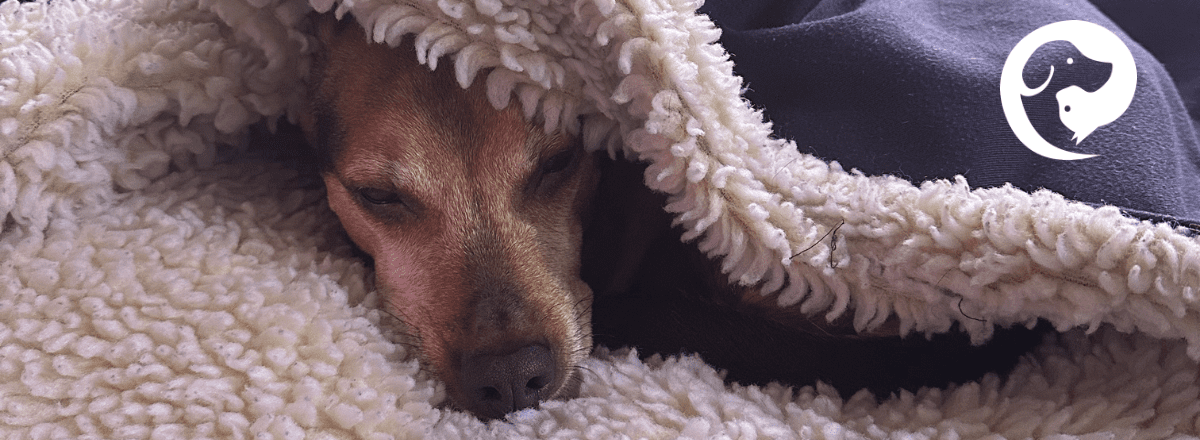
Creating a Relaxing Environment for Your Pet
Updated: June 23, 2026
Estimated reading time: 3 mins
Relaxation: it’s a skill that’s so important, that it even has its own category in Canine Enrichment for the Real World. Over on the podcast, we’ve talked about what relaxation really is, how to help our pets learn these skills, and some of our favorite approaches to teaching relaxation.
There are tons of ways to help your pets with their relaxation skills, and now we challenge you to create a relaxing environment for your pet!
What does a relaxing environment look like?
Why thank you for asking, that’s a great question, and I would love to tell you. The catch is, that, like so many answers in the behavior world, “it depends.”
There are a lot of factors that go into what a living being finds relaxing, and let’s explore those a bit!
Step 1: Know how your pet naturally sleeps
The first step to understanding what your pet might find comforting and relaxing is to understand what that looks like for your pet’s species. Different species will need different things. For a dog, being stuck on a tree limb is going to require active muscle engagement, balancing, and full-body awareness. For a bird, laying on the ground may be stressful, in the wild, which would expose them to predators, and put them in a vulnerable spot.
Ask yourself: Do I know how [insert your pet’s species] typically sleep?
Is it up high or down low? Is it in something, under something? What time of day do they typically sleep? Do I really know, or is this based on something that I’ve been hearing all my life that I should fact check?
Step 2: Learn what relaxation actually looks like in your pet
The next element of this is to know what relaxation looks like on your pet’s species, and on your pet. Just because they are still, does not mean they are relaxed.
I can be perfectly still on a rollercoaster, and you better believe I am not feeling relaxed! Relaxation is about the body moving through the stress response cycle, physiological changes like heart rate, respiration, and the like.
Ask yourself: Do I know what my pet looks like while they are relaxing?
What are their eyes doing? Are they blinking slowly, or are their eyelids looking droopy? How deep and slow are their breaths? How do they position their body? How much muscle tension do they have in their back, neck, and/or shoulders?
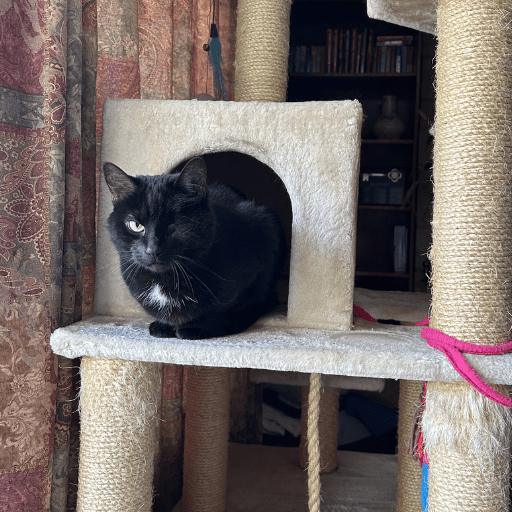
Like many cats, Beans likes a small space above the ground where she can relax and observe her surroundings. This cat tree is next to a window. Photo courtesy of Karla Alexander
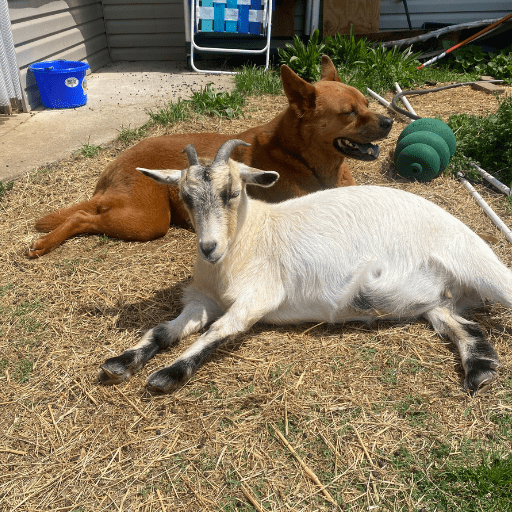
Sundae the goat relaxes in a sun spot with her brother Sully the dog. Consultant Beccy has a variety of spaces set up for the goats to use and some to share with humans and dogs.
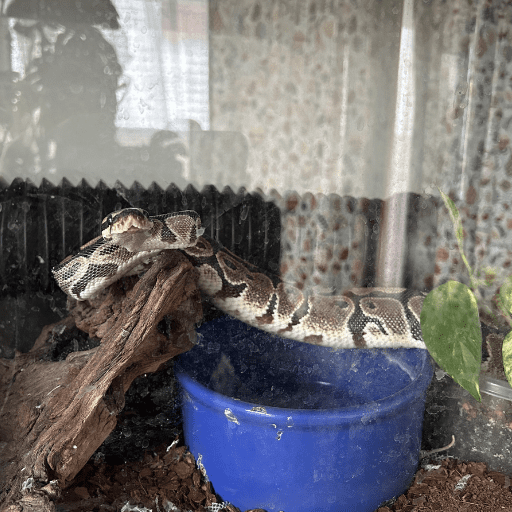
Holding still but not relaxed: Consultant Tiffany’s ball python Artie has his head pulled back, with white gaps showing between the brown scales on his neck. His neck is puffed up and rigid, indicating discomfort. Artie’s tank has many places for him to hide, since he prefers to rest curled up in an enclosed space.
Step 3: Notice where and when your pet unwinds
Now, sometimes, we are starting from scratch on this, but you may find that your pet has already given you some information on what they find relaxing. And, keep in mind, these can be locations or activities!
You may start to see a pattern to what your pet finds relaxing. When we know what relaxation looks like, we can let them tell us what they need to have a relaxing environment.
Where do you see signs of relaxation? When do you see signs of relaxation? Do they gravitate to the same spot to sleep? Do they prefer a wood floor over a dog bed? Do they sleep under or behind something? Do they spend a lot of time next to a fan, heater, or searching out a sunspot? Do they rest more after certain activities like a sniff walk, shredding a destructible toy, licking on a lick-mat, or using a flirt pole? Do they seek out a dark, quiet place?
Ask yourself: What are some things that help my pet relax?
Is there a type of bed that you see more relaxation on? For example, a cot might get a different response than a plush bed. Is there a time of day when you see the most signs of relaxation?
Are there activities that you do with your pet that either get or are followed by an increase in signs of relaxation?
Step 4: Create your pet's ideal relaxation spot
You’re ready to start building your pet a relaxing environment!
Create a spot where your pet can start relaxing more often. Take the information you collected and build your pet’s ideal relaxation station. In this spot, you can try providing them with some of those activities you identified that elicit an increase in signs of relaxation. You can practice mat work or relaxation protocols to help your pet learn to relax in this location.
Here’s to harmony,
Ellen
Now What?
Build your pet’s ideal relaxation station! This might be a dark, quiet room with a cozy dog bed, or it might be a high shelf in your office for your cat. After you’ve observed their behavior, take their preferences into account, so that you’re starting from a place of success.
Continue to teach your pet to relax here, whether that’s with opportunities to engage with activities that help them relax during or after the fact.
If you want to practice some of those relaxation protocols that were mentioned in the podcast episodes, awesome! Here’s a blog for that!
Tag us on Facebook or Instagram @petharmonytraining, so we can see your pet’s relaxation station!
PS: Capitalism
Want to support our free, public content? Check out our Amazon shop. It’s full of enrichment and pet care items (that we really, actually use). Our team spends a significant amount of time working on content every week. We love it! But we’re also out here trying to pay our bills.
* Pet Harmony, LLC is a participant in the Amazon Services LLC Associates Program, an affiliate advertising program designed to provide a means for sites to earn advertising fees by advertising and linking to Amazon.com.
Copyright 2025 Pet Harmony, LLC. All Rights Reserved.
Terms & Conditions, Privacy Policy
Results are not guaranteed because behavior, human, canine, or otherwise, are not guaranteeable.