
For those of you who aren’t familiar with the animal behavior industry, there’s a very well-known and influential trainer and consultant named Ken Ramirez who once said, “Advanced training is basic training done really well.” Even though this quote is well known and often repeated among animal behavior professionals, it also merits a lot more attention and consideration. We as humans are so eager to reach our goals and achieve expertise, but we often miss the fact that reaching goals and achieving expertise is accomplished by becoming fluent at the foundations. This misunderstanding causes people – both pet parents and pros – to think that “going back to basics” means starting over–but in reality, it’s how we move forward.
Let’s spend some time talking about why that is, and how focusing on mastering the basics can help you achieve your goals.
Kolb’s Experiential Learning Cycle
When I first started the very first version of a mentorship program that eventually evolved into PETPro, I did a deep dive into the world of educational psychology to learn how to be the best mentor I could be. I learned a lot during that deep dive, but the concept that by far and away has stuck with me the most and been the most applicable is Kolb’s Experiential Learning Cycle.
Have you ever heard anyone say – or perhaps said yourself – something like, “I’m more of a hands-on learner,” or, “I’m more of a book learner”? That seems to be how most of us think that learning works: either you’re someone who thrives on learning the concepts, or you’re someone who thrives on learning by jumping in the deep end.
And to be clear, there is a kernel of truth to that: it is absolutely true that some people do better by starting skill acquisition by learning the theory first, while there are others who do better by starting with real world experience first. There are also people like me who sometimes prefer one and other times prefer the other, depending on the context.
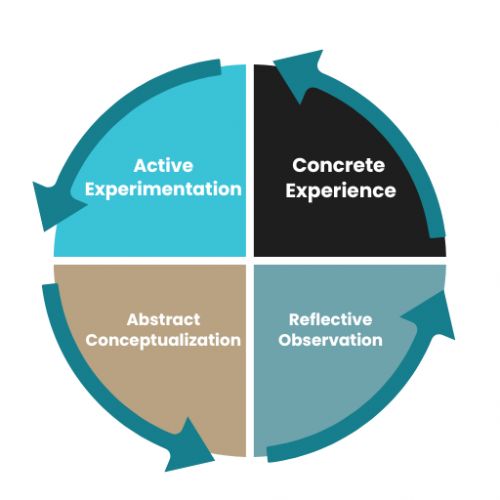
But in reality, the only way any of us can gain fluency at any skillset is by going through not two learning processes – theory and practice – but, it turns out, four: theory, experimentation, real world application, and feedback.
Let’s dig in to what each of those four processes looks like:
- Abstract Conceptualization – This is the theory part. It’s where we learn about concepts, why things work the way they do, and how they relate to other aspects of whatever skillset you’re learning. Examples:
- For pet parents, this may look like your behavior professional explaining to you why your dog is behaving the way they are, what you’re going to do about it, and why what you’re doing about it should address the issue.
- For pet professionals, this may look like learning about non-contingent learning, two-term contingency learning (classical conditioning), three-term contingency learning (operant conditioning), descriptive assessments (antecedent-behavior-consequence identification), and so forth.
- Active Experimentation – This is the part where you practice theoretical skills outside of their real-world context. This component is critical for connecting the dots between theory and practice, as well as refining our attempts as we repeat the learning cycle. Examples:
- For pet parents, this may look like your behavior professional having you practice training mechanics, like priming the marker, the timing of your food delivery, the sequence of cue > behavior > mark > reward, etc.
- For pet professionals, this may look like observing animal behavior in videos (in behavior observation practice, perhaps?) doing a descriptive assessment for videos of animal behavior, practicing writing out a succinct and effective behavior plan based on your descriptive assessment, etc.
- Concrete Experience – This is the boots on the ground, live experience of doing the thing in its real-world context. This is where you get actual experience under your belt. Examples:
- For pet parents, this may look like taking your leash reactive dog out on a walk and practicing the skills you’ve worked on with your behavior professional.
- For pet professionals, this may look like taking your client’s dog out to work on leash reactivity, just like a pet parent, or it may look like working with a client yourself to teach them how to do the things.
- Reflective Observation – This is the part where you take in the feedback you receive from your teachers, your learners, and the environment itself, and reflect on that feedback. What worked well so you want to keep doing it? What worked ok, but could be done better? What didn’t work, indicating that you need to adjust your strategy and try something else? Examples:
- For pet parents, this may look like taking videos of your training sessions and reviewing them with your behavior professional.
- For pet professionals, this may look like taking your client’s feedback into consideration and tweaking your approach based on what they tell you, or accepting guidance from your mentor on a case.
Never Skip Kolb’s Cycle Day
And then we do it all again. And again. And again and again and again and again… It’s called Kolb’s Experiential Learning Cycle because a single pass through this process isn’t enough. Reflecting on the feedback you received isn’t going to do you much good if you don’t then return to the theory and gain a deeper and more nuanced understanding of where the disconnect happened between theory and practice, or what additional details of the theory you might have missed. And gaining that deeper understanding of the concepts won’t do you much good unless you go back and practice the things you want to try differently next time. And that practice won’t do you much good unless you put it to the test in the real world to see how your outcomes changed based on the adjustments you made.
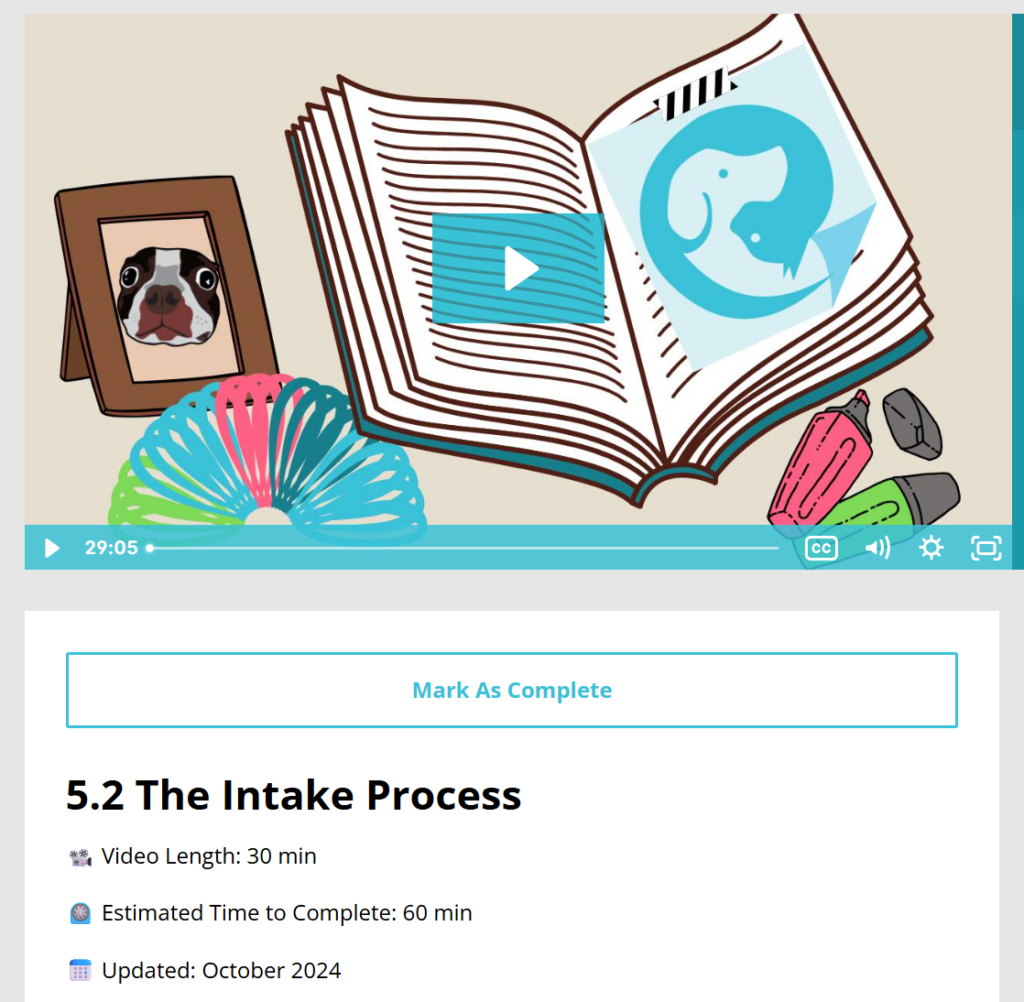
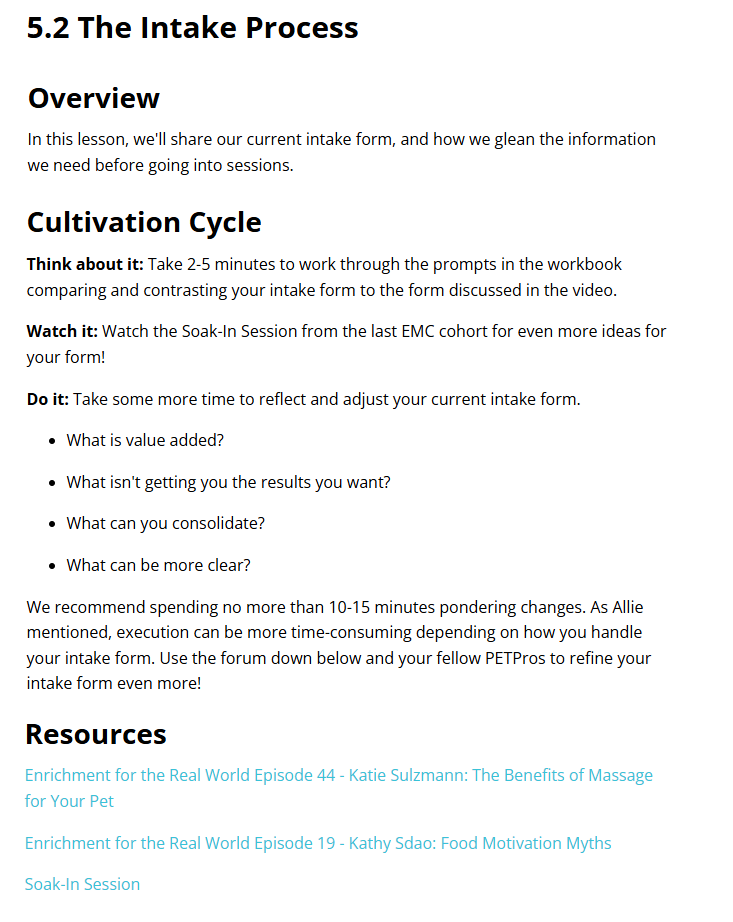
The screenshots above are taken from the Pet Harmony mentorship program, PETPro. Each lesson includes a video, along with a “cultivation cycle” where participants can apply what they have learned. In this example covering the intake process, participants are asked to Think about it: compare their intake process to the one covered in the lesson; Watch it: watch a video from a recorded session where Allie and Emily go over an intake form; and Do it: use some prompts to reflect on their current intake process and what adjustments they might make. Last is a list of resources.
When we skip over any part of this cycle, there are bound to be gaps in our knowledge and skillsets. Spending a lot of time in the theory without putting that theory into practice sets us up for a big disconnect between what we think we’re doing and what we’re actually doing.
Spending a lot of time doing things in the real world without gaining a greater understanding of the concepts behind what we’re doing sets us up to misinterpret our outcomes and therefore take inappropriate actions when what we’re doing isn’t working.
Skipping straight from theory to the real world without practicing in between sets us up to make lots of errors and generally be less effective. Ask any professional athlete how much time they spend doing basic conditioning exercises in preparation for their games!
Ignoring or rejecting feedback sets us up to have lots of experience without much actual expertise. (To be clear, we’re talking here about feedback from our teachers, learners, and the environment directly related to our attempts. Feedback from randos on the internet or relatives and acquaintances who lack both boundaries and expertise should absolutely be ignored.)
It is this four-part cyclical process that gives us a solid foundation without any gaps.
The Role of Practice and Repetition
As the old saying goes, fluency = speed + accuracy. Accuracy comes from completing Kolb’s full cycle over and over again to refine both our understanding and our attempts. Speed comes from the repetition of accurate attempts until it becomes muscle memory and our bodies take over the driver’s seat from our prefrontal cortex.
There is no shortcut for this process. Sadly, we have yet to invent the technology from The Matrix where we can just upload an entire skillset to absolute fluency in a matter of seconds. Wouldn’t that be nice, though!
In reality, fluency takes time, effort, and repetition, and it is our impatience with this process that sabotages us.
For pet parents, this can look like working with a bunch of different trainers and trying every technique you can find for short periods of time, then moving on to the next trainer with the next technique when the current one doesn’t work fast enough. If you’ve been there, it’s not your fault. In an unregulated industry filled with charlatans who promise quick fixes, you can’t be expected to know whether you’re on the right track and just need to keep going or whether it’s simply not a good strategy. We’ll talk more later about how to tell the difference between repetition for its own sake vs. repetition for the sake of building fluency.
For pet professionals, this can look like taking more and more continuing education courses and collecting more and more letters at the end of your name, and still feeling like you don’t know enough, you’re not good enough, and you’re missing something major. If you’ve been there, it’s not your fault, either! Most of the continuing education opportunities in our industry (even most of the ones that are called mentorships) are linear, single-pass processes, and that single pass may or may not even include all four components of Kolb’s Experiential Learning Cycle. So yeah, it’s unrealistic to assume that anyone would have fluency after completing a course! There’s nothing wrong with you; that’s just how learning works! And by the way, I’m not bashing those courses. That would be entirely hypocritical, considering that I regularly teach courses myself. What’s missing from the conversation is setting the expectation that a linear course is just the beginning. To gain fluency, you gotta keep practicing the four-part learning cycle over and over and over again.
In our own mentorship program, we get a lot of students who start off wanting to race through the material so they can get to the “sexy” stuff towards the end of the curriculum, where we start talking about maladaptive behaviors and how to work with them. Most new mentees think that’s where they’ll finally find that missing piece of the puzzle that will make them feel confident in their abilities. But those who stay in the program learn to slow down and get comfortable diving into the foundations, fearlessly asking “basic” questions and having discussions about “beginner” topics–because that’s where the fluency, and therefore confidence, happens.
The Role of Generalization
All of that said, there’s another facet beyond fluency that we need to consider, and this one can be a real buggerbear. You can be completely fluent at a skillset in one context, but if you’ve never or rarely practiced it in another context, guess what? Yeah. You’re still gonna struggle.
Generalization is the process of learning a skillset in multiple contexts so that you can gain fluency in every context where you need it. In the animal training world, we call this “proofing”. When starting in a new context, we have to lower our expectations and go back to the basics all over again.
Pet parents, tell me if this sounds familiar: your dog has an amazing recall at home, at the dog park, and at Sniffspots. So you take them out on an off-leash hike through the mountains, and suddenly they act like they’ve never heard your recall cue before. They aren’t being stubborn, and it’s not that they don’t care about you, this is just a new context for them, so the same skill isn’t as solid here as it is in places where they’ve practiced it many times before.
Pet professionals, this applies to you too! Here are some of my favorite examples:
- The look on mentees’ faces when they ask me how to decide what continuing education they should take next, and I tell them, “Ok, let’s run it through the enrichment framework.” And when they ask me how to decide how to make business decisions, I tell them, “Ok, let’s run it through the enrichment framework.” And when they ask me how to achieve work-life balance, I say, “Ok, let’s run it through the enrichment framework.” It’s the exact same skillset. They’re just learning how to apply it to new contexts.
- When mentees are terrified to work with a new species until they realize that it’s all the same foundational skills, just generalized to another species.
- When mentees feel stymied by client behavior until they realize that it’s all the same foundational skills, just generalized to humans.
And y’all. It never ends. Literally this week there were three separate situations where I realized that I already had the skillsets I needed to solve a problem, I just had to figure out how to generalize those skillsets to these new contexts.
Learning is a lifelong process with no end point–and a big reason for that is because we will be continuously discovering new contexts where we need to learn how to put our existing skillsets to use. Back to the basics, on repeat. If that sounds tedious or discouraging to you, it’s time for a reframe!
So What Should This Look Like?
Let’s go back to another basic: learning evolved to help individuals adapt to their environment to optimize our chances of not just surviving, but thriving. In other words, learning is a condition of being alive and sentient. It’s not just a lifestyle, it is literally life.
So if that feels tedious to you, that probably means you aren’t getting nearly enough reinforcement for your efforts, and the process isn’t nearly joyful enough to keep you interested and motivated. So how do we get more reinforcement and joy from this process?
Remember earlier when I said that we’d talk later about the difference between repetition for its own sake vs. repetition for the sake of building fluency? Well, now’s the time. And I wanna start by telling you about some clients of mine from a few years back.
I first met these clients when they attended a talk I gave about intraspecific (dog-dog) aggression. After the talk, they came up to me and told me about their dog aggressive Rottie, who they’d been faithfully taking to a local trainer’s socialization classes twice a week for five years. I asked them, “If you’ve been going to these classes twice a week for five years and your dog’s behavior hasn’t changed at all, what are you hoping to get out of these classes?” Their lightbulb moment was epic. I will never forget the looks of dawning realization on their faces. It was a beautiful sight to behold.
I will forever admire their dedication–and also, no one should have to spend that much time, effort, and money without a clear understanding of what they’re hoping to accomplish as well as clear criteria for what progress looks like.
Whether you’re a pet parent looking to hire a behavioral professional, or a behavior professional looking for a mentor, look for someone who can:
- Help you to identify and refine your goal(s)
- Explain what the journey is going to look like, what skills are needed to reach your goal(s), what skill acquisition will look like, and what success looks like at each stage of the journey, indicating that you’re ready for the next stage
- Help you to identify and celebrate all the small wins as well as the significant milestones along the way
- Make the journey as fun, simple, and sustainable as possible while still holding space for the hard times, the complexities, the struggles, and the setbacks
With someone like that on your support team, the repetition necessary to master those oh so important foundational skills will feel much less tedious and much more joyful–not to mention satisfying. Because when repetition yields progress instead of redundancy, your rate of reinforcement goes through the roof.
Remember: progress isn’t about racing ahead, it’s about strengthening the ground you stand on.
Here’s to learning!
Emily
Now What?
- If you’re a pet parent who wants to dip your toes into the generalization water, check out this training challenge.
- And if you need someone on your support team who can help you go on a learning journey with your pet, we’re here for you!
- If you’re a pet professional who wants to dig a little deeper in the behavior basics, check out this series of podcast episodes:
- Episode 36: Become a Better Animal Trainer (w/ Dr. Susan Friedman)
- Episode 37: Unlocking the Behavior Matrix (Part 1)
- Episode 38: Unlocking the Behavior Matrix (Part 2)
- And if you need a mentor who can help you go on a professional development learning journey, we’re here for you!
Copyright 2025 Pet Harmony, LLC. All Rights Reserved.
Terms & Conditions, Privacy Policy
Results are not guaranteed because behavior, human, canine, or otherwise, are not guaranteeable.