How Cherry Picking Your Plan is Getting in the Way of Your Progress– and What to do About it!


There are a lot of factors that go into how successful a behavior modification program is. Some of those factors are uncontrollable: genetics, certain things in the environment (i.e. city-living is always going to be louder than rural living), age, etc. Some of those factors are controlled by your behavior consultant: science-based, empathetic, ethical training techniques, splitting steps down small enough for both you and your pet to be successful, etc. And then there are those factors that are controlled by you, the pet parent: communicating successes and hardships with your consultant, practicing the exercises, managing stress and unwanted behaviors, etc. 

There’s one pet parent factor in particular that I want to talk about today: cherry picking parts of your behavior modification plan. What I mean by that is following some parts of your behavior plan but not all of them. Let’s dive into why it happens and why it’s so detrimental. 


Why Cherry Picking Your Plan is Detrimental

Cherry picking parts of your plan and ignoring other parts is detrimental to your progress. Yes, you can still make progress this way. Yes, sometimes you can even reach your goals this way. However, it’s probably going to be slower than it could be if you followed all parts of your plan. If the behavior modification journey already typically takes several months, why would you risk adding more time onto it?

It may also not be possible to reach your goals if you’re cherry picking. For example, if you want your pet to stop counter surfing but you keep leaving food on your counter while you’re not home and your pet is loose, you’re not going to reach your goal. Your pet could have an amazing stationing (go to a spot and hang out there) behavior when you’re cooking, an amazing “off” cue, and other foraging opportunities. You’re still not going to reach your goal without that particular management component.

Because there are so many factors that go into behavior, we usually need to address several factors to be successful. Think about it this way: all of those factors are like an orchestra that comes together to create one end result. All of the factors of behavior come together to create one end result, too. Now, if our orchestra is practicing and we improve the woodwinds, brass, and percussion, but completely ignore the strings, the end result isn’t going to be the same as if we improved each section. We can’t cherry pick and expect the end result to be the same. 


Why Cherry Picking Happens

I see cherry picking happen for a lot of reasons:

  • Not knowing what a recommendation is for, does, or why it’s important
  • Not knowing how to do or implement that recommendation
  • Not seeing the recommendation work, including not knowing how to troubleshoot it to make it work better
  • The consultant put in too many recommendations at one time
  • Forgetting a part of the plan
  • Old habits– and concepts– die hard

I’m probably missing a few but those are the most common reasons I see when speaking with my clients. Almost all of these merit an entire blog post to themselves, but let’s briefly explore each and talk about solutions. 


Not knowing what a recommendation is for, does, or why it’s important

This one is all about buy-in. Some people need to know why they’re doing something before they’ll do it. There are plenty of times that that’s applied to me, too! If you don’t know (or remember) why you’re supposed to do something or do it in a particular way, ask your consultant. There’s no shame in asking and, believe me, we’d much rather you ask straight off the bat if you’re not sure why instead of avoiding it for a few weeks. 


Not knowing how to do or implement that recommendation

This usually comes down to a break-down in communication when you’re given instructions (or can come from people skipping ahead in their plan instead of following instructions as they were relayed). An example of this is when a consultant might say “separate your dogs with baby gates and perform this exercise on either side of the gate” and you have an open-floor plan. Even though the instructions seem straightforward, the environment makes it a whole lot trickier to implement. Again, speak with your consultant and relay specifically what you’re having trouble with. The more specific the better!

If the reason you don’t know how to do something or implement it is because you’ve skipped ahead, go back to what your consultant recommended. When we say, “practice this only in your yard or with someone they know for the next 2 weeks”, we really mean it. There may be tweaks that need to be made before the recommendation can work in other capacities and we don’t want you to have to figure that out yourself. Plus, moving too fast is a prime reason for seeing setbacks later in the process. 


Not seeing the recommendation work, including not knowing how to troubleshoot it to make it work better

Reasons for a recommendation not working can run the gamut and is going to be based on the individual case. That said, almost all of those reasons can be resolved with some troubleshooting. Before giving up on a recommendation completely, talk to your consultant (noticing a pattern here?) Tell them what you tried, for how long, and send a video if you can! We don’t expect you to know how to troubleshoot something to make it more effective; that’s our job. 


The consultant put in too many recommendations at one time

I was incredibly guilty of this when I was a newer consultant, and am still sometimes guilty of this! Your consultant should tailor their recommendations to you as they get to know you better, but in the beginning it can be difficult to find that sweet spot. Tell your consultant when there’s too much, but only after you’ve made sure that it’s not actually because of one of these other reasons. I often hear someone say they don’t have time for one thing in particular, but when we talk more about it we discover that one of these other reasons is the real culprit. 


Forgetting a part of the plan

Okay, we’ve all been here, right? Remembering everything you’re supposed to do can be hard, especially in the moment. I see a lot of my clients get around this by posting their training worksheet (which we send to all of our clients after every session) on the fridge. Others opt for post-it notes around the house. The point is that the system needs to work for you. I recently spoke with a client who was cherry picking her plan. When I brought it up, she admitted that she forgot about some parts of it and doesn’t check email frequently and so wasn’t utilizing the training worksheets I was sending. We decided that her taking her own notes would be more effective. No system will work unless it works for you! Think through what systems work for you in your regular, daily life and figure out how to incorporate what you should be working on into those tried and true systems.


Old habits– and concepts– die hard

This one is part buy-in, part forgetting, and part habit. There are so many times that someone has come to me with a history of leash popping their dog and looking for a more LIMA-friendly way to walk. Usually the short-term solution involves them looping their thumb in their belt loop or pocket to keep them from leash popping. Even habits that we want to change die hard! And, sometimes, we have no idea that we’re even doing them. Give yourself some grace as you’re working on changing your own thoughts and behaviors- and remember that your pet is going through the same process. Ask your consultant if they have any recommendations to help you change particular habits (like looping your thumb in your belt loop). 


Now What?

  • Take an honest look at your behavior modification and what you’re doing. Does it match up? Even the little details? If yes, awesome! Keep on keeping on. 
  • If it doesn’t match up, which of the above (or combination thereof) best describes your situation? 
  • Talk to your consultant about what’s going on, even if you’re not quite sure what the issue is. They’ll be able to help troubleshoot the issue to set you up for success better!


Happy training!

Allie
5 Signs Your Pet Needs Professional Help


I’m very much a Do-It-Yourself person– so much so that I consider it a fault. I will absolutely try to do something by myself and learn a new skill if I think that I can. I see this with a lot of my clients, too. They originally tried to tackle their pet’s maladaptive behaviors by themselves and eventually found their way to getting professional help. 

In many of those situations I wish that they’d contacted a professional sooner. Sometimes that’s because they’ve tried something that has actually worsened the behavior or because they waited until it was more serious or dangerous before getting a professional involved. But there are other times I wish they’d contacted a professional sooner simply because it’s easier to change a behavior that’s been happening for less time. Well-established habits are harder to change. 

I then occasionally get cases where someone has just adopted an animal and reaches out to our team immediately. In those situations we’re almost always asked, “Do you think it’s too soon for us to see you? Should we wait a bit?” Our answer is usually a resounding, “no, it was a great decision to involve us so quickly!” 

So, as someone who is a staunch DIY-er, who tries to tackle problems without additional help, but also recognizes that getting a professional involved sooner rather than later can be beneficial, I thought it’d be helpful to discuss some key signs that would cause me to recommend someone seek professional help for their pets’ behavior. 

  1. Safety is on the line. This could be the safety of you, your pet, another human, or another animal. If any individual’s safety is at risk you should immediately seek the help of a behavior professional. 
  2. It’s a behavior you haven’t dealt with before or dealt with recently. It’s much better to learn something from a professional the first time around instead of trying your hand at something you’re not experienced with. And, if you haven’t dealt with this particular issue recently, chances are that there are now more effective or empowering ways to work with the behavior and it’s time to update your skills. This field is constantly growing and evolving and that’s a good thing!
  3. You’re not making progress. If you’ve been working on your pet’s behavior for a few months and you’re not making any progress, it’s time to call in a professional. Save yourself the time and hassle by getting help. 
  4. You’re having to resort to more forceful tools and methods. It’s a myth that certain animals need more forceful tools or methods. We work with aggressive animals of all shapes and sizes for a living and can do so in a way that’s empowering and empathetic towards our animal learner. If you’re stuck and finding yourself reaching towards more forceful tools and training methods, it’s time to get help from a behavior professional who can keep you working in a way that is effective, ethical, efficient, and empowering.
  5. You want to make sure you’re doing something well and as efficiently as possible. There are plenty of things that I choose to muddle through myself, knowing that it would be more efficient if a professional did it. However, there are other things that I want done well the first time and don’t feel that I can afford the mistakes that come with learning (like our business taxes). If you feel that way about your pet’s behavioral and mental health, then look for a professional sooner rather than later. 

Now what?

Happy training!

Allie

November 2020 Training Challenge: Use a Relaxation Protocol or Mat Work to Prepare for the Holidays


When we had originally planned our 2020 training challenges last year, we hadn’t expected there to be a worldwide pandemic. Even though this month’s challenge was with Thanksgiving in mind and this year’s Thanksgiving will likely look different, we decided to keep the planned challenge and count it as a practice run for next year! Our November training challenge is:


Use the Relaxation Protocol or mat work exercise from the August challenge to prep for Thanksgiving festivities.


The situation we were specifically thinking about when we came up with this challenge was the Thanksgiving meal, including cooking and sitting down to eat. We routinely have clients tell us how annoying their pets when they’re trying to cook and sit down for a meal. Extrapolate that to an even larger, potentially more stressful meal and you can see where preemptive training comes into play!

I talked a little about this concept in this blog post about using “human food” in training. I mentioned that I taught Oso to hang out in our dining area when we are cooking so that he’s not in the way. I was pretty lax with my criteria when I taught him this (as long as he was on the hardwood and not the tile it counted) but you can tighten up your criteria by using a mat, bed, blanket, rug or something similar to create a specific spot for your pet to hang out. 

Brindle dog lying next to kitchen table and chair.
Oso demonstrating how to politely lie next to me while we eat.

Here’s how to go about doing this task:

  1. Decide what makes sense to manage and what makes sense to train during your normal Thanksgiving festivities (remember- this counts as a practice year!) Some people will choose to manage the majority of the day and that’s perfectly fine. Others will want to put more preemptive training in place. Do what makes sense for your festivities, training schedule, and desires. 
  2. Decide where you want your pet to be during cooking and/or eating. Set up a bed, mat, blanket, rug, etc. for an easy visual cue for your pet. 
  3. Start training your pet to hang out in that spot (you can use your Relaxation Protocol and/or mat work exercise from the August challenge) when you’re not cooking or eating. We’re starting in pet kindergarten first and then raising expectations as they become more proficient at this task. 
  4. Incorporate other distractions into this training exercise. You’ll likely want to include distractions like people walking around and anything else that will happen during the holiday. You may also want to practice while you’re pretending to cook a meal so you get the hang of training while cooking in a lower-stakes situation. This step is called proofing, and is one of the stages of learning
  5. Start incorporating this exercise into real-life cooking and/or eating scenarios. Remember to reinforce your pet as much as necessary to make it worthwhile for them to hang out in their spot!


One last note: dogs are opportunistic scavengers by nature. Even with solid mat work training, leaving a pet prone to counter surfing alone in the kitchen with counters full of food for an extended period of time is asking for trouble. We recommend still managing situations in which you aren’t watching your pet.


Now what?

  • Start training with the above steps!
  • Let your trainer or behavior consultant know if you’re getting stuck. That’s what we’re here for, after all!
  • Send us pictures and videos of you working on this month’s training challenge to us @petharmonytraining on Facebook and Instagram


Happy training!

Allie

The Human Side of Animal Behavior


The past couple of weeks I’ve been talking about warning signs, like growling. I’ve been talking about warning signs from the perspective of our pets and why we should be respectful– not punishing– of those body language signals. But one thing that I’ve left out of the previous posts is all of the human emotions that happen as a result of those particular behaviors. That’s what today’s post is for. 

When I meet a new client and they start telling me about their pet’s behavior, I often hear things like:


They’re really quite sweet. I just want everyone to see that, too.

They’re sweet 95% of the time. 

They’re a good pet, just scared.

I’ve been telling you all of the bad things about them. Let me tell you some good things, too. 


I chuckle internally when people tell me these things. I know that they’re trying to convince me to not judge their pet, or them, too harshly. That they don’t have a “bad” pet. But here’s the secret: I know that! We as humans are the ones who attach morals (I.E. good or bad) to certain behaviors. Our pets aren’t thinking about if something is right or wrong. They’re thinking about if a behavior works for them or not: what the outcome of that behavior is.

It’s a false dichotomy to say that someone is all good or all bad. Individuals, including our pets, live in a grey area. That’s why good pets can sometimes do bad things and why bad people can sometimes do good things. I don’t need to be convinced that a pet who’s biting is also sweet. My job is working with good pets who sometimes do bad things. 


The less-lighthearted part 

I try to keep our blog posts relatively lighthearted and optimistic. That style is what I enjoy writing and what I enjoy reading. However, I’d be remiss if I didn’t touch on the less-lighthearted parts of human emotions in relation to pet behavior. 

The animal behavior consulting field is incredibly emotional. On a daily basis folks reach out to our team, often on the verge of tears, because they’re scared of their pet’s behavior. It’s easy for me to say in a post that all behavior just is and that we’re the ones who attach morals to them. The water muddies when those behaviors are at the expense of mental health (for both the pet and the human) and/or safety of others. There very much are “bad” behaviors– as deemed by our society– that result in the euthanasia of animals. 

Now, this post is not about the many sides of behavioral euthanasia. That’s an enormous discussion and one that I don’t currently have the bandwidth to write in a way that does the topic justice. One day I’ll tackle it, but not today. This post is specifically about human emotions, like:


I’m scared they’re going to hurt someone. 

I feel like a prisoner in my own house because of their behavior. 

It’s really difficult to live with this. I don’t know how much longer I can do this. 

It’s embarrassing when they’re reactive on walks. 


Embarrassment. Frustration. Helplessness. Shame. Defeat. Regret. Remorse. Fear. A whole lot of fear. There are a lot of really big emotions that come into play when you have a pet with maladaptive behaviors. And, yes, it’s our duty to help the animal we chose to bring into our home and we should be doing our best to meet their needs but that doesn’t negate the human element, either. 

Your feelings are also valid. 

I think the human side of animal behavior consulting is often swept to the side. We put such a large emphasis on animal emotional states and making sure they’re comfortable, but can sometimes forget to tell people that it’s okay to be feeling however they’re feeling about their pet’s behavior. Sometimes good pets do bad things and that’s scary. We’re allowed to be scared by that. But the good thing is that you don’t have to be alone. That’s what behavior consultants are for. 


Now what?

  • Have you stopped to truly take stock about how you’re feeling in relation to your pet’s behavior? Take a moment to do so. 
  • Are there certain aspects of your pet’s behavior that are taking a larger toll on you? Focus on tweaking your management plan for those behaviors so they’re less likely to happen (like putting up a baby gate around the front door to lessen the chances of door dashing.)
  • Not sure where to start? Check out our Setting Yourself Up for Success: Behavior Modification Basics course to take the first steps in your pet’s behavior modification plan.
  • Get help from a professional. You don’t need to do this alone. Our team works with people all over the world. Email us at info@petharmonytraining.com to schedule your first appointment.

Happy training!

Allie

October 2020 Training Challenge: Assess Your Home Alone Activities Efficacy


Part of me can’t believe it’s already October and part of me reminds the first part that this has been the longest year ever. Regardless, it’s time for our October training challenge!

List enrichment strategies you employ while you’re gone and objectively go through the list to determine if those strategies are effective. 

Not only is this training challenge dedicated to the “Independence” chapter of our book, it’s also a great exercise in taking a descriptive vs. prescriptive approach to your enrichment plan. (Note: we decided what the training challenges were going to be well before Covid hit. While you may not be gone at work all day at the moment, this exercise still applies for shorter outings!)


Descriptive vs. Prescriptive

For those of you who’ve heard us speak this year, you’ve heard us talk about taking a descriptive approach to your enrichment plan.

Descriptive: “I see a change in my animal’s behavior because of the activities we’ve done or provided.”

Prescriptive: “I provided an activity for my pet therefore he’s enriched.”

With the descriptive approach, we observe behavior to determine if the activity was effective instead of assuming that it was. Did it actually meet the animal’s needs as we intended? If it did, great! We can keep doing it. If it didn’t, well, then it’s back to the drawing board. Emily wrote a great blog post about this here. It’s not enough for us to just assume that our pet’s needs are being met while we’re gone, we need to actually observe that that’s true. 


How can I tell if those activities are effective?

There are a few ways we can tell if these activities are effective:

  • They’re being used. If you leave a stuffed Kong for your pet and it’s untouched when you return, that’s not an effective strategy. 
  • Watch your pet on video. Want to know if the window film you put up for your pet’s reactivity is actually decreasing reactivity throughout the day? It’s time to break out a recording option and see what your pet is up to during the day. 
    • Recording options can be high-tech, like Furbo and Nest (these are affiliate links), or low-tech, like Skyping or Zooming yourself or setting up a laptop to record shorter absences.
  • Observe your pet’s behavior when you come home. Providing activities while you’re gone can be the determining factor between having an adolescent dog who’s bouncing off the walls when you come home vs. one who’s excited but not uncontrollable. 


Now what?

  • Make a list of the enrichment activities you utilize while your pet is home alone. 
  • Make a list of desirable and undesirable behaviors that you’re hoping these enrichment activities address.
  • Observe your pet’s behavior. Are those activities effective in increasing desirable behaviors and decreasing undesirable behaviors?
  • Adjust your enrichment plan accordingly. 
  • Share your findings with us on social media! @petharmonytraining on Facebook and Instagram


Happy training!

Allie

PSA: Don’t Lure Uncomfortable Pets Closer to People


Today’s post is really more of a PSA:


Don’t lure uncomfortable pets closer to people. 


We get a lot of requests from people who are struggling with their pets showing aggressive behaviors towards new people, kids, other pets, or sometimes themselves if it’s a new adoption. And while I love when people take the initiative to start getting their pets comfortable with scary things by using food, we have to be really careful about how we do it. 


The danger of using food incorrectly

A phrase that I wish I heard a lot less than I unfortunately do, is, “I don’t get it. He is clearly uncomfortable but approaches people.” While there are a lot of reasons why that behavior can crop up, one of them is that we can teach our pets to approach people they’re not comfortable with by luring them closer with food. 

For example, let’s say a creepy van pulls up to the sidewalk as I’m walking and offers me $1000. The driver’s arm is outstretched with a stack of cash. Let’s be real; I’ll probably approach the van and try to take the $1000. That’s a super valuable amount to me and worth the risk. However, I’m definitely not comfortable. If the driver makes a sudden movement I will absolutely go into fight or flight mode. If I safely get the $1000 and nothing bad happens, I’ll be more likely to approach other strange vans handing out free cash. But, again, that doesn’t mean I feel safe doing so. 

Now, let’s replace the creepy van with a person your pet is uncomfortable with and the $1000 stack of bills with a super delicious treat. It’s the same scenario. Your pet may approach the person and take the treat from their hand, but probably doesn’t feel comfortable doing so.They may stretch their neck as far as it’ll reach to grab the treat. They may flinch or startle (or worse) if the person makes the slightest move. It’s absolutely possible to teach an animal (or me, apparently) to put themselves in an uncomfortable position for a high-value reward. And, by doing so, we can teach animals to approach people who they’re not comfortable with, which I often see leading to bites. 


Decreasing distance is a side effect. Comfort is the goal

When I’m working with a new client and their pet is exhibiting stranger danger or leash reactivity, I often have to remind them that distance– getting closer to the person or other animal– should be a side effect but not a goal. As illustrated above, it’s very possible to teach an individual to move closer, but without comfort, we’ve forfeited safety and can be inadvertently teaching a dangerous behavior. Distance in and of itself should not be the goal. It should not be the sole factor by which we measure success.

Comfort, which can be observed in the animal’s body language, should be our goal. When an animal is more comfortable, they’ll typically, naturally move closer to the person. The getting closer part isn’t something we really need to teach. Decreasing distance between the pet and the new person is a side effect of them feeling comfortable, not the other way around. 


What to do instead

I’m going to be intentionally vague here because realistically if your pet is exhibiting aggressive behaviors you should seek professional help. Safety is serious. We can (and usually should!) use food to build a desirable association with the new person, but start by using food at a distance. This can take several forms and, preferably, we should be setting up the environment to keep the pet from feeling like they have to exhibit the aggressive behaviors. Again, a professional behavior consultant can help you with all of the nuances of that. 


Now what?

  • If you’re currently using food to lure your pet closer to individuals they’re afraid of, discontinue doing so. 
  • Pair scary things with treats from a distance with the help of a professional behavior consultant. We offer remote sessions locally to internationally; email us at info@petharmonytraining.com to schedule your first session.
  • Need help now? Check out our “Setting Yourself Up for Success: Behavior Modification Basics” course to get immediate help. 


Happy training!

Allie

How to Work with Multiple Pets at a Time


Last week we discussed the pros and cons of working with pets individually vs. with multiple at the same time. Check it out here if you haven’t yet read that post. Now that you’ve considered if you should be working with an individual pet vs. your whole crew, let’s get into the details of how to make that possible. 


Working individually

I observe body language for a living: canine, feline, and human. Often when I make the recommendation to someone to work with one of their pets individually, I’m met with a look of apprehension. Sometimes that apprehension stems from time or worrying about not being fair to another animal, but sometimes it’s because they’ve tried it before and it didn’t work well for them. In those cases, the client usually describes to me that their other pet– the one left alone– spent the entire time barking or scratching at the door. I can understand the apprehension of trying it again if that was the case before!

When this happens and it’s not a matter of separation, isolation, and/or confinement anxiety, then I recommend to my client to give the other pet something really awesome to work on while they’re alone: stuffed Kong, bully stick, food puzzle, etc. If that doesn’t work, we can work on building duration with the other pet in the separated room. If it is a matter of separation, isolation, or confinement anxiety we can work through a behavior modification plan to address those more serious behaviors. 


Working with multiple pets simultaneously

There are a number of ways to be successful at this task and each situation may look a little different depending on the specific needs of the animals and what you’re working on. Here are some tips for working with multiple pets at the same time (but know that there are other options out there than just these!):


Many hands make light work

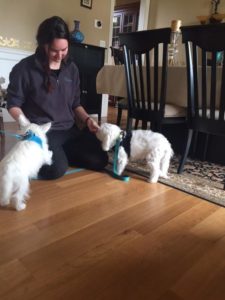
So often I hear that people are worried about two animals trying to take the same treat at the same time and a fight ensuing. In that case, if your pets don’t yet have a great “wait” behavior, treat each simultaneously from two hands like in the picture below. 


You can also get additional help from others. Have 4 animals? Get 4 hands into the training mix. This can help with letting you focus on your particular task, too, if you’re working on growing your animal training skills. Many hands really do make light work in this case.


Baby gates can help improve safety

As I mentioned in the post about how Covid-19 is impacting behavior (read it here), I have a lot of clients at the moment currently working on dog-dog interactions within the house. I’ve seen a significant uptick in dogs having trouble living with one another and I know some of my colleagues have mentioned seeing the same trend. In those cases, we will eventually need to work with the dogs in relatively the same space. We’ll also need to make sure we do so carefully and safely. 

We can absolutely have both dogs on leash (and for those of you working on dog/cat relationships, we often get the cat comfortable wearing a harness and leash, too!) with two handlers. That said, it becomes trickier when we need to rely on multiple people’s schedules to work on the pets’ relationship. This is where baby gates can be incorporated. 

Set up a baby gate so that you can work with one pet on one side and one on the other. This usually brings some peace of mind to the humans as well which can make the session more fun for everyone. If having pets on just one side of the baby gate is still too close for them, then you can set up two gates with however much “dead space” you need in between, kind of like an airlock:


Stationing

The last technique we’ll talk about here is stationing: teaching a pet to go to a particular place and hang out there. Sometimes trainers will refer to this as place work, mat work, or something similar. With stationing you can have one animal on a mat or bed out of the way while working with another, then switch them. This is a more advanced approach in that you need to be able to focus on the animal in front of you but also keep whoever is stationing in mind and reinforcing each appropriately. I tend to give a treat to the stationing animal whenever I treat the one I’m currently focusing on.

This is a regular technique used in zoos where it’s more challenging to separate animals for training. Regardless of your feelings about zoos, many do a wonderful job of training their animals– usually to safely participate in husbandry and medical procedures– and can be a good place for inspiration of what’s possible with training. 

Check out this video showing crocodiles training and stationing from the Wildlife Conservation Society and Bronx Zoo:


It’s often easier to teach animals to station separately before bringing them together. A professional trainer can help you with this process; it will need to be well-proofed, especially if you have trouble keeping a high rate of reinforcement (aka how frequently you treat).


Now what?

  • Try your hand at training multiple animals at once. Choose one of the above options to start with.
  • Practice whichever option you choose before bringing your pets into the mix. Practice doling out treats single-handedly. Teach stationing separately. Practice splitting your attention between observing multiple individuals at a time. Whatever you choose, it will be easier for you and less frustrating for your pets to practice without them first.
  • Start short and sweet. Work with your pets just a minute or two at a time. Assess how it went and how it can be improved on then try again for another minute or two. 
  • Consult with your professional trainer or behavior consultant– especially if there are safety concerns between the pets. A professional can help you fine tune your skills, your pets’ skills, and help you keep everyone safe during the training process. Email us at info@petharmonytraining.com to be paired with a consultant and set up your first session. 


Happy training!

Allie


Pros of Working with Pets Individually vs. Multiple at a Time


We’ve been asking y’all what you want us to talk about and a topic that keeps coming up is training in mult-pet households. It just so happens that I had planned a short series of posts for this month talking about training in multi-pet households so the timing is serendipitous! This first post is going to go into the pros of working with one animal at a time vs. multiple animals at once. The cons for each are essentially the pros of the other so I didn’t feel the need to go in-depth on those. Next week we’ll get into how to work with multiple animals at a time.


Pros of training individually 

For those of you who have multi-pet households and have used professional training services, you’ve probably heard at some point to separate your pets and train them individually. Here are some of the reasons why a professional trainer or consultant will recommend this:

  • It’s easier for your pet to focus
  • It’s easier for you to focus and be more effective
  • Eliminates competition between pets if there’s concern for guarding

Let’s explore the pros of working with one pet individually in more depth:


It’s easier for your pet to focus

Distractions come in many forms, and one of them can be in the form of other individuals. If you’ve ever been reprimanded as a kid for talking with your friend during class, you know that’s true. One way of decreasing distractions is by working one on one with an animal. This can especially help if you’re teaching something brand new or something more challenging!


It’s easier for you to focus and be more effective

Unless you’re training with a multitude of different animals every week, chances are that training is still a skill that you’re actively developing. That means it will require you to focus more on the task at hand and will be more challenging to split that focus between multiple animals. Here’s an example of what I mean by having your focus be split being more challenging:

You’re driving down a route that you’ve driven many times before. You know exactly where you’re going so you have the music cranked and you’re singing along to a song you know well. You’re able to do both of those things because both activities are well-versed and fairly habitual. 

Now let’s say you’re driving to a place you’ve never been before. Your GPS says that you’re getting close. You turn the music down so you can find the place better. Finding this new place requires more of your focus and attention so you prioritize it by taking away the distraction of the music.


It’s absolutely possible to train multiple animals at once. The question is, though, are you currently proficient enough at training to do so? Can you observe and make quick decisions on multiple animals behaving in different ways at the same time? Can you continue to keep a high rate of reinforcement with multiple animals so nobody gets frustrated working in this environment? 


Eliminates competition between pets if there’s concern for guarding

While there are many other benefits to working with your pet solo, the last one we’ll talk about here is resource guarding. Training activities can have a lot of resources associated with them: treats, toys, your attention. If we’re not careful about how we’re going about the training, it’s possible for pets to guard those resources and end up in a fight. Training pets individually is a good way to mitigate this issue or potential issue. 


Pros of training multiple animals at a time

Although pet parents likely hear that they should work with their pets 1 on 1 more often, there are also pros to training multiple animals at a time:

  • Saves time
  • Provides distraction more similar to real life for a multi-pet household
  • May be necessary for certain goals

Saves time

This is one of the main reasons I hear pet parents asking about training their pets together. If we have multiple pets and a busy schedule, it makes a lot of sense to work with everyone all at once. I also find many people tell me that they feel bad for sequestering one of their pets to another area while they’re working with another individually. Sometimes it’s less to do with time and more about the guilt we place upon ourselves.


Provides distraction more similar to real life for a multi-pet household

Wait… didn’t I just say that limiting distractions can be a “pro” of training individually? Yep! Distractions can be either desired or undesired depending on where your pet is in their training! If your pet is on the “proofing” stage of learning then it might be beneficial to have another pet around providing distractions. Learn more about the stages of learning here.

If you have a multi-pet household and want to be able to use a certain cue with a certain pet in day-to-day life, you’ll likely need to proof that cue with the other pets around. This is especially true if you’re working with pets who feed off the others’ behaviors.


May be necessary for certain goals

If you have, say, a dog who is getting into fights with the other dog living in your house, eventually we’ll need to work with both individuals simultaneously depending on what the goal is. This goes back to working in more real-life situations. 

We’ll get into different options for how to work with multiple animals at the same time next week. 


Now What?

  • Identify a behavior that you’d like to teach your pet. 
  • Looking at the pros of working with your pet individually or with multiple pets at once, where do you think you and this particular pet need to start? If you’re teaching a brand new behavior to your pet, it’s usually recommended to teach individually first. 
  • Start training!
  • Stay tuned next week for tips on how to work with multiple animals at a time. 


Happy training!

Allie

Are You Allowing Your Pet to Use What You Taught Them?

I scheduled all of my 2020 blog topics at the end of last year. I have a giant list (that keeps growing!) of topics either from questions I get in sessions with clients or questions that folks are asking me to write about. Sure, there are weeks that I go off-course where either I have absolutely no desire to talk about that topic at the moment or where there’s a topic that becomes more pressing than what I had planned (like the post about how Covid is impacting pet behavior.) Then there are weeks where it’s like the stars align and the topic I planned for is absolutely the one. This is one of those weeks. 

On my calendar I simply wrote “Plugger asking to play find it” and expanded briefly in my running list. As I saw this topic looming in the distance, I had no idea what I wanted to say about that anymore. It didn’t seem as interesting or as important as it did when I chose it last year. Then yesterday I had a professional consultation with a local trainer to discuss the flight cue and flight training. I found myself essentially verbalizing exactly why Plugger’s story was so important and interesting to me. 

When we teach our pets appropriate coping skills, we need to provide ample opportunity for them to perform them. 

We need to listen to what they’re saying. We need to give them agency. We need to trust them and trust in what we’ve taught them. Training is a two-way conversation and we get in our own way when we forget that. 

Plugger Asking to Play “Find It”

I worked with Plugger and his mom on a variety of things, but the one that sticks out the most revolves around the vacuum cleaner. This wasn’t a regular fearful barking at the vacuum behavior. Plugger would chase the lights cast on the walls from the vacuum. 

For those of you who aren’t familiar with light chasing, this is a compulsive and serious maladaptive behavior where pets will stare at, chase, try to catch, etc. lights and/or shadows. It’s often caused by playing with a laser pointer (though not in Plugger’s case) and can become so serious that it diminishes quality of life for an animal. It’s truly not a cute behavior for pets to chase lights and shadows; if your pet does this please seek professional help. And just say “no” to laser pointers!

Plugger’s mom already knew that his light chasing was a problem for both his behavioral health and for her trying to vacuum. She would usually put him in the fenced-in yard when she needed to vacuum, but it wasn’t an entirely sustainable solution in the winter. Was there another option?

I often start dogs exhibiting compulsive behaviors with a “Find It” game for many reasons that go beyond the scope of this post. Plugger already knew how to play the game so we practiced bringing the vacuum out and playing Find It with it off, then doing the same when it was on. I asked her to continue working on it for her homework.

Our next session, Plugger’s mom was so excited to tell me about the progress Plugger made with the vacuum. She brought the vacuum out and turned it on. Plugger’s nose went to the ground before the treats came out. He looked at the lights, then me, then the ground, then me again. Apparently I was supposed to be tossing treats! I did so and Plugger was able to play Find It instead of light chasing. A huge win, indeed. 

Now, I mentioned at the beginning of this post that I wanted to talk about coping skills. What I mean by “coping skills” is some sort of appropriate behavior that an individual can perform that decreases stress and behaviors that we assume come from a place of stress. There’s some anthropomorphism in this thought process, for sure. There are some things that the hardcore behavior folks reading this will likely slap me on the hand for. There are, of course, the laws of behavior science that explain his behavior as well, without attributing it to coping skills (like teaching an alternative behavior). But, y’all, to go out on an anecdotal, anthropomorphic limb: this behavior looked different. It really looked like Plugger was saying, “The lights are here and I usually chase them but Find It is better so please play that with me instead.”

Plugger is not alone

If this were the only story I had, I’d probably tuck it away as a neat thing that happened that can be explained as something else. But it’s not the only story I have where it appears that we can teach our pets more appropriate coping skills. The flight cue is where a majority of those stories come from. 

One of the things that I frequently find happening when we teach a flight cue (go away from the stressor) is that pets seem to internalize it and ask to go away or choose to go away on their own. They’ve learned that going away is better than staying there and getting overly stressed. Yes, the laws of behavior are at work as they always are (release from pressure is reinforcing in these cases). But can we also not call this set of behaviors coping skills? 

I collect new stories on this weekly. There was the shepherd who was sitting, participating in his behavior modification session to start feeling comfortable with other dogs walking down the sidewalk. He suddenly got up and started walking in the other direction. I instructed his handler to follow him. He hung out around 15’ away from where we’d been training for a few minutes. Then as quickly as he’d gotten up the first time, he got up and walked right back to the training spot and sat down. It was as if he needed a quick break and then was ready to get back to it. 

There was the Aussie mix who started trying to cross the street or head up people’s driveways when a scary person approached. There’s my dog, Oso, who instead of peeing on his favorite bush as he always did chose to go on the other side of me to be further away from another dog. There was the mixed breed dog who would put herself in the laundry room and barked until the gate was closed behind her when she’d had enough of the young boys in the house. The list keeps growing.

Teaching is only half of the equation

Teaching these behaviors that I’m calling “coping skills” is typically not terribly difficult. They’re taught like any other behaviors and follow the laws of behavior just like everything else. But teaching is only half of the equation. Implementation is the other half, and I find that people have a far harder time with that part because it requires the conversation to be a two-way street– a notion that’s sorely lacking in regular animal training conversations. 

For any of those stories I mentioned above, what would have happened if the animal wasn’t able to perform their new skills? What if I didn’t play find it with Plugger? He’d start chasing lights. What if the handler didn’t follow the Shepherd? What if the Aussie mix wasn’t able to cross the street or head up the driveway? What if Oso was forced to walk only on one side of me instead of switching to the other? They’d all likely start barking and lunging at the approaching trigger. What if the mixed breed dog didn’t have access to the laundry room? She’d start snapping at the boys. 

All of those success stories required the human to be listening to and responding appropriately to what their pet was saying so that their pet had the opportunity to perform the more desirable behavior. Each person had to watch the body language, the behavior, and not only teach their pet other choices but also allow them to choose them.

I could speculate why I think this is a difficult ask for many pet parents. It requires giving up some level of control to our pets in stressful situations. It requires acknowledging that behavior isn’t random and always has a function, whether we know what the function is or not. It requires adept observational skills that we’re rarely taught in a formal capacity. 

It’s not enough to just teach our pets skills. We need to be able to use them in context. And, arguably more importantly, we need to give our pets the ability to perform those skills on their own. We need to trust in our training.

Now what?

  • Does your pet have a reaction to stressful situations that could be improved upon? Do their coping skills need some help? First think about the situation, then think about an appropriate behavior that you’d rather they do instead that allows them to alleviate stress (not confronting the trigger). We recommend speaking with a professional if you don’t have experience with this. 
  • Teach the skill in training sessions.
  • Implement the skill in gradually increasing more stressful but planned situations. 
  • When you encounter one of those situations naturally, watch your pet’s body language and behavior. Are they trying to perform the skill you taught them? Give them the opportunity to do so if they don’t already have the opportunity!
  • This is a more nuanced training skill and one where consulting with a professional can be massively beneficial. Email us at info@petharmonytraining.com to schedule an appointment. 
  • We’ve gotten a TON of requests for how to teach flight cues and flight training this past week. Emily and I are working on a course for this that will come out in the next few months. Join our email list and keep an eye in our social media platforms for more info!

Happy training!

Allie

Leash Reactivity Practice… in a Parking Lot?

Leash reactivity (I.E. barking, lunging, growling on leash when seeing another person, dog, car, etc.) is one of the maladaptive behaviors that I help clients with the most. It’s a pervasive issue in our country. When I’m in the beginning stages of working with a client and their leash reactive dog, I often hear myself saying, “the exercises that we’ll do are fairly simple; it’s the implementation that’s difficult.” And, because of that, I almost never have them start out by using those exercises on a walk. Here’s why.

You have to crawl before you can walk.

Have you ever had that dream where you show up for a test but you’ve never attended the class? How did you feel in that dream? Scared? Frustrated? Destined to fail?

Teaching your dog a new behavior modification exercise on a walk is like having them take a test when they’ve never attended the class. We’re expecting them to not only use a brand new skill, but learn a brand new skill, in an incredibly difficult environment when they may or may not be ready and capable of learning. Doing this often leads to frustration on both the human and the canine ends. There are, of course, exceptions to the rule but by and large it’s not as effective or efficient to start out training in this difficult scenario. Slow and steady wins the race.

Your dog isn’t the only learner.

 As I tell many of my clients, “If you already knew this you wouldn’t need me.” We often add this pressure onto ourselves that we need to know everything and be instantly good at something. We don’t give ourselves the same grace during our learning process that we would to a child. That pressure can lead us to throw ourselves into situations that we’re not ready for. 

I usually find that it takes longer for the human to learn how to do the behavior modification techniques than it does the dog. Though, to be fair, the human usually has more to remember, implement, and sometimes unlearn than the dog does! Plus, ask any teacher: you need to know way more about a subject when you teach it vs. when you’re using it. And if you’re training your dog then you are teaching. 

For this reason, I like to move at the pace of whoever is at the earliest step in that particular learning process– regardless of species. For example, I will sometimes do consultations for new adopters who’ve adopted a dog that I or a team I know has worked with in a shelter. I know the dog has been taught a particular exercise and now it’s a matter of teaching their new family how to do it too. We’ll need to work at the human’s pace, as they’re at an earlier step in that particular process than the dog is. 

Conversely, take someone who has worked with a leash reactive dog before. They’re adept at doing the exercises from working with a previous dog and just need help transferring those skills to a new one. In this case we’ll need to work at the dog’s pace. 

Most frequently, however, I have cases where both the human and the dog are new to leash reactivity exercises. We’ll need to play these by ear and examine skill levels at each step to ensure that all parties are ready to move onto the next task. Each individual moves at their own pace, and that is perfectly okay. 

Real-life situations have a lot more variables

Even when both dog and handler have a solid foundation built of their leash reactivity exercises in easier, low-stakes situations, taking those skills straight to a neighborhood walk can still be challenging. There are a lot of variables on a walk and you’re likely to encounter extra-challenging situations, like people popping up from behind corners or exiting their houses, multiple triggers coming from different directions at the same time, barking dogs in yards (especially if they’re on an electric fence and you don’t know if they’re going to stop or go through it), general trigger stacking throughout the experience, and more. It’s much easier to continue working on those skills and exercises in increasingly difficult situations and work your way up to implementing those skills on a walk instead of jumping straight to a neighborhood walk. 

Your neighborhood wasn’t designed for leash reactive dogs.

Neighborhood planners don’t keep leash reactive dogs in mind in their design plans and it shows! I always tell clients that distance is their best friend when working with a leash reactive dog; if their dog starts reacting then move away from the trigger until they stop. I frequently hear some protest to that statement in the beginning, along the lines of, “I can be 4 houses down and he’s still barking!” Both statements are true. There’s a distance that exists where your dog will not be reactive towards a trigger and it’s farther than 4 houses away. Your neighborhood planner wasn’t thinking about leash reactivity. 

I find that in many cases we can’t start off immediately working in the neighborhood partially because we can’t get the proper distance. Across the street or 4 houses down doesn’t cut it. That’s where parking lots can come in. Specifically, I like using those giant strip mall parking lots that big name pet stores often have (at least in my area!) Park and work in the very back of the lot and you’ll get the distance you need, a more steady stream of triggers to practice with, and fewer surprises as usually people will park near the store and go only from their car into the store and back. (Note: large parks can also get you the distance you need but because people walk more sporadically and erratically in parks I still prefer parking lots.)

What if I have to walk my dog?

Up until this point, I’ve made a big and sometimes untrue assumption: you don’t need to walk your dog. There are many cases I see where this assumption is true. The family has a fenced-in yard that the dog will potty in and we can replace walks with other mental and physical activity while we’re working on the reactivity. In the suburbs that is often the case. However, there are absolutely situations where the family does not have a fenced-in yard that the dog will potty in or doesn’t have a yard at all and an indoor potty space isn’t a viable option. These are more challenging because we can’t avoid walks but we’re also not ready to practice on walks. In these cases we’ll heavily increase the management on walks to avoid triggers as much as possible until we’re ready for this scenario. 

Now what?

  • Are you someone who’s struggling with working on your dog’s leash reactivity while on a neighborhood walk? Take a few steps back (figuratively) and find an easier scenario to practice in. Your behavior consultant can help you with this!
  • Not sure how to work on leash reactivity? Join us for our FREE Roadmap for Behavior Solutions Workshop next week (8/16/21-8/20/21) to take the first step towards your behavior modification journey. Sign up here: https://petharmonytraining.com/roadmap-workshop/

Happy training!

Allie