7 Tips for Introducing a New Dog or Cat to Your Resident Pets

As I’m writing this, we’re smack dab in the middle of our free “Dog-to-Dog Aggression & Prey Drive Workshop” this week and both Emily and I are having a blast getting to know our workshop attendees! As I was thinking about the workshop and our upcoming course on the same topic, I realized that one of the topics we don’t get into as much is how to set up introducing a new dog or cat into your household so you can mitigate some of those future issues. A blog post seemed like the perfect way to supplement the workshop! So without further ado, let’s get into 7 tips for introducing a new pet into your household. 

1. Learn each species’ body language first.

For those of you who’ve followed our blog for a while, you probably knew that this tip was going to be in here! I truly believe that one of the most important, most influential things we can do as pet parents is to learn our pets’ body language. Yes, there are signals that are intuitive and there are some people who have a natural inclination towards understanding body language without learning it. However, there are body language signals that aren’t intuitive: lip licks, stress yawns, tap outs, cat tail wagging is usually angry, and so on. 

Everyone needs to study animal body language to understand the nuances and it’s our responsibility as pet parents to know what our pets are saying. There are a lot of great resources available online (and some not so great ones) to help learn each species’ body language. Check out this blog post for more information on dog and cat body language and resources. 

2. Go slow. Even slower. 

I know it’s tempting to try immediately integrating your new household member in with the rest of your pets. We want to start this new chapter in our lives as soon as possible! Sometimes doing that turns out fine. But there are many times where it does not and people need to bring in a behavior professional after fights have already happened and there’s been damage to the relationship– which makes it harder to work on. Resist the temptation; do slow introductions. Whatever time frame popped into your head– go slower. 

When I’m working with clients who are integrating new pets into the household I tell them that  my time frame is at least 2 weeks for day-to-day cohabitation with supervision; longer if any pet has a history of having trouble making new friends. There have been cases where it’s taken months but everyone was happy, healthy, and safe throughout the entire process. This is absolutely a situation where slow and steady wins the race.

3. Don’t provide opportunities for conflict. 

Reading it that way, many people would say, “Sure! Makes sense! Moving on.” But what if I said that trying to feed your new pets together can count as a common opportunity for conflict? Giving them chewies together? Playing fetch together? Being in a tight space together? 

For some pets these scenarios may not be sources of conflict; but you don’t know if that’s true or not for your new pet. And, you don’t know if that’s true or not for your pet and this particular individual at this particular point in their relationship. For example, I’ll share my credit card with my husband, but not a stranger. Nor would I have shared my credit card with my husband when I first met him. There would’ve been conflict if he’d tried to take it from me when we first met. Relationships change and evolve over time.

Let’s work on their relationship together before adding resources– and opportunities for conflict– into the mix. (Side note: I always recommend feeding pets separately even after the initial introduction period. It’s such an easy management tool and I have so many people tell me that their pets got into a fight over the food bowl that the risk just doesn’t seem worth it to me. Unfortunately, I feel like I see few people agree with that sentiment until it happens to their own pets.)

4. Provide plenty of exit strategies (especially for cats!).

There’s a fine balance between keeping your pets near you so you can supervise them and keeping them so confined that they can’t leave the situation if they want to. For introducing new dogs to one another, this can look like having them interact in a larger space (but not so large that you can’t get to them if needed) and routinely monitoring interactions and separating when needed (see the next tip for more information on that.) For dogs and cats, cat trees are my go-to for providing exit strategies. 

5. Provide plenty of break time and be an advocate for your pet.

Have you ever had a roommate who just won’t leave you alone? How did you feel in those interactions? Did you eventually snap at them? The same thing happens with our pets, too.

We need to provide adequate break time and time apart for our pets. This can especially be true for the resident pet and older pets. They didn’t necessarily consent to having a new roommate and it’s unrealistic to expect them to hang out with their new roommate 24/7 without conflict. 

Break time should also be based on their body language and behavior. This particular point reminds me of a client I had last year. They brought a new, younger female dog home and the male resident dog was periodically growling at her and eventually lunging and biting. When they brought me in they asked about changing the resident dog’s aggressive behavior. As I asked them more questions, it became clear that the resident dog was asking the new dog to give him space and that she wasn’t respecting his request and eventually that led into the fights. I told them to be his advocate; she was the one pestering him until he snapped. As we worked through their behavior modification plan and reintegrating them, they realized that that was true– she was annoying him. When they saw that happening they’d call her over and give her something else to do. Fights didn’t happen anymore after that! 

6. Don’t let them “just work it out”.

This is another fine balance item. There’s a fine line between micromanaging appropriate interactions and stepping in and appropriately managing and modifying behavior. This is one of the reasons why it’s vital to know and understand your pets’ body language before you’re in a situation. You need to first know what appropriate interactions and inappropriate interactions really look like! There are plenty of instances where I’ve seen people try to discourage appropriate interactions and other instances where people needed to step in a lot sooner to keep everyone happy and healthy. (Another side note- there are very polite ways to step in without correcting, physically grabbing, etc.)

7. Seek professional help- especially for animals who’ve had trouble making new friends in the past.

When in doubt, seek professional help. A professional can help you with all of the above and help create a viable, sustainable behavior modification plan for your household. It’s what we’re here for!

Now what?

  • It’s never too late to learn about body language and appropriate vs. inappropriate interactions. Our Setting Yourself Up For Success: Behavior Modification Basics course is chock full of body language information for dogs!
  • Do you have a relatively new pet in your house and you think their relationship with the resident pets could be better? You can always go backwards, increasing management through separation, and start back at square 1 with the above tips.
  • Do you have pets in your household that aren’t getting along well or are sometimes getting into fights? Our Dog-to-Dog Aggression & Prey Drive course is for you! This course starts on Wednesday 9/2/20 and client spots are going fast. Check out more course info here

Happy training!

Allie

Shifting the Focus

“It’s not all about you.” How many times have you heard this statement? We could all probably be rich if we had a dollar every time we heard that phrase (okay, maybe not rich but could at least buy a new food puzzle for our pets). Well, I’m here to give you one more dollar; this time, in relation to our pets’ behavior. 

Others’ behavior often feels very much about us. It can feel like a slight, like retaliation or revenge, or purposefully trying to get our goat. But – here’s your dollar – your pets’ behavior isn’t about you. It’s about them. This isn’t to say that we don’t cause or influence certain behaviors to happen. It’s not to say that your relationship with your pet isn’t a factor in their behavior. It means that they’re behaving this way to meet their own needs first and foremost. 

Let’s narrow our focus a bit to look at the situations where I find myself having this conversation with clients. Common statements that start this discussion include:

He gets mad at me when I leave and pees out of spite. 

She’s protecting me whenever someone comes to the house. 

He won’t listen to me when he’s reactive; he’s stubborn.

Why is he doing this to me?

In each of these statements, the focus is on the human. What if we assumed it had nothing to do with the human? What if we put the focus on the animal? In that case, those statements could become:

This cat is anxious when left alone, and elimination can often happen due to fear or stress. 

This dog is afraid of strangers, and is protecting herself from a perceived threat.

This dog currently has “mountain lion brain” and can’t respond to you because the fear center of his brain has taken over everything else.

Your pet isn’t giving you a hard time, they’re having a hard time. 

Okay, that last one I stole from a social media meme that was going around a while ago. If anyone knows who the original source is please let me know so I can give them credit! 

When we change the stories we tell ourselves about why our pets do what they do, it can be not only eye-opening, but also relieving. I wrote about that in this blog post last year. 

Behavior serves the individual who’s doing the behavior and all behavior serves a function (except arguably for stereotypic behavior, which is beyond the scope of this post). Behavior serves to meet needs, from physical to mental to behavioral needs. Reactivity and aggression serve to tell a threat to go away. A recently declawed cat eliminating outside of the box serves to relieve the pain litter often causes on sore paws. Not coming when called from the yard serves to prolong the fun they’re having. It’s about them, not about you.

Now what?

  • The next time you catch yourself thinking about your pet’s behavior with yourself as the focus, try reframing it and put your pet as the focus instead. What need could they be trying to meet?
  • Not sure what’s included in your pet’s needs? We go in-depth into those categories in our book Canine Enrichment for the Real World. Join us in our Enrichment for the Real World Community group on Facebook for more free info, too!
  • Speak with a consultant if you need extra help shifting the focus of your pet’s behavior.

Happy training!

Allie

When Positive Reinforcement Isn’t

If you’ve been following us, even for just a short period of time, you’ve probably already heard us say, “Only the learner decides what’s reinforcing.” I talked a bit about this in a blog post last month in regards to high-value foods, but I wanted to expand on it and share one of the reasons we say it so frequently from a different angle. And, to do that, we need to rope in a common phrase heard in the dog training world: positive reinforcement. 

Now, because this blog is meant for pet parents, I try not to use too much terminology. But because I hear many pet parents use the term positive reinforcement themselves, I think it’s safe to talk a bit about it here. I’ll try to break it down as much as possible while still being accurate (because inaccuracies from watering down science can get us into trouble!) The simplest definition of positive reinforcement is: 

A consequence [to a behavior] that is added to the environment and maintains or increases that behavior in the future.

Positive = added (think math, not morals). Reinforcement = any consequence that makes the behavior more likely to occur in a similar context in the future

I get it; this can be a really confusing topic. That can be especially true because the way in which this phrase is used in reference to dog training or animal behavior has been pretty bastardized as it’s made its way into mainstream vernacular. The diluted definition that I most frequently see is something along the lines of, “I’m giving him treats that he likes so he does the behavior more in the future.”

But… Allie… isn’t that the exact same thing? Nope. There are two big differences between the real definition and the diluted one:

  1. Positive means added– period, end of story. It does not mean that we’re adding something that’s necessarily desirable, or that the animal likes (even though in most cases it is!). There are times where adding something undesirable increases behavior. (I know; it’s weird and gets confusing when we throw things like high-value vs. low-value treats into the mix. For now, just trust me.)
  2. The real definition relies on observation to determine whether the consequence was, indeed, reinforcing. We can only say that a consequence was reinforcing when the past consequence strengthened future behavior. The diluted definition makes an assumption that it will be reinforcing, but doesn’t follow through with the critical component of making sure that the assumption is true. 

Let’s break that down further with a few examples:

Example 1: Positive means added, whether it’s desirable or undesirable.

A dog is barking at a stranger. The dog has a history of fearful body language around strangers, and this is no exception. The stranger yells at the dog to stop barking (adding: yelling). The dog cowers further and starts barking louder. The next time the dog encounters a stranger, he barks loudly at them. (People frequently call this punishment, but it’s actually reinforcement: the behavior was strengthened in future scenarios & the barking increased in volume). 

Example 2a: The only way to determine if a consequence was reinforcing is to observe the behavior in similar context(s) after the consequence was presented.

A cat head butts you for attention. You pick him up, believing that you’re reinforcing the behavior (adding: physical contact). The cat does not head butt you in the future. (This tells us it wasn’t reinforcement, but punishment: the behavior decreased or stopped). 

Example 2b: The only way to determine if a consequence was reinforcing is to observe the behavior in similar context(s) after the consequence was presented

Millie is fearful of people reaching toward her, as evidenced by her body language. To help her feel more comfortable with hands in general, we start working on a “hand targeting” exercise (touch your nose to the hand). I lay my hand flat on the floor, when she investigates I mark with a “yes”, then place a treat a few inches in front of her (added: treat). Millie investigates my hand 3-4 times, then stops investigating. (Punishment: the behavior decreased or stopped). 

Example of hand targeting
Picture by Nick Djalila on Unsplash

Why is this distinction between definitions important?

As much as I try to avoid terminology in this blog, I see enough well-meaning people talking about “positive reinforcement” incorrectly that I decided that we needed to hash this out. When we think we’re doing a technique correctly, but in fact aren’t, then we think that that methodology doesn’t work. We get the mindset that “using positive reinforcement” doesn’t work in some scenarios or with some animals or even at all. When, in reality, we can’t actually “use” positive reinforcement. We can deliver a consequence and see if it actually fits the positive reinforcement criteria by observing future behavior. 

We need a descriptive observation, not a prescriptive assumption. This is why your consultant will ask you what you’ve tried to do in the past to modify a behavior and compare that to what’s happening now. They’re figuring out if that approach actually works in the way that they or you assumed it would. In the Millie example, I assumed that she would continue investigating my hand because I gave her a treat for doing so. But Millie’s behavior said that my assumption was wrong. She stopped investigating my hand. (For those curious, we tweaked how we were delivering the food so instead of placing the treat in front of her we tossed the treat behind her and that fixed it. It was then truly positive reinforcement [added: treat; reinforcement: she more frequently investigated the hand when it was presented to her].)

This is what we mean by “only the learner decides what’s reinforcing.” We need to observe their behavior, determine whether the behavior is being strengthened, and only then can we decide if the exercise we’re doing is reinforcing. We don’t get to make an assumption. We don’t get to decide that it’s going to be. Only the learner can tell us that it is or isn’t through their future behavior. 

Now what?

  • Think about a behavior that you’ve been working on for a while where there hasn’t been much long-term progress (even baby steps of progress). Is your assumption matching your observation? 
  • If you’ve been working on something for a while without any progress, it’s time to tweak! Your trainer or consultant can help you figure out what component is not working as assumed and how to troubleshoot. 
  • Need professional help with troubleshooting? That’s literally our job. Email us at info@petharmonytraining.com

Happy training!

Allie

P.S. Since we’re talking about consequences, I feel obligated to put in this post that a consequence needs to happen within 3 seconds of a behavior to be associated with it (technically up to 5, but it’s much less effective after 3) and the consequence is the first thing that happens after a behavior. This is why scolding a dog who potties in the house while you’re gone isn’t effective. Way too much time has elapsed and a lot of other things have happened in between. We’ll delve more into this in a future post.

The Truth About Using “Human Food” in Training

I hear the phrase “human food” frequently. For those of you who haven’t heard this term, “human food” refers to foods that we commonly eat as opposed to food that is specifically marketed for our pets’ consumption. Usually it pops up in one of the following phrases:

I never give him human food. 

Is it okay to give him human food? 

If I use human food for training won’t it make her beg?

I’m going to be blunt. This phrase bothers me, for several reasons, one of which is because it’s pretty arbitrary. What’s the actual difference between “human food” and “pet food”, especially with the higher quality foods now available for our pets? They’re both edible and in many situations they’re the same core ingredient. Whole, natural foods should not be exclusively for human consumption.

Another reason for my gripe is that I think this phrase unnecessarily burdens some aspects of training and behavior modification. Let’s explore a few examples of how this distinction can be burdensome:

I recently met with a new client who had already started her behavior modification journey with a veterinary behaviorist. She mentioned the expense that comes with behavior modification: the veterinary behaviorist, me, and the treats. She was using great-quality, expensive treats for activities requiring high-value food. I commended her for using great treats, and agreed that they were expensive, which is why I use things like boiled chicken, string cheese, and peanut butter for Oso’s high-value foods. He loves them, I have them on hand more frequently, and they’re way cheaper than pet foods that he equally loves. I saw a look of relief cross her face as she admitted that she hadn’t thought about using those kinds of foods. 

A few years ago, I had a client who wanted to work on her dog’s behavior while she was making dinner. We discussed the management options but she really wanted to work on training instead, so we started talking about place training. She told me that she wasn’t keen on using treats for this because she’d need to wash her hands too frequently between working with the dog and preparing the meal. I suggested she use dog-safe components of whatever she was cooking, instead of store-bought treats, and that solved that problem. The dog now calmly waits on her mat instead of being a nuisance in the kitchen. 

Sometimes we create our own problems by having an arbitrary distinction between “human food” and “pet food”, as seen above. Instead, I tell clients that as long as it’s safe (I.E. non-toxic and does not cause digestive problems) and your pet likes it then consider it an option for training. 

But does that make them beg?

Often, when I recommend using meats, cheeses, fruits, and vegetables, I get some form of the question, “But does that make her start begging?” I think this is more the point that people are after when they talk about “human food” vs. “pet food” in the first place. So let’s address that!

There is nothing intrinsic to the food we eat that makes our pets beg. Sure, we eat some things that our pets may find pretty tasty, but that’s probably not true of everything (even Oso decided ginger wasn’t his jam). The same rules of food preferences and high-value foods vs. low-value foods still apply regardless of who the food is marketed for (check out last month’s blog post on food preferences here!) The reason that some people see an increase in begging when giving their pets “human food” is all about the delivery and timing, which is being incorrectly conflated with the food itself. Let me show you a few examples.

Here’s a picture of Oso, who is learning to stay out of the kitchen while we cook. Specifically, I want him to be on the hardwood instead of the tile. He gets to choose where exactly that is and in what position he’s in. I trained this behavior using– you guessed it– the dog-safe ingredients from our meal (particularly veggie scraps we weren’t going to eat anyway). 

Here’s another example of Oso while we’re eating. The behavior I want is for him to lie next to me and I trained this using food from my plate

And one last one: snacking on the couch means “head down”. I also trained this with the food I was eating. 

It’s clear the old adage, “Don’t feed your dog from your plate or else he’ll beg”, doesn’t have to be true. So what’s the difference?

The reason that Oso can politely hang out while being trained with “human food” is because I kept in mind that our pets are always learning, even if we don’t mean to be teaching them. I reinforced Oso for very specific behaviors that I liked instead of giving him food willy-nilly or based on my behavior (E.G. When I’m done eating he licks the bowl clean, regardless of what he was doing before I offered the bowl). 

Reinforcement increases the probability of a behavior happening again. We do things that work for us, our pets included. Additionally, to truly be reinforcing the consequence has to happen within 3-5 seconds of the behavior and there can’t be another behavior in between (behavior chains are a thing that make the last part of that sentence not completely accurate, but that’s a topic for another day). That means that I need to be strategic about when I give him food in order to get the behaviors I want to see more of. 

If I were to give him snacks for classic “begging” behaviors– putting his nose next to my plate, his head on the table (he’s barely tall enough), nudging my hand– then those are the behaviors I’d see more of. Instead, I only gave him snacks when he was on the hardwood (which gives us space), lying down, or with his head down, respectively. So I got more of those behaviors! The trick is in the timing. 

Now what?

  • Do you have a mental block against using “human food”? Let’s start small. Do a food preference test with some veggies (frozen often work great) to see if you can incorporate any of those into your training. 
  • Ready to try it out? Try teaching a stationing behavior (go to a place and hang out there) while you’re doing something with food: preparing a meal, eating. 
  • Working through a behavior modification plan with your consultant? Do a food preference test to determine if there’s something higher-value than what you’ve been using. Meats are a classic go-to for both dogs and cats. 
  • Share with us your own examples of training with “human food” on Facebook or Instagram @petharmonytraining.

Happy training!

Allie

A small white dog getting a treat from their human at the kitchen table. Only the learner decides what food is high value!

Ice Cream Vs. Brussels Sprouts: High-Value Foods

Updated June 19, 2026 I like both ice cream and Brussels sprouts. However, there is a difference in my preference level between those two foods. I will choose ice cream over Brussels sprouts almost every time. I like ice cream more; it’s more valuable to me. Our pets are the same way. They may like a lot of different types of foods, but that doesn’t mean there’s no preference between them. There’s a difference between ice cream and Brussels sprouts even if you’re not picky.

Why Do We Use Food in Training?

A common question when it comes to animal training is:

Why are we using food to train?

Do we have to use treats?

Can’t I just use praise or petting?

Let’s dive into why we use food in training and why it can be so beneficial to the learning process. Doing so requires knowing a little about the science behind it and a reminder that only the learner gets to decide what is actually reinforcing to him.

Types of reinforcers*

There are several different categories of reinforcers, but let’s just focus on primary and secondary reinforcers for now. Primary reinforcers are those things that are necessary for survival: food, water, shelter, etc. Because they’re necessary for survival, all individuals find these reinforcing in most situations. Secondary reinforcers are things that have been paired with primary reinforcers so that they too become reinforcing: toys (paired with play and fun), petting (paired with physical contact), etc. Because they must be learned, they are not inherently reinforcing to all individuals. 

As mentioned, food is a primary reinforcer because it’s necessary for survival. That’s why it’s so easy to use food in training; it’s [almost] always desirable! Whereas secondary reinforcers, which can be powerful training tools, need to be paired with a primary reinforcer first and in a way that makes them just as powerful. Essentially, we have to do extra training in order to make those things as successful. This is why toys may be reinforcing for one dog but not for another, whereas food is generally reinforcing for both. In short, primary reinforcers are more likely to actually be reinforcing without additional training and among those, food is usually the easiest to dispense. 

*Side note: there’s a problem with how I’m talking about reinforcers in sweeping generalizations in this section which goes back to only the learner decides what’s reinforcing. We have to actually observe the behavior to see if it’s increasing or decreasing to deem something as reinforcing in that context. It’s not enough to just apply a reinforcer and assume that it’s going to work in the way that we intended; observation is vital. Additionally, reinforcers are not always desirable (yeah, behavior is weird sometimes) and so these sweeping generalizations can get dicey. In short, know that there’s a lot more to the story above and that this is just meant to dip your toe into this topic as a pet parent.

Common concerns

When speaking with pet owners, I find that the concerns about using food vs. another type of reinforcer have less to do with the actual science and “why”, and more to do with one of the following concerns. 

“I’m worried about them gaining too much weight.”

I often hear something along the lines of, “He’s going to weigh 300 lbs at the end of this!” while speaking with clients about their pet’s behavior modification plan. While it’s said as a joke, it really is a way of voicing concern about weight gain. Others come right out and tell me that they’re worried about their pet gaining weight because of training. It can be a valid concern, especially for certain breeds.

If we’re working with a young, growing pet or a high-energy individual who hasn’t had weight concerns before, I tell my clients that while it’s something to keep in mind, we don’t necessarily have to be immediately concerned. Let’s start the behavior modification process and if we see some weight gain then let’s adapt accordingly. If we start to see problems or if it’s an individual or breed who is prone to weight gain, then we have some options:

  • Use smaller treats (I break small training treats in halves or quarters even for Oso)
  • Experiment with fruits and veggies for treats
  • Set aside some of their meals to use for training
  • If it’s a treat-heavy day then give them a little less during meal-time

“I’m worried they’ll get an upset stomach.”

There are many people who’ve experienced their pet having an upset stomach due to the type of treat or having too many treats. I often hear of pets throwing up or having diarrhea after hour-long training classes. Some pups will keep eating even if they’ve surpassed their limit! If this is something you’ve experienced, keep in mind that training sessions at home should never be that long. 

As trainers, we have to compromise in providing longer services (aka training sessions) because it logistically works better; we wouldn’t recommend actually training that long (which is why there needs to be so much down time where the pet isn’t working during those services). I generally start with training for 2-3 minutes, then take a break, then train for another few minutes. Many pets are done after 10-15 minutes of this repeating cycle. Some pets (*cough cough* puppies) need less training time than that whereas seasoned learners can go for longer. Short bursts of training can be quite effective. And, short sessions means you’re not plying them with food for an hour at a time, causing upset stomachs.

The other factor behind this concern is for pets who have naturally sensitive stomachs. In that case, we should be speaking with the vet about what foods they can have and limiting the ingredients to what their stomach does well with. Sometimes we have to get creative when it comes to certain diets; a professional can help with that since it’s more specific to your individual pet’s needs.

“I don’t want them to become dependent on food.”

Cheeky response warning: I hate to break it to you, but if they’re alive then they’re dependent on food. We all need food to survive and that’s where the dependence comes from, not from using it in training. 

What I think people really mean when saying this is…

“Do I have to use food for training forever?”

It depends. It depends on if you’re talking about one specific behavior or when teaching new skills, your pet, and a few other things. If you’re talking about always using food while teaching new skills, I would say the answer is, “Sure, because it’s easier to do so.” You could absolutely beef up your other reinforcers so that they’re as effective as food is at teaching new behaviors, but the “work smarter not harder” response is to continue using food for teaching new skills.

If we’re talking about one specific behavior, then my answer is still, “It depends.” Oso has a few behaviors that I never treat him for; I use “real-life reinforcers” to maintain the behavior. For instance, he knows an “up” cue for jumping on the furniture or jumping into our laps. The reinforcement for doing those behaviors is proximity to us (which his behavior has said is reinforcing) and being on the comfy furniture. However, there are behaviors that I will always treat him for because they’re a matter of safety and they need to be super reliant, like coming when called. Real-life reinforcers aren’t enough to maintain that specific behavior for him in all situations. 

To break down that “it depends” into a more concrete answer: It depends on whether other things– like petting, praise, toys, etc.– are enough to maintain the behavior to the level you want/need it to be. If yes, great. You can maintain the behavior with other reinforcers. If no, then continue using food. 

“It’s difficult to have food on me all the time.”

If you’re one of those people, like me, who doesn’t enjoy having treats in their pockets then yes, this is true. (More power to those people who do it, though!) To get around this, I have treat jars set up around my house for easy training and recommend that folks keep a stocked treat pouch attached to their leash for easier access. 

“Food doesn’t always work.”

Even though it’s a primary reinforcer, there are reasons why food would not be reinforcing in certain situations. In more extreme cases, I’ve seen where punishment related to food has essentially made food itself scary. But the more common reasons are that we’re asking them to do something that’s not worth the food or that they’re not able to learn at that moment. 

Let’s use a human example to explore when food isn’t worth it. Say you’re doing one of your favorite activities and someone approaches you and tells you that you need to stop what you’re doing and do your taxes instead. Fat chance, right? Maybe they offer your $5 to switch tasks. Thanks but no thanks. Now let’s say they offer you $50,000 to stop what you’re doing and do your taxes right now instead. I don’t know about you, but I would jump on that opportunity.  If you were given $50,000 for switching from your favorite activity to doing your taxes enough times then you would readily make the switch because you have a reinforcement history for doing so with a reinforcer that’s worth it. 

Now, let’s apply that to an example that I mentioned earlier: I always use food as a reinforcer for Oso’s recalls. Oso is outside doing one of his favorite activities of hunting for rodents. I need him to come inside so that I can leave; he’ll be left alone with something to do but it’s definitely way less fun than hunting for rodents. I could offer him the Oso-equivalent of $5 for coming inside: a kibble. Or I could offer him the Oso-equivalent of $100 for coming inside: treats he loves. A kibble just isn’t worth it; it needs to be better than that. Oso now has a strong enough reinforcement history that I don’t necessarily need to give him the treat but because I want to keep it as a super reinforcing behavior I will continue to do so. 

The other reason why food might not work in that moment is because of stress, fear, or anxiety. Food isn’t reinforcing when you’re protecting yourself from a perceived threat. We’re just focused on living to eat another day at that moment. I wrote an article dedicated to this here, titled “Does Your Pet Have Mountain Lion Brain?

Now what?

  • If you’re hesitant to use food in training, which of the above reasons most resonates with you?
  • Take the time to read through and sit with that point. What concerns do you still have?
  • Speak with your behavior consultant or trainer about those concerns; they can help!
  • Get to training and make your own observations. What reinforcers build super strong behaviors in your pet? 

Happy training!

Allie

Bridging the Gap Between Training Sessions & Real Life

I told you last week that behavior challenges come in waves, and I’ve been hearing this one quite a bit this past week:

“He’s great in training sessions, but won’t do it in real life situations.”

Show of hands, how many of y’all have been here before? Yep, me too. The hard thing is that this is often when people STOP training. At this stage, you’ve already invested time, energy, and sometimes money into getting your pet to this level. And they’re still not where you need them to be. It’s frustrating. It’s disheartening. And it feels like training doesn’t work.

But! All that this means is that you haven’t completed the learning process. You’re only halfway through at this stage. I talked about this last year in a post called “Why You Should Care About the Stages of Learning”. Today, though, I want to share another aspect of what’s going on when your pet can perform a behavior in a training session but not yet in real life. 

Let’s Talk Antecedents

Terminology alert: antecedents. [Immediate] Antecedents are those cues that tell an individual that a particular behavior-consequence contingency is available. Whoa. Too technical. Let’s break that down further…

There are different ways in which we learn. One of those ways is through the past consequences to our actions. This is often what we think of when we think of animal training. If the dog sits he gets a cookie. If the cat jumps on the counter he gets sprayed with water (just an example, we don’t recommend doing this). These are behavior-consequence contingencies. “If I do x, then y often happens”

Specific behavior-consequence contingencies aren’t always available. The antecedent tells the individual if it is or isn’t. For example, when I was little I burned my fingers while on a camping trip by picking up a grate that had been in a recently doused fire. You better believe that I learned that particular consequence that touching a hot grate hurt like heck in that single-learning event and have since avoided doing that. That’s only true, though, when the antecedent is: the grate was recently in a fire. When the antecedent is different, I pick up the grate without a second thought because that painful behavior-consequence contingency isn’t there. The antecedent tells me an important part of the puzzle as far as what I should expect the consequence to be. 

What’s included in the antecedent?

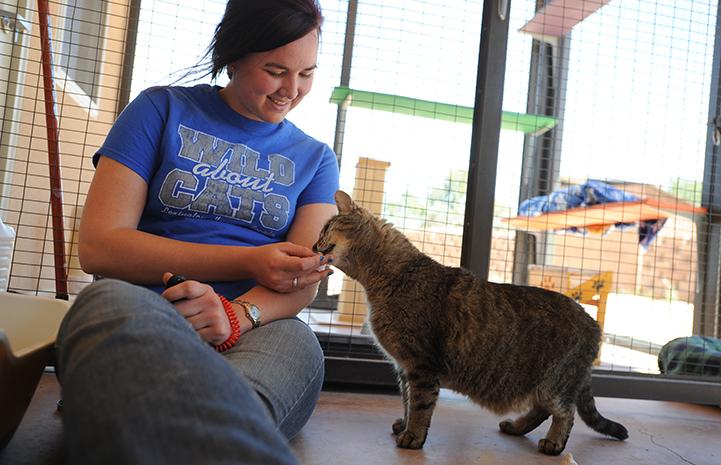
Hoo boy, a bunch of things. While a lot of times you’ll hear the antecedent being referred to as simply the cue (eg: saying “sit”), really it’s the entire picture. This is often why your pet can perform a behavior in a training session but not the very different picture that real-life situations provide. Let’s illustrate that with an actual picture of me working with one of my favorite cats in the whole wide world: Grey. 

Photo by Molly Wald

From this one picture, we can see a lot of factors included in that antecedent picture that told him this was a training session:

  • Location: we always trained together in his cattery
  • Position: I always sat while we worked together
  • Presence of food & a clicker: clicker in hand, jar of baby food next to me
  • Handler: our interactions together were always training interactions (teacher’s here; we’re going to learn new stuff!)

All of these factors told Grey that this was a training session and that there was a lot of opportunity for treats depending on his behavior. Change any of those factors and his behavior is also likely to change. 

In short: your pet knows when it’s a training session and when it isn’t.

Why does it matter if it’s a training session?

There are two main reasons why I see this being an important distinction with my clients’ pets: 

  1. The behavior-consequence contingency is different in training sessions vs. real life
  2. For pets with anxiety-related behaviors, training sessions aren’t always scary and real life often is

Let’s look at that first one.

The behavior-consequence contingency is different

Since we follow the 4 E’s of effective, ethical, efficient, and empowering training, I’m going to talk about this point in relation to treats vs. no treats, but know that this is true for other training or management tools too (eg: this is why dogs who walk politely on a prong collar usually don’t when the collar isn’t on). Treats happen quite a bit in training sessions. For many households though, treats don’t happen frequently when the humans aren’t in “training mode”. 

In short: training session = possibility of treats, real life = no possibility of treats

Here’s where many people ask, “But shouldn’t they do it anyway even if there are no treats?” Here’s the thing. All behavior serves a function to the individual performing it. Period. End of story. That’s the reason that we stop going to work if we stop getting paid. Now, we don’t necessarily need to treat every time (a conversation for another time), but we can’t completely get rid of our behavior-consequence contingency. You’ve likely already experienced what happens when we do. 

For pets with anxiety-related behaviors, training sessions aren’t always scary and real life often is

I see this a lot when I’m working with clients whose pets have stranger danger and we’ve started working on the doorbell. The pet will sometimes learn very quickly that doorbells are safe when played during a training session. However, that usually doesn’t immediately translate to doorbells being safe when they happen in real life. No one comes in the door during a training session but they do in real life. We need to do more work for that translation to take hold by continuing through the stages of learning. 

How can I bridge the gap between training sessions and real life situations?

It’s a matter of proofing! Proofing, or generalization, is a necessary step in the stages of learning. To bridge the gap, we need to work on the same behavior in situations where the antecedent picture gradually morphs from “training” to “real life”. Factors can include:

  • Your attention (is it on the dog or on regular tasks?)
  • Where your treats are
  • Location
  • Distraction-level
  • Other household pets being present

And so many more! Many pets have excellent attention to detail; never assume that a small factor can’t make a difference. 

Now what?

  • Choose one situation in which your pet does great while training, but hasn’t yet generalized the behavior to real-life situations.
  • Determine all the factors that you can think of that make the training session different from the real-life situation.
  • Choose one of those factors and incorporate that change into your training session. Only pick one at a time!
  • When your pet is successful with the previous step, choose one more factor to integrate. Repeat in this fashion. 
  • If you’re struggling with how to do this, you’re not alone! This is a large reason why trainers & behavior consultants exist; we have experience breaking down those factors and strategically incorporating them. Email us at info@petharmonytraining.com to set up a session so we can help you!

Happy training!

Allie

Pet Behavior During & After the Pandemic

It’s been hard to write this post. Heck, I’ll admit that I didn’t want to and wasn’t planning to, but have gotten requests from some of you and feel a sense of obligation to our readers and clients who are searching for information. We try to be a pretty upbeat, positive company but the reality is that we’re scared, too. We’re not sure of all the effects that this pandemic will have in the years to come. And it’s hard for all of us, ourselves included, to be at our best when we’re struggling to make sure that our most basic needs are being met. Often I can use writing and focusing on other projects as a way to step out of reality, even just for a moment. And, because of that, I often avoid writing about things that are still quite fresh and heavy on my heart: like this post. The one that I knew I would eventually have to write. The one that I know that you guys are looking for. 

I suppose this is all to say that this article isn’t meant to be a comprehensive guide to your pet’s behavior during the COVID-19 pandemic. We, like you, are still learning what the ramifications are and how this impacts animal behavior. There are things we may be wrong about. There may be experts who disagree with something here. There are things that we may say later that contradict something written today. That’s okay. Part of the beauty of a learning journey is being vulnerable and honest throughout, and admitting when we’ve learned something that is different to what we used to think. And, I’ll be frank in saying that this will be one of the more candid posts you read from me (as you can already surmise). It’s just plain hard for me to be eloquent and concise at the moment. But, I’m allowing myself some grace in the name of helping pets, and I hope you can do the same. So, without further ado and with no more disclaimers, I bring you Pet Harmony’s take on pet behavior during the 2020 pandemic. Buckle up; it’s a long one.

Photo by Ian Battaglia on Unsplash

What we’ve been seeing

Emily and I joke that behavior challenges come in waves. Sometimes it makes sense as to why that happens, like when we suddenly get a burst of leash reactivity cases every spring. Or why we sometimes see a surge of stranger danger cases right after Thanksgiving leading into Christmas. But other times there doesn’t appear to be any rhyme or reason. Just a few months ago it seemed like the only new cases I was getting were dog and kid cases; but I digress. This pandemic has brought forth a few behavior challenges that we’re getting many requests for, including:

  • Reactivity (on leash and behind a barrier)
  • Intraspecies aggression with housemates
  • General anxiety (especially regressions)

These make a whole lot of sense and, you’ll notice, that these are all anxiety-related behaviors. So why would we expect to see an increase in anxiety-related behaviors right now? A few reasons:

  • Change in routine. Individuals with anxiety do quite well with routines; they can help to lessen stress. It’s quite common to see individuals who experience anxiety normally to have regressions in their otherwise improved coping skills when their routine is disrupted. Like, say, when their humans are now home 24/7 and schedules are complete anarchy. 
  • Less nap time. I have spoken with a number of clients, and my husband, about how pets who don’t get enough sleep can wind up like cranky toddlers, thus increasing agitation, reactivity, and anxiety. Oso had a hard time the first couple of weeks that we were home and I realized it was because he wasn’t napping as much throughout the day (us pesky humans wanting to cuddle him got in the way of that). 
  • More togetherness. This is along the same vein as routine changes and less nap time. I’m seeing an increase in clients asking for help with their pets suddenly not getting along in the house. Oftentimes, when I learn what their routine was before and after shelter-in-place procedures, I find that the animals are spending a lot more time together than they once did. We all need breaks from our housemates no matter how much we love them; especially when we’re with them 24/7. Many people are acutely feeling that fact right now.
  • Everyone and their dog, quite literally, is outside walking. I get it; I also try to get out and walk daily. But for pets who already have reactivity or anxiety from people passing by their house, yard, or while they’re on leash are now experiencing a lot more triggers than normal. And, not only are there more triggers, they’re far less predictable than they used to be. We used to know when the quieter walking times and areas were and people with reactive pets could gauge when and where it was better to walk to avoid stressors. It’s far harder than it used to be to do that. 
  • Some household triggers are increasing. If triggers outside increasing weren’t enough, there are plenty of pets out there whose fears are coming from inside the house. This can include things like noises, household members moving around or doing certain activities, and, for some of those newly adopted pets, fear of their new humans altogether. More triggers means more stress and more stress often manifests itself in anxiety-related behaviors.
  • Our stress adds to their stress. You’ve probably heard this adage before, that when we are stressed our pets become more stressed, too. It can be true! Dogs can even smell our stress hormones so it’s very hard to fake it with them. We’re all stressed right now. That can further lend itself to our pet’s new or exaggerated behaviors. 

What we expect to see

We’ve now been in this long enough that it appears the above are primarily where people are currently feeling friction. But what happens when the world resumes to some semblance of normality? There are two concerns that I’ve seen over and again: separation anxiety and puppy development. Let’s briefly explore both. 

Separation anxiety

I’ll confess, I have a pet peeve (well, more than one but this one is relevant to the topic). I’ve seen a lot of articles talking about “Preventing Separation Anxiety” and it frankly gets under my skin. Separation-related disorders are complex and there are several factors that are involved, including genetics and other contributing factors we have no control over. Prevention is not guaranteed and we shouldn’t be talking about it as if it is. Additionally, development of a separation-related problem is also not guaranteed and we shouldn’t be talking about that as if it is, either. We need to strike a balance. 

Experts in the field all seem to be speaking right now about their fear of a rise in separation-related disorders when people start leaving for work again. I’d be remiss if I didn’t pay attention to what they’re saying. It’s wholly possible that we will see many more separation-related cases in the future. There is certainly anecdotal evidence of pets having separation-related disorders crop up after their humans start a new job and their hours change.That will happen to some pets soon, unfortunately. 

That said, it’s still a complex issue and there are many, many factors involved, some of which scientists are just scratching the surface of (like epigenetics). I expect to see an uptick in these cases in the future, but I’m not concerned about every single pet out there. I am, certainly, concerned about pets who’ve shown inklings toward this in the past and those with general anxiety. If that’s your pet, let’s do something now to address it. If that’s not your pet, let’s keep it in the back of our minds but focus on other things. 

Puppy Development

Hoo boy there are a lot of new puppies out there! In addition to the wave of cases I’m currently seeing above, I’ve also gotten more requests for puppy sessions than I have in the past several months combined (to be fair, I don’t often get many puppy requests since aggression, reactivity, and anxiety are my passion, but still). The question that’s on everyone’s mind is: how will these puppies who are experiencing their critical socialization period during shelter-in-place behave when they’re older? I’m curious to know the answer, too. 

Puppies’ critical socialization period is from about 3-5 to 12-14 weeks. During this time they’re like sponges absorbing information about the world around them: the good, the bad, the familiar, and the dangerous. Learning continues throughout their entire lives, but the socialization window is over far before they reach mental maturity. So what will happen when we are limiting our own exposure to the world, and consequently theirs?

Honestly, I’m not quite sure. I can see it going a lot of different ways. An interesting thing about the critical socialization period is that it’s actually composed of two parts: one where they’re learning how to be a member of their species and the other where they’re learning about the rest of the world. While there’s a huge emphasis on socialization with other dogs in American culture, the truth is that by the time puppies enter our households at 8 weeks old they’re ending the period where they’re learning how to dog and entering the period where they’re learning how to live in a human world. The puppy should’ve already been meeting other dogs before they came to us (within the safety protocols for their health). So is it necessary for puppies to practice their social skills with other dogs after that first half of the socialization period? Absolutely. Is it necessary for them to learn how to keep their cool when seeing other dogs out in the world? Absolutely. Is it necessary for them to interact with a bunch of other dogs while they’re learning how to be in our world? Probably not. But we’ll certainly learn more as these pandemic puppies grow up.

The reason that I’m skeptical as to the claims that this will be terrible for puppy development is two-fold. One: people have more opportunities to interact with their puppies, to build relationships with them, to teach them how to interact with our human world, and to build their confidence and resiliency when they’re home all day with their puppies. Two: most other countries put far less emphasis on dog-dog interactions than the United States does, and they also have lower incidences of reactivity. When we put more of an emphasis on relationships with humans than other dogs, we see a difference in behavior. Maybe this won’t be the worst thing from the lens of dog-dog socialization.

Where I am more concerned is with these dogs having a harder time when folks go back to working in offices and when meeting other people. Specifically, I’m concerned that these puppies won’t learn how to cope with being alone, learn how to entertain themselves, and be properly socialized with people of all sorts of shapes, sizes, ages, genders, and ethnicities. The first is taught early on in day to day life and the latter often happens in puppy classes without the owners realizing it. New puppy owners will need to be more cognizant of working on these things; they are still quite possible to do even with social distancing. We’ll get into that in the next section.

Photo by Alvan Nee on Unsplash

What to work on now 

Alright. We’ve spoken about what’s currently happening and what may happen in the future. Let’s talk about what we can do right now for our pets. 

  1. Develop a new routine, including nap time and decompression time from housemates.
  2. Get window film. Seriously. If I had a dollar for every time a client thanked me for suggesting window film for their reactive pet I would be rich. It’s hard to yell at things out the window when you can’t see them (though, noises are still fair game). [P.S. That’s an  affiliate link. We receive a small commission for purchases made through these links at no extra cost to you. This helps us continue to put out free content to help you and your pets live more harmoniously!]
  3. Tweak your management plan to accommodate new or increasing triggers. What used to work might not work right now and that’s okay. Avoid triggers for now and your behavior consultant can help you modify the behavior later. 
  4. Build calming activities into your day. Things like calming music or background noises, aromatherapy, and massage are often calming to members of all species (but not all individuals!)
  5. If you haven’t already been dealing with separation-related behaviors, leave your house. Go for a walk without your dog; it will be just as beneficial in the long-run as going on a walk with him. Give him a stuffed Kong, food puzzle, or chewy when you leave so he gets to party while you’re away. 
  6. If you have already seen separation-related behaviors, start (or continue) working with a consultant now. I would also be rich if I had a dollar for every time someone told me, “I tried to do a bunch of suggestions that I found or heard and wish I’d started with a professional sooner.” Gimmicks are just that. They don’t work for every individual. Honest to goodness behavior modification done at a pace that doesn’t elicit anxiety will yield results far more efficiently and effectively than trying a bunch of gimmicks to see if they work. Now is the perfect time to work on separation anxiety with the help of your consultant. 
  7. Work on puppy socialization at home. I love Dr. Yin’s puppy checklist found here. Other great resources include those from Puppy Culture and Puppy Start Right. There are a whole heck of a lot of ways to build confidence and resilience in your puppy right from home. 
  8. Take your puppy out and about and teach them humans and dogs are great at a distance. Your puppy doesn’t need to meet someone to know that they’re alright! Simple things like playing, basic training, and treats falling from the sky can tell your puppy that great stuff happens with you when all those other people and dogs are around. You become more fun and others become less scary. Win-win!
  9. Focus on enrichment as a way to meet all of your pet’s needs. Building a solid enrichment plan can help with all of the above and more. We can help with this; more info below.

Now what?

  • Just as I mentioned in the beginning of this post, I’m giving myself some grace to not be at my best right now. I invite you to do the same. Focus on just one thing that you can do right now. When that feels manageable, add another if it makes sense to do so. 
  • When in doubt, increase management. We can modify behavior later. Right now just focus on the behavior not getting worse. 
  • Reach out to a behavior consultant if you need help developing a management plan and/or if you have the wherewithal to start on a behavior modification plan. Remote sessions are just as effective as in-person sessions with a seasoned consultant! 
  • Register for our FREE enrichment workshop: 5 Days to a More Effective Enrichment Strategy. We’ll give you tools to create a more effective plan efficiently and without breaking the bank. Register here: https://petharmonytraining.com/freeenrichmentworkshop

Happy training,

Allie

Will My Pet Grow Out of This?

A question, or topic, that comes up frequently when I meet with a new client who has a pet displaying aggression, anxiety, or fearful behavior is:

Will my pet grow out of this?

I would’ve gotten help sooner, but I thought that he’d grow out of it. 

Will this get better as he gets older? 

There are a lot of factors that contribute to an individual’s behavior, and age is one of them. However, it’s not usually the panacea that people are hoping for. The short answer is, if we’re talking about fear, anxiety, or aggression, then no. Your pet won’t grow out of it. 

How age impacts behavior

As I said, age is one of the many factors that influence behavior. No one can deny that puppies and kittens act differently than adults. Energy levels change as animals age. Sexual maturity elicits new behaviors. Mental maturation makes activities requiring self control easier. And adolescents– aka teenagers– of any species tend to be trying (it’s not their fault; their brains are in a difficult developmental stage!)

Age does impact things like attention span and self control. Behaviors such as exuberant greetings and picking up everything they can find do tend to get better with age (and regular training). Attention-seeking behaviors that we find annoying can get better or sometimes worse with age (but learning history is a huge factor happening alongside aging). Tolerance often decreases with age. Age *does* impact behavior. 

Puppy behavior
Photo by Daniël Maas on Unsplash
We don’t call them “silly puppies” for nothing!

Why is the answer still “no”?

If age impacts behavior then why am I still saying that your pet won’t grow out of their aggression, anxiety, or fear? Well, the more-succinct answer is that these issues aren’t usually ones related to age. The times where age does play a role in those sorts of behaviors is during early fear periods (more info on those here) or as seniors, sadly often as sight and hearing diminish or as dementia takes hold. Essentially, when age is a factor in anxiety-related behaviors it’s when they’re quite young or quite old: not so much in between. 

I tell clients to think of it this way: if we were able to grow out of anxiety-related behaviors we wouldn’t need therapists. We wouldn’t routinely see commercials for anti-anxiety medication and antidepressants. Many of us would experience the world a whole lot differently. Sadly, we simply don’t grow out of mental health issues. (Wouldn’t that be amazing if we did, though?)

What factors do contribute to these behaviors?

There are many factors that contribute to aggression, anxiety, and fear: brain chemistry, stress hormones while they’re in utero, early nutrition, socialization periods (which ends sooner than many think!), learning history, and more. It’s not purely genetic nor is it all in how you raise them. Behavior expression is fascinatingly and wonderfully complex, and scientists have just begun skimming the surface of how nature and nurture influence one another to form the behavior we see in front of us. 

If my pet won’t grow out of these behaviors, what should I do?

My answer to this will come as no surprise to anyone who’s read our blog before; contact a qualified behavior professional to help you at the first sign of trouble. Behavior modification is not the same as basic manners training. It’s more complicated and it’s often counterintuitive from how we’ve been raised to think about learning and training. And, unfortunately, many things can exacerbate the behavior so that it’s worse by the time someone reaches out for help (which means the process takes longer). A qualified behavior professional can give you the tools to modify your pet’s behavior while keeping everyone safe and making sure it doesn’t get worse. 

Now what?

  • Do you have a pet who’s exhibiting aggressive tendencies, fear, or anxiety? Email us at info@petharmonytraining.com to schedule an appointment with a qualified consultant. 

Happy training!

Allie

Nuisance Behaviors? Try the Water Principle.

Warning: does not contain actual water.

Last week we revealed our April 2020 Training Challenge: Explore DIY Destructible [Trash] Toys. Check out our blog post with more info on that challenge here. In that post, I mentioned that this can be a great option for dogs who shred inappropriate items, like tissues, paper towels, bedding, etc. This week, I want to talk more about that concept– working with your pet’s natural behaviors– by first talking about martial arts.

The martial arts style of Hapkido follows three principles, one of them being the “Water Principle”. While that principle can have multiple meanings, one of them is that of water flowing down a hill. When the water reaches a rock, it flows around it. It’s easier to simply flow around the rock than to push against it

One of the things that we seem to forget when we bring animals into our homes is recognizing that they’re a different species with different needs. What’s natural and normal for them is not natural and normal for us, and vice versa. Many of the behaviors that we label as “nuisance behaviors” are really just a difference in what different species think of as “normal”. 

We ask a lot of our pets. We ask them to essentially abandon what is normal to them in order to live in our society in a way that we deem appropriate. Perhaps it’s time that we start to loosen the reins and allow some room for their natural behaviors, too. 

That can sound scary. It doesn’t have to be! We can work with our animals’ natural behaviors instead of asking them to change them: the Water Principle. It’s easier to give our pets items that they’re allowed to destroy instead of expecting them to never destroy things. It’s easier to provide chewies than to expect them to never chew. It’s easier to provide a digging pit than to tell them they’re never allowed to dig again. We can work with our pets’ natural behaviors instead of against them. We already do that by providing cats with scratching posts, so why can’t we do that with all the other natural behaviors as well?

One of my favorite ways to do this is by letting dogs jump to teach them not to jump on visitors. You had to read that sentence over a few times, right? It doesn’t seem like it could make sense. But it can! For young, high-energy dogs it’s often unrealistic to expect them to remain in a sit-stay or even just keep all four feet on the floor when guests come over. Even after quite a bit of training I see these dogs need to get in just that one jump, and then they can sit-stay like a pro. 

In these cases, I say, “let ‘em!” Let’s teach them to jump up to a hand target, away from the person, to get those couple of jumps in before asking them to remain on the floor. 

It looks like this:

Oso demonstrating a “jump to hand target” behavior.

The dog gets to jump, like they want, and the person doesn’t get jumped on, which is what we want. Win-wins like this happen when we work with our animal’s natural behaviors, instead of against them. Flowing around the proverbial rock just makes sense.  

Now what?

  • Think about the behaviors your pet does that you don’t like. Is there a way to let them perform those behaviors more appropriately? (Hint: almost always there is!)
  • Set up the environment to allow them to perform those behaviors in a more appropriate way (aka: management). Encourage them to choose the appropriate option by making it easy for them to do so and reinforce the heck out of that decision. 
  • Start training! Oso didn’t immediately jump up to the hand target when I first got him; he had to learn how. Ask your trainer or behavior consultant for help with this if needed!
  • How do you already apply the Water Principle to your pet’s behaviors? Tell us in the comments!

Happy training!

Allie