
Simple Enrichment Ideas for Shy or Nervous Dogs
Estimated reading time: 5 min
If you’re a pet parent with a shy dog, we see you. You just want them to feel comfortable and secure in the life you are creating with them, and it can be really painful to witness their discomfort.
One of my absolute favorite types of pups to work with is one who demonstrates shy or nervous behaviors. I love working to earn their trust, watching to see their families feel relief, and delighting in how these pups’ personalities blossom.
This trust building process can lead to beautiful relationships and communication tools and I think it boils down to four main guidelines:
- Allow them to have control
- Provide predictability
- Create a safe space
- Get their nose involved
Now, how we implement these things is where the fun comes in. There’s so many options! Let’s scratch the surface on a few.
Allow them to have control
Agency, or control of the outcomes of your environment, is not something that is unique to one species. When I’m at a concert, I feel less anxious when I’ve located the exits. When I have back-to-back client sessions, I feel less overwhelmed when I was the one to schedule them myself. Feel more comfy driving than flying despite the safety statistics? Yeah, probably because you have the perception of more control when you drive vs when you’re in a metal tube in the sky.
A simple starting point for shy dogs is to ask yourself—when are they feeling shy and what options do they know they have/how to access (not what was our intentions)? Typically, this happens when interacting with humans and typically, we only give them 2 options: 1) stay where you are or 2) come take this treat from me. The idea of giving a treat to a dog to build trust makes SO much sense (human=treat, so humans are good!), but we can do this in a way that helps the dog know there are more options (and they have the freedom to choose any of them regardless of our desires).
For these types of interactions, I just make a small tweak: toss the treat behind instead of giving it right to them and if they come by you, don’t pet them. This teaches them that:
- they can move away (and life gets better moving away)
- they can stay where they are and I’ll leave them alone
- they can come by me and not be touched.
From there, it’s all about reading body language, doing petting consent tests, incorporating a safe space (keep reading!), and always, ALWAYS allowing them to say “um no thanks byeeeee”
Provide predictability
When we know what to expect, we feel the world is more comforting and safe. I was just talking with one of my close friends and she said “I really want to do group fitness classes, and it’s silly but I’m just so nervous with even the logistics of what happens when I walk into the room.” Have you felt the same going to a new coffee shop, using a new check out terminal, or ordering food in a different country?
The same can be true for dogs. When we create consistent routines and outcomes, it takes the guesswork out of what’s coming next. My suggestion is to observe when your dog feels the most comfortable, brainstorm what is predictable about that scenario, and see if you can create a similar pattern in a less comfy scenario. Think about routines like food times, bathroom breaks, relaxation time, social time, etc. For more ideas, check out this podcast episode.
And just like above, make interactions with other humans highly predictable.
Create a safe space
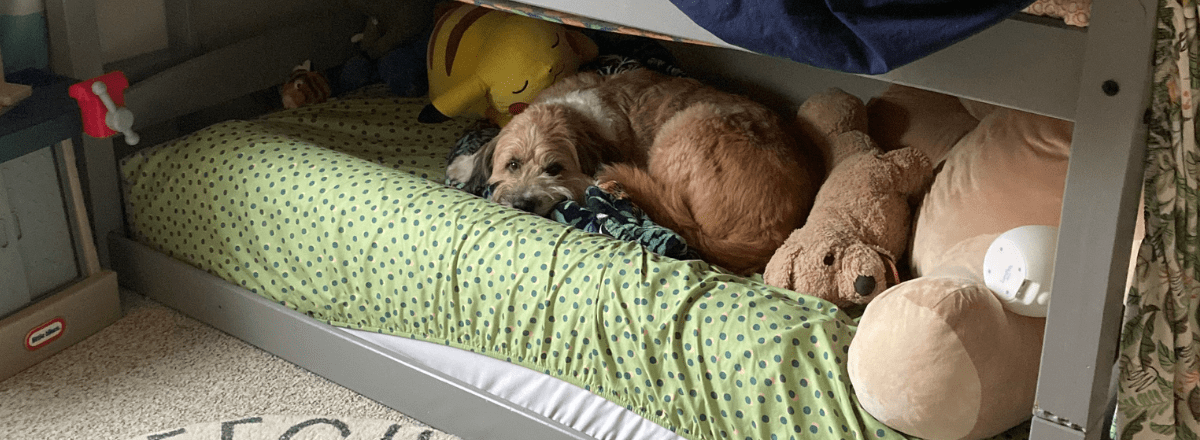
I’m talking about a space where the rest of the world can go take a seat and your pup can just be unbothered. No touching, no kids, no taking things away, no pressure to do anything other than be.
When developing a safe space, make note of where your pet goes when they choose to lay down—the flooring, the sound scape, the lighting, the temperature, the access, the location, the smells, the visuals, everything. Encourage your pup to seek out this space, relax in this space with a stationary calming project (think: licking/chewing/snuffling), and leave them alone. Even if they’re cute! Even if every fiber of your being says to just give a little scritch! Leave them alone.
I’ve seen a lot of nervous dogs who urgently seek out hiding spots. That’s ok! Take that information to help build their safe space. You may even build it in that hiding spot! Observe what happens when you encourage them to go there for calming projects before the urgency and go from there.
Incorporate going to their safe space as a routine activity to help with predictability/agency (it’s all connected!), and to support stress regulation. More on safe spaces in this podcast episode.
Get their nose involved
Seriously, is there anything better than watching a dog forage (…except maybe forage to shred, my absolute fave)?! Their big, beautiful brains have these big beautiful foraging abilities and it hits almost all the enrichment categories for a real substantial bang for your buck. Start simple where they’re mostly using their eyes/ears, then once they get the game with the low hanging fruit, listen for that rapid nose breathing that indicates we’re tapping into true foraging. Emily helps to teach this from scratch in this episode.
Try scatter feeding, snuffle mats, find it, random placements, hide and seek, pick the hand, etc—whatever is fun and engaging. If they’re not into it, it’s probably too hard, so simplify first.
Here’s to harmony,
Corinne
Now What?
Having a pup who is shy can be difficult. It may not match what you pictured, it may feel disheartening, it may even feel frustrating at times, but they don’t have to feel trapped. We can help to build their trust in the world by providing them agency, predictability, safe spaces, (and a touch of foraging).
Take the time to think about one scenario where your pup may seem uncertain and just try one of those strategies and observe the outcomes.
Copyright 2025 Pet Harmony, LLC. All Rights Reserved.
Terms & Conditions, Privacy Policy
Results are not guaranteed because behavior, human, canine, or otherwise, are not guaranteeable.