
Why Kids Might be More Trick Than Treat From Your Dog’s Perspective
Estimated reading time: 9 mins
Cover image courtesy of Lindsay Dellas, Good Dog Happy Dog Training
You don’t have to live in a home with dogs and children for your dog to be exposed to them. Maybe your family members have children and they come for visits. Or kids come to the door ringing the bell to sell cookies or to get free candy. Hello Halloween, I’m looking at you. Or you take your dog for a walk in the neighborhood and suddenly a child is rushing forward to say hello.
Dogs and humans have been sharing this world together for a long time and you might think because humans all start out the same way, that your dog should be ok with them at any age. But a baby who grows into a toddler who grows into a preschooler who grows into a grade schooler who grows into a teenager who grows into an adult look quite different at each stage.
I doubt that dogs understand a single thing about developmental milestones in children as they grow and change. What they are brilliant at however, is observing environmental changes. How fast, how loud, how wobbly, how huggy, how jumpy, how screamy. How, how, How! HOW! did we go from stationary baby to scary, jumpy, unpredictable thingy so fast?
Dogs don’t get memos, warnings or updates on changing environments. All they know is when something is different than it was and that can be truly scary. This blog post is scripted to help you understand why children in the early stages of childhood development might feel like a goblin to your dog instead of the lovely humans they are.
Developmental stages are cool…unless you’re a dog
As parents, guardians or otherwise interested humans, I will assume that you know at least a little bit about how children change as they develop. Parents and guardians have most likely invested a great deal of time learning about how babies grow, change and adapt to the environment around them. It is incredibly intoxicating to watch babies figure things out, to watch those first steps, and to see your child learn that they can use behavior in a way that produces interesting outcomes for themselves. Learning is cool!
Most dogs probably don’t care a single bit about babies learning to crawl, learning to walk and then learning to run. They probably don’t care about babies learning at all. All they know is that something is afoot and it has human smells but super unpredictable behavior.
Let’s take a look at just some of the developmental changes that children undergo as they age and mature and why it might be spooky from your dog’s perspective. This post will focus on the first two big child development stages; infancy and toddlers.
Babies and Dogs: What Your Dog Notices in the First Year
As a Family Paws licensed professional it might surprise you to hear me say that the majority of dogs handle a newborn joining the family fairly well. I am not saying there are not some challenges because babies cry a lot and dogs can get freaked out by the sounds of an infant wailing for dinner.
Also, with babies come changes in routines. Your availability and priorities have no doubt shifted to meet the needs of your baby. That means that your dog’s dinner time, walk time, play time, and nap time may also change.
Dogs, being the routine oriented creatures that they are, can become dysregulated by changes in routine which is something we should bear in mind. Also during this time your baby is likely doing some of the following:
- Cries to express needs or discomfort
- Focuses on faces
- Moves body in response to changes in environment
- Spends time either being held or in a carrier or on the floor when awake or asleep
- Independent movement will start with manipulating hands, arms and legs
- Movement will continue to rapidly change from manipulating limbs to:
- to raising and turning head
- rolling over
- reaching for and grasping items
- rocking on hands and knees
- crawling
- pulling oneself up on furniture
- standing
- taking steps
Milestones from your dog's perspective
It’s exciting to experience, isn’t it? Our big human brains see these changes as a natural progression of growth and we are delighted by each new skill being learned. On the other hand, dogs may see each of these new found steps towards greater independence as frightening and strange.
If we look at these changes from a dog’s perspective, we might conclude that they are experiencing the following:
- Crying: new, unfamiliar, often high pitched sound happening at all hours of the day and night and guardians who are scrambling to make it stop while likely also feeling stressed
- Focusing on faces: extended periods of sustained eye contact can make many dogs uncomfortable and some might even see it as confrontational
- Randomly moving limbs: this might mimic things that some dogs like to chase
- Rolling over: sudden movement often times accompanied by parental squeals of delight
- Reaching for or grasping items: dogs have fur that is attached to their skin-need I say more?
- Crawling/standing/first steps: dogs don’t know how to interpret this new found freedom and if the baby is crawling or moving towards them? Especially at the dog’s eye level? Very possibly straight from a horror movie from the dog’s perspective and they may not have the skills to know how to navigate it safely.
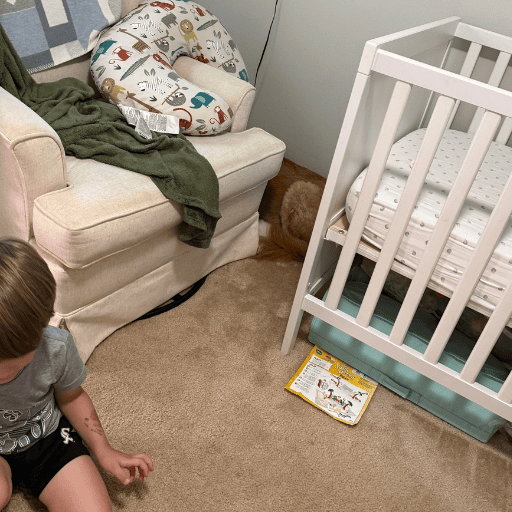
Consultant Corinne’s four-legged bestie Opie taking a break from his human siblings in his safe corner. The rules of the safe corner are easy: don’t bother Opie if he’s in his corner. Rules like this apply only to kids old enough to understand them. Management in this room looked different when Corinne’s sons were younger.
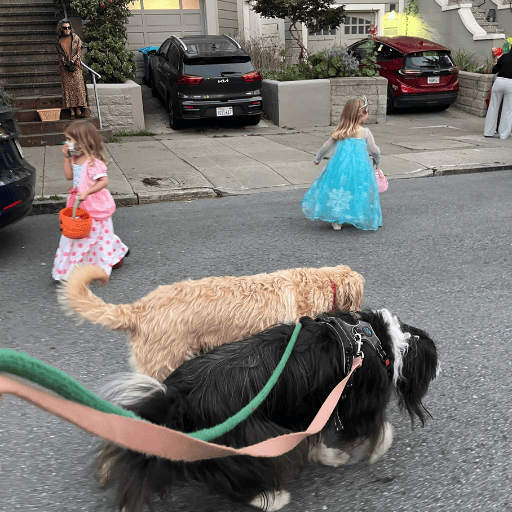
Sometimes the management is an Auntie. Here social butterflies Barnaby and Hank (dressed as muppets, obviously) experience the magic of trick or treat with plenty of supervision and at a safe distance. Photo courtesy of Lindsay Dellas, Good Dog Happy Dog Training.
Toddlers and Dogs: Why Ages 1 - 3 are the Toughest Stage
Toddlers are a force of nature in a 20(ish) pound package. They are determined, curious, active and verbalizing in single words working themselves up to sentences a word at a time. They are more aware of their surroundings and know how to move their body in space to gain access to things they want. And they experience rapid emotional growth between the ages of 1-3. Honestly, in my professional experience, this is by far the toughest stage for families with dogs to traverse. When forces of nature collide into beings who thrive on structure, familiarity and predictability, the result is often chaos in varying degrees. Let’s look at why that might be the case.
During this time frame your toddler is likely experiencing some of the following:
- Acquisition of language and mimicking others in often varying levels of volume and pitch
- Movement can include walking, running and climbing
- They can drag, push and throw toys
- Discovering their own independence separate from their parents
- They show signs of affection with hugs and kisses
- They physically manipulate items to explore them
- They have brains that are biologically under construction, specifically the region responsible for logical thinking, decision making and self control. In other words, they can’t and they don’t.
- They do not understand long term consequences or take risk factors into account so even if something is unsafe, they don’t make a conscious decision to avoid it
The following sections cover how your dog may be affected by some of these milestones.
Learning to speak
While toddlers are acquiring language, they mimic others. Toddlers are not known for modulating their voices and sudden, loud squeals, shrieks and screams can be disturbing for sound sensitive dogs.
Movement
Suddenly the way your baby navigates their environments will increase in intensity, including walking, running, and crawling. They will be more adept at moving more quickly and obstacles (even resting dogs on floors) can just be something else to climb. And while they may be moving more quickly, their gait can be clumsy, their movement awkward and unsteady. Dogs may find this strange movement quite peculiar and unsettling. And the vast majority of unsuspecting resting dogs will not appreciate a toddler using their body as their personal version of Mount Everest. Being startled out of sleep and rest is a thing, even for our dogs.
Using Toys
I can think of so many toys that make a lot of noise as they are being moved. Those toys with all the balls in it that pop, pop pop as the toddler pushes it. The wooden toys on strings that toddlers can pull behind them as they waddle along. There are so many more. Most of them make noise of one kind or another. This combination of weird movement and sound stresses many dogs.
Developing Independence
Toddlers who feel safe and have a secure attachment figure, will start exploring their environments more and more and farther and farther away from caregivers. Which means that they may close distance away from the caregiver and directly towards the dog resting across the room. Toddlers moving directly towards them while staring will likely make lots of dogs feel anxious.
Learning Human Affection
I am here to tell you that hugging and kissing is a uniquely primate expression of affection.
Primate studies indicate that the function of embraces is likely used as a bonding, reassurance, or consoling gesture. It makes perfect sense that a toddler who has been carried and hugged and kissed countless times will want to mimic that behavior because social learning is a thing. Other species of animals may have other ritualistic behaviors that have the same effect but they are not hugs.
Dogs do not hug other dogs. Hugging can become something that a dog associates with their beloved humans but there is plenty of evidence to suggest that most dogs tolerate hugs from humans and don’t actually love them (PS-or actually even like them.) And here is where it gets real messy, real fast. Tolerating a hug from a trusted adult human who knows where to put their hands on your body gently, is enormously different than a hug from a toddler who might grab your fur, pull your tail, prod their fingers into your ears or lean their face right into yours for a kiss. This close proximity and unasked for, unpredictable touch can make a lot of dogs very, very stressed.
Human Brains Under Construction
Toddlers are so stinking cute, and it’s a good thing they are. I often wonder if their cuteness is a biological adaptation so that adult humans aren’t driven completely mad by them. Because anyone who has spent any amount of time with a 1 or 2 or 3 year old, knows that their emotions and actions can change swiftly and intensely.
They want what they want when they want it and it doesn’t matter how many times you say no. This means that a toddler exploring everything in their environment is going to consider the family dog fair play for further exploration. And for many dogs that exploration is quite unwelcome.
Remember, dogs are sentient beings who have their own needs and comfort levels (just like humans!) and for the many reasons I’ve already outlined, a toddler wanting to interact or play with them may not be on their dance card. Toddlers also do not understand dogs’ early warning signs and they do not have the ability to assess risk. Which means they will proceed with zero caution towards a dog who is desperately trying to communicate that they are uncomfortable. This is often the cause of an unfortunate accident waiting to happen.
How to Keep Your Dog and Toddler Safe Together
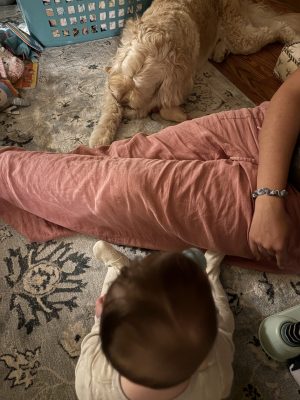
Management category: mom leg barrier and active supervision. Luna chilling near her little sister. Photo courtesy of Jenna Swiertz Doubek, Silver Linings Companion Animal Services
Here is a list of my hottest tips for setting your household up for harmony while little humans are developing.
- Know your dog. Know their preferences and what things cause them to feel stressed. Learn how they complete their stress response cycle and what causes them to feel trigger stacked.
- Learn their body language and when you think you are done, learn some more.
- Lean as heavily into management as you need to feel like you are not going to lose your sanity
- Try to be as proactive as possible so that you can anticipate potential problems before they actually are one
- Give this podcast episode a listen for more tips
- Check out the free resources at Family Paws Parent Education
- Work with a behavior professional who understands the dynamic between young kids and dogs and who can help you navigate and troubleshoot how to keep all members of your household safe.
During this season of spookiness please remember that no one is at fault here. Dogs are dogs; kids are kids. Each has their own unique set of needs and behaviors. There are no ghosts or goblins here. It is unlikely that your young child is purposely trying to make your dog feel apprehensive. It is also unlikely that your dog wants to escalate their behavior to get your child to back off. What we have here is a failure to effectively communicate. Making informed, proactive decisions to keep the fright out of their interactions is the best strategy to keep everyone safe, happy and healthy!
Here’s to harmony,
MaryKaye
Now What?
If this post had you nodding along (or wincing), you’re not alone, and it doesn’t mean you or your dog have done anything wrong. Babies and toddlers change fast, and most dogs need a little help keeping up. Small, proactive changes now can prevent a scary moment later. If your dog is already showing signs of stress around kids, or you’re expecting a new arrival and want a plan before things get hard, we can help. Book a discovery call and tell us what’s going on at home. We’ll build a sustainable plan that fits your family, so everyone can grow together.
PS: Capitalism
Want to support our free, public content? Check out our Amazon shop. It’s full of enrichment and pet care items (that we really, actually use). Our team spends a significant amount of time working on content every week. We love it! But we’re also out here trying to pay our bills.
* Pet Harmony, LLC is a participant in the Amazon Services LLC Associates Program, an affiliate advertising program designed to provide a means for sites to earn advertising fees by advertising and linking to Amazon.com.
About the Author

MaryKaye Kendrick, IAABC-ADT, CSB-D, Family Paws Parent Educator
MaryKaye Kendrick is dog trainer and behavior consultant with Pet Harmony, and Allie’s first official employee! She is a Family Paws Parent Educator, an Accredited Dog Trainer & is Certified in Shelter Behavior – Dog (CSB-D) through the International Association of Animal Behavior Consultants (IAABC).
MaryKaye found her way to animal behavior by first working in human mental health and teaching. After a career in social work, MaryKaye was a Montessori school teacher for 17 years. She has worked and volunteered in animal sheltering since 2011.
Copyright 2025 Pet Harmony, LLC. All Rights Reserved.
Terms & Conditions, Privacy Policy
Results are not guaranteed because behavior, human, canine, or otherwise, are not guaranteeable.