
The Top 5 Reasons Your Dog Won't Sleep Through the Night
Estimated reading time: 8 mins
It doesn’t matter who you are, how much you love your pet, or how devoted you are to their well-being: if you live with an animal who keeps you up at night, and you’re sleep deprived, it is going to make you feel cranky and will deteriorate your relationship with that animal. That doesn’t make you a bad person, it just makes you a person. People are finite beings with finite resources. We have needs. Sleep is one of the big ones. When our needs aren’t met, we can’t show up the way we want to show up for our loved ones.
So let’s just start off by saying, if this is happening to you, you are not a bad person. You are a wonderful person who cares about their pet and who has a legitimate unmet need.
Secondly, you are not alone. Pets – especially dogs and cats – keeping people up at night is super common. We hear this from a LOT of our clients.
Thirdly, if you have gotten advice to punish or ignore your pet, please don’t. I know it’s easy, when you’re sleep-deprived and cranky, to lash out at the source of your pain! And doing so is not going to be a long-term solution.
Conversely, if someone is suggesting that you wake up at night and do some training – clicker training, or counterconditioning, or anything that requires alertness, focus, skill, and concentration – please don’t do that, either. Even though those suggestions are much kinder to your pet, they aren’t kind to you at all, because those types of activities will further disrupt your sleep cycle and make it that much harder for you to get back to sleep–and those techniques are almost certainly missing the point anyway.
Instead, let’s look at the 5 most common reasons that dogs don’t sleep through the night, and what to do about them. Yes, we’re focusing on dogs in this article because I have the most direct experience working on this issue with dogs. But a lot of what we’ll be discussing here is applicable to many other companion animal species, especially cats.
Reason #1: Your dog is getting exercise at the wrong time of day.
Dogs (and cats!) are crepuscular, meaning that they are most active at dawn and dusk. And while domestication may have softened those crepuscular tendencies and given our pets a more flexible or variable circadian rhythm, nevertheless, I cannot count how many clients have reported to me that their dogs have a “witching hour” between around 4-7pm when they get reeeeaaaalllllllyyyy wound up.
And yet, most of the time, when we’d look at their daily routine together, that is not when they would provide their dog with opportunities for physical exercise. They would go on walks or play with their dog in the mornings, over their lunch breaks, and/or after dinner.
So the conversation would go like this, “Let’s see what happens when you shift one of your dog’s exercise sessions to right before the witching hour, before they get all wound up.”
Most clients were shocked at how many things changed just by shifting their routine to honor the dog’s biological rhythms. One of the things that changed most often? The dog slept more soundly at night.
Reason #2: Your dog doesn't have a consistent sleep routine.
When it comes to sleep schedules, dogs aren’t that much different than humans–and it turns out, many of the techniques that sleep doctors recommend for humans to get better sleep are pretty dang similar to what dogs need, too.
It’s not good for any of us to try to go straight from All Jacked Up On Mountain Dew to Nighty-Night. And yet, a lot of dogs have never been taught to wind down and get ready for bed.
When it’s bedtime, create consistent environmental cues that signal to the dog that it’s time to sleep. Usually, people do this part without realizing it because their own bedtime routine becomes a signal to the dog! But if your dog is struggling, you can supplement your own bedtime routine with additional scent, sound (e.g. white noise machine or meditative music playlist), and/or lighting cues.
Be sure to also do the bedtime routine events in the same order each time. For example, this is my nighttime routine with my dogs:
Is interrupted sleep just one of your pet's many issues?
Look, some dog behavior problems won’t just get better with time. So if you’re struggling to manage behavior that freaks you out, affects your daily life, or just gets on your nerves, it may be time to seek professional to help!
With Pet Harmony, you have someone in your corner that understands exactly what you’re going through—and will create and hone a sustainable training plan based on your needs.
Emily's step-by-step night time routine for better sleep:
- I shut down everything in my office
- I take my evening meds
- I give the dogs their evening meds
- I let them outside for one last potty time
- I make sure the doors are locked and turn off all but one light in the kitchen
- I go upstairs with the dogs, and let them get in bed first
- Copper curls up between Chuck’s and my pillow
- Brie waits at the end of the bed
- I get in bed and get comfortable, then lift the blanket
- Brie crawls under the blanket and curls up against my stomach
We all sleep like babies!
Reason #3: Your dog never learned how to truly relax.
The sleep routine mentioned above is often sufficient for dogs who otherwise have no problem resting. But there are some dogs who can’t seem to ever relax or truly, deeply rest. But did you know that resting and relaxation are actually skills that can be taught?
In fact, for a lot of working and sporting breeds, they have expressly not been taught those skills because pet parents have been told that these dogs are high energy and need exorbitant amounts of exercise. And if they’re still energetic afterwards, it’s because they haven’t exercised enough. And the cycle can get really, really intense.
What most people in this situation don’t realize is that they’ve created an athlete with no off-switch, so they have a restless, wired, overtired toddler on their hands. And that’s no fun for anyone, including the toddler! For dogs who are struggling to sleep through the night because they are the overtired toddler, teaching them how to complete their stress response cycle and return to baseline can make a huge difference.
After their last high energy activity of the day, move to some type of mental exercise that serves as an intermediate energy activity to help them downshift. Depending on the dog, this could look like some kind of scent work game, a food puzzle, or training a skill that requires minimal movement (such as biofeedback, stationing, chin rest, or match to sample).
Transition from that activity to something that helps them to feel relaxed. This could look like a licky or chew toy that gets them all droopy-eyed and melty, or it could be a massage, or even just snuggling with you.
And finally, move into a bedtime routine, as described above.
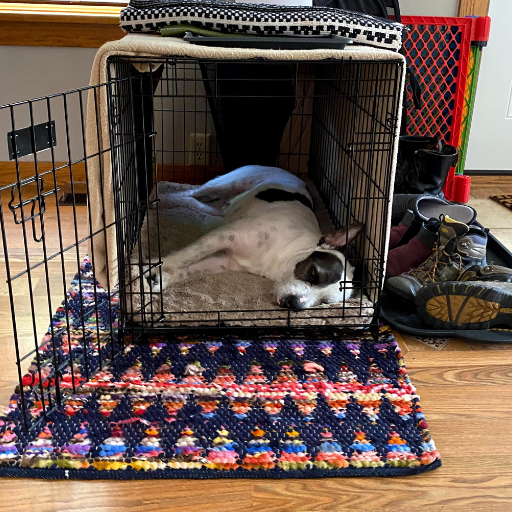
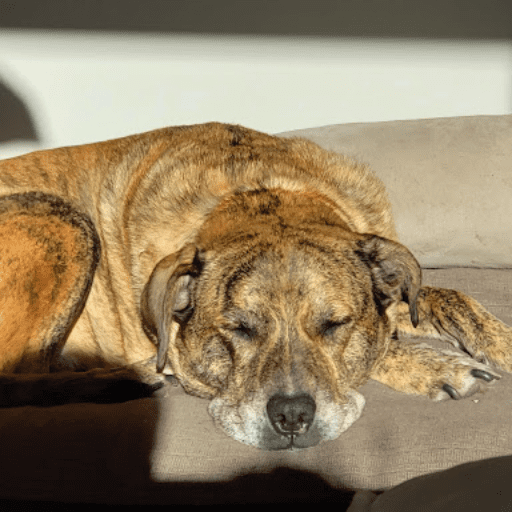
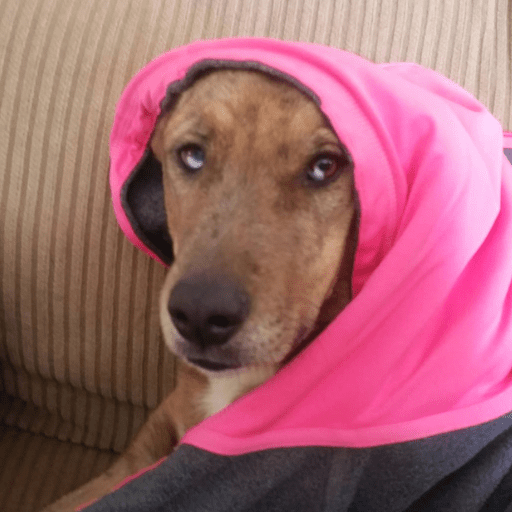
Different households, relaxations spots, and routines. Left to right: Petey relaxing in his crate, Oso snoozing in the sun, and Brie being cozy in her blankies.
Reason #4: An underlying health issue is disrupting your dog's sleep.
There are a whole host of physical and behavioral health issues that can be subclinical – in other words, there are no obvious symptoms – but can disrupt a dog’s sleep. Here are a few:
- Pain is a big one, that can often be hard to detect.
- GI issues can also be tricky, for many reasons. Most people think that, because their dog doesn’t have diarrhea, they don’t have GI issues–but GI issues can look like a whole lot of things: intermittent inappetence, infrequent or too frequent defecation, hypersalivation, excessive reverse sneezing or throat clearing, gassiness, or abnormal color and/or texture of the feces.
- High blood pressure is pretty well known to cause cats to loudly vocalize at night, but I have seen this with some dogs, too.
- Endocrinological diseases can disrupt sleep–and in fact, when Brie first started having real symptoms of what we later learned was Schmidt’s Syndrome, one of the most profound behavioral changes we noticed with her was pacing at night.
- Canine Cognitive Dysfunction also disrupts, and sometimes even reverses, a dog’s sleep cycles.
- And of course, just as in humans, anxiety and hypervigilance can prevent dogs from entering and staying in a deep and restful sleep.
If you have any reason to suspect that your pet might be suffering from an as of yet undetected physical or mental health issue, take them to the vet and tell your vet exactly what you’re seeing (or not seeing) that is causing concern.
Reason #5: Your dog's diet may be affecting their sleep.
Nutrition is such a touchy subject, so let’s start this section by saying that you can be the best, most dedicated pet parent in the world and feed your pets the most expensive, highest quality food on the planet, and your pet could still have a nutritional problem. It’s not a reflection of our dedication or love, or how good the food is. Bodies are just weird, y’all.
Nutrition, like behavior, is a study of one. And while it’s true that food is food is food is food and the nutrients in foods are what they are, the part that gets real tricky is how each individual body interacts with those nutrients. It’s complicated. If you want to hear exactly how complicated – and exactly how individualized – nutrition is, you can listen to this podcast episode where I interviewed Ellen’s dietitian.
So when I say that the reason your dog may not be sleeping at night is because they have a nutritional issue, that is not code for “you’re a bad dog owner” or “you’re feeding your dog garbage.”
Unfermented soy products like edamame and tofu make me violently ill. But I’m not allergic to it! Other foods that are high in phytic acid – like other legumes, some grains, and some nuts – can also cause me enormous discomfort and drain the life right out of me. But my labwork looks totally normal! Another example: ever since I was a wee bab, caffeine has had the opposite effect on me: instead of making me more energetic or hyper, it puts me right to sleep. I can drink a ton of coffee or tea and then immediately go to bed and sleep like a baby. But if I have even a sip of chamomile, I’m awake all night, dealing with racing thoughts and waves of nausea.
You pickin’ up what I’m putting down? The things we eat can affect us in profound and highly individualized ways without leaving any evidence that standard diagnostic tests can detect.
The same is true for non-humans. So when I see a dog who isn’t sleeping at night, and we’ve ruled out everything else above, we do some trial and eval with the diet.
- What happens when we try a different (but still nutritionally balanced!) brand (or recipe, if it’s homemade)?
- What happens if we change the protein?
- What happens if we change when we feed?
- How often we feed?
- How much we feed?
- What happens if we change how it was processed: if it’s raw, can we try a cooked diet, or an extruded kibble? If it’s an extruded kibble, can we try cooked or raw?
It may sound far-fetched, but I truly can’t count the number of animals I’ve worked with where we tried everything else, and a diet change was the thing that helped to improve their sleep quality.
Here’s to harmony,
Emily
Now What?
If your pet can’t sleep, and if anything in this article really resonates with you, give it a try! And please talk to your vet if you suspect a medical or dietary issue.
If you need the help and support of a behavior professional, we’re here for you!
PS: Capitalism
Want to support our free, public content? Check out our Amazon shop. It’s full of enrichment and pet care items (that we really, actually use). Our team spends a significant amount of time working on content every week. We love it! But we’re also out here trying to pay our bills.
* Pet Harmony, LLC is a participant in the Amazon Services LLC Associates Program, an affiliate advertising program designed to provide a means for sites to earn advertising fees by advertising and linking to Amazon.com.
Copyright 2025 Pet Harmony, LLC. All Rights Reserved.
Terms & Conditions, Privacy Policy
Results are not guaranteed because behavior, human, canine, or otherwise, are not guaranteeable.