
Teaching Kids To Be Their Dog's Best Teammate
Estimated reading time: 7 min
For some folks out there, teaching kids feels daunting or overwhelming. Not for me. I love working with families with kids of all different ages. Would you like to know why? Well if I had to make a list, it would include the following:
- Kids are naturally curious
- They can also be very observant about things we adults sometimes miss
- They are willing to ask questions and they don’t care whether or not anyone thinks it might not be a “good” question. That’s how badly they want the answer.
- They are less likely to be self-conscious about making “mistakes” so they willingly participate in training exercises.
- Neuroplasticity helps them absorb new information quickly.
- They are natural explorers which drives them to test new ideas bravely (we should always make sure they are safe for this reason)
- They may have a fresher perspective and less bias about novel things because they have less learning history baggage that can prevent new learning from taking place
All of this means that they are primed for learning and that gives us a deep advantage when it comes to their relationship with the family pet.
I know, I know. You might be scoffing right now because your kids may have desperately begged for a puppy and when the novelty wore off or the puppy’s teeth got too sharp, they rode off into the sunset to chase bigger and better things.
The thing is, when we invite kids to help be responsible for the family dog, we might be missing important teachable moments beyond filling the food bowl. Those nippy puppy teeth are a typical part of a puppy’s development which they commonly grow out of. The teachable moment? It’s not that your kids need to be a human pin cushion for your puppy. But what if we frame it as a lesson in understanding how dogs communicate and express themselves?
What if we taught them what to look for before things go awry? What if we empowered them to make observations and share them with the adults in the room? What if we invited them to teach us and others the skills they are learning? Imagine how much better a relationship between your child and pet might be if only we put that kid’s curiosity to work!
Why Teaching Skills Beyond “Be Gentle” Matter
Learning to interact with dogs in a safe and gentle manner is a good starting point. But here is my problem with saying that to kids:
- Have you defined what gentle means?
- Does your child understand that “gentle” varies from person to person and from person to different species and all the way back again?
- Does your child understand that gentle on one day might be vastly different on another? For example:
- If your dog is painful, even “gentle” might be too much
- If your dog is scared, stressed or anxious, “gentle” is probably not what they want or need
- If your dog is busy chewing on a bone, it’s unlikely that they want to be distracted, even gently
- If your dog is resting or sleeping it is highly unlikely that any amount of gentle is going to be desired or appreciated
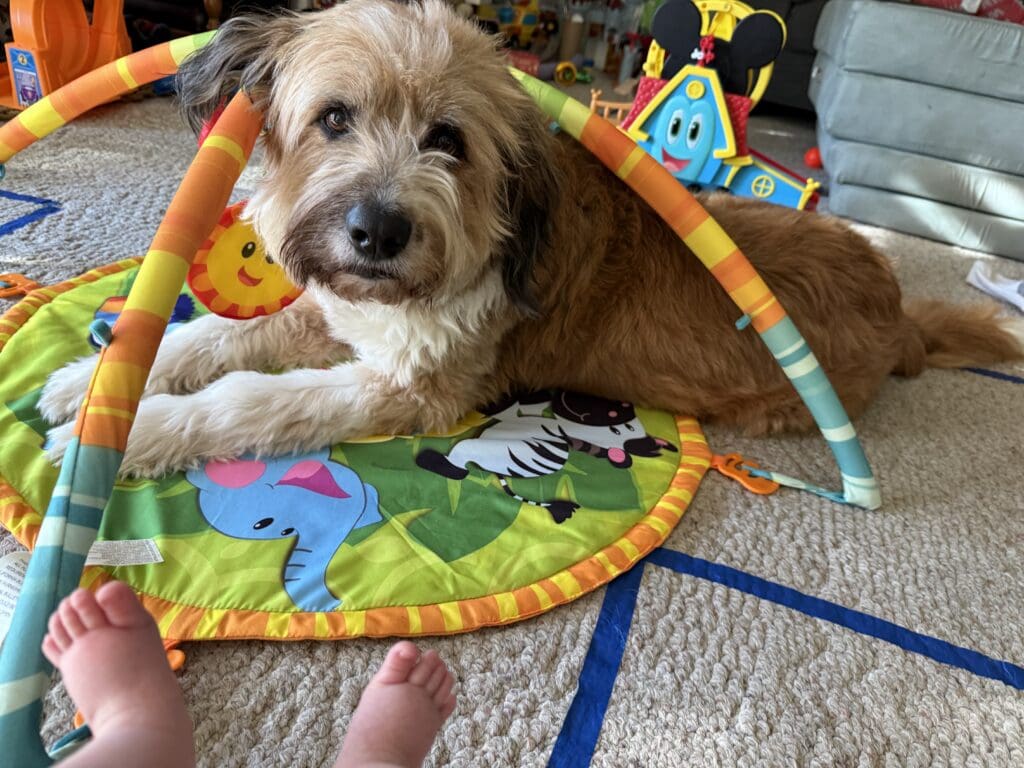
Creative management and enrichment opportunities: Corinne’s Opie vs. the infant activity mat.
I’m truly not trying to overcomplicate matters but the “rules” change depending on the context and that can be confusing for anyone. But still, these things really do matter when it comes to dogs and kids and safety.
If we want our kids’ relationships with our pets to be built on a solid foundation of trust, communication and safety, we need to shift away from rules and move towards observations.
Start With Observations, Not Rules
We’ve already identified that kids are, generally speaking, a curious, observant lot. How lucky are we that we can put those traits to good use?
When my kids were little they loved those I Spy books. They could spend hours looking for the tiniest trinket secretly embedded in a very busy landscape. Even before they were verbal, they could understand the concept of looking for the mouse hidden on each page of the children’s classic Goodnight Moon.
Those observation skills are just the thing we need when it comes to helping our children understand that even though Fido can’t talk, Fido is most certainly telling us when they are feeling scared or upset.
Simple Observations Kids Can Make About Dogs
We don’t need to get all analytical with our kids either. In fact, the simpler the better. Sit with them and watch your dog. Start with simply identifying a single part of your dog’s body and what that part is doing. For example, let’s say you start with the mouth. Here are some sample questions you can ask or observations you can share:
- Is Fido’s mouth open or closed?
- Can you see Fido’s teeth?
- What is Fido’s tongue doing?
- Did you just see that Fido licked their lips?
- How interesting! Fido just yawned right after Grandpa patted them on the head.
- Does it look like Fido is breathing fast or slow?
Let’s try with another body part, the tail:
- Where is Fido’s tail now?
- Is it moving or still?
- Is it moving quickly or slowly?
- Is it high or low?
- Oh my goodness, that was a loud noise outside! What do you notice about Fido’s tail now?
You can do this with each part of your dog’s body to help familiarize your child with each individual component. And you can easily incorporate how the environment might be impacting any visible changes. If you would like to brush up on how dogs use their bodies as a form of communication, this blog post on body language is a good place to start.
Next Lesson: What to do With What They Notice?
The next thing we want our children to understand is how to interpret what they see and actions they should take when they see it. I like to do something I learned when I was taking my Family Paws course to become a licensed Family Paws Parent Educator. It’s called broadcasting, and I think it works really well.
Let’s go back to our mouth example and Grandpa’s pat on the head eliciting a yawn from Fido. The broadcasting would go something like this:
“I saw Grandpa approach Fido and pat Fido on his head and then Fido yawned. When dogs yawn, it means they might feel uncomfortable. When dogs are feeling uncomfortable we need to give them space.”
Using Observations to Find Solutions
You can then troubleshoot simple solutions such as:
- Not patting Fido on the head as we pass by
- Waving at Fido or saying hi to Fido from a distance
- Moving away from Fido when we see them yawning
- If you are not sure what to do, ask an adult to help you figure it out
Role-playing these is even better but instead of putting Fido in a situation that makes them uncomfortable, try using your child’s favorite stuffy instead. You can make up a scenario and have your child practice the necessary steps that will help them feel empowered to make good decisions in the future.
When in doubt, the easiest thing to do is teach them a simple, repeatable response such as: notice > give space > tell an adult.
It is also important to validate your child when they do observe and share something whether that is with you, another family member or guest. There will be no benefit from not acknowledging that your child shared an observation or if it wasn’t taken seriously. In fact, it is likely to make sharing less likely to happen next time.
Next Lesson: Building Habits as a Family
We all know that children learn over the course of a lifetime not in a day, week or month. And learning also happens through repeated exposures and repetition. That means, there will be a lot of rinsing and repeating of your messaging.
The more you broadcast what you see and then ask your child for their input, the more you are building habit and muscle memory. The more they hear it, see it, experience it, process it and make sound decisions about it, the more impactful it will be over time. As an added bonus, this skill goes beyond the relationship between your dog and your child. It expands to your child’s relationship with every other dog they meet. It might even help other kids and how they interact with dogs if your child starts to share their knowledge with their peers. These ripples might turn into waves but first we have to start at home.
Growing a Life Skill
Kids don’t automatically understand how dogs communicate and if we want to prevent them from becoming adults who don’t understand how dogs communicate, it makes sense to put in the effort to help them learn the skills now that will last them a lifetime.
Sharing with your child that you not only value but also deeply appreciate their observations and advocacy for the family dog will likely grow the relationship between a child who understands and the dog who feels understood. This is how trust is built, safety is met and bonds grow.
Here’s to harmony,
MaryKaye
Now What?
- Start watching and talking! Body language has to be observed before it can be interpreted.
- Observations are great! Interpretations are great! Make sure to include actionable items that your child can practice and implement.
- I love this book by Lili Chin It is perfect for school-aged kids.
- If you are looking for other ways to grow your child’s bond with your dog, this blog talks about kids helping craft enrichment plans for the dogs in their lives.
Want help helping your kids and dog become true teammates? Let’s talk about your dog and build a plan that works for your whole family.
PS: Capitalism
Want to support our free, public content? Check out our Amazon shop. It’s full of enrichment and pet care items (that we really, actually use). Our team spends a significant amount of time working on content every week. We love it! But we’re also out here trying to pay our bills.
* Pet Harmony, LLC is a participant in the Amazon Services LLC Associates Program, an affiliate advertising program designed to provide a means for sites to earn advertising fees by advertising and linking to Amazon.com.
About the Author
MaryKaye Kendrick, IAABC-ADT, CSB-D, Family Paws Parent Educator
MaryKaye Kendrick is dog trainer and behavior consultant with Pet Harmony, and Allie’s first official employee! She is a Family Paws Parent Educator, an Accredited Dog Trainer & is Certified in Shelter Behavior – Dog (CSB-D) through the International Association of Animal Behavior Consultants (IAABC).
MaryKaye found her way to animal behavior by first working in human mental health and teaching. After a career in social work, MaryKaye was a Montessori school teacher for 17 years. She has worked and volunteered in animal sheltering since 2011.
Copyright 2025 Pet Harmony, LLC. All Rights Reserved.
Terms & Conditions, Privacy Policy
Results are not guaranteed because behavior, human, canine, or otherwise, are not guaranteeable.