
How to Simplify Walks With Your Reactive Dog
Estimated reading time: 11 mins
When your dog has big, loud, barky, lungey, snarly, scary feelings about [insert entities here], it doesn’t feel like a walk in the park to…you know, walk in the park (or the neighborhood or public trails, or many of the places you might find yourself walking a dog).
Humans of reactive dogs know what I’m talking about here: head on a swivel, treat in one hand, leash in the other, trying to make the “right” move at any moment to help your dog process the barrage of sensory information that may or may not put them over threshold. Walking a reactive dog can be a lot. It may never be simple, but I have some ideas that might help you streamline your process, make room for your own stress response cycle, and support your dog.
How to Plan Walks When You Can't Predict What You'll Encounter
Look, I know we’re not all planners, so this suggestion goes out to those of us who prefer to be as minimally surprised by what we might encounter on our walks as possible (it me).
Since I walk a dog who does not care for people or dogs, my criteria for an ideal walk spot might be different than yours. Ideal walking conditions for us include:
- There is enough open space that it’s easy for us to spot triggers from a distance
- Petey can meander and track various scents
- It’s pretty easy for me to follow along with the long line
- We have as little contact as possible with humans or dogs
- There is space to quickly and easily create distance from triggers
- There is also something interesting for me to look at or explore
I generally take Petey to the same handful of places. Our regular haunts (pun intended) include two cemeteries, a couple of nature preserves that Big Man manages, and when the sun comes up real early in the late spring/early summer, our neighborhood park at 6am. We’re also lucky in Fort Wayne to have access to Fido’s Forest, a wooded, fenced, private dog park you rent by the hour. The Sniffspot selection in our area is not great yet, but we occasionally make a day trip out to some spots in Indiana and Michigan.
I have put some time into finding new cemeteries within an hour drive of my home. I even loaded Big Man up one weekend so we could go on a coffee shop tour of several nearby-ish towns to scope out their cemeteries. When I plan to take Petey to a new spot, I try to go see the space first so I at least have an idea what to expect. That’s not always possible, especially if it’s a Sniffspot. Navigating new spots is a bigger drain on my bandwidth, so I lean on my self-care practices to help me out.
As I mention in this blog, I often essentially schedule walk time. Here’s how:
- I try to look at my schedule a week in advance and block some walk time out on my calendar.
- Since I live in the midwest, I keep an eye on the weather. Shout out to the Wunderground app!
- If I am planning an early morning walk, I also check my weather app for when first light and sunrise are happening so I can set an alarm (with time to get us dressed, give meds, etc.).
- I figure in clean up time based on the weather and add that to the time block.
Other considerations for blocking walk time:
- Look for times in your schedule that you know you’d like your dog to be snoozy. Maybe you have people coming to work in your house, a project to concentrate on, a long day at work planned, or you want to clean out your closet. If you know a nice sniffy walk helps them rest, schedule the walk so snooze time happens while things your dog doesn’t need to be involved in are happening. Emily and I discuss this in episode 164 of the podcast!
- Your bandwidth. I recently completed a big course design project with the Karen Pryor Academy. I was putting in a lot of hours, and learning new software against deadlines was taxing my nervous system. Big Man walks Petey less often than I do, but I scheduled walk time when the two of them could get out, and figured in the clean up time for me. I also blocked out time for nosework and other projects that didn’t involve leaving the house.
One of the many reasons I like to block out time for walks on my calendar is that I’m rarely done when we pull in the driveway. Depending on how dirty we got, there may be bathing or other clean up tasks involved before I can get back to whatever else is on the docket for that day. If I’m bustling about, I like to have a little project prepped so Petey’s also got something to do.

What to Do After the Walk
I don’t know how many times I’ve typed this statement: Enrichment is about outcomes. Even if you have a nice, long, sniffy stroll, there is usually some transition time between the end of a walk and when your pet might settle in for a snooze.
In warmer weather, Hose Time often follows a walk. The Hose is one of Petey’s favorite things in life, and if I have the time (because I blocked it), I’m going to let him chomp at the spray after a walk since it also cleans off of his feet.
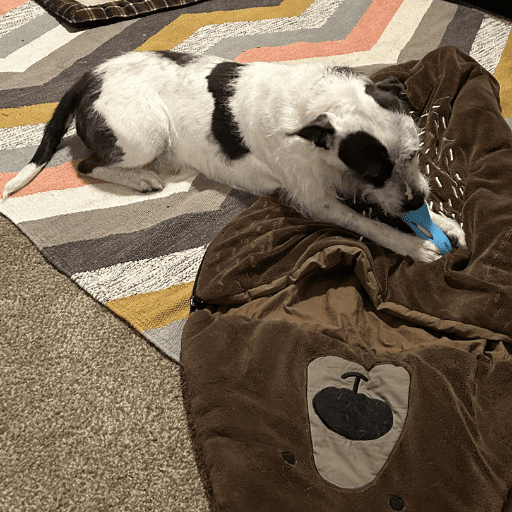
I like to have some kind of long term calming project ready for him to work on before he settles and rests. These projects promote resting and self regulation, usually through prolonged licking or chewing. Here are my go-to long term calming projects:
- A frozen cheese stick shoved inside of a WestPaw Qwizl*
- Goat milk frozen into a WestPaw Toppl *
- Frozen goat milk in a Woof Pupcicle *
Before he started having problems with his teeth, my other go-tos were:
- Frozen marrow bone
- Bully stick
- Beef trachea
There are more ideas for long-term calming projects here and here.
The Gear That Makes Walking a Reactive Dog More Manageable
I feel like my trial and eval of gear is neverending, but our current setup has been working really well for about a year now!
Here’s what I currently carry:
- Fanny pack + treat pouch with poop bag dispenser (Sipsey-Wilder Rover pack) and:
- Mix of medium and high value treats, plus an extra high value favorite such as a cheese, jerky, or pepperoni stick, or a Babybel if I’m feeling fancy
- Silicone loop on belt for holding full poo bags
- A small comb in case of burrs
- Travel pack of wipes
- My inhaler, keys, and phone
- Emergency items to detract a potential approaching off-leash dog: Citronella spray and can of compressed air
- Optional: Muzzle attached to belt with a carabiner
- Leash belt connected to:
- 20’ biothane leash for decompression walks
- 10’ biothane leash for early morning neighborhood park walks
- Petey’s gear:
- Harness with handle
- Collar with tags
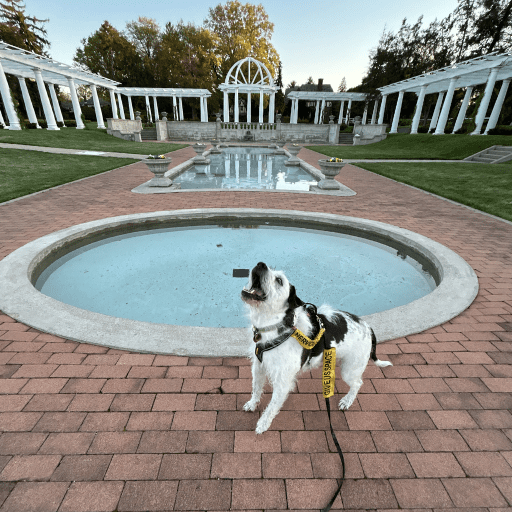
- Leash wrap: “Give us space”
- Safety strap + wrap: “Nervous dog”
I am a hypermobile human with particularly bendy wrists and hands. Although my grip is pretty strong, I have developed arthritis in my thumbs, which can be quite painful. That’s why I wear Petey’s leash clipped to a belt, and guide the leash with both hands. Big Man, on the other hand, has been training for Strongman competitions for as long as I’ve known him, and has bear paws to grip the leash. I have leashes with detachable handles that work well for both of us. I prefer biothane over other types of leashes because they are so easy to clean and can take quite a beating.
I carry all kinds of stuff that Big Man does not. If you think I’m getting him to wear a fanny pack or a treat pouch, you thought wrong. Luckily, large man = deep pockets. He carries a small reusable ziplock-style baggie of treats and some poop bags in his pocket. Because he is so large and imposing, I also don’t worry about him not having the same emergency items that I carry. With nearly 30 years of experience as a field biologist, he has many tricks up his sleeve should he need to fend off an off-leash dog or human.
Welcome to my car! Her name is Effie, and this is how I keep all of my walking equipment organized but easy to access.
In this clip, Petey had just chased a rabbit. He was still frantically sniffing at the end of the leash, so I wanted him to bring it down a notch. I cued him to shake off and he could not yet respond, so I made some sounds. When he did finally shake it off, I celebrated this de-escalation with him! I then turned my feet and body the other way and cued “this way” to indicate we were going to walk in the opposite direction of where we had seen the rabbit.
How to Set Up Your Gear So You're Not Scrambling Before Every Walk
If you walk a reactive dog, chances are you, like me, carry extra stuff, so gearing up for a walk can feel like a whole process. But environmental arrangement (aka management) is not just for our pets! Having your walking supplies and gear stashed in easily accessible spaces and, as much as possible, packed up with what you need, can free up some bandwidth.
Here are a few strategies I’ve implemented over the years that have helped me:
- Harnesses, leashes, treat pouch, and supplies are all stored by the back door on hooks or in baskets.
- A “trail mix” of treats is stored in a container in the kitchen so it’s easy to grab if I need to fill up my treat pouch
- A small stash of treats stays in my car in case I need to help Petey with something he is having feelings about (motorcycle men are public enemy #1).
- A car coat hanger behind the back seat makes for easy leash access. I have leash keepers for all of my long lines and I loop them on the hanger.
- I keep rubber boots, jackets, and other weather-related gear in my car, along with bug spray, sunscreen, towels, and wipes.
Defining Our Terms
- Escalation: behaviors that indicate a dog is moving into an elevated level of arousal toward fight, flight, or freeze.
- De-escalation: behaviors that indicate a dog is gradually becoming more relaxed. In other words, they are calming down rather than ramping up. Learn more about the ladder of de-escalation here.
What to Reinforce on a Walk with a Reactive Dog (And What to Look For)
When Petey first came home, he was hypervigilant on walks; constantly scanning the environment, darting at the end of the leash, and weaving side to side. It felt impossible to catch even a second of his attention. We had to change A LOT of things (including getting the right meds) before we got the chance to toss him treats when he’d look at us, but that’s not what this blog is about. Trainers are always telling you to reinforce stuff you like to see, but what might that look like on a walk with a reactive dog? Here are a few behaviors that have me reaching into my treat pouch:
- Looking at me
- Getting closer to me (even if I know full well he just showed up to get a snack, he can certainly have one)
- De-escalation behaviors:
- Shake off
- Turning attention from something interesting and/or triggering toward me
- Putting slack in leash / slowing down
- Turning and moving away from a trigger
- Responding to known cues, of course
Learning your dog’s body language and identifying their ladders of escalation and de-escalation is an incredibly important component of navigating the world with a reactive dog. You can read more tips from Allie for working with your reactive dog here.
Celebrate Small Wins and Remember That Little Treats are for Everyone!
What made your walk successful today? Quicker recovery (for human or dog), lots of time sniffing/investigating, less hypervigilance, exploring a new space…email your trainer and let them know so they can celebrate you! Get a coffee on the way home (or a Dr. Pepper if you’re me), take yourself on a small date to the garden center, or just have a snack when you get home. Find a small, simple way to take a moment for yourself!
Pro tip: Things getting stressy on your walk? Sing a song about the things you don’t like. Talk smack about other people. Tell your dog in your best opera voice that they are on your last nerve. Have a rap battle with the honking geese. It’s a non-threatening and deeply unhinged way to promote de-escalation in your own body.
Simply…Doing the Best We Can
Life with a reactive dog isn’t simple. With so many factors out of our control, we need routines and practices that set us up to have the best possible outcomes, because sometimes things just don’t go as planned. Even with 7+ years of practice, even Petey and I have an unpleasant walk once in a while. Back at home, we’ll have space and time to complete our stress response cycles, regulate, rest, and try again another day.
Here’s to harmony,
Tiffany
Now What?
Think of one thing you can tweak that might make walking your dog easier, and trial it this week! Some suggestions based on my blog:
- Get a mix of mid value treats and create a “trail mix” in a container that is easy to access before a walk.
- Find some high value treats that are easy to carry and place them in an easy to access spot.
- Don’t know what your dog values? Check out this blog.
- Organize your walking gear so it’s easy to grab.
- Block out some time on your calendar this week that gives you the best chance to have a nice stroll (based on you and your dog’s criteria for what’s nice).
As always, If you and your dog need a plan that helps you both feel better about getting out and about together, we’re here to help!
PS: Capitalism
Do you want a list of enrichment and training products we’ve already tried while supporting our free, public content? Check out our Amazon shop. Our team spends a significant amount of time working on content every week. We love it! But we’re also out here trying to pay our bills.
* Pet Harmony, LLC is a participant in the Amazon Services LLC Associates Program, an affiliate advertising program designed to provide a means for sites to earn advertising fees by advertising and linking to Amazon.com.
Copyright 2025 Pet Harmony, LLC. All Rights Reserved.
Terms & Conditions, Privacy Policy
Results are not guaranteed because behavior, human, canine, or otherwise, are not guaranteeable.