When Kids Are Part of the Plan: Crafting Enrichment Plans for Families

By this point in time, I imagine that many pet parents have heard the term “enrichment” being bandied about, especially if you are one of the pet parents that happen to be frequent visitors around these parts. I can offer no apologies for being as passionate about enrichment as we are here at Pet Harmony. After all, the way we define enrichment should help you to understand why. Enrichment is all about meeting ALL of an individual’s needs which is, you know, kinda important for survival and well being. 

I one hundred percent acknowledge that defining things can be much easier than putting them into practice, however. Especially for busy families. Work, school, after school activities, meal prep, household tasks, paying bills and meeting kids’ enrichment needs can take a toll. I felt exhausted just writing that sentence! Y’all are responsible for so much! 

It gets even more complex when we add a pet or two into the mix. How do we navigate meeting everyone’s needs when we barely have enough time to get the basics done? How do we make sure that the kids’ needs, the pets’ needs and our own needs are being met when there are still groceries to buy, dinners to prepare, homework to complete, practice to attend, and baths to give? 

While I can’t help you with grocery shopping or carpool responsibilities, the purpose of this post is to help you with crafting plans that will help you help your pets. My goal is to empower you to create sustainable, safe and enriching environments that support all the members of the family including small humans and your furry four legged friends. 


Let’s be strategic first. 

There are plenty of ways that you can safely involve your kids with partial responsibility for meeting the needs of your pets. There are also plenty of good reasons why you might want to consider doing so. There is existing research that indicates that having and caring for pets has a positive effect on child development, including intellectual development, concentration, social interactions, and stress reduction.

Even so, it is a good idea to make sure you take your pets and your children into consideration. Factors to consider include the ages of both your pets and your children, the physical health of the pet, the sociability of your pet and the relationship your pet and child share. We should never do something just for the sake of doing it. We have to do an analysis of the benefits for the individuals involved. If you are feeling uncertain about what that looks like, working with a training and/or behavior professional can help you come up with strategies that will work for your particular situation. Overall, the goal should focus on building/strengthening bonds, fostering responsibility and empathy, while balancing the needs of your family with the needs of your pets. 


Still with me? 

Strategies that can work for the younger child crowd are outlined in this blog post and include Montessori-inspired ways to have your child prep food, water, food puzzles and lick mats. Older kids can have more independence in terms of helping with the day to day tasks that are required to maintain physical and emotional health in our pets. Depending on the child’s age this can include the following ideas: 

  • feeding
  • playing tug or fetch
  • playing hide and seek
  • teaching new skills through training 
  • prepping enrichment puzzles or toys
  • simple games like “find it” or “kibble fetch.”  


Again, the focus here should be on fostering the relationship between child and pup so choose the activities that match the energy level of both. In order for enrichment to truly be enriching, we should not be taking a one-size-fits-all approach in any case. If you have a low key pup but a high energy kid, playing a short, active game like tug or fetch can easily be followed by having your child scatter some treats in the yard for their best friend to sniff out. Don’t be afraid to ask for your kids’ input too. They are incredibly creative problem solvers and there is likely to be higher buy-in from them if they are part of the decision making process! They might enjoy looking at this blog post about creating low cost DIY enrichment to get their creative juices flowing. 


School’s almost out for summer…let’s make a plan! 

While we are on the subject of kids and dogs and meeting needs, I’ve got one more suggestion to share. With summer quickly approaching and kids’ presence in the home looming large over a dog’s day, it’s important to plan for the inevitable changes in daily routines, schedules and predictability.  I highly recommend getting a jump start on your planning now so that habits can be built (for pets and humans alike) before a potential conflict occurs. 

As excited as I suspect most kids are at the prospect of lazier summer days, I wonder what pets would say if they had the ability to tell us what is on their minds. After all, the majority of pets spend a fairly significant portion of their days resting, relaxing, and napping off and on. With more folks present in the home during summer vacation, the environment might be less supportive of meeting a pet’s individual need for rest. It might be a surprise for some folks, but rest and relaxation fall under the very important enrichment category of calming enrichment. It’s so important that it gets its own chapter in Canine Enrichment For the Real World. Rest, relaxation and sleep are all integral for well being no matter what species we are talking about.  


So, what’s the plan? 

If we know that calming enrichment is significant in its importance for our pets, how can we arrange things so that it is more likely that our pets will have this need met during the hustle and bustle of summertime? Great calming enrichment activities with ways that kids can prep for them are as follows: 

  • Licking enrichment: 
    • Create dog safe recipes that the kids can spread on a  licki mat or stuff into a Kong or Toppl. 
    • Kong has some great recipe ideas on their website as does West Paw and here is a list of dog safe foods for ideas that can be used. 
    • Don’t forget the kitties-they like licking activities too!   
  • Scent enrichment:
    • Send the kids on a treasure hunt to see what smells they can dig up from inside and outside the house. Dirty socks are sure to be a hit! 
    • Basil or other herbs from the garden can be of interest to some pets. 
    • Catnip for cats can be grown in a pot and tended to by the nurturers in your family.
    • Found tufts of rabbit fur can be intoxicating. 
    • Sea shells from the beach, or leaves, branches and dirt from a nearby forest preserve can be collected and brought back to be used on a rainy day. 
    • If you like listening to podcasts, here is an Enrichment for the Real World podcast episode that has other scent enrichment ideas that you and your child can implement together. Many of which are super easy! 
  • Chewing enrichment: 
    • Does your child like to engage in citizen science? If so, can the animal they observe and learn about be the pets in your house? 
    • If we narrow that down, can they design an “experiment” to see which chewing enrichment your pet enjoys the most? What do they hypothesize? 
    • How can they collect data? Once they have their observations encourage them to share their findings with the other members of the family. Perhaps a little data scientist will emerge in the future! 
  • Safe spaces that include the ability to rest and nap: 
    • Ask your child for their observations about where they see your pets resting frequently. 
    • Based on the information they provide, discuss the ways in which you will keep that location as “dog friendly” as possible. Ask them for ways in which they can make sure to communicate this to other household members. 
      • Would they like to make a sign that says “Daisy’s Sleep Zone” so that everyone knows that when Daisy is resting there, they should not be disturbed? 
      • If your pet’s favorite resting place is in the hub of the home, let’s say on the family room couch, ask them to help you think of alternate resting spaces that will give the pet a kid free, quieter location to rest.
    • Share this Grumble and Growl Zones resource from Family Paws with them so they understand the importance of leaving the family pets alone when they are resting or enjoying a doggie snack.

Now What?

If you know me at all, you know that one of the things I say a lot is to be proactive, not reactive! Let’s start creating healthy sustainable habits now that will set everyone up for success in the future. This includes the following goals:

  • Include the human kids in the household to be part of the creative, troubleshooting process. You might be surprised at the ideas they come up with. A nice side-effect is that taking a team approach typically works to create a deeper investment in the process.
  • Enrichment is a wonderful way to build bonds between pets and kids. With the suggestions above, getting started should not be super labor intensive. 
  • Start planning for a safe space now so that when summer vacation starts, you are well prepared. 
  • I’ve already shared that at Pet Harmony we are passionate about creating enrichment plans that support your pets without being terribly taxing on the human. We know you are busy and that, while you love your pets, they are not your only priority. If you need help, we are here for you

Here’s to harmony! 

MaryKaye 


Resources

  1. Yu, C. (2024) A Systematic Review of the Positive Effects Of Pets on Child Development. Communications in Humanities Research, 39, 82-87 

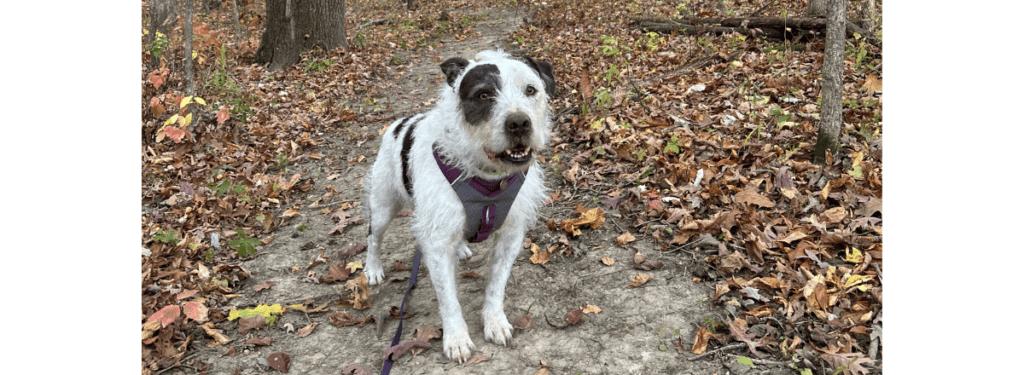
Scruffy white and grey dog in a purple harness standing in the snow.

A Day in the Life of Petey the Wondermutt: Enrichment That Works for All of Us

If you’ve been around for long enough, you’ll already know that enrichment is about outcomes. And if you don’t already know that, hi, welcome! When we observe the outcomes of an activity, we’re watching for what our pets do after it’s over. You may have also met Petey the Wondermutt on the blog or podcast

This practice has gained me a useful set of skills. Based on my observations of Petey’s behavior, I can pretty accurately reverse-engineer what he needs and pull out an activity from our enrichment menu. On my menu are go-to activities that I can easily slide in throughout the week and don’t require a lot of planning, which I work around the adventures that do require a plan.

I try to block out time in my calendar for longer Petey activities like walks, as I generally need to get him dressed, put him in the car, drive to the walk spot, pack up and drive home, and then get us both cleaned up. One recent outing to Fido’s Forest (a fenced, private dog park) required three rounds of soaking and washing to get all the mud out of Petey’s paws–which obviously means he had a great time, but extended my clean up time on the other side of this adventure.

Here are most of the variables that go into planning enrichment for the week (in no particular order):

  • Weather – Obviously treacherous weather prevents us from our preferred outdoor activities sometimes. 
  • The humans’ schedules – This is a big consideration when I’m blocking time. 
  • The humans’ bandwidth – Some things are more draining than others, you know? I’m also going to lump budget into bandwidth because it’s not always financially prudent to pay for an outing (like a Sniffspot).
  • Petey’s needs – Based on what I’ve observed and what he got to do the previous week.
  • The humans’ needs – Our needs to get outside and touch grass don’t always line up…especially because Big Man works outside all day anyway. Sometimes what the humans need is rest.
  • Clean-up time – Is this a quick foot wash situation or does he need a full bath? Sometimes the humans also require clean-up!

But not everyone involved in Petey’s enrichment plan takes this same path up the mountain.


Variations on a Theme: A Daily Enrichment Plan for the Non-Planner

Unlike me, Big Man is not much of a planner–he’s not going to look at the calendar and the weather and pencil in some adventures a week out the way I like to. So he’s got a different approach to providing Pete with activities if they are home alone together. In a very Big Man move, he shrugged and said, “I don’t put that much thought into it,” when I asked him how he decides what Petey needs. 

Except when he told me what he does, it obviously required data collection and trial and eval, even if that’s not how Big Man saw it. He’s a biologist, by the way–he’s got observational skillz built into his brain. He gave me some examples, and what I heard was how observing Petey’s body language and the outcome of an activity guides Big Man and helps him meet Petey’s needs. This is exactly what I meant when I say I can see what Petey is doing and reverse engineer what he needs.  

Here are some examples:

  • If Petey comes into the basement when Big Man is gaming and starts barking at him, he will take him up to the main floor to get a toy so they can play with it together. 
    • He has observed that when Petey barks at him and he goes to get a toy for play, Petey settles and rests after they are done.
  • If Petey starts sniffing around the room they are in together, Big Man hides some snacks for him to find.
    • He has observed Petey sniffing around areas where he had previously scattered or hid food for leftover snacks. When he gave him a “find it”-type project, Petey settles and rests after he’s done. 
  • If Petey comes into the basement while Big Man is gaming and begins climbing up into his lap (which is not a good place for him to be given his sensitivities to touch and movement), Big Man will either get up and take him outside to hang out in the back yard together, or go up to the couch and lie down where Petey can assume the safe position of laying between Big Man’s legs. 
    • He has observed that when Petey climbs up and tries to get close to him, if he spent some time together in social connection either in the back yard or on the couch, Petey was able to either explore the yard and settle (and did not continue to scale furniture and Big Man’s body), or would rest and sleep. 


Enrichment for the Real Pete

So what’s a typical day look like for our spicy boy? Living in the midwest, the seasons factor heavily into our plans. I try to make some kind of outdoor outing or adventure happen 2-3 times a week. When the weather is bad and the sun isn’t out for as long, it may only be once a week. If my mental, physical, emotional, temporal, or financial bandwidth (or any combination thereof) is very low on top of the other variables I mentioned, there may not be an adventure that week, and I rely on the strategies I discussed in the blog Indoor Adventure Time

Since I work remotely full time, I am generally home throughout the day to respond to Petey’s requests for attention and activities. They are similar to what Big Man has observed when he is home with Petey, but it is worth noting that Petey does not solicit play from me very often, which is a great example of how every member of a household has a different relationship with their pets. This is especially heartening to me because Petey has a long history of conflicted and aggressive behavior toward Big Man, which factors heavily into our use of management throughout the house. 

The following example is what Petey’s enrichment looked like throughout the day when we were able to get out and about. I’m going to point out the corresponding categories of enrichment for this first example so you can see how they fit into an enrichment plan. This is an adventure day we had recently because the weather was perfect, and it was a Saturday so I wasn’t working. Here’s what his enrichment for the day looked like:

  • Nap upstairs while I got groceries (independence, safety, security, calming)
  • Sniff groceries (sensory stimulation, species-typical behavior)
  • Car ride sniffs out the window (sensory stimulation)
  • Long walk in the woods on a nature preserve on 20’ longline (physical exercise, sensory stimulation, species-typical behavior, environment, social interaction)
  • Digging in the woods on walk (physical exercise, species typical behavior)
  • Chasing THE HOSE! (physical exercise)
  • Bath (hygiene)
  • Car ride home w/ nap and music (sensory stimulation, calming)
  • Shared chinese takeout w/ me while I watched TV (social interaction, species typical behavior)
  • Dinner in a takeout container (nutrition, foraging)
  • Snuggs on couch w/ me (social interaction, calming)

After a big adventure like this, the following day is a rest day. Here’s what it looks like:

  • Naps upstairs in several spots while I worked downstairs (independence, calming, safety, security)
  • Long term calming project (LTCP): Pupsicle w/ frozen goat milk (species typical behavior, calming, mental stimulation)
  • Nap w/ me (calming, social interaction)
  • Freework dinner (foraging, species typical behavior, mental stimulation, nutrition)

As far as outcomes from activities, the adventure day example has a great mix of activities that are up-regulating/arousing (digging, chasing the hose, sensory input of the woods and woodland creatures), and down-regulating/de-escalating (sniffing, snacks, time with me). Combined with being physically tired from walking and exploring different terrain, running, and digging, prioritizing rest the next day was important. 

Here’s a typical day when we are not going on an adventure and I have stuff to do:

  • AM nosework session around house
  • Nap with window open while I worked on a blog
  • Fresh mozzerella stuffed in a toy while I did the dishes
  • Upstairs nap time while I cleaned and waited for Big Man to come home 
  • Nap w/ Big Man upstairs
  • Shreddy dinner in trash tent (a small pop-up x-pen tent that contains the shredding mess)
  • Snuffle in toy bin for rogue treats
  • Rest in crate while people watch TV and occasionally toss a Cheez-It over the gate

This example was from a week where spring storms were rolling in and out, I had plans to drive to Ohio to see my parents, and I had house stuff  to do. I needed an indoor activity that I knew would tax Petey mentally and get him moving around a bit as well. Shout out to nosework! We are still working up to tracking odors, so we do short rounds with food hidden at different levels (floor, low shelves, table, up on couch, window sills, etc.) and with lots of structures to move around (up and down stairs, around pillows and blankets, on and off furniture, etc.). He goes into his crate while I set up, I release him and cue “search,” and once he’s found all of the hidden snacks (it was mozzarella pearls this time), I cue him back to his crate and start again. He usually takes a long nap after a 30-45 minute nosework session. 


Enrichment for the Latchkey Pete

I didn’t always work at home, so I wanted to provide an example from back when I was out of the house 9-10 hours a day. Here again you’ll see a day off where I was able to prioritize an outing, plus a rest day for Petey when I was working.

Wednesday (day off):

  • AM snuggs on the couch w/ me
  • AM back yard time
  • Breakfast in a cereal bowl I had just eaten out of
  • Cemetery walk on 20’ longline
  • Back yard hose chase
  • Nap time upstairs (gate up in hall, access to two rooms)
  • Rest/lounging downstairs
  • Shared lunch w/ me
  • Nap on couch w/ me
  • Afternoon chew (trachea)
  • Sniffing the rain and observing out upstairs window
  • Upstairs nap
  • Dinner in a leftovers container
  • Toy play w/ me
  • Sniffed lavender bath bomb and hung out in bathroom while I was in the bath

Thursday:

  • AM snuggs on couch w/ me
  • AM back yard time
  • Breakfast on plate I just ate off of
  • Home alone naps
  • Lunch w/ me
  • Home alone naps
  • Dinner destructible in the back yard
  • Long term calming project: Frozen cheese stick in a WestPaw Qwizl


I Love it When a Plan Comes Together

Petey’s enrichment chart is overly complicated because of who I am as a person, but I wanted to share an excerpt so you can see how it compares to the days that I have shared above. Many of the categories of enrichment (including independence, instinctual behaviors, mental exercise, physical exercise, and sensory stimulation) have options that are fairly easy for us to access. For example, a trip to the private dog park checks a lot of boxes for us because he gets to be off leash and romp in the woods. It does, however, cost money, require a reservation, a trip across town, and usually clean-up time. But it tends to be doable most weeks. 

I use Google Sheets to keep track of Petey’s enrichment plan. I have broken my plan out into specific activities that fit the categories of enrichment because that’s how my brain works.

Pet Enrichment Plan Overview
Category Activity Need met? Agency? Plan
Independence “Office Hours” behind gate upstairs without humans Somewhat. Encourage more office hours w/ LTCP As much as possible – multiple areas for rest and activities. Start to do more office hours this year now that Tiffany works from home full time.
Instinctual Behaviors Chasing, digging, exploring, chewing, barking, etc. Yes. Regular decompression walks and time at Fido’s Forest. As much as possible. Increase decompression walks with improving weather. Improvements to sensory garden.
Mental Exercise Nosework Yes, he seems to enjoy it, and he usually settles well after a session. Yes, he can opt out and also ask for help. Working toward tracking scent vs. snacks, but really enjoys tracking the snacks.
Physical Exercise Play (toys, hose, etc.) Mostly — often depends on weather. Can solicit play with humans. Free movement during off-leash time at Fido’s. Hose time when possible for joyful romping. Yes. Can solicit play with humans. Free movement during off-leash time at Fido’s.
Sensory Stimulation Quiet sniff/observation time Mostly? Sensory garden/yard time. Yes, can retreat inside or ask to stay outside. Revamping sensory garden for the warmer months.

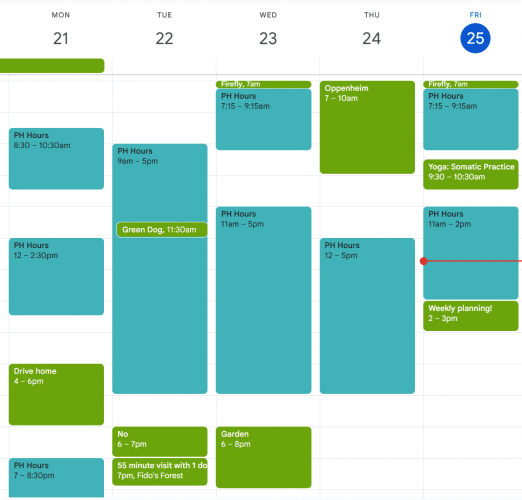
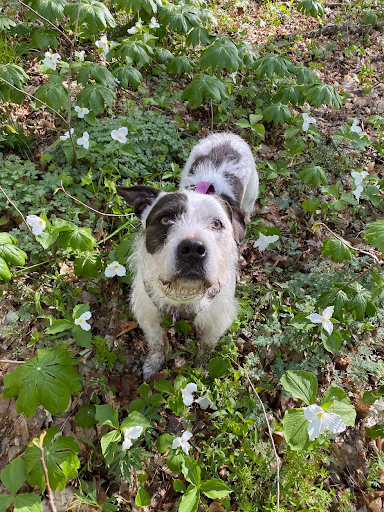
I talked a little bit about planning and blocking time, but I also wanted to share what this looks like. There are only three activities on the schedule that involve Petey: Tuesday 4/22 @ 7 pm we have a spot booked at the private dog park (Fido’s Forest), on Wednesday 4/23, I have a block of time to work on the sensory garden, so Petey will chill outside with me while I work hard and he lounges on the picnic table and sniffs the wind or checks out the new configuration of tires, blocks, and hay bales I make for him. On Thursday 4/24 I have time blocked to drive us out to a nature preserve that I know fills up with wildflowers in the spring, meeting some needs for both of us!

A calendar screenshot shows a typical week with time blocked for Petey's longer activities and Tiffany's work hours.
A calendar screenshot shows a typical week with time blocked for Petey’s longer activities and Tiffany’s work hours.

Because Enrichment Shouldn’t Be Another Full-Time Job

Remember, enrichment is also for humans! Time blocking and sliding in activities from our enrichment menu help me alleviate the daily pressure of making sure Petey’s physical, mental, and behavioral needs are met. And that gives me time to enjoy my scruffy bestie and meet my own human needs.

The truth about enrichment for dogs with behavior issues is that fancy puzzles and frozen meals that look like works of art are not remotely part of the plan. When the minimum time needed to pack Petey up and safely get him for a walk is 1.5 hours, it’s not a daily occurrence. We need simple, proven strategies to get us all through the week. Meeting the needs of the members of this household isn’t fancy or glamorous, and it’s always a work in progress. 

Now What?

What data are you collecting and tracking around your pets enrichment needs? Do you have a pretty good idea of how certain activities affect their behavior? Do you know how to utilize those observations to provide activities throughout the day or week? If you are struggling to help your pet with behavior issues, ensuring their individual needs are met can be overwhelming. Reach out to our team if you need help. We can turn what you already know about the non-human members of your family into an actionable plan that brings your household relief!

Here’s to harmony!

-Tiffany

A scruffy white and dark grey dog looking through a round opening in a wooden wall

Indoor Adventure Time

It’s 7am on a blustery December day and Petey the Wondermutt has a very important 8am appointment for a jaunt in the woods. I can hear the wind howling outside, so I pick up my phone to check the weather. Windchill of -4 degrees!? Guess we’re stuck inside.

Last night we had seen an increase in frequency, intensity, and duration of barking when my husband (hereby known as Big Man) came home from work. I knew that meant Petey could use some time tracking scents, moving his body, investigating his surroundings, and ideally spending some time digging. An off-leash romp in the woods, a meandering walk in the cemetery on a long line, or an adventure to a nature preserve would be ideal options for engaging in most of these behaviors (I’m not going to make the cemetery grounds crew mad at me by letting him dig a hole!). But with the sudden drop in temperature, those options were off the table.