

5 Ways Your Dog's Leash Reactivity Starts Before You Leave
Estimated reading time: 5 mins
With the weather getting nicer, you’re probably itching to get out more with your dog. If you’ve ventured out recently, you’ve likely noticed that everyone else has the same idea.
You know your dog’s triggers, so you do what you can to avoid them. You’re calculating routes to avoid the “nemesis” neighbor dog (the one who is always off-leash). You’re timing your exits to miss the school bus rush. My personal favorite: you’re driving to a deserted office complex or parking lot where you’re least likely to encounter anyone else.
Look at you go! You’re practicing diligent management, advocating for your dog, and setting them up for success. You’re killing it!
But here’s the kicker: Environmental management is about more than just what happens on the sidewalk. It’s not just what we encounter on a walk that causes our dogs to be reactive. What happens before the walk has a massive impact on how that walk is going to go.
1. Medical Reasons: The Silent Short Fuse
I’ll shout it from the rooftops: physical health is the absolute foundation of behavior. If your dog is uncomfortable, their fuse is significantly shorter. Think about how you feel when you have a pounding migraine—are you as patient with your coworkers? Probably not. I’m sure not.
Even super active animals and young dogs can experience chronic pain that manifests as irritability or hyper-awareness. Back and neck tension, dental discomfort, or undiagnosed osteoarthritis can make a simple leash tug feel like a major assault. To complicate matters, many dogs are stoic—they won’t limp or whimper, but they will growl or lunge because they are defensive of their personal space.
GI issues are heavily linked to mood. A picky appetite isn’t usually just a personality trait—it’s often a sign of underlying nausea. If your dog is experiencing gassiness, frequent vomiting, or a Fecal Score of 3 or above, their internal system is already in red alert mode.
Chronic allergies or ear infections cause a constant, nagging drain on a dog’s coping bank. Imagine trying to stay calm while wearing an incredibly itchy sweater you can’t take off. I’m already cringing just thinking about it!
Important Note: If any of this sounds familiar, start by talking to your veterinarian. We cannot train away physical pain or systemic illness. Addressing these medical roots is the necessary first step toward living in harmony.
2. Routine Rumbles: Life Changes & Sleep Deprivation
Dogs are creatures of habit. When the rules of their day shift, their baseline stress rises.
Changes in your work hours, a recent vacation, or even having a guest stay over can leave a dog feeling unsettled.
Nearby construction isn’t just a noise issue; it’s a sleep issue. Dogs need significantly more sleep than humans. If your dog is in a state of constant hypervigilance because of hammering from the construction workers outside, or with the garbage truck going up and down the street on trash day, they aren’t getting the restorative REM sleep needed to regulate their emotions. A sleep-deprived dog is a reactive dog.
3. Trigger Stacking: The 72-Hour Rule
Stress hormones like cortisol don’t just vanish; they can linger in the system for up to 72 hours. This is trigger stacking.
It is vital to remember that the body doesn’t always distinguish between “happy” excitement (eustress) and “scary” stress (distress). Cortisol is context-blind. Whether your dog is terrified of a storm or over-the-moon excited about a high-intensity play session, their body pumps out the same chemicals.
Example Stack:
- Monday: The mailman startled them (Distress).
- Tuesday: A high-intensity 2-hour playdate with a favorite friend (Eustress).
- Wednesday Morning: A stressful nail trim (Distress).
Imagine your dog has a stress cup…by the time you clip on the leash Wednesday afternoon, the cup is nearly overflowing from both the scary and the fun events. A simple sight of a dog across the street causes the cup to spill over in an explosive reaction.
4. Pre-Departure Etiquette & Gearing Up
The walk starts the moment you move toward your walking shoes. For many dogs, the pre-departure cues (grabbing keys, putting on a jacket, or picking up the leash) send their heart rate skyrocketing. A couple of things to watch out for:
- The anxiety of the routine: If your dog has separation issues, these cues signal a major transition they might find overwhelming.
- Equipment struggles: Take a look at your gear. Is the harness too tight? If you have to wrestle them into their collar, they are entering the walk in a state of conflict, where the dog’s survival brain takes over before they even step outside.
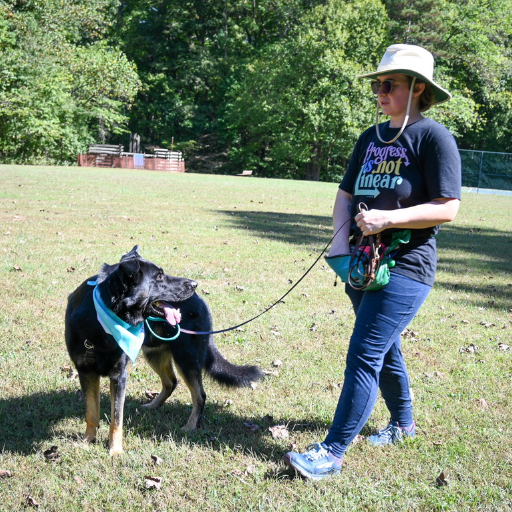
Pacha and Jordan on a nice quiet walk. Photo courtesy of Jordan Bradley (Click to Communicate)
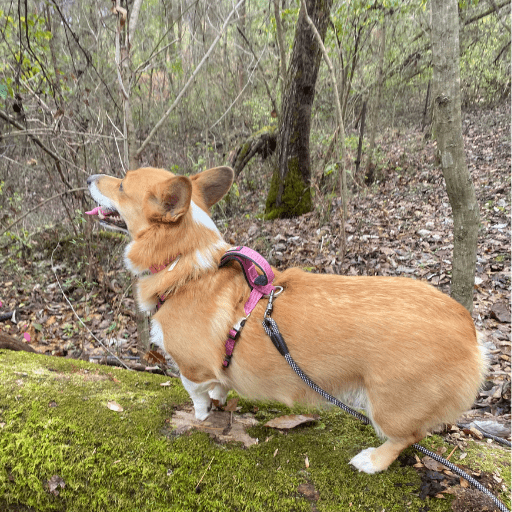
Consultant Beccy’s pup Tigerlily gets most of her exercise at home, but here she is out stretching her legs in the woods. (Don’t make fun of her legs.)
5. Your Energy Transfer: The Biological Mirror
Our dogs are biological mirrors of our own internal states. They are incredibly attuned to our heart rates and breathing patterns.
If you’re rushing through your morning or feeling frantic, your dog picks up on that high-arousal energy. If you’re scanning the horizon for “the enemy” with a white-knuckled grip on the leash, you’re sending a clear signal down the line: I’m nervous, so you should be too.
When the Walk is a No-Go: Long-Term Calming Projects to the Rescue!
If your dog’s cup is already at the brim, the best thing you can do is stay in. At Pet Harmony, we love using long-term calming projects (LTCPs) to help dogs de-escalate, lower arousal, and encourage physiological rest. A few favorites:
- Foraging: Activities like snuffle mats tap into natural scavenging instincts, which are naturally decompressing.
- Licking & Chewing: These behaviors release soothing endorphins. A frozen lick mat can provide 20 minutes of focused, quiet work.
- Scentwork: Hide high-value treats around a room. Engaging the nose is incredibly grounding and shifts the dog from mountain lion brain back into a thinking state.
Is it Working? Evaluating De-Escalation
We aren’t just looking to tire them out; we want to see a shift in the baseline. When evaluating if your LTCPs are hitting the mark, look for at least one of the following:
- Lower frequency: Reactions to triggers happen less often.
- Lower intensity: The explosions are less dramatic (e.g., a huff instead of a lunge).
- Shorter duration: The reaction ends more quickly.
- Faster recovery: Your dog returns to a calm state (shaking off, sniffing, or resting) much sooner after a trigger passes.
- Direct engagement: Visible signs of relaxation or de-escalation while they are actually engaging with the activity.
Silver Linings
Choosing to stay in and play Find It instead of battling the neighborhood school bus isn’t a failure. You are prioritizing your dog’s mental health and your own sanity.
Think of these indoor days as a spa day for your dog’s nervous system. By the time the weather is perfect and the neighborhood is quiet, your dog will be starting their walk with a completely empty cup and a tail that’s ready to wag.
So, grab a snuffle mat, hide some treats, and enjoy the peace and quiet of a “no-walk” day. You’ve got this!
Here’s to harmony,
Veronica
Now What?
Go back through the five categories above. Which one hits closest to home for your dog? Is it a medical issue you haven’t ruled out yet, or pre-departure jitters that are sending your dog’s heart rate through the roof before you even reach the door?
Pick one. Write it down.
Next, write down one small thing you can try this week. That might mean videoing your pre-walk routine to spot tension in the leash or in your own body language, tracking your dog’s sleep and stress patterns for a few days, or simply loosening up the harness fit. Your behavior consultant can help you figure out exactly what to look for.
Put it on the calendar. Five minutes a day is plenty to start.
If the task feels too big, work with your behavior consultant to break it down further. And if you haven’t starting working with one yet, we’re here to help!
PS: Capitalism
Want to support our free, public content? Check out our Amazon shop. It’s full of enrichment and pet care items (that we really, actually use). Our team spends a significant amount of time working on content every week. We love it! But we’re also out here trying to pay our bills.
* Pet Harmony, LLC is a participant in the Amazon Services LLC Associates Program, an affiliate advertising program designed to provide a means for sites to earn advertising fees by advertising and linking to Amazon.com.
Copyright 2025 Pet Harmony, LLC. All Rights Reserved.
Terms & Conditions, Privacy Policy
Results are not guaranteed because behavior, human, canine, or otherwise, are not guaranteeable.