

Years ago, I worked as a behavior consultant at an animal sanctuary. One of the skills that the facility thought was super important was for their dogs to feel comfortable getting into a car, to the point where it had a name: “car training.” It made sense; getting into a car is something that the average adopter assumes will happen. After all, how else will they get the dog to the vet clinic? Or, for that matter, home?
So, as part of the behavior team, one of my duties was to help my caregivers car train the dogs in their care. I’d say the majority of the dogs in our care had an issue getting into a car when they first arrived at the sanctuary. Many were strays who likely had never been in a car before. Others were from hoarding and abuse cases and had additional anxiety issues on top of getting into a car. Oh, and I should mention that the sanctuary had around 400 dogs on the premises at any given time. All this to say: I’ve done a lot of car training.
Now that I work with private clients, I don’t see this problem come up as frequently, but it does come up. And, like all things, it can be more complicated than it seems. There is, however, a fairly standard list of strategies that I go through to solve this issue.
Note that you might not need to try all of these strategies if you know what to look for when building your plan (body language, reading the antecedent and consequence of subtle behaviors in real time, gait analysis and body mechanics, essentially a whole host of things that go way beyond the scope of this blog).
I also find that there’s often a larger interplay between physical and behavioral solutions for helping with car anxiety than expected, so don’t be quick to write off any suggestion. We’ll talk more about that in a moment.
Tip #1: Investigate pain – even in younger dogs
Getting into a car, especially something taller than a sedan, is quite physical. It requires coordinating a lot of different body parts and muscles and having them all work together with precision. Pain in just one area can make that more difficult and cause avoidance.
Let’s be really clear: pain does not always look like pain. Our pets are really good at hiding pain. By the time we see obvious signs like limping or whimpering, it’s likely that the problem has been going on for a while. In fact, Malkani et al. (2024)1 found that behavioral changes, like increased fearfulness, prolonged recovery from stressful events, and reduced interest in social interactions, often appear before obvious physical signs like gait changes and limping.
I mentioned not to be quick to write off any suggestion. Exploring pain as a contributing factor is commonly glanced over. I have my personal theories for this, which we don’t need to get into, other than one: the assumption that joint pain only, or even primarily, affects senior dogs.
Canine Arthritis Resources & Education (CARE) cites research that finds, “40% of dogs under the age of 4 years old have evidence of arthritis on x-rays, and about half of these dogs show symptoms of pain associated with arthritis.”2 As I once heard Veterinary Behaviorist Dr. Amy Learn say, “Arthritis is a young dog’s game.” Other pain-related issues may cause your dog to avoid cars, but arthritis comes to my mind first.
While X-rays are the way to rule something like arthritis out, your vet may opt for a simpler route first with a pain med trial. It’s not foolproof, as different medication treats different types of pain, but it’s a much cheaper start than x-rays!
There are a whole lot of ways to address pain, so we recommend working with your vet to come to a solution that works for everyone. On podcast episode #47, we discuss how to phrase feedback to a vet so that you’re both on the same page and your vet is receiving the information they need from a medical standpoint.
Tip #2: Address motion sickness
Anyone with motion sickness can tell you that it’s a powerful aversive. My husband – who has had severe motion sickness since childhood – tells a story of literally jumping out of a [slowly] moving car when he was little to avoid the feeling. Like the possibility of joint pain, it’s not something to write off. And, like joint pain, motion sickness doesn’t always look like vomiting or excessive drooling. Sometimes it just looks like listlessly sitting there.
Like in human children, puppies and young dogs are more likely to have motion sickness due to undeveloped inner ears. Many individuals grow out of this, but not all do (like my husband). However, I find that if a dog had motion sickness as a puppy, they often develop anxiety around car rides, even if they do grow out of motion sickness (also like my husband).
A simple solution for the physical side of motion sickness can be an anti-nausea medication trial. I have had clients with adult dogs where that alone did the trick. But I’ve also had plenty of clients with adult dogs who needed a combination of anti-nausea medication and behavior modification because the dog learned that car = nausea, regardless of whether the nausea was actively happening.
Tip #3: Make the car easier to physically access
When it comes to car anxiety, my brain splits tips and tools into two categories: predominantly physical and predominantly behavioral. I have seen enough situations in which body mechanics and physical ability, not related to behavior, are actually the issue. Some of this goes hand in hand with addressing pain, but the method of entry or the space itself can contribute to a pet’s reluctance to enter a vehicle. For example, littles who don’t love being picked up!
Try stairs or a ramp
Stairs vs. ramp is partially a preference (a ramp may be easier than stairs if pain is involved) but is also dependent on your setup and space. For example, I have a single-car driveway with no garage, and the front yard is on an incline. Depending on the car, it could be nigh impossible for us to use a ramp because we simply don’t have that much space to set it up. (P.S. Stairs are also hard for Oso, so we instead opted for the Help ‘Em Up Harness)
When it makes sense to include stairs or a ramp in my client’s plan, I have them start inside, going up to a piece of furniture. It can be hard to teach a dog how to use a new piece of equipment. Even if they can go up and down the stairs in your house, it’s new to get into the car. The details are beyond the scope of this article, so for now, just trust me that this is the easiest way to teach that piece of equipment before adding it to the car.
Tip #4: Change the entry point or interior layout
Think about it: a large dog, especially one with a longer back (think typical Golden Retriever), has to both jump and turn almost simultaneously to get into the trunk of an SUV if the seats are up. They have to essentially stop their forward momentum as soon as their feet hit or they will faceplant into the seat in front of them. That’s a big ask, and one that physics might not make possible.
Try a different door or seat configuration
Experiment with the trunk vs. back seat for SUVs and hatchbacks. Stairs or a ramp can solve this problem, but if those aren’t an option then for many kiddos I find just trying the back seat instead of the trunk solves that physics and body mechanics issue. The back seat allows them the space to stick the landing and then move forward to turn around.
This is one of the strategies that I experiment with for most dogs who won’t jump into the trunk of an SUV or hatchback. It’s simple and can give us a lot of information, primarily: is this just an issue of trying to defy physics or is it that the car itself is truly the problem? If they willingly jump into the back seat – awesome! It was the first and we can explore down that path. Potentially no training needed. If they’re still opting out, behavior modification may be the answer.
If the back seat isn’t an option, put the back seat down for entry. Sometimes the back seat isn’t a viable option for daily use (usually because kids sit there). With the back seat down, the dog has enough room to maneuver getting into the trunk, then they can put the seats back up for the humans.
Open both back doors
I can’t actually tell you why this works, but I’ve seen it work enough times that it’s become part of my toolbox. I have theories about it increasing the amount of light (aka increase in sight) in the car interior or that it provides agency by providing a very clear exit route, but until dogs learn how to speak English I likely won’t know the truth. Regardless, it’s another simple tool that doesn’t hurt to try.
The other reason I like this option is because, if I have another human helping, we can have one handler on one side with the dog and the other human on the other side. Depending on the dog, treat placement can get awkward, tricky, or even dangerous, when you have to be behind them in a cramped space. This gives me more options for precise treat placement. I will also sometimes have a dog practice walking through the car without stopping to build repetitions of getting in and out with the (sometimes scary) stopping part. That becomes easier when both doors are open and there’s another human to transfer the leash to.
Tip #5: Reduce slippery or scary surfaces
Leather seats can be slippery. So now we’re asking them to coordinate a bunch of body parts and muscles to work together with precision, and then they may slip at the end of it. I don’t know about you, but I know that when I come across a known slippery surface, I’m not keen on jumping on it. That’s just a recipe to fall flat on my butt and hurt something.
My favorite solution for this is a car seat cover. We have something similar to this one* for Oso. It keeps him from slip sliding and also protects the leather and keeps it clean. It’s a win-win for both of us! Blankets can work in a pinch but because they’re likely to slide around make sure to tuck them tightly into the seat before trying.
I imagine you could also use Dycem,* a common non-slip tool for Occupational Therapists, if you don’t want to go the car seat cover route. I have not personally tried this tool in this setting, so take a grain of salt with that recommendation! (But let me know if you’ve tried it and it works!)
Tip #6: Identify your dog’s specific car triggers
Like addressing pain, there are a whoooole lot of ways to do this, and much of it will depend on what is actually triggering the anxiety. For some kiddos they’ve equated the entire experience as scary so we may not be able to parse it out, but for many of my clients we have been able to pinpoint more specific triggers. Triggers I’ve seen in the past include:
- The car moving (with the dog being okay if the car is stopped). I’ve also seen dogs who have issues with the car moving over a specific speed.
- The engine starting
- Windshield wipers being on
- Turns (and, in turn [pun intended], turn signals that signal a turn is about to happen)
- Routes that predict scary things (e.g. the turn that signifies we’re going to the vet and not daycare)
- The heater or air conditioner being on
- Duration of car rides
- Other vehicles going past the window
- Getting in or out of the car (with the dog being okay once they’re in. This is usually due to pain or a history of pain.)
- Humans buckling their own seatbelts
- The sound of the alert for the seatbelt not being belted
- The dinging when the keys are still in the ignition
- Confinement
- Beeping sounds when backing up
- Motorcycles
- Revving engines
- Compression breaks
- Side streets vs. highway speeds
- Speedbumps
- Emergency vehicles and sirens
- Traffic
- Dogs and humans outside the vehicle
As you can imagine, the specifics of how we address each is going to differ. Some are visual triggers (e.g. things going past the window), whereas some are auditory (e.g. the engine starting), and many triggers likely involve multiple senses (e.g. heater or air conditioner being on). The core of behavior modification typically boils down to a few things:
- Limiting scary things, aka management.
- Pairing scary things with awesome things so they become awesome (aka counterconditioning).
- Learning skills to deal with unavoidable situations
We’ll discuss these options at length in a bit.
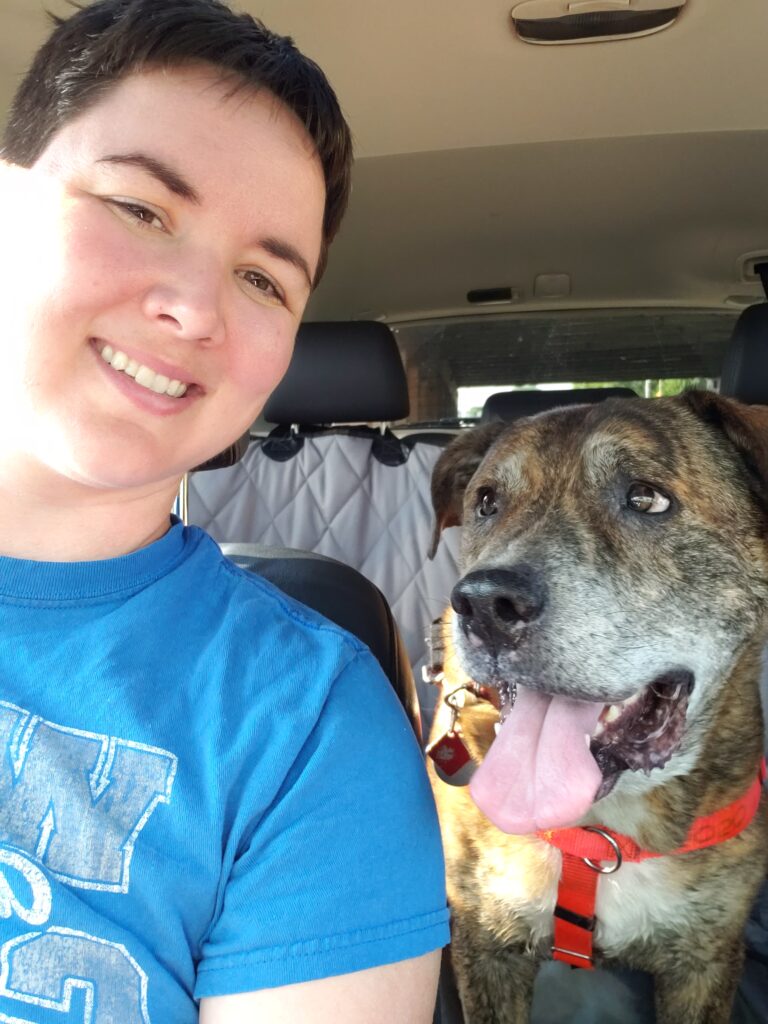
It isn't as simple as "get over it"
I often get asked about putting the dog in the car and letting them “get over it.” That strategy is called flooding. I don’t recommend it for the following reasons:
- I personally believe that learning should be fun and enjoyable for everyone, so this strategy goes against my personal belief.
- I also believe that individuals of any species should have consent, and this strategy doesn’t allow for non-humans to consent to the process.
- If you do it wrong you’ll make it worse.
- And, by do it wrong, I mean stop too soon. So, unless you’re prepared to camp out in your car with your dog for the next week, chances are it will increase the car anxiety. It may not actually take a week, but it could take that…or more. We don’t know how long it might take until we do it.
Tip #7: Use management to limit the scary parts (when possible)
This can be tricky for car rides depending on the trigger. For example, if the issue is the windshield wipers being on, we could try to never take our dog in the car when it’s raining, but let’s be real. If you live in the Pacific Northwest, that might mean your dog just never goes in the car.
The two most common management strategies I use are limiting visual access and increasing the amount of fun places we go to. Limiting visual access can be as simple as a covered crate for kiddos who already love their crates. For others, we may opt to teach them to love wearing a calming cap.
The second strategy typically works better as a prevention strategy or for kiddos with very mild anxiety – increase the amount of fun places the car goes to. For many dogs, the only time they get into a car is to go to the vet to be poked and prodded. If car = vet and vet = scary, then eventually car = scary. But if 9 times out of 10 car = fun, then it’s harder to ruin the experience with the 1 out of 10 times that it’s scary.
Tip #8: Use training to change how your dog feels about the car
When scary things consistently predict awesome things (e.g. sound of car turning on = chicken) then they become less scary. Done enough times they can become awesome themselves! This sounds relatively easy in theory, but in practice does require quite a few skills.
I typically see two big mistakes here: timing of the treat wrong and making food scary by using it coercively (using pressure to compel an individual to do something), and moving too far too fast.
Just like I recommended working with your vet to establish a safe and effective pain management strategy, I also recommend working with a behavior consultant to establish a safe and effective behavior modification strategy. “I know enough to be dangerous” is a cliche for a reason. Check out our blog post here to decide if you can DIY your pet’s behavior modification plan or if it’s time to call in an expert.
Timing is important!
I said previously that the scary thing needs to predict the awesome thing. That means that the scary thing needs to happen first. The awesome thing then needs to happen within 3 seconds of the scary thing, but preferably less than 1 second for maximum effectiveness.
There are times to break those rules, but that’s professional-level skills that the average pet parent doesn’t need to worry about. Again, on paper that sounds relatively easy. What I usually see going awry is the scary thing not happening first and the awesome thing not happening quickly enough.
For the first, it’s important to understand that predictors of awesome things are, in and of themselves, awesome things. For those familiar with clicker training, where the sound of the clicker predicts a treat, you have seen this in action. But your dog may know and look for other predictors. For example, most people absent-mindedly reach for the treat at random times to give it in the 3-second window. But reaching for the treat often means the awesome thing is actually predicting the scary thing, which can make treats scary.
To ensure this isn’t happening, I recommend having someone watch you and provide feedback until it becomes muscle memory. For my clients, this may include giving them a rhyme or tune in time to the motion to remember when to move which hand, providing alternative behaviors like having a resting position for their treat hand if their hand tends to reach for treats to early, or simply providing feedback in real time so they can tweak what they’re doing with each repetition. If you don’t have someone to watch you, or usually most commonly, if you don’t have someone who can watch and provide meaningful feedback, then I recommend videoing yourself and analyzing the video. Is the scary thing truly happening first?
For that second big issue – the awesome thing not happening quickly enough – I actually already mentioned a solution that can work: clicker training. Many people struggle with having another thing in their hand, so I often have my clients use a verbal marker like the word “yes” instead. The clicker or “yes,” when taught correctly to predict awesome things, can become an awesome thing themselves.
That means that you can have scary thing happen and then an awesome thing happen more quickly than you might be able to get a treat out for. It looks like this:
Look at scary thing (e.g. dog outside car window) > “yes” > treat
I generally use this strategy only for visual triggers when the animal looks at the trigger. The reasons for this are far beyond the scope of this article.
Tips for not using food coercively
There’s a myth out there that if you’re using food in dog training it is automatically positive reinforcement. However, that isn’t true. If you want to get nerdy, we have a 2-part podcast episode that goes into the science. If you don’t want to get nerdy, just trust me on this. (If you’re a pet parent unfamiliar with this type of terminology, no worries, you don’t have to know the scientific lingo to get good results.)
The two biggest ways I see food used coercively are:
- Using food to lure an animal closer to a thing that it’s afraid (I see this go wrong a lot in stranger danger cases too)
- Only providing food for doing the scary thing
Using food to lure an animal closer to a thing that it’s afraid of, in relation to car anxiety, usually looks like creating a treat trail or some other form of luring to coax the dog to get closer to or into the car. Like we discussed with getting the timing wrong of “scary thing then awesome thing”, this is a good way to convince your dog that it’s pretty suspect when you pull out the treats.
The second way goes hand-in-hand with the first and looks like only providing treats for getting close to the car or getting in the car. That may sound like I just said the same thing twice, so let’s look at some strategies I recommend instead so you can see the difference.
Instead of luring your dog closer to the car, assuming the sight of the car itself is a trigger, you can treat them for looking at the car at a distance that they feel comfortable doing so. As I said earlier, this is often when I include a verbal marker so it looks like this:
Dog looks at car > “yes” > treat
This way you’re still pairing the scary thing with the awesome thing, but from a distance where your dog is comfortable and able to learn. In my experience, when the dog is ready they will move closer to the scary thing on their own without coaxing. I typically wait for them to make this decision themselves as my gauge for when to move closer.
Another strategy I use is a variation of the rubber banding exercise: tossing treats toward and away from the car. This way the dog gets treats for any movement so we know that if they do choose to get a treat closer to the car it’s not because they’re being coerced by treats. I also have clients start this at a distance – wherever their dog is comfortable and not displaying distress body language signals – so that the dog isn’t too stressed to learn.
Learning skills to deal with unavoidable situations
While a primary goal for behavior modification is to teach that scary things aren’t so scary, it’s impossible to completely eliminate stressful situations. We would all be living in a very different world if that weren’t true! For that reason, it’s important to teach individuals skills for how to deal with stressful situations that will inevitably arise.
For example, braking suddenly is unpleasant for everyone in the car. We can do a great job of teaching our dogs that normal car rides are okay, but they likely will have a problem with sudden braking. And, for the sake of my clients’ brakes, I don’t have them continuously brake hard so they pair it with awesome things for their dogs. It just doesn’t make sense to work on that. Instead, we’ll work on teaching the dog how to cope with stressful situations that come up unexpectedly.
When it comes to car anxiety, I help my clients teach their dog how to disengage from stressors and how to self-soothe (decompress, relax, whatever you want to term it.) For example, if the dog has issues with seeing people or dogs through the window, we can teach them that when you see that, lie down and work on something like a LickiMat or bully stick instead. Sometimes it can be as simple as chucking treats into the back seat for find it!
This could also look like teaching predictor cues so your dog knows that something unpleasant is about to happen. I use “sorry” when I know I’m going to have to brake more quickly than I’d like for Oso. That gives him a heads up to brace himself or sit down if he’s standing.
For all of the tools mentioned, having a deep and thorough understanding of canine body language is necessary. And that’s exactly where we start with a new client. Addressing pain, discovering preferences, troubleshooting spatial concerns, managing anxiety and modifying behavior are all easier when we can notice and anticipate what our dogs are saying with their bodies.
Here’s to road trips,
Allie
Now What?
- Schedule a vet visit. Truly, I can’t stress enough how many dogs who have car anxiety have a physical component to it. Talk to your vet about medication trials for pain or motion sickness.
- Identify what part of the car riding experience is the problem and when the stress starts.
- Figure out if it’s possible to manage any of the triggers. For triggers that aren’t possible to manage, start working through exercises to help your dog feel differently about the scary things.
- If you don’t feel comfortable working on this issue yourself (or just don’t want to have to make decisions yourself), email us at info@petharmonytraining.com We’ll be happy to work with you on this!
References
*Disclosure: This is an affiliate link. We receive a small commission for purchases made through these links at no extra cost to you. This helps us continue to put out free content to help you and your pets live more harmoniously!
Copyright 2025 Pet Harmony, LLC. All Rights Reserved.
Terms & Conditions, Privacy Policy
Results are not guaranteed because behavior, human, canine, or otherwise, are not guaranteeable.