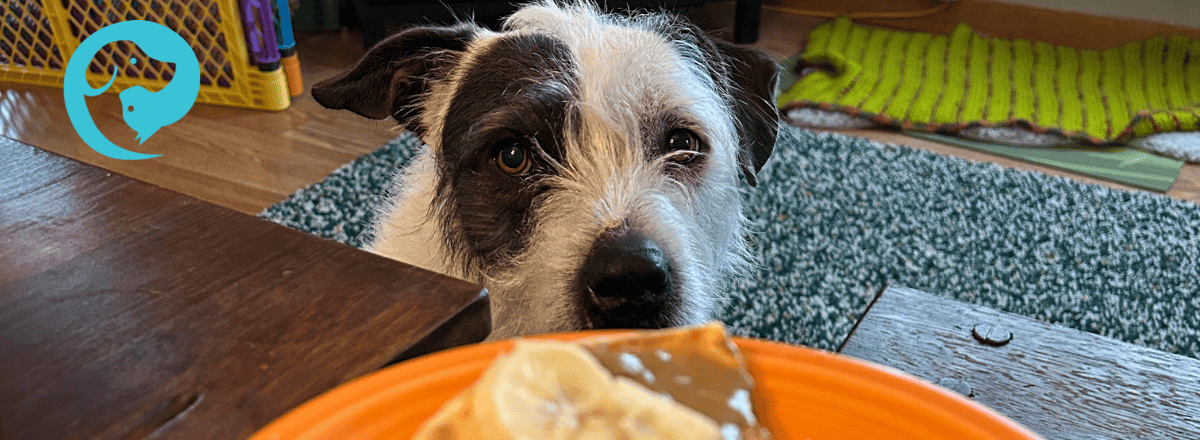
A scruffy white and dark grey dog looking at an orange plate with something on it. Resource guarding in dogs goes beyond the food bowl.

Resource Guarding Beyond the Food Bowl

Estimated reading time: 8 mins

The first time I saw a glimmer of Petey’s issues around resources wasn’t at his food bowl. 

We had enrolled in group classes immediately after bringing him home. “Why not get a head start?” I thought. In our first class, a yoga teacher friend of mine came through the classroom door with her young adult male great dane. Knowing nothing about body language, I’m sure I didn’t pay attention to how Petey reacted to the dogs entering the class until he started to have some more obvious reactions, like staring and growling.

A week or two later, sitting in class with Big Man and Petey, my yoga friend and her huge buddy come plodding through the door. I knew by then to distract Petey with treats. As they’re settling in, a treat is dropped. I watch it roll toward Petey, and then in slow motion I see her dog go after it, right under Petey’s nose. I’ll be honest, I don’t remember exactly what happened at that moment, but I do know that it felt like Peter had a grudge on my friend’s poor dog after that. Luckily she’s never held it against me, and to this day we jokingly refer to her pup as “Petey’s mortal enemy” any time we talk.

Let’s take a moment to define what we’re talking about when we say resource guarding.

What Resource Guarding Actually Is

I wrote this in another blog, so I’m going to borrow the same definition I used there. Resource guarding is the behavior patterns that dogs use to control access to items of value. 

Examples of behaviors dogs use to indicate they intend to maintain control over items of value: 

  • Placing their body between an item and the other individual.
  • Leaning over or putting a paw over the item.
  • For food or an edible item, chewing or swallowing at a faster speed or in a larger quantity.
  • Curling the top lip (exposing some teeth) or pulling the lips long (tight) so that teeth are exposed.
  • Growling, often in conjunction with other signals like stiffening.
  • Lunging, growling/barking, snapping, biting.

If you’d like to learn more about why resource guarding happens, personal experiences on what it looks like, how professionals work on related behaviors, check out this blog. 

It's Not Just About Food

The most common thing for a dog to guard is food or things they know contain or have contained food (bowls, bags, boxes etc.). Other common things we see resource guarding pop up around:

  • Bones/chews (edible and non-edible)
  • Toys (food dispensing and just plain toys)
  • Beds, couches, and comfortable resting spaces
  • Illegal snacks (items dogs find on walks that they want to eat)
  • Personal space/bubble, especially if they are resting
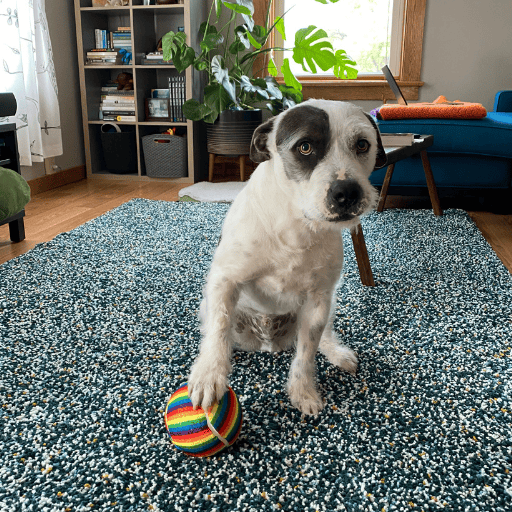
A scruffy white and dark grey dog with his front paw placed on top of a rainbow ball. His eyes are wide and his body is tense, this is resource guarding.

If I see this situation (eyes wide, pupils dilated, ears pinned back, mouth closed tight, corners of mouth pushed forward, paw on top of item, stiff body), I walk away and grab some treats. PS – Don’t take photos of your dog if they are resource guarding. When you know better, you do better.

Some of the non-food items I’ve seen Petey guard:

  • The collapsible tent where he works on shredding projects, by lunging and snapping at me (I was half inside the tent cleaning it out, but he was right next to it)
  • Me, a human person, by putting his scruffy body on top of me and growling (granted, I am a great resource)
  • A very small squeaker, by swallowing it 😑(why I always trade for squeakers)
  • An unidentifiable dead thing (?) that was more maggot than whatever it used to me, also by swallowing it (the $80 fecal just came back clean from the vet)

Years after taking group classes with Petey, I started teaching them. My experiences in class and at home lead me to use caution in how I instructed folks to put food on the floor. Always on the lookout for subtle signs that a dog in class might be sensitive about resources. A lowered head, a fixated stare, an occasional growl, and making adjustments in the setup of the room to help them feel better.

I never met any dogs like Petey when I taught group classes (because dogs with his issues are not group class dogs). But living with him helped me to develop some habits that were useful when I was managing a group of dogs. 

Here are a few things I did in class when I’d first meet a group of dogs:

  • Moving in an arc and approaching from the side (indirectly rather than head on) as I step toward the space a dog and their person are sitting, then letting the dog approach me, in case their space was a concern.
  • If I needed to put food on the floor while I was meeting a dog, dropping it behind the dog, away from the middle of the room to avoid food rolling toward the other dogs, in case food on the floor was a concern.
  • Sat families with larger dogs in  a specific corner where they’d have space to back up, and further away from smaller dogs,  in case the dog pulled their people toward something of interest.

In the upper level classes, we would place distracting objects, food, and obstacles in the room. At this point we’d been working with the humans and dogs for 10+ weeks, so they’d all be dogs we felt comfortable doing this with. Regardless of anything I had seen in class, if a dog got to a toy or object and picked it up, I always did a food scatter and moved them away from an item before picking it up rather than taking anything from them. 

Training and behavior pros learn to watch for quiet cues that a dog might have issues around resources, and arrange the environment (including ourselves) in response. The examples that follow will show you why.

Text reads: Beyond the Food Bowl: Resource Guarding Roadmap - 6-week live course w/ Emily - September 2026

How Resource Guarding Shows Up in Real Life and Nowhere Near a Food Bowl

If we remember that guarding behaviors are about retaining access to resources (which could be pretty much anything), the possibilities are kind of endless. It’s finders keepers, and the dog isn’t going to give up [insert whatever the thing happens to be here]. Guarding can also be contextual, as in it only happens in very specific circumstances. And just like any other behavior concern, pain and trigger stacking can really crank things up a notch. 

I asked the team to share some stories from their toughest and wildest resource guarding related behavior cases. Since I wrote a whole blog about this already, it’s their turn. 

Finders Keepers

Dogs can (and do) guard things that would never occur to most of us to manage. At a facility she worked in, consultant Beccy encountered an elderly jack russell terrier who took one resource very seriously: poop in the kennel. Anyone’s poop. If he saw someone coming with the scoop, he’d gobble it down, and bite anyone he caught already scooping up his resource. To manage the environment and curb the behavior, the set of dogs he lived with were set outside in the play yard first thing in the morning. That kennel was scooped first while the dogs were out. Any time he was out performing in a show or away from the kennel, the other trainers cleaned up the kennel where he lived.

Ellen worked with a dog who had a habit of finding things on top of counters and tables, and was also an intense resource guarder. This family did an incredible job of rearranging everything so that there wasn’t anything to “steal.” But after perusing the kitchen sink one day, a chef’s knife was the object he refused to give up. No one was hurt, but everyone had a different picture of what might be a resource for this dog following the incident.

Consultant Veronica has her own stories from home. Her Sprite, a small jack russel terrier mix once found a bird in the yard, decided (correctly) that Veronica was closing in on it, and ate the entire thing — feathers, beak, and all. She (fortunately?) threw it up not long after. Resource guarding behaviors are not among Sprite’s documented issues. A great example that dogs, even trainers’ dogs, do dog things when they decide a resource is worth keeping. 

Sometimes the resource is attached to a body. Emily worked with a sanctuary dog named Milo with a history of resource guarding. One hot summer day, Milo was napping in her office at her feet. When he woke up, he started guarding Emily’s shoe…from them…while it was still on their foot. 

Guarding doesn’t always mean an object sitting on the floor between two parties; sometimes it’s whatever happens to be within reach, including a person’s body.

Sometimes What's Being Guarded Is Sentient

This is the form of resource guarding we often see labeled as jealousy, or protectiveness, or “he just doesn’t like when we touch.

Allie has seen this more than once, but her first case is the one that’s stayed with her. A pregnant client  needed help off the couch, and every time her husband reached to help her, their dog would growl. Allie recalls the dog biting him at least once. Session by session, they worked in small increments: touch her shoulder for one second, pause, touch again. Eventually he was able to help his wife up off the couch, and the two of them could hug again.

Allie also worked with two small dogs who would get upset and bark whenever their humans hugged. Resource guarding was not indicated here in the strictest sense, but she understood it as something adjacent, and treated it as such. Gradually dogs learned that a hug was actually their cue to run to their crates and wait for snacks.

Why Guarding Can Show Up in One Room and Not Another

Ellen worked with a family whose dog guarded intensely against exactly one member of the household. Intensely enough that if the dog was given a stuffed Toppl or Kong behind a barrier, he’d break through or jump the barrier just to drag the item to that person’s feet and guard it there.

Allie had a case where a dog would have issues if one particular family member would walk through the living room toward the couch if he was cuddled up with mom. Approaches in other situations or toward he and mom in other spaces were not an issue. It was this one context that set off the dog’s guarding behaviors.

This is why “I can take things away with no problem” doesn’t close the book on resource guarding. A dog can be completely relaxed about a swap with one person, in one room, and be a different animal entirely with someone else, somewhere else, over something else. If you’ve only ever tested the version of the scenario that’s easiest to test, you’ve only ruled out that version. 

Pain, Stress, and Trigger Stacking Can Make Guarding Worse

Guarding isn’t a fixed trait a dog either has or doesn’t have. Health, with stress, and other stimuli can set the dog up to have big feelings about resources. 

Pain from elbow dysplasia affected how intensely Emily’s sanctuary dog, Milo, guarded. On the day he guarded her shoe (on her foot), he was in significant pain and it was uncomfortably hot. This is trigger stacking in action: no single factor is necessarily enough on its own, but stress adds up, and a dog who tolerates something fine on an easy day may not tolerate it at all on a hard one.

Emily’s response is worth borrowing: she kept her body still and played a scattered “Find It” with him, tossing treats around the office until his body language relaxed and he came back to himself, tail wagging, licking her hand. From then on, “Find It” became their go-to reset any time a bad pain day brought on sudden guarding of an object or a space.

What To Do If You Recognize Your Dog in These Stories

If any of this sounds familiar: a growl over something you didn’t see as a resource,  a dog who’s fine with you but not your partner, guarding that seems to come and go with your dog’s mood or health, you’re not imagining it, and you’re not dealing with something unfixable. Resource guarding, in all its forms, responds well to the right approach. The dog doesn’t need to learn that guarding is “bad.” They need to learn that they don’t have to guard in the first place. They need their environment to be arranged in a way that helps them feel safe and secure. And that giving something up, or letting someone close, doesn’t mean losing it.

The specifics matter, though. What works for a dog guarding a couch cushion isn’t necessarily what works for a dog guarding a person, and a dog whose guarding tracks with a pain condition needs that piece addressed alongside any training. That’s exactly the kind of nuance a force-free, science-based behavior consultant can help you sort out.

Here’s to harmony,

Tiffany (& Peter, who has never done anything wrong in his life)

Now What?

Want more information on resource guarding? Start here:

If you are experiencing some of the scarier sides of resource guarding and are ready to work with a team who knows a thing or two about finding solutions for such issues, reach out.

PS: Capitalism

Want to support our free, public content? Check out our Amazon shop. It’s full of enrichment and pet care items (that we really, actually use). Our team spends a significant amount of time working on content every week. We love it! But we’re also out here trying to pay our bills. 

*  Pet Harmony, LLC is a participant in the Amazon Services LLC Associates Program, an affiliate advertising program designed to provide a means for sites to earn advertising fees by advertising and linking to Amazon.com.

Copyright 2025 Pet Harmony, LLC. All Rights Reserved.

Terms & ConditionsPrivacy Policy

Results are not guaranteed because behavior, human, canine, or otherwise, are not guaranteeable.

Beat the Heat Flash Sale

Use coupon code LearningIsCool! at checkout 

Save with our Dog Days of Summer Promo!

$35 off a
4-session bundle

$65 off an
8-session bundle

Use code DOGDAYS2025 at checkout

WordPress Cookie Plugin by Real Cookie Banner