

Image of woman holding a cat in a bowtie with a dog standing next to them on a couch,. Text reads: Recognizing Your Limits: How Pet Parents and Pros Know It’s Time to Refer Out

Recognizing Your Limits: How Pet Parents and Pros Know It’s Time to Refer Out

Learning when and how to ask for help is hard. It’s not a skill that comes naturally to most people. And in an emotionally charged context like animal welfare, it can be even harder. This is especially true when dealing with intense behaviors like sound phobias around fireworks or when you’re in a busy season where you’re overwhelmed with travel plans, kids on summer break, and lots of summer activities. But whether you’re a pet parent doing everything you can or a pro trying to help your clients, there will always come a time to say, “I need help.”

Several years ago, one of my mentees said that he couldn’t wait until he knew as much as I did, because then he wouldn’t need to refer clients to other people anymore. I was quick to reply with a crucial reframe: the goal is not to get to a place where you never need to refer out anymore.

In fact, the goal is quite the opposite: a sign of expertise, wisdom, and professionalism is knowing when you need help, and asking for that help in the right place. No one can ever know everything, have every solution to every problem, and be all things to all people. Recognizing limits – your own or someone else’s – is a strength, not a weakness.


For Pet Parents: Knowing When You’ve Hit the Limit of DIY Help

Taking a proactive role in helping your pet by doing your own research and trying to solve problems on your own is admirable. I love to see when people are deeply committed to providing their beloved pets with the best possible care and support! By all means, please continue doing that. 

And also, no one can be their own behavior consultant 100% of the time. Not even behavior professionals. So don’t expect that of yourself, either. 

Here are some signs that it might be time to bring in a pro to get help for your dog behavior problems–or whatever species of pet you have:

You’re doing all the right things but nothing’s working.

First of all, that might very well be true! It’s totally possible that the things you’re doing are absolutely the right things to do in your pet’s situation. And also, the devil’s in the details. I can’t count how many times clients have told me that they’re doing the thing I asked them to do and it’s not working, and when I watched them do the thing I noticed a detail they missed. And when they change that detail, they change everything. A behavior professional can help you to identify when you need to tweak what you’re already doing to make it work better for you

You feel like you’ve tried everything.

There’s this gnarly little group of logical fallacies that we humans are prone to called the autoepistemic logical fallacies. “Autoepistemic” is just a fancy word for “our own knowledge.” Essentially, these fallacies trick us into believing that we know everything there is to know about a certain topic, and that belief can express itself in several different ways. “I’ve tried everything,” is one of those ways. If you think you’ve tried everything, that means you’ve tried everything that you know of. When dog training isn’t working for you, one of the most important reasons to work with a behavior consultant is because they’re going to know things you have never thought of. After all, that’s what a behavior professional is for.

You feel stuck, overwhelmed, or unsure where to go next.

Dealing with a dog’s behavior issue can turn even the most emotionally stable superhuman into an overwhelmed pet parent. And that’s obviously true for other pet species as well. The animal behavior professions are unregulated fields, which means they are rife with misinformation and even disinformation, as well as a whole lot of people who have learned the right information in theory but haven’t yet learned how to adeptly apply that information in practice.

On top of that, a lot of pet parents are inundated by the opinions of their family, friends, and neighbors. The end result is that a lot of pet parents can end up feeling paralyzed by the cacophony of voices giving them conflicting information with a heaping side of shame. If that describes your situation, first of all, unsolicited advice is not ok, and you can learn how to set boundaries with people who are doing that to you. Secondly, a knowledgeable and experienced behavior professional can help you cut through the noise and help you to identify realistic goals and map out a path to reach those goals.

Behavior is escalating or safety is a concern.

If your pet’s behavior is getting worse or anyone’s safety is compromised, it’s time to hire a behavior professional. I know that can be scary, especially if you’ve been burned before. So in the interest of helping you take the leap, here’s a blog about how to identify what type of behavior professional is right for you and your situation, and here’s an article about how to look for a qualified consultant who can help you and your pet. Also, we don’t just blog and podcast about this, we’ve got a whole team of behavior consultants! Get in touch if you think it’s time to add a behavior professional to your team. 


When Your Trainer or Consultant Refers Out—What It Means

Ok, so you hired a behavior professional and thought you had found a solution to your problem, but now that behavior professional wants to refer you to someone else or add someone else to your support team. What the heck??

Don’t worry; this doesn’t mean you hired a dud. In fact, that’s a really good sign that you hired a competent, effective, experienced behavior professional. Why? Because good behavior professionals don’t pretend they know everything and try to be all things to all people. They recognize their own limits, know how to build and manage a collaborative support team, and are advocating for you and your pet. If your doctor referred you to a rheumatologist, a physical therapist, and a dietician, you wouldn’t think that they might secretly be a hack, right? You’d be grateful that they are connecting you with the healthcare professionals who can meet your needs. The same is true with behavior issues!

Here are some reasons that your behavior professional might refer you to other professionals:

They’ve identified signs of pain or other medical issues.

Mental and physical health issues can sometimes be hard to identify, and it takes a professional to see some of the more subtle signs. If your behavior professional refers you to get some kind of veterinary care, they’re not implying that you aren’t taking good care of your pet. They’re simply using their training to see things that the average person hasn’t been trained to see.

They’ve identified that some aspect of your pet’s behavior issues lie outside the scope of their expertise.

Behavior is really complex, and sometimes a behavior issue can look like one thing at first, but once you get in and learn more about the animal and the issue, you realize that it’s actually something else. Behavior professionals frequently agree to work with a client because at first blush the behavior looks like something in their wheelhouse, but after working with the client and the pet they realize it’s something that they should refer to someone with a different area of expertise.

They’ve identified that you and your pet need more hands on deck to provide additional logistical support.

Oftentimes a client and their pet will need additional support in the way of exercise, enrichment, pet sitting, nutritional support, or some other parallel profession that behavior professionals aren’t set up to offer. It’s best to let them recommend someone who can offer you that support in a collaborative way so that you reach your goals more efficiently and sustainably than if you tried to do it on your own.

They’ve identified that you and your pet would flourish using a service that they don’t offer.

Even when a behavior is well within a behavior professional’s wheelhouse, that doesn’t necessarily mean they offer a service that would work best for you and your pet. When I worked with clients directly, I frequently referred clients to friend-colleagues who offered board and train services, group classes, or day training, because those were services I didn’t offer. Instead of trying to force a client to work within my services so I could continue to make more money off of them, I would refer them to someone whose service better aligned with their needs, schedule, and preferences.

They’ve identified that they are not the best person to give you the support you need.

Remember when I said that no one should try to be all things to all people? Have I ever had to learn that the hard way! Due to my chronic illnesses, there were several times when I wasn’t physically capable of meeting with my clients within a reasonable time frame. So I partnered up with friend-colleagues who had similar skill sets and similar services so they could collaboratively work with me and my clients when I was unable to work with my clients directly. 

There are also going to be times when you and a behavior professional just don’t get along. Your personalities rub each other the wrong way, your communication styles don’t mesh, your schedules are polar opposite of each other, etc. A behavior professional who is willing to set aside their ego and refer you to someone whom you’ll be more likely to click with is someone you want in your corner, even if you don’t particularly like them, because they are still advocating for you even when you’re not the right client for them.

Regardless of the reason, it may be tempting to feel deflated, like you’re having to start over. But remember, you’re not starting over. You and your behavior professional have learned a lot, and this is just the next step forward by building a stronger support team for you and your pet.


For Pet Pros: Knowing When You Need to Refer or Call in Help

If you read the above sections for pet parents instead of skipping to this section, hopefully you will have heard and internalized what I’ve said. Referrals aren’t incompetence; they are the opposite.

At its heart, behavior consulting is a project management profession. Our job is to assess what our clients need to succeed, be willing to build as large of a support team as they need to make that happen, and make sure everyone on the team is on the same page and are all working towards the same goal. The moment we try to be the star of the show is the moment we should quit the profession and go do something else. It’s not about us. It’s about our clients and their pets.

So let’s talk about ethical pet professional boundaries and pet trainer referral ethics, and signs that it’s time for you to refer out or add someone to your client’s support team:

  • If you have been taught a prescriptive approach to a behavior issue (e.g. for reactivity I use this protocol, for resource guarding I use this protocol, for separation anxiety I use this protocol, etc.) and that protocol isn’t working, it’s time to refer out. 
    • If you want to learn more about how to work on cases more descriptively, you can ask the person you’re referring to if you can sit in on the case to learn how they are handling it, or you can join PETPro so we can teach you how we approach behavior cases descriptively through an enrichment framework.
  • If you’ve run out of ideas and now you feel like you’re spinning your wheels or just throwing everything at the wall to see what sticks, it’s time to refer out or, again, seek mentorship.
  • If you don’t feel qualified or comfortable with any aspect of your client’s case, refer them to someone who has expertise in the areas you lack.
  • If you’ve identified that the client would thrive with a different teaching style, a different personality, a different type of service, or a parallel service, refer them to someone who fits the bill.
  • If you’re losing unconditional positive regard for the client or their pet, refer out.
  • If you’re going through some life stuff that is preventing you from showing up for your client in the way that they need and deserve, and you realize that you’re becoming an overwhelmed animal trainer, refer out.

Remember that referring out doesn’t always mean handing off the client and never seeing them again. Sometimes it means building a support team where you’re still working with your client in one capacity and others are working with them in other capacities. When I offer case support for the folx in PETPro, we very rarely suggest that they just hand the client off to us; more often than not, we just help them build the plan for their client, and then they still work with the client to implement the plan. 

But yeah, there are sometimes where we really do need to send the client to someone else and part ways with them. And I know how hard that can be. In situations like this, we can be susceptible to a logical fallacy called the “sunk cost fallacy,” which you can think of as “in for a penny, in for a pound.” If we’ve already invested so much time and energy into a client, our impulse is to just keep throwing more time and energy at the situation in the hope that we’ll eventually get that sweet, sweet success that we crave. But that’s not fair to our clients or to ourselves, and it’s a major contributing factor to behavior consultant burnout. Let them go, learn from the experience, and move on.


Working Together: The Power of a Collaborative Behavior Team

We humans are a communal species. We do better when we work together collaboratively. That’s not any less true when it comes to animal behavior than anything else. Whether you’re a pet parent or a pet professional, you shouldn’t have to do this alone.

Looking at behavior through an enrichment lens means reducing harm and improving welfare and well-being for everyone involved–that includes the humans. Your needs matter too!

To give you an idea of the kinds of collaboration we often do here at Pet Harmony, here’s a list of professionals that we frequently collaborate with:

  • Behavior professionals who offer services we don’t, like board and train, group classes, day training, and dog sports
  • Veterinarians
  • Veterinary behaviorists
  • Pain and movement specialists
  • Veterinary physical therapists
  • Veterinary nutritionists
  • Enrichment-informed pet sitters, dog walkers, and dog daycares
  • Veterinary social workers and trauma-informed coaches
  • And, of course, each other! We frequently discuss our cases with each other and ask each other for help with our own pets’ behavior issues.

By cultivating collaborative behavior support systems for our clients and practicing team-based dog training, we are far more effective than if we tried to pretend that each of us were the end all be all of animal behavior consulting. Everyone has limits: being prepared and professional means knowing yours, staying in your lane, and referring out when something isn’t in your lane. 

Here’s to harmony,

Emily

Now What?

Asking for help, referring out, and building a team are signs of strength and compassion, not weakness. Working collaboratively doesn’t mean you’re failing, it means you’re showing up for your pet or your client in the best way possible. If you are a pet professional who is looking for more collaboration and support, check out PETPro. If you are a pet parent ready to bring a professional onto your team, we’re here for you!

Copyright 2025 Pet Harmony, LLC. All Rights Reserved.

Terms & ConditionsPrivacy Policy

Results are not guaranteed because behavior, human, canine, or otherwise, are not guaranteeable.
How & Why Online Consulting Works


2020 was the year of Zoom and it looks like at least part of 2021 is going to be the same way. We at Pet Harmony were fortunate that we’d been offering effective remote consulting services for years already; it was an easier transition for us than for many other training and behavior companies. But, just because it was an easy transition for us doesn’t mean that it’s been an easy transition for pet parents to take the leap and try remote consulting services. 

We address concerns every single day– usually multiple times per day– from pet parents who know they need help from a behavior consultant but are skeptical if remote services can help them. And, what pains me is when people choose to hold off on much-needed professional help because they’re skeptical about remote services. 

The hard truth is that I know they’ll likely contact us again, but the next time it will be when the behavior is worse and more difficult to modify. I’ve had a number of clients this year who decided not to take us up on remote services at the beginning of Covid, only to contact us months later in desperate need of our help when their dog had bitten someone again or the family was at the end of their rope. I wish I had gotten to work with them sooner. 

After receiving another response today of, “We’re looking for in-home sessions only. We’ll be in touch when things open back up.” I decided that it’s high time I write a blog post specifically about how and why remote consults work to help struggling pet parents understand that they don’t need to put off seeking much-needed help. Let’s talk about the main concerns folks have with remote consultations and why they’re not as concerning as you may think.

If you’re looking for a quicker answer, check out this video pulled out of one of our recent FB live chats:


Common Concerns About Remote Sessions


“I don’t know how you’ll help me if you can’t see the behavior.”

This is by and large the number one concern we hear from people, especially for pets displaying aggression or reactivity. And, the short answer is, we don’t need to see the behavior to help you. Even if we were doing in-person sessions we still wouldn’t want to see the behavior (especially if the behavior is biting strangers coming into the house.) The longer answer to this is in this blog post about how your pet is not like your car. 

When someone knows enough about behavior (which an evidence-based consultant should), then we don’t need to see a behavior to know how to modify it. Behavior is much more predictable than people think; it follows specific rules. That means that professionals know what questions to ask you to understand your pet’s behavior and even if a behavior seems unpredictable to you, it usually isn’t to us. If something does sound funky or we need additional help aside from asking questions, we’ll ask for a video if it’s safe to get one. 

Again, this is the same for both in-person and remote services. Purposefully stressing out an animal so we can see the behavior in real-time doesn’t help us or the animal and usually means your pet is less capable of learning later on in the session when we’re doing hands-on exercises. Trying to show us the behavior in a session (remote or in-person) usually comes back to bite people in the butt. 

While we don’t need to see a behavior to know what’s going on, watching you work with your pet is a different story. That’s where videos come in! And, to be honest, I find videos more helpful than watching someone in real life (and I know my fellow PH consultants agree). We can watch the video as many times through as we want and focus on different aspects each time: something that’s not possible in real time observation. The other great thing is we can then play through the video for our client (via screen share) so they can see what we’re seeing, too. We’ve seen that videos are a more effective teaching tool in that way as well.  

To sum up this concern, we don’t need to see your pet’s behavior to know how to modify it and what we do need to see we’ll ask you to send us a video of it. 


“How can I get hands-on practice in a remote session?”

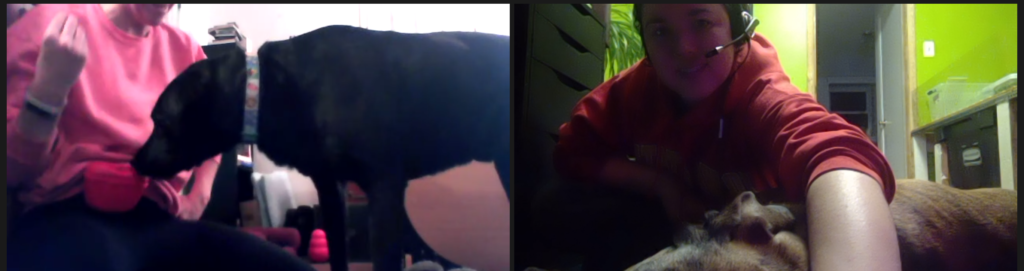
This is probably the second most asked question we get when someone is skeptical about remote services. The answer is: pretty much in the same way you’d get it in an in-person session! There are a number of ways for us to demonstrate exercises: videos, demonstrating with our own pets, props. We then watch you over the video feed and provide real-time feedback as you practice. The only difference is that we can’t demonstrate exercises using your particular pet. But, if we’re doing our jobs well by providing clear instructions and splitting steps into small enough approximations (I.E. baby steps) so that you and your pet can be successful, hands-on practice is just as effective remotely as it is in-person. 


An example of hands-on training in a session (and Oso lounging after his demo work was done!)

“I’m not great at training, so I want a professional to do the exercises with my pet.”

We know our clients aren’t professional trainers (usually). If you knew what to do and how to do it you wouldn’t need us! The great news is that you don’t need to be a professional trainer in order to see results with a good behavior modification program because so much of a good behavior modification program is not actually about training. 

Behavior modification techniques can actually be fairly simple at their core and our consultants purposefully choose the simplest exercises we can for our clients. If you can toss some treats on the floor you can already do several of those exercises. The implementation and what to do in different situations is usually the trickier part and where a behavior consultant is vitally important. But, again, the training mechanics are often easier than what you’d see in, for example, a trick-training class. 

The other side of answering this question has to do with how relationships and training for real-life situations play a part in behavior. I frequently tell my clients that it doesn’t matter if I can get their pet to do something, it only matters if they can do the same. I don’t live with them so it doesn’t matter that much if I can do it. I can absolutely help teach the dog foundation skills and then transfer that knowledge to the humans, but over the years I’ve found it more effective in the long run to spend that time helping the human train those foundation skills instead. 

The reason for this is that when we move to a different environment or situation, we often need to reteach those skills to our pets (who don’t generalize very well). If I taught the foundation skills, the pet parent is now stuck. If I taught the pet parent to teach that particular behavior all the way through, then they know exactly what to do in those situations and don’t need me. Behavior consulting is one of those jobs where we teach you how to not need us. 

The last part of answering this question, as I mentioned above, comes down to relationships (which includes a learning history with someone). If a dog learns that they can trade coveted items with me in exchange for something delicious, it doesn’t mean they’ll do the same for anyone else. A human example of this is that I’ll let my husband take my credit card but wouldn’t let someone else do the same. It will take less time (and money) for me to teach someone how to trade with their dog rather than building that skill with me first then transferring it to the pet parent. 

To sum up this answer, you don’t need to have amazing training skills to see great results and at the end of the day it doesn’t matter if a professional can get your pet to do something. It only matters if you can.  


“I don’t know how remote sessions can be effective.”

This one really boils down to not knowing what the behavior modification process entails. At the end of the day, your behavior consultant is a human trainer who knows a lot about animals. A whole lot of the behavior modification process is actually educating the pet parents in topics like body language, management, and enrichment. So as long as we can communicate effectively, we can educate effectively. That doesn’t have to happen in-person.

We have hundreds of clients whom we’ve never met in person who have successfully worked through their behavior modification plan with pets presenting really challenging behavior issues. We’ve also worked with all of the typical maladaptive behaviors remotely quite successfully: stranger danger, leash reactivity, intra-household aggression, resource guarding, separation anxiety (this one works way better remotely, actually), stereotypic/compulsive behaviors, and so many more. Remote services have not limited our effectiveness, the types of cases we see, or the relief we can help you get from the dog behavior problems you’re facing.

“What if I’m open to giving online dog training a try but am not sure who I can go to for help?”

Then you’re in the right place! At Pet Harmony, we have over 75 years of collective pet training experience in dealing with nuisance, sad, scary, and dangerous behaviors. We have a proven track record of helping pet owners all around the world live more harmoniously with their pets—through in-person and remote consultation packages.

Whatever your needs and your pet’s needs are, we’re here to meet you where you are at! We’re ready to give your pet the most up-to-date, science-based, empathetic behavior modification journey we can provide, so click below to learn how we can help you the way we’ve helped thousands of pets and people before you.


Pros and Cons of Remote Sessions vs. In-Person Sessions


Aspects of remote consulting that are more effective than in-person sessions


It’s easier for the human learner

As I mentioned above, behavior consultants are really human teachers who have a lot of knowledge about pets. And, just like our pets, it’s difficult to learn when our attention is split between different things. That’s exactly what happens in an in-person session. I’ve seen so many people worried about what their pet is doing or going to do in an in-person session that they haven’t really absorbed the necessary information I’m telling them and that they’re paying for. Because that happens so frequently, I ask all of my clients to put their pets away before I arrive (also for safety reasons) and then they’re often worried about what their pet is doing while they’re away or what their pet will do when they’re let out. Their attention is still split. 

From my experience, remote clients have a much easier time absorbing the necessary information they need to know to keep their pets and others safe. That also means that we don’t need to go over the same information as many times so we can often progress a bit quicker. 


You can revisit your session

We try to record all of our remote sessions and either send them to clients afterwards or let clients know to ask us if they want access to them. So in addition to their training plan and other training resources we send, clients can share their session with household members who didn’t get to attend or go back to helpful tips we shared while they were working with their pet. 


Our presence changes the pet’s behavior

A large portion of the pets we’re working with have anxiety-related issues and for many of them the presence of new people in the house or a change to their routine is stressful. That means that our very presence is going to change the pet’s behavior and oftentimes also means that it’s going to be harder for them to learn the skills we’d like to implement during that session. There have been many times where a pet has been too stressed to learn during an in-person session and I’ve had to explain how to do something just like I would do in a remote session (actually, I have access to videos and can use Oso to demonstrate in a remote session so it would have been a better explanation if it was done remotely). 

The other side of this is that, because we’re professionals, your pet isn’t going to act the same way they would with us as they would with someone else. We know how to set up the environment, how to move and act so we don’t elicit unwanted behaviors as much as someone who doesn’t work professionally with pets. I’ve heard so many times, “Well, he’s not doing it with you but he usually barks at people when they come in.” Or, “He must know something’s up. He’s on his best behavior.” Our presence will change your pet’s behavior but sometimes not in the way you’d expect. 


It encourages taking video of your training session

As I mentioned above, video is a wonderful tool for learning. While we make the offer for our in-person clients to send us videos, it realistically does not happen often. The remote setting lends itself to folks taking more videos for us and that is incredibly helpful for both the client and the consultant. 


Aspects of remote consulting that are less effective than in-person sessions


We can’t troubleshoot for ourselves, which is sometimes harder

There are occasionally times where a client is working on something and I wish I could reach through the screen and try a few things with their pet to troubleshoot so I can better help them through a sticky spot. While it’s not impossible to do that troubleshooting remotely, being able to troubleshoot in person in those situations would likely save us some time. 


Videos of walks are more difficult because of the scope of the camera

I’ve worked on a lot of leash reactivity cases without ever seeing the dog out on a walk. It’s very doable to work on the issue without the consultant being there walking alongside you. That said, there are times where clients want me to see their dog on a walk or are having trouble explaining something and so want me to watch a video of their dog on a walk. 

One of the nice things about being able to go on a walk with someone in person is that I can watch their dog and all around the environment at the same time. That’s more difficult to do in a video because of how wide the frame is. There are some videos I’ve seen where this isn’t a problem because the person videoing is at a great angle and/or distance, but that’s not always the case. 


Stranger danger with us

I’ve also worked on a lot of stranger danger cases without ever meeting the animal. It’s also very doable. That said, many people feel more comfortable feeding a professional to the lions, so to speak, than starting out with their friends and family. There are many things that we do and have in place to keep people safe (including practicing first with known people to troubleshoot the set-up), but many people still feel more comfortable going through a meeting people protocol with a professional first. We obviously can’t do that remotely. 


How our remote consults work

Throughout this blog post I’ve been speaking specifically about our remote sessions at Pet Harmony, and I recognize that different companies perform them differently and they’re probably not all created equal. I can only speak to ours, though. The short answer to how our remote consultations work is there’s a discussion portion and a hands-on portion and the amount of time with each is dependent on where folks are in their plans and what we’re working on. 

The longer answer is found here


Now what?

  • Have you been putting off getting professional help for your pet because you don’t want to try remote sessions? Look at the above concerns and see which speaks to you. 
  • What concerns do you still have after reading those relevant sections? Think through them and start fleshing them out.
  • Tell us those concerns. Email us at info@petharmonytraining.com to start a dialogue about what remote sessions can do for you. Or, if this addressed all of your concerns email us to set up an appointment. 
  • Behavior professionals: are you looking for help on how to do effective behavior consults? Check out our How to Do– And Love!– Remote Consulting Course


Happy training!

Allie

We Don’t Know What We Don’t Know


Every now and then when speaking with a prospective or new client they’ll tell me:


“I don’t know what to do. I’ve tried everything already!”


I’ll ask them to describe to me what they’ve already tried. Often the list is quite long and I understand why they made the above statement. But, here’s the thing. We don’t know what we don’t know. And, even if we did try something, that doesn’t mean that it wouldn’t work without some troubleshooting. We shouldn’t let not knowing what a professional can do for us keep us from reaching out.


Everything to you is not everything to me

Think about a time when you started learning something new. In the beginning, it seemed pretty simple and straightforward, right? It seemed like you could easily master this new skill in no time. Then you took a deep dive into different aspects of this topic and realized that it’s not so simple and straightforward. There’s a lot of nuance. There are a lot of related topics that you probably needed to learn about in order to better hone your skill. The more you learned the more you realized how much there was to know.

Animal behavior is the same way. Just because you don’t know of another way to do something doesn’t mean that it doesn’t exist. It just means that you don’t yet know how to do it. When people tell me they’ve tried “everything”, it really means that they’ve tried everything that they know to do or have researched. That doesn’t mean it’s everything that I know. Everything to you is not everything to me. 


Troubleshooting is key

Occasionally I get a new case where someone is already doing the exercise that I was planning to recommend to them, but they’re telling me that it’s not working very well. Do we immediately try a new exercise? No! I first ask them to show me what they’re doing (even in a remote session) or send me a video of them working on it if they’re not able to demo live. 

Watching them perform the exercise is often where that aha moment happens and I find myself saying, “That’s why it’s not working! It’s an [insert training mechanic here] problem.” As with most things, the devil’s in the details. Let’s take counterconditioning for example. Counterconditioning is a specific scientific term that essentially means associating a scary thing with an awesome thing in a way that scary predicts awesome so it can become awesome in and of itself. That’s a diluted definition and we’d actually need to see the scary thing become awesome for it to count, but you get the gist. 

Every now and then someone will tell me that they’re working on counterconditioning with their pet. However, when I ask them to demonstrate what they’re doing they are not actually counterconditioning. There are a lot of ways to do it incorrectly and there are only a few ways to apply it correctly. Once we tweak how they’re doing the exercise we’re able to make more progress with it. 

Perhaps the problem in implementation is not in their mechanics, but in their setup. Let’s say someone is implementing a counterconditioning exercise in a situation where their pet is too stressed to learn (hello, mountain lion brain!) While technically we can still do that and make progress, there are ways that we can change the setup to make it easier. Once again we can tweak how they’re doing the exercise so they’re able to make more progress with it. Even if someone’s tried “everything”, it doesn’t mean that troubleshooting isn’t necessary.


It hasn’t been long enough

One last note on “trying everything”. Many times when I hear this statement I see someone who’s tried a lot of different things for only a few days at a time. Think about how long it took you to learn something new or, better yet, to develop a new habit. It was a lot more than a few days. The same is true for our animals; change takes time and a whole lot of practice. Trying something for just a few days doesn’t count. 


Now what?

  • Do you find yourself not reaching out for professional help because you don’t know what they could recommend that you haven’t tried already? Reach out! Chances are that they know of something you haven’t seen before or can help you troubleshoot what you’re already doing. We offer services worldwide; email us at info@petharmonytraining.com to set up your first session. 


Happy training!

Allie