
It doesn’t matter how good your relationship with your vet is, if your dog displays aggressive behavior toward humans, vet trips are not something you look forward to. Regardless of the measures you take to decrease your dog’s fear, anxiety and stress around vet trips, chances are the humans involved in the planning and execution of vet visits feel some stress. This stressful situation is a good setting to discuss where enrichment for pets AND humans is applied in real life.
Taking Petey to the vet is a beautifully orchestrated event that begins two days before the actual appointment. This is when I’ll get him out for a nice, long sniffy walk. I want there to be some variety in terrain for physical exercise, and plenty of stuff to investigate so he’s using his big, beautiful brain. Ideally I can get us out to a space that is enjoyable for both of us so that I also get to relax (as much as possible being in charge of a dog like Peter).
After our jaunt, it’s time to clean up and relax with a long-term calming project. These days it’s usually a Pupcicle with frozen goat milk. The next day is a restful day, usually with some kind of extended game of find it around the house, and a good night’s sleep. First thing in the morning, it’s time for pre visit meds, which take about two hours to kick in. I try to have some quiet time together with him while they start to work.
Before our most recent visit, before gearing Pete up and packing his treat pouch, I tapped into my self-care practices: I ate something, took my meds, and packed up my purse with some stress-busting essentials for me: a book, something to fidget with, and of course my phone. Once I had Pete in his party hat and his treat bag filled, feeling like Mary Poppins, I was ready to take on our vet appointment.
What’s in the Bag? Crisis Kit Essentials
When I’m out on adventures with Petey, I carry some practical items (poop bags, a small comb for burrs, my inhaler, etc.), along with items to help him with the ways he commonly struggles (different value treats, a compact umbrella for a visual barrier, spray shield, etc.).
When I’m preparing for situations that I know will tax my nervous system in some way, particularly if there is a lot of sitting around and/or waiting involved, I make sure to include items from my crisis kit to help me where I struggle. A crisis kit is essentially a collection of items that help you cope with difficult situations. Allie learned about this concept from her therapist. Her suggestion was for Allie to find items that helped her connect with her senses. Crisis kit items can be used to self-regulate or interrupt feelings of stress or anxiety. They are not always items that can be stashed away in a purse to bring to a vet appointment. They may just be placed in your home spaces to create comfort (unless you actually know where I can get a Mary Poppins bag so I can be surrounded by plants when I’m at the BMV).
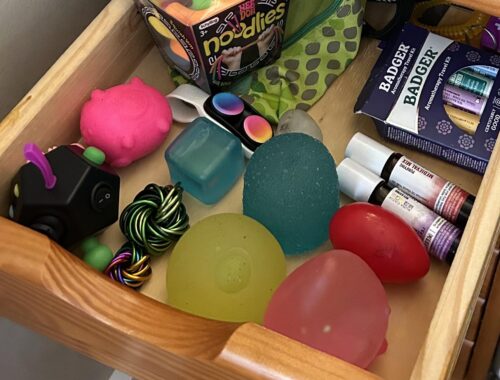
My collection of crisis kit items includes things like:
- Sight – silly little trinkets and mementos, photos, cute stickers, potted plants
- Sound – playlists that fit various moods or elicit certain feelings
- Tactile – lots of little fidget toys of varying textures
- Taste – multiple drinks of varying temperatures and, always, snacks
- Scent – mostly essential oil stuff that is not too strong (strong smells trigger migraines for me).
Distress is your body’s response to something that bothers you (this is what we typically think of as just “stress”). The stress response involves specific physiological reactions and the release of chemicals that help regulate the body — this includes distress and eustress (the kind of stress that comes from fun or exciting stimuli). The purpose of the crisis kit is to interrupt the sensations in my body that tell me I am beginning to experience distress.
Climbing the Ladder (of Escalation)
Learning body language and observing Petey’s ladders of escalation and de-escalation have helped Big Man and I to structure our home life in a way that benefits all of us. But it took learning a whole new language (canine body language) to help me turn my observational skills inward.
Ladder of escalation refers to behaviors and sensations in our bodies that happen as stress increases and, conversely, de-escalation encompasses what happens as we move closer to relaxation and rest. Emily and Allie talk about their own ladders in episode # 95 of Enrichment for the Real World. Mine generally starts with what I call the “hot ball of doom,” which is a burning sensation in the center of my chest that radiates out into my arms and abdomen. The fastest way for me to interrupt this feeling is with a big, deep, expansive breath in, and a sustained, controlled breath out. Here’s some more info on breathing to settle your nervous system, courtesy of me, an actual yoga teacher.
Many of the strategies I have for managing stress involve moving my body. But I’m not always in a location or at a point in my day where it’s practical to get on the floor to roll around with my therapy balls for a self massage, or to go pick up some heavy kettlebells and do a farmer’s carry, or swing my steel mace, or hop up and get my moon salutation on. When I was a member of PETPro, before I was on the team, I learned about the importance of completing the stress response cycle from the brilliant Nagoski siblings in their book Burnout. Lifting weights, practicing yoga, and flinging fitness equipment that looks like an ancient weapon are all important ways for me to meet my physical exercise needs and allow me to complete my stress response cycle.
Learning when and how to interrupt and self-soothe in the meantime has been an important addition to my self-care toolbox, along with putting some structure to the types of enrichment activities I do for myself.
(Human) Enrichment for the Real World
When I read Canine Enrichment for the Real World in 2019, I had some sense that it was about to change my life with Petey, but I had no idea that the learning journey I was on would profoundly change the way I met my own needs. I learned the categories of enrichment, I honed my observational skills, and I became adept at looking at Petey’s behavior and seeing where there was an unmet need at play. But it wasn’t until I was introduced to the Healthy Mind Platter, the work of neuroscientist Dr. Dan Siegel, that I could do the same for myself.
The Healthy Mind Platter is essentially breaking up human mental health needs into categories. That’s right, enrichment categories for humans! They are as follows:
- Focus Time – Focusing on tasks in a goal-oriented way
- Playtime – Spontaneous, creative, playful, and novel experiences
- Connecting Time – Connecting with other humans and fostering appreciation
- Physical Time – Movement
- Time In – Quiet and internal reflection on sensations, images, feelings and thoughts
- Downtime – Non-focused and relaxing with no goal
- Sleep Time – Rest and recovery
I am very open about the fact that Petey requires medication to live his best life in a world that is not tailored toward and does not make much sense to him. And the same has been true for me. When I started to notice my internal experience and spend time thinking about my own needs, I realized there was a gap. Finding ways to improve physical and mental health gives me the bandwidth to do the same for Petey. I cannot take care of myself, my responsibilities, my relationships, and my chaotic bestie if I am not healthy!
Enrichment in Action
Our most recent vet visit was as smooth as we’ve ever had. Prepped with his pre-visit meds, Petey tried (and kinda failed, the meds make him pretty wobbly) at sniffing around the parking lot for a bit. We entered the clinic and he got a good sniff of a squirrel toy, and I slowly got him to target my hand and get on the scale. We wandered over to the hall, where I again got him to target my hand so I could pin his shoulder to the wall (a skill we practice at home). I cued Dr. Quinn to swoop in behind us and deliver his sedative, and once he had his shot, we went out the side door for more sleepy sniffs. Around the parking lot and back through the front door, we stopped on a comforter as he eventually drifted off to sleep.
While Dr. Quinn and Jessica performed Petey’s yearly exam and a tooth extraction, I texted with friends, did a bit of reading, fidgeted with a toy, and generally kept myself occupied. The clinic is set up to be very homey and comfortable, which keeps everyone’s stress levels down, but when I did feel that familiar warm sensation in my chest, I took a breath, flipped my toy over my fingers, and sent a picture of the cool clinic I was sitting in. The feeling passed, and I grabbed my book.
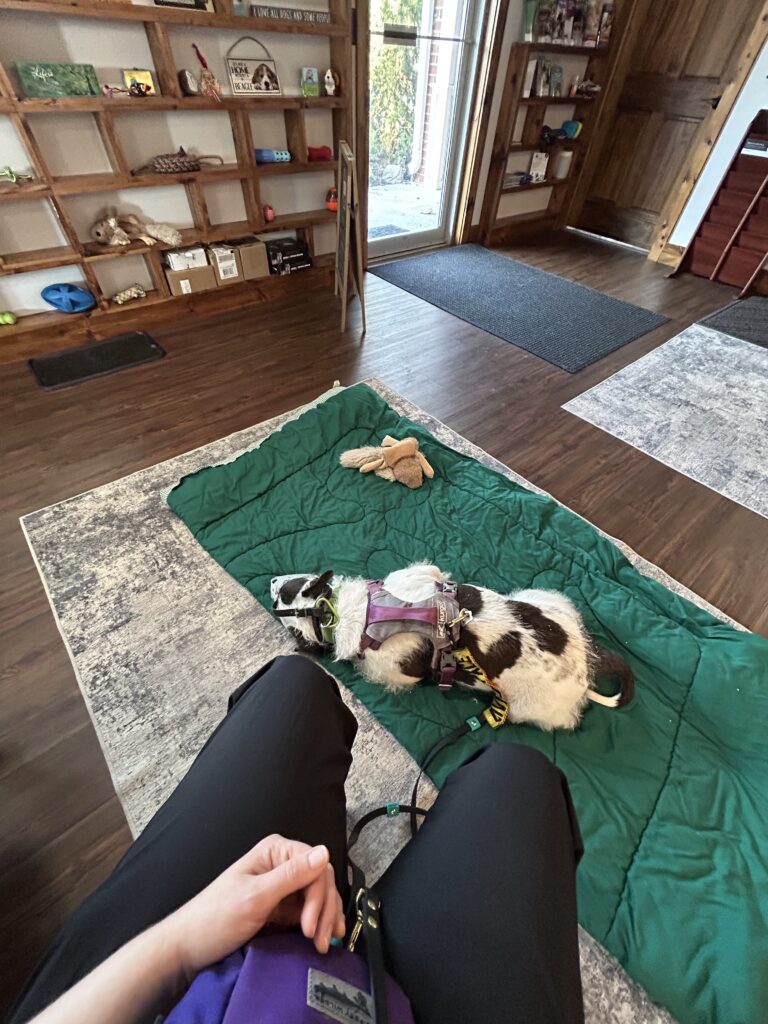
Once Petey started to wake up, we were up and out the door. I had prepped soft food for Petey and completed some of my weekly tasks early, so I had no expectations for myself or from anyone else. All we needed to do was rest, recover, and hang out.
A Balanced (Mental) Diet: Putting My Healthy Mind Platter to Use
For my Healthy Mind Platter, in the days surrounding Petey’s vet visit and tooth extraction recovery, I made sure to pile up servings of:
- Connecting Time & Downtime – one-on-one time with Petey and also with Big Man
- Playtime & Physical Time – I attended a weight lifting class and practiced yoga
- Time In – Yoga practice and self massage
- Downtime & connecting time – resting and hanging with Petey
- Time In – I do my best quiet reflecting whilst simmering in the bath tub (for whatever reason, the sensory input I get from being submerged in water is also an important part of completing my stress response cycle)
- Sleep Time – Also important to complete my stress response cycle – I try to get a good night’s sleep before and after a vet appointment
Since Petey was recovering from a tooth extraction, we spent a lot of time hanging out in the back yard, where last summer we had put together his sensory garden. This way we both got to spend some time outside, he got some low-key sensory input while he was healing up, and we could make the best of having to stay home for a few weeks.
Although I had a lot of skills around meeting Petey’s needs, prepping him for stressful events, and helping him recover, my self-care toolbox has improved immeasurably with the additions of my crisis kit, observing my own ladders of escalation and de-escalation, ensuring I have time and space to complete my stress response cycle, and using the Healthy Mind Platter to make sure my own needs are met.
Here’s to harmony,
Tiffany
Now What?
Are you preparing for a stressful event? Here are some tips to keep in mind:
- Observe, Don’t Assume: Observe and identify your household’s baseline so you know when things are back to normal.
- Plan Ahead: What goes in your bag of tricks for you and your pet? This might include training that is useful for the situation (e.g., cooperative care, muzzle training, etc.)
- Include Yourself: What’s on your Healthy Mind Platter? What’s in your crisis kit? How will you complete your stress response cycle?
- Practice Before the Crisis: When you can identify signs of escalation and de-escalation, you can practice and observe outcomes when the stakes are low.
If you need help with tricky situations you and your pet find yourselves in, our team has A LOT of tricks (and treats) up our sleeves. Reach out!